User-Generated Content Strategy for Pet Stores


Table of Contents +
- Why Is User-Generated Content So Powerful for Pet Stores?
- What Types of UGC Should Pet Stores Collect?
- How Do You Build a UGC Collection System?
- How Does UGC Improve Your Search Rankings?
- How Do You Display UGC on Your Website for Maximum Impact?
- How Can You Use UGC on Social Media Effectively?
- What Does a UGC Strategy Look Like Alongside Professional Content?
- How Do You Measure UGC Success?
- What Are Common UGC Mistakes Pet Stores Make?
- Frequently Asked Questions
- References
Build a UGC strategy for your pet store. Collect customer photos, reviews, and videos that boost trust, drive conversions, and strengthen your SEO.
Most pet stores create every piece of content themselves. They photograph products, write social captions, film short videos, and spend hours each week trying to keep their feeds active. Meanwhile, their happiest customers are already taking photos and videos of their pets enjoying the products they bought - and none of that content ever reaches the store's marketing channels. That is a missed opportunity, because user-generated content (UGC) is the single most trusted form of marketing today. 60% of consumers identify UGC as the most authentic marketing content[1], and product pages featuring customer content convert 74% higher than pages without it[2].
TL;DR
User-generated content from pet owners - photos, videos, reviews, and social posts - is more trusted, more engaging, and cheaper to produce than brand content. Pet stores that collect, curate, and display UGC across their website and social channels see higher conversions, stronger SEO signals, and deeper customer loyalty. This guide covers a practical step-by-step framework to build a UGC engine for your store.
Why Is User-Generated Content So Powerful for Pet Stores?
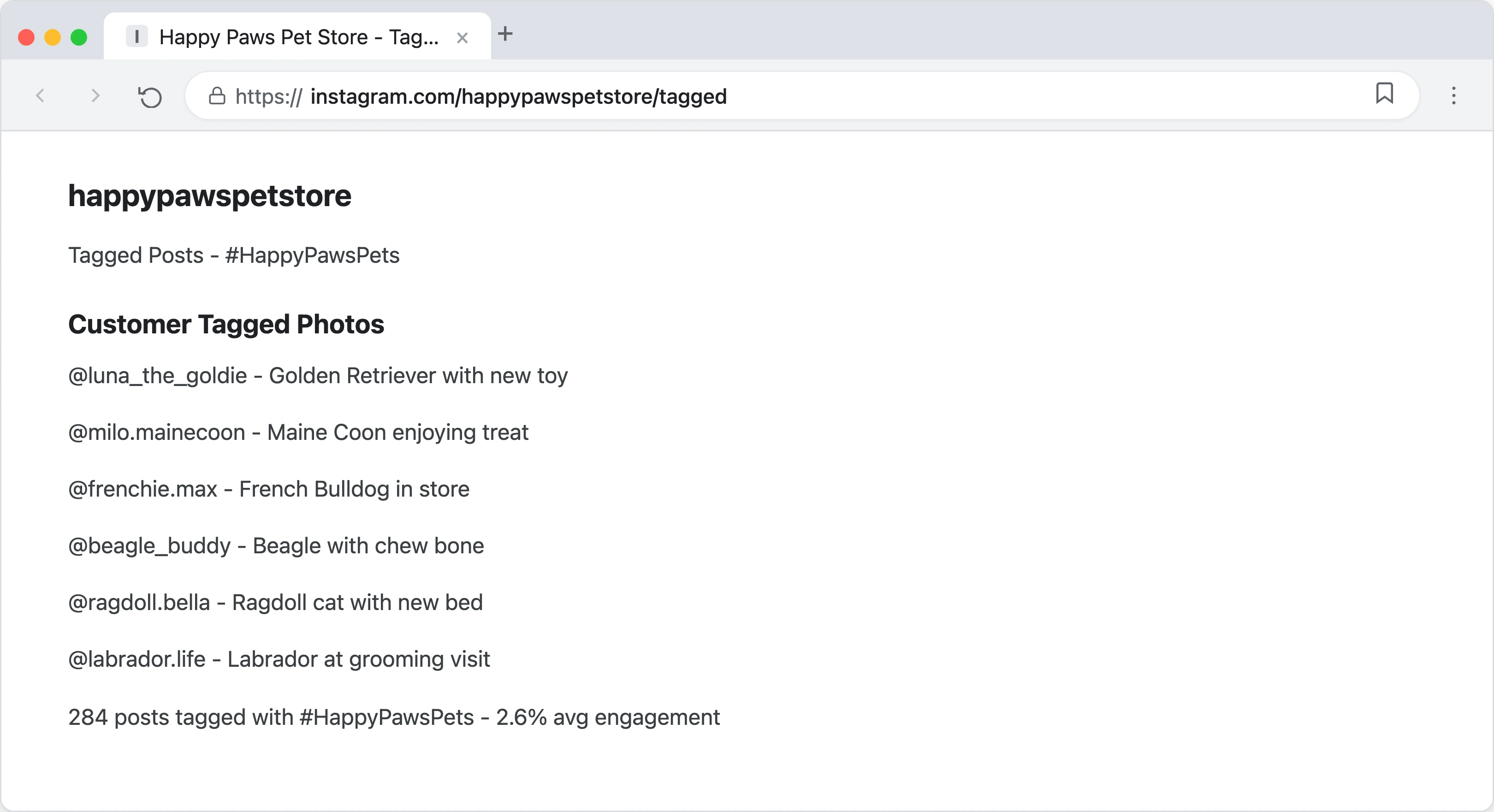
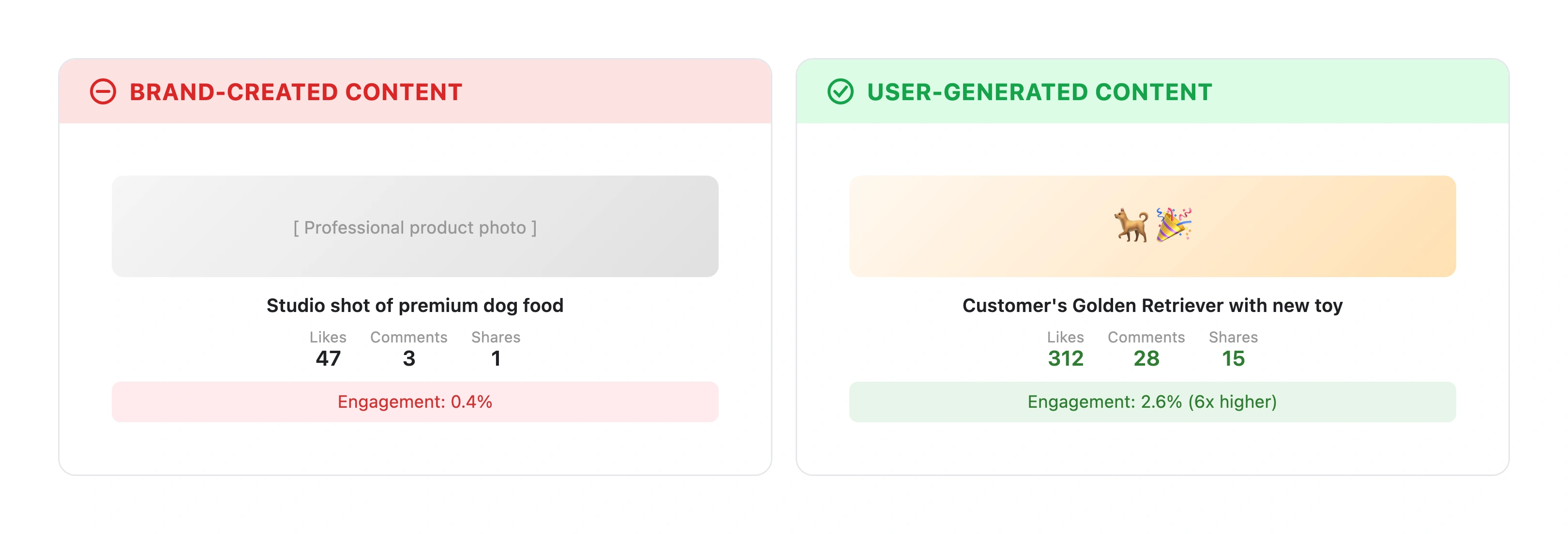
Pet content is uniquely shareable. People love showing off their animals, and audiences love watching them. Pet-related UGC generates 6x more engagement than brand-created content[3]. That is not a small margin - it is a multiplier that most pet stores are leaving on the table. On Instagram, pet and animal content earns a 2.6% engagement rate[4], well above the platform average of 0.50%. On TikTok, the #PetsOfTikTok hashtag has accumulated over 147 billion views[5].
The reason UGC works so well comes down to trust. Consumers are 2.4x more likely to view user-generated content as authentic compared to brand-created content[1]. When a pet owner sees another pet owner's photo of their dog enjoying a toy from your store, that carries more weight than any product shot you could stage. It is real proof from a real customer - the kind of social validation that moves people from browsing to buying. 86% of pet owners say they are more likely to purchase a product when they see real customers using it with their pets[3].
From a business perspective, UGC also solves a practical problem. Running a pet store is demanding. You are managing inventory, serving customers, handling logistics, and somehow expected to also be a full-time content creator. UGC shifts some of that content burden to the people who are already enthusiastic about your products - your customers. 93% of marketers report that UGC outperforms traditional branded content[6], and brands implementing UGC platforms report EUR 4 in value for every EUR 1 invested[6].
Petbase automates SEO content for pet stores - publishing 10 optimized articles monthly so you can focus on running your shop - start your free trial.
What Types of UGC Should Pet Stores Collect?
Not all user-generated content is equal. Different types serve different purposes in your marketing and SEO strategy. Here is a breakdown of the most valuable UGC types for pet stores and where each one works best.
| UGC Type | Trust Impact | SEO Value | Best Channel | Effort to Collect |
|---|---|---|---|---|
| Product reviews (text) | Very high | Very high (keyword-rich) | Website, Google Business Profile | Low - just ask |
| Customer photos | High | Medium (alt text, engagement) | Instagram, website galleries | Low to medium |
| Unboxing/haul videos | Very high | High (dwell time, embeds) | TikTok, YouTube, product pages | Medium |
| Social media mentions | Medium | Low (off-site signals) | Instagram Stories, Facebook | Very low - monitor tags |
| Testimonials | Very high | Medium (trust signals) | Homepage, landing pages | Low - request directly |
| Q&A contributions | Medium | Very high (long-tail keywords) | Product pages, FAQ sections | Medium |
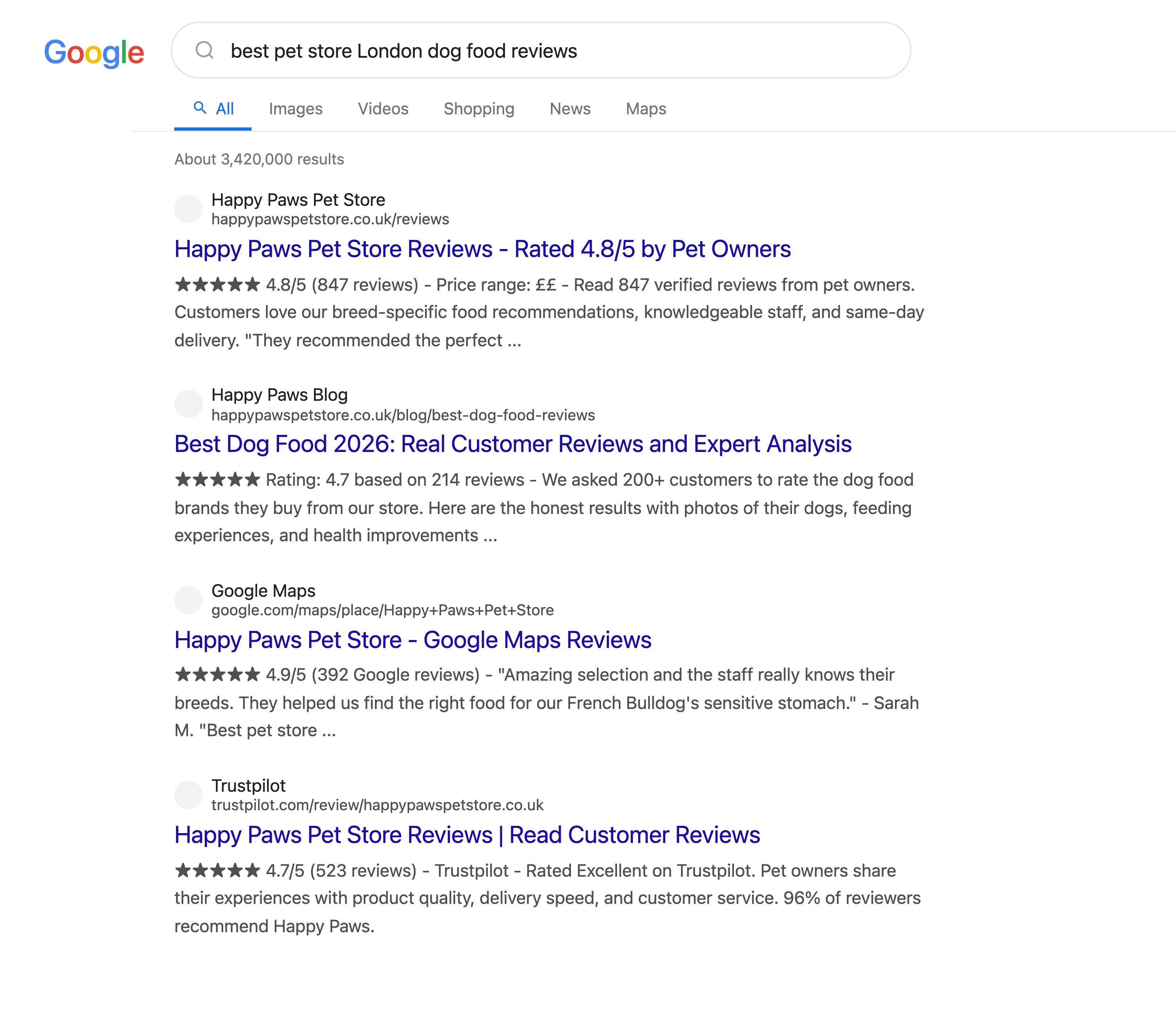
Product reviews deliver the highest combined impact. They build trust with shoppers and feed search engines with fresh, keyword-rich content that you did not have to write. 91% of customers rely on online reviews for purchase decisions[7], and conversion rates increase 270% when retailers display five or more product reviews[8]. For a deeper look at building a review generation system, see the online reviews guide for pet stores.
Customer photos and videos are the second priority. 72% of consumers say they want to see real customer photos and videos on ecommerce sites when making purchasing decisions[1]. A photo of a golden retriever happily chewing a dental stick from your store is worth more than a studio product shot - because it answers the question every pet owner has: "Will my pet actually like this?"
How Do You Build a UGC Collection System?
Waiting for customers to post about your store on their own does not work at scale. You need a system that makes sharing easy and gives people a reason to participate. Here is a practical framework any pet store can implement.
Step 1: Create a branded hashtag
Choose a hashtag that is short, memorable, and unique to your store. Something like #[YourStoreName]Pets or #PetsOf[YourStoreName]. Print it on receipts, packaging inserts, and in-store signage. Mention it in post-purchase emails. A branded hashtag gives you a central place to discover and collect all customer content. It also builds a community identity around your store.
Step 2: Ask at the right moment
The best time to request UGC is right after a positive experience. In-store, that is at checkout after a good conversation. Online, it is 5-7 days after delivery when the customer has had time to try the product with their pet. For grooming services, ask while the owner is admiring the result. Timing matters - a generic email blast asking for photos will not perform as well as a personal request at the moment of peak satisfaction.
Step 3: Make it worth their while
You do not need to pay customers for content. Simple recognition is often enough. Feature their pet on your social channels ("Pet of the Week"), display their photo in your store, or give them a shoutout in your newsletter. Some stores run monthly photo contests with small prizes - a bag of treats or a toy. The prize does not need to be large. Pet owners are motivated by the chance to show off their animals and feel part of a community.
Step 4: Build a permission and rights workflow
Before using any customer content in your marketing, get explicit permission. This can be as simple as: "We love this photo of [pet name]! Would you mind if we featured it on our website and social channels? We will credit you, of course." A quick DM or email works. For higher-volume collection, some stores include a consent checkbox on their review forms. In the EU, be mindful of GDPR - store consent records and make it clear how the content will be used.
Step 5: Organize and tag your library
As you collect UGC, organize it by type (photo, video, review, testimonial), product category (dog food, cat toys, grooming), and quality level (social-ready, website-ready, needs editing). A simple spreadsheet or folder structure works for stores just starting out. This library becomes your content bank - the assets you pull from when creating social posts, updating product pages, or building email campaigns.
How Does UGC Improve Your Search Rankings?
User-generated content does more than build trust with shoppers. It sends direct signals to search engines that improve your visibility. Here is how UGC contributes to SEO for pet stores.
Fresh content signals. Google rewards pages that are regularly updated with new content. Every new review, Q&A entry, or customer comment adds fresh text to your pages. This signals to Google that the page is active and relevant, which can improve crawl frequency and rankings. Search engines crawl frequently-updated pages more often, indexing new content faster[9].
Long-tail keyword coverage. Customers naturally use the exact phrases that other shoppers search for. A review that says "perfect harness for my French Bulldog puppy who pulls on walks" adds long-tail keyword coverage you could never plan in advance. Over time, hundreds of reviews create a rich semantic layer on your product pages that helps you rank for queries you never explicitly targeted. UGC increases click-through rates by over 50%[9].
Dwell time and engagement. Pages with customer photos, videos, and reviews keep visitors on your site longer. They scroll through reviews, watch unboxing clips, and browse customer galleries. This increased dwell time sends positive engagement signals to Google. Companies with blogs generate 55% more website traffic[10], and when that blog content is paired with authentic customer stories, the effect compounds.
Schema markup opportunities. Product reviews can be marked up with structured data (Review and AggregateRating schema), which enables rich snippets in search results - those gold stars you see beneath certain listings. Pages with review stars in search results get significantly more clicks than those without them. For a full guide to implementing schema, see the pet store SEO guide.
Backlink generation. Exceptional UGC - a viral pet video, a heartwarming customer story, a creative photo series - can earn organic backlinks from media outlets, bloggers, and other websites. These backlinks are among the strongest ranking signals in SEO. For more on earning links, see the backlink building guide for pet stores.
How Do You Display UGC on Your Website for Maximum Impact?
Collecting UGC is only half the equation. Where and how you display it determines whether it actually drives conversions. Here are the highest-impact placements for pet store websites.
Product pages. This is the most important placement. Display customer reviews prominently - not buried at the bottom, but visible without scrolling. Include customer photos alongside reviews when available. Displaying customer reviews can boost sales by 19.8%[7]. If a customer uploaded a photo of their cat using a scratching post you sell, show that photo right next to your product images.
Homepage social proof. Feature a rotating selection of customer photos or testimonials on your homepage. This immediately signals to new visitors that real people trust and buy from your store. A grid of happy pets with their owners' quotes creates an emotional connection that no amount of brand copy can match.
Dedicated gallery page. Create a "Happy Pets" or "Our Community" page that showcases the best customer submissions. This page serves double duty: it provides social proof for browsing customers and creates a page rich with unique visual content for search engines. Link to it from your main navigation so visitors can find it easily.
Blog content integration. When writing blog posts, weave in customer stories and experiences (anonymized, of course). A post about "best dog food for sensitive stomachs" becomes more credible when it includes real customer feedback about their dog's experience with a product you carry. For a broader blog strategy, see the pet store blog strategy guide.
Email marketing. Include customer photos and short testimonials in your email newsletters. Emails with UGC see higher open and click rates because they feel personal rather than promotional. A "Pet of the Month" feature in your newsletter gives customers a reason to submit content and gives subscribers a reason to open the email.
How Can You Use UGC on Social Media Effectively?
Social media is where most pet UGC originates, and it is where that content performs best. The key is having a repeatable process rather than posting randomly whenever you happen to find a good customer photo.
Create a content calendar with UGC days. Dedicate specific days to featuring customer content. "Feature Friday" or "Pet of the Week" posts create a rhythm your audience expects and participates in. This also reduces the pressure to create original content every single day. Content marketing costs 62% less than traditional marketing while generating 3x more leads[11], and UGC takes that efficiency even further by letting your customers create the content for you.
Repost with credit and context. When sharing a customer's photo or video, always credit them by name (or handle) and add context about the product. "Thanks to @[customer] for sharing this photo of Luna enjoying her new elevated feeding bowl! Luna's owner tells us the raised height helped with her digestion." This approach respects the creator, educates your audience about the product, and encourages others to share their own content.
Use Stories and Reels for quick UGC. Instagram Stories and Reels are ideal for reposting customer content because they feel casual and time-sensitive. A quick repost of a customer's Story with a "Thank you!" sticker takes 30 seconds and shows your community you are paying attention. Short-form videos generate 2.5x more engagement than long-form content[12].
Build UGC into your paid advertising. If you run social ads, test UGC creative against your brand-shot creative. In most cases, UGC ads outperform polished brand ads because they look like organic content in the feed rather than advertisements. A shaky phone video of a dog going wild over a toy from your store often outperforms a professionally lit product photo in terms of click-through rate and cost per acquisition.
What Does a UGC Strategy Look Like Alongside Professional Content?
UGC and professional content are not competing strategies. They are complementary. Professional content - well-researched blog articles, optimized product descriptions, structured SEO pages - builds your search engine authority and drives organic traffic. UGC builds trust, drives engagement, and converts that traffic into sales.
Think of it as a two-layer system. The professional content layer is your foundation. It targets keywords, establishes topical authority, and brings people to your site through search. For more on building topical authority through content, see the content marketing guide for pet businesses. The UGC layer sits on top of that foundation. It adds social proof, keeps pages fresh, and gives visitors the human validation they need to trust you with their purchase.
As the founder of Petbase, I see this dynamic play out with our clients regularly. The stores that combine consistent professional content with active UGC collection consistently outperform those that rely on either one alone. Professional articles bring the traffic. Customer photos and reviews close the sale. Neither works as well without the other.
The pet stores that struggle most are the ones trying to do everything themselves - writing SEO articles, managing social media, creating product content, and somehow also running their actual business. The smart approach is to automate or outsource the professional content layer so you can focus your personal energy on community building and UGC collection. That is where your unique advantage as a local, customer-facing business actually lives. No content service can replicate the relationship you have with Mrs. Schmidt and her three dachshunds.
How Do You Measure UGC Success?
Track these metrics monthly to understand whether your UGC strategy is working.
Collection volume. How many pieces of UGC (reviews, photos, videos, social mentions) did you collect this month? Set a target and track it. A reasonable starting goal for a small pet store is 10-15 new pieces per month.
Engagement rates. Compare the engagement (likes, comments, shares, saves) on your UGC posts versus your brand-created posts. You should see UGC posts outperforming brand posts. If pet-related UGC generates 6x more engagement than brand content[3], your numbers should reflect at least some of that uplift.
Conversion impact. If you display reviews or customer photos on product pages, track whether those pages convert at a higher rate than pages without UGC. Most analytics platforms let you set up A/B comparisons or segment conversion data by page features.
SEO contribution. Monitor whether pages with active UGC (frequent new reviews, customer Q&A) rank better than static pages. Track impressions and clicks in Google Search Console for product pages with and without reviews. Also monitor whether UGC-rich pages rank for long-tail queries that you did not explicitly target - a sign that customer language is expanding your keyword footprint.
Content cost savings. Calculate how much time and money you would have spent creating the equivalent content in-house. If you collected 20 customer photos this month that each replaced a product photo you would have needed to shoot, that is real savings in time and production cost.
What Are Common UGC Mistakes Pet Stores Make?
Several pitfalls can undermine an otherwise solid UGC strategy. Here is what to avoid.
Ignoring permissions. Using a customer's photo without asking is a trust violation - even if they tagged your store. Always request explicit permission before featuring UGC on your website, in ads, or in email campaigns. In the EU, GDPR makes this a legal requirement as well as an ethical one.
Over-editing customer content. The whole point of UGC is authenticity. If you run every customer photo through heavy filters and professional editing, you strip out the authenticity that makes it effective. Light cropping is fine. Completely restyling a customer's photo defeats the purpose.
Collecting but not displaying. Some stores actively collect reviews and photos but bury them in hard-to-find sections of their website. If UGC is not visible where buying decisions happen (product pages, homepage, category pages), it is not doing its job.
Focusing only on positive content. A mix of 4-star and 5-star reviews is actually more credible than a page full of perfect scores. Shoppers are skeptical of businesses with nothing but glowing reviews. A thoughtful 4-star review that mentions a minor issue alongside genuine praise often builds more trust than a generic 5-star "Great product!" 94% of consumers say verified purchase reviews increase their confidence in feedback authenticity[7].
Not integrating UGC with SEO. Many stores treat UGC and SEO as separate efforts. They are not. Reviews add keyword-rich content to product pages. Customer Q&A sections create FAQ-style content that targets long-tail searches. Photo alt text adds image SEO value. Every piece of UGC should be considered through the lens of search visibility. For more on connecting pet influencer content with SEO strategy, see the pet influencer SEO guide.
Frequently Asked Questions
Do I need a large social media following to benefit from UGC?
No. UGC is not about your follower count - it is about your customer count. Even a pet store with 200 Instagram followers can generate valuable UGC if those followers include loyal, repeat customers who love your products. Start by asking your best customers directly. A pet store serving 20 customers per day in-store has more than enough interactions to build a steady UGC pipeline. The content you collect from customers also works on your website, in emails, and on product pages - channels where your social following size does not matter at all.
How do I handle negative UGC or unflattering customer photos?
Negative feedback is an opportunity, not a threat. Respond publicly with empathy and a clear path to resolution. Other customers watching will judge you more by your response than by the complaint itself. For unflattering photos (blurry images, poor lighting), you are under no obligation to feature every piece of content you receive. Curate for quality while keeping things authentic. A slightly imperfect photo that clearly shows a real pet using your product is better than a professional shot that looks staged. See the online reviews guide for detailed response frameworks.
What tools can small pet stores use to collect and manage UGC?
You do not need expensive platforms to start. Google Business Profile handles review collection for free. Instagram's tagged photos and branded hashtag search show you customer content at no cost. For reviews on your own website, tools like Judge.me, Stamped.io, or Yotpo offer free tiers suited to small stores. A simple shared Google Drive folder works as a UGC library for organizing photos and videos by category. As your collection grows, you can upgrade to dedicated UGC platforms. The important thing is to start with the tools you already have and build the habit of asking for, collecting, and displaying customer content consistently.
How often should I post UGC on social media?
Aim for at least 2-3 UGC posts per week, mixed with your other content. A good ratio is 40-50% UGC, 30% educational or product content, and 20-30% promotional content. This keeps your feed feeling authentic and community-driven without abandoning your brand voice entirely. If you have a strong UGC pipeline, you can increase the ratio. The key is consistency - posting UGC once and then disappearing for two weeks signals to your audience that sharing was a one-off request, not an ongoing community practice.
References
- Nosto / Stackla (2025). 43 Statistics About User-Generated Content You Need to Know. nosto.com
- Backlinko (2026). 24 Key User-Generated Content (UGC) Statistics. backlinko.com
- Billo (2025). Generating Furry Fame: How Pet UGC Can Unleash Brand Loyalty and Success. billo.app
- Social Insider (2026). Social Media Benchmarks. socialinsider.io
- TikTok Hashtags (2025). #Pet Hashtag Statistics. tiktokhashtags.com
- inBeat Agency (2025). 50 UGC Statistics + Strategic Implications for Your Brand. inbeat.agency
- Capital One Shopping (2025). Online Review Statistics: Influence on Buying Decisions. capitaloneshopping.com
- Fera (2025). 59 Online Review Statistics. fera.ai
- Coalition Technologies (2025). How to Use the Power of User-Generated Content for SEO. coalitiontechnologies.com
- HubSpot (2025). Marketing Statistics. hubspot.com
- Siege Media (2025). Content Marketing Statistics. siegemedia.com
- DemandSage (2026). Video Marketing Statistics. demandsage.com