Veterinary Clinic SEO: Rank Higher, Win Trust

Table of Contents +
- Why Veterinary Clinics Need SEO
- How Pet Owners Search for Veterinary Services
- Building a Veterinary Website Optimized for SEO and Trust
- Google Business Profile - The Heart of Local Veterinary SEO
- Why Reviews Are Critical for Veterinary SEO
- Comparing Vet Clinic Marketing Approaches
- Educational Content - The Most Powerful SEO Asset for Veterinary Clinics
- Specialty Veterinary SEO - A Competitive Advantage
- Emergency Veterinary SEO - Ranking When Pet Owners Need You Most
- Backlinks and Veterinary Authority
- Scaling Veterinary SEO With Petbase
- Frequently Asked Questions
- References
Data-backed veterinary SEO guide for clinics, hospitals, and mobile vets. Learn how to rank on Google, attract high-LTV clients, and grow your practice.
The global veterinary services market was valued at $138.98 billion in 2025 and is projected to reach $233.21 billion by 2034 at 5.92% CAGR.[1] Pet owners are spending more on veterinary care than ever. Yet most clinics rely on word of mouth and paid ads while their competitors rank on Google and fill appointment slots organically.
This guide covers how veterinary clinics rank on Google, attract new clients, and turn search visibility into long-term practice growth - backed by industry data at every step.
Why Veterinary Clinics Need SEO
Veterinary medicine is a trust-dependent, high-lifetime-value business. The average veterinary client has a lifetime value of roughly $5,000 - that is $500 per year across a 10-year relationship.[2] A single new client found through organic search can generate thousands in revenue without a dollar spent on ads.
The economics are clear: a 5% increase in client retention can boost profits by 25-95%.[3] SEO does not just bring in new clients - it builds the kind of trust that keeps them coming back.
When a pet is sick, injured, or due for routine care, owners turn to Google. Searches like "veterinarian near me," "emergency vet," "dog x-ray cost," or "cat vaccination schedule" determine which clinic gets the call first. 46% of all Google searches have local intent, and 98% of consumers search online for nearby businesses.[4]
Veterinary SEO helps clinics:
- rank for emergency and urgent care queries
- attract long-term, high-LTV clients
- increase preventive care bookings
- educate pet owners at scale
- reduce reception workload by answering common questions online
- compete with corporate practices through demonstrated expertise
- become the most trusted clinic in their area
This strategy connects to the broader local visibility approach covered in our pet business local SEO guide.
Petbase automates SEO content for veterinary clinics - so you can focus on patients, not blog posts - start your free trial.
How Pet Owners Search for Veterinary Services
Pet owners search with urgency and emotional weight. Their queries typically fall into these categories:
- emergencies ("emergency vet near me open now")
- routine care ("dog vaccination schedule")
- diagnostics ("cat blood test cost")
- symptoms ("dog vomiting blood what to do")
- specialty treatment ("pet dermatologist near me")
- mobile care ("mobile vet for anxious cats")
"Near me" searches reach 1.5 billion per month - roughly 50 million per day - with over 500% growth in recent years.[4] Google search is modern triage. Clinics that publish content addressing these concerns establish immediate trust, and SEO ensures that content gets discovered.
For more on educational content strategy, see our pet blog SEO guide.
Building a Veterinary Website Optimized for SEO and Trust
A veterinary clinic's website must communicate professionalism, safety, and care. Google's ranking system heavily favors medical content that demonstrates E-E-A-T (Experience, Expertise, Authoritativeness, Trustworthiness). Organic search drives 53% of all website traffic - making your website the single most important client acquisition channel.[5]
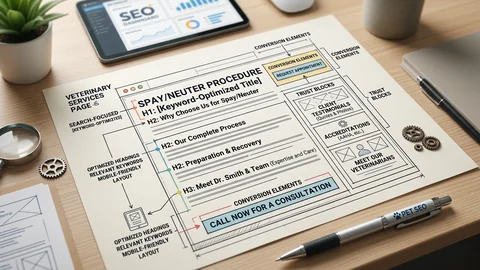
Service Pages for Every Veterinary Offering
Each service you provide should have its own page: vaccinations, dental cleanings, spay and neuter, diagnostics, bloodwork, radiology and ultrasound, dermatology, orthopedic care, emergency services, senior pet care, behavioral consultations, and mobile vet visits.
Each service page should describe symptoms, reasons for the service, what pet owners can expect, how the procedure works, preparation steps, aftercare, risks and contraindications, and costs (even ranges help). This level of detail matches the educational depth used in our pet product brand SEO guide.
Meet the Veterinarian Team Page
Pet owners want to know who will care for their pet. This page should include professional headshots, credentials, specializations, experience, a warm human introduction, and continuing education details. People trust people - not buildings. Highlight expertise, but also empathy.
Clinic Tour and Facility Photos
Business profiles with photos receive 42% more direction requests and 35% more website clicks than profiles without.[6] Include images of exam rooms, diagnostic areas, surgical suites, reception, staff members, treatment spaces, equipment, and boarding areas. Use descriptive alt text with medical keywords on every image.
This strategy mirrors the image-rich approach covered in our pet groomer SEO guide.
Google Business Profile - The Heart of Local Veterinary SEO
Your Google Business Profile (GBP) drives map pack visibility, phone calls, direction requests, and new appointments. The Local Pack appears for 93% of local intent searches and receives nearly 44% of all clicks.[4] If you rank in the Local Pack, you capture almost half the traffic.
A complete GBP should include:
- accurate categories ("Veterinarian," "Animal Hospital," "Emergency Veterinarian")
- full address and service hours
- up-to-date facility and team photos
- a complete services list
- booking links
- a keyword-rich description
- weekly posts with clinic updates and pet health tips
- Q&A optimization
This connects directly to strategies outlined in the pet business local SEO guide.
Why Reviews Are Critical for Veterinary SEO
93% of consumers say online reviews affect their buying decisions for local businesses.[4] For veterinary clinics, reviews are the single most influential decision factor. They impact click-through rates, local ranking, trust, perceived expertise, and emotional reassurance.
Encourage clients to mention their pet's issue, the service they received, and your city or clinic name. Example: "Dr. Smith treated my dog's ear infection quickly. Best vet in Denver!" This natural keyword inclusion improves semantic relevance and helps future pet owners find you for the same services.
Comparing Vet Clinic Marketing Approaches
Veterinary practices have several marketing options. Not all perform equally. The table below compares the most common approaches.
| Marketing Approach | Monthly Cost Range | Lead Quality | Time to Results | Best Use Case |
|---|---|---|---|---|
| Google Business Profile (Local SEO) | Free - $300 | Very High | 2-4 months | Emergency queries, map pack ranking |
| Website SEO (service + blog pages) | $300 - $800 | High | 3-6 months | Preventive care, specialty services |
| Google Ads (PPC) | $500 - $2,000+ | High (for emergency) | Immediate | Emergency clinics, new practice launch |
| Facebook / Instagram Ads | $200 - $600 | Medium | 1-4 weeks | Wellness promotions, seasonal campaigns |
| Email Newsletter | Free - $100 | Very High (existing clients) | Immediate | Retention, vaccination reminders |
| Referral Partnerships (groomers, trainers) | Free | Very High | 1-3 months | New client acquisition through trust network |
| Yelp / Healthgrades Listings | Free - $300 | Medium | 1-2 months | Review-driven discovery for new clients |
Local SEO and referral partnerships consistently produce the highest quality clients at the lowest cost. With an average of $554,982 in revenue per veterinarian and 1,499 active clients per FTE[2], even small ranking improvements translate into meaningful revenue gains. Emergency PPC makes sense for clinics that need immediate volume, but the return stops the moment the budget does.
Educational Content - The Most Powerful SEO Asset for Veterinary Clinics
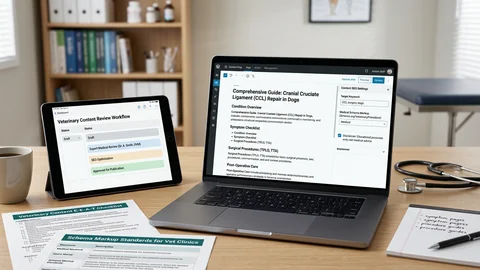
Veterinary clinics are uniquely positioned to publish authoritative content. Pet owners constantly search for medical advice online - but they prefer answers from a real clinic, not a generic magazine.
High-impact veterinary content includes:
- symptom guides ("dog limping but no injury")
- care instructions ("post-surgery recovery for dogs")
- medication explanations
- preventive care how-to guides
- breed-specific health risks
- first-aid instructions
- chronic condition education
- emergency signs to watch for
- diagnostic overviews
- senior pet care tips
- puppy and kitten development stages
This content builds domain authority and brings pet owners to you before they contact a competitor. Internal linking should connect these articles to broader SEO pillars like our pet business local SEO guide and consumer-focused pages like the pet store SEO guide.
Specialty Veterinary SEO - A Competitive Advantage
Specialty practices - dermatology, oncology, cardiology, ophthalmology, dentistry, and rehabilitation - benefit even more from SEO because these topics are highly searched and medically nuanced.
Your specialty pages should include symptoms, diagnostics, treatment options, case studies, success rates, post-treatment care, and professional qualifications. These pages can interlink with topics like our pet product brand SEO guide when referencing medical products, prescriptions, nutrition, or supplements.
Emergency Veterinary SEO - Ranking When Pet Owners Need You Most
Emergency veterinary care is one of the highest-intent areas of pet search. Pet owners type "emergency vet near me open now," "dog choking help," "cat poisoning symptoms," and "pet emergency hospital." Clinics that rank for these queries earn immediate, critical business.
To rank for emergency terms, clinics need well-optimized emergency landing pages, up-to-date clinic hour listings, schema markup, Google Business Profile updates, fast-loading pages (under 3 seconds), mobile-first layouts, and symptom-based educational content. Emergency SEO saves lives - and builds the kind of trust that turns one-time visits into lifelong clients.
Backlinks and Veterinary Authority
Veterinary clinics can earn strong backlinks by collaborating with trainers, groomers, pet stores, breeders, shelters, rescue organizations, pet influencers, and local news outlets.
For example:
- a local dog trainer linking to your "Leash Reactivity and Pain-Related Issues" guide
- a groomer linking to your "Skin Irritation Causes" article
- a breeder linking to your "Genetic Testing Explained" resource
These partnerships mirror concepts discussed in our pet influencer SEO guide, expanding your clinic's authority ecosystem.
Scaling Veterinary SEO With Petbase
Veterinarians are busy. Between appointments, surgeries, emergencies, diagnostics, and administrative work, content creation is nearly impossible. Yet 61% of small businesses are not investing in SEO[7] - which means the clinics that do invest gain a significant advantage.
Petbase helps veterinary clinics generate optimized service pages, medical content, symptom and care guides, local landing pages, and educational blog posts - all tailored to the veterinary industry. 10 articles per month, published directly to your website, for EUR 199/mo.
The veterinary services market is growing at 5.92% annually toward $233.21 billion by 2034[1]. With each client worth roughly $5,000 in lifetime value[2], a handful of new clients per month from organic search pays for your entire SEO investment many times over.
Start your free trial and see what consistent, research-backed content does for your veterinary practice.
Frequently Asked Questions
How do vets rank on Google?
Vets rank on Google through a fully optimized Google Business Profile, individual service pages with medical keywords, and consistent review collection. Profiles with photos get 42% more direction requests.[6] Educational articles targeting symptom and care searches build long-term authority. Emergency pages with fast load times and mobile-friendly design capture high-intent searches and often rank quickly due to urgency.
Is SEO worth it for a vet clinic?
Yes. The average veterinary client generates roughly $5,000 in lifetime value.[2] A single new client acquired through organic search pays for months of SEO investment. Unlike paid ads that stop generating leads when the budget ends, SEO compounds. Clinics that invest consistently for 6-12 months often reduce their paid ad spend significantly while increasing total appointment volume.
What keywords should veterinary clinics target?
Veterinary clinics should target three keyword categories: emergency queries ("emergency vet near me"), service queries ("dog dental cleaning cost"), and symptom queries ("cat not eating for 2 days"). Symptom and care articles attract the most organic traffic. Emergency and service pages convert that traffic into booked appointments at the highest rate. With 46% of Google searches having local intent,[4] always include your city and neighborhood in page titles and headings.
How long does veterinary SEO take to show results?
Most veterinary clinics see measurable ranking improvements within 3-6 months of consistent effort. Google Business Profile optimizations (photos, reviews, posts) can impact map pack rankings within weeks. Service pages and blog content take longer to index and climb, but they compound - each new article strengthens your overall domain authority and helps existing pages rank higher too.
References
- Precedence Research (2025). Veterinary Services Market Size, Share, and Trends 2025 to 2034. precedenceresearch.com
- AVMA (2024). Benchmarking Data Plus Elevating Efficiency Equals Practice Productivity. avma.org
- HappyDoc (2024). Understanding Client Lifetime Value and Its Importance for Veterinary Clinics. happydoc.ai
- BrightLocal (2025). Local SEO Statistics. brightlocal.com
- BrightEdge (2024). How Much Traffic Comes from Organic Search. seoinc.com
- Sterling Sky (2024). How to Interpret Google Business Profile Performance. sterlingsky.ca
- Clutch (2025). SEO Statistics 2025. clutch.co