Video SEO for Pet Stores: YouTube, TikTok, and Product Pages

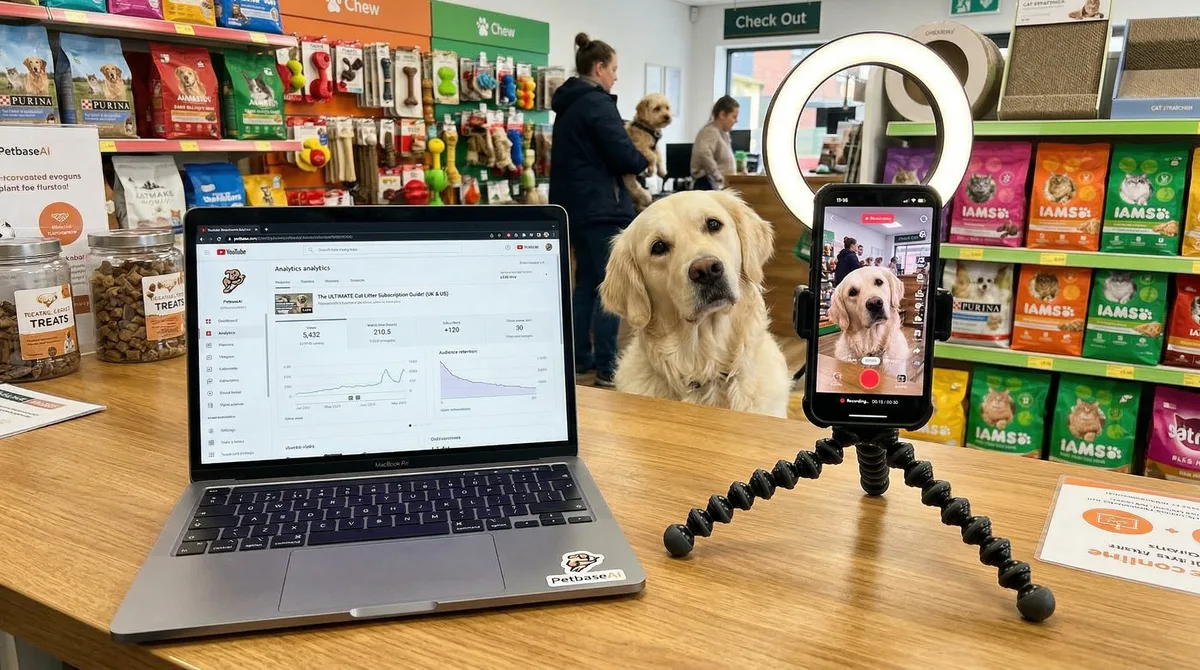
Table of Contents +
- Why Is Video the Biggest Untapped Channel for Pet Stores?
- How Does YouTube SEO Work for Pet Stores?
- What Makes TikTok Different for Pet Store Marketing?
- Which Platform Should Pet Stores Prioritize?
- How Do Product Page Videos Increase Conversions?
- How Can Pet Stores Repurpose One Video Across Multiple Platforms?
- What Are the Technical Requirements for Video SEO?
- What Does a Realistic Video Content Calendar Look Like?
- How Do You Measure Video SEO Success?
- Frequently Asked Questions
- References
Learn how to use video SEO across YouTube, TikTok, and product pages to drive traffic and sales for your pet store. Platform comparison and practical workflows.
Your pet store probably has a blog. It might even rank for a few keywords. But if you are not publishing video content, you are leaving a massive traffic channel untapped. 91% of businesses now use video as a marketing tool[1], and 85% of consumers say a video has directly convinced them to make a purchase. YouTube alone processes over 3 billion searches every month[2]. That is 3 billion opportunities your text-only content cannot reach.
The gap is clear. Most pet stores invest in written SEO but ignore video entirely. Your competitors are already filming product demos, posting grooming tutorials, and showing up in video search results. The question is not whether video SEO matters for pet stores. The question is how quickly you can start.
TL;DR
Video SEO helps pet stores rank on YouTube, TikTok, and Google simultaneously. Pet content gets 318 billion views on TikTok alone. Product pages with video convert 80% better. Start with YouTube for search traffic, TikTok for discovery, and product page videos for conversions.
Why Is Video the Biggest Untapped Channel for Pet Stores?
Pet stores face a unique situation. The pet industry is one of the most video-friendly niches on the internet. The #pet hashtag on TikTok has accumulated over 318 billion views, and #PetsOfTikTok alone has surpassed 147 billion views[3]. People want to watch pet content. They actively search for it. And they buy products because of it.
Yet most pet stores limit their digital marketing to text-based blog posts and static product pages. That approach worked five years ago. Today, more than 23% of Google search results include video content[4]. If your site has no video, you are invisible in nearly a quarter of all search results.
The data on video and purchasing decisions is equally compelling. 70% of shoppers say they have bought a product after seeing it on YouTube[1]. For pet stores, this means product demonstrations, feeding guides, and grooming tutorials are not just content - they are direct sales drivers. When a customer watches a 2-minute video of a dog happily chewing a new dental treat, that video does more selling than a 500-word product description.
Pages with embedded videos see average session durations 2.6 times longer than text-only pages[4]. Longer sessions signal quality to Google, which improves your rankings. It is a compounding effect: video improves engagement, engagement improves rankings, and better rankings bring more traffic to your videos.
Petbase automates SEO content for pet stores - publishing 10 optimized articles monthly so you can focus on running your shop - start your free trial.
How Does YouTube SEO Work for Pet Stores?
YouTube is the second-largest search engine in the world, processing over 3 billion searches per month[2]. That is more search volume than Bing, Yahoo, and every other search engine combined. For pet stores, YouTube represents a search audience that your blog alone cannot reach.
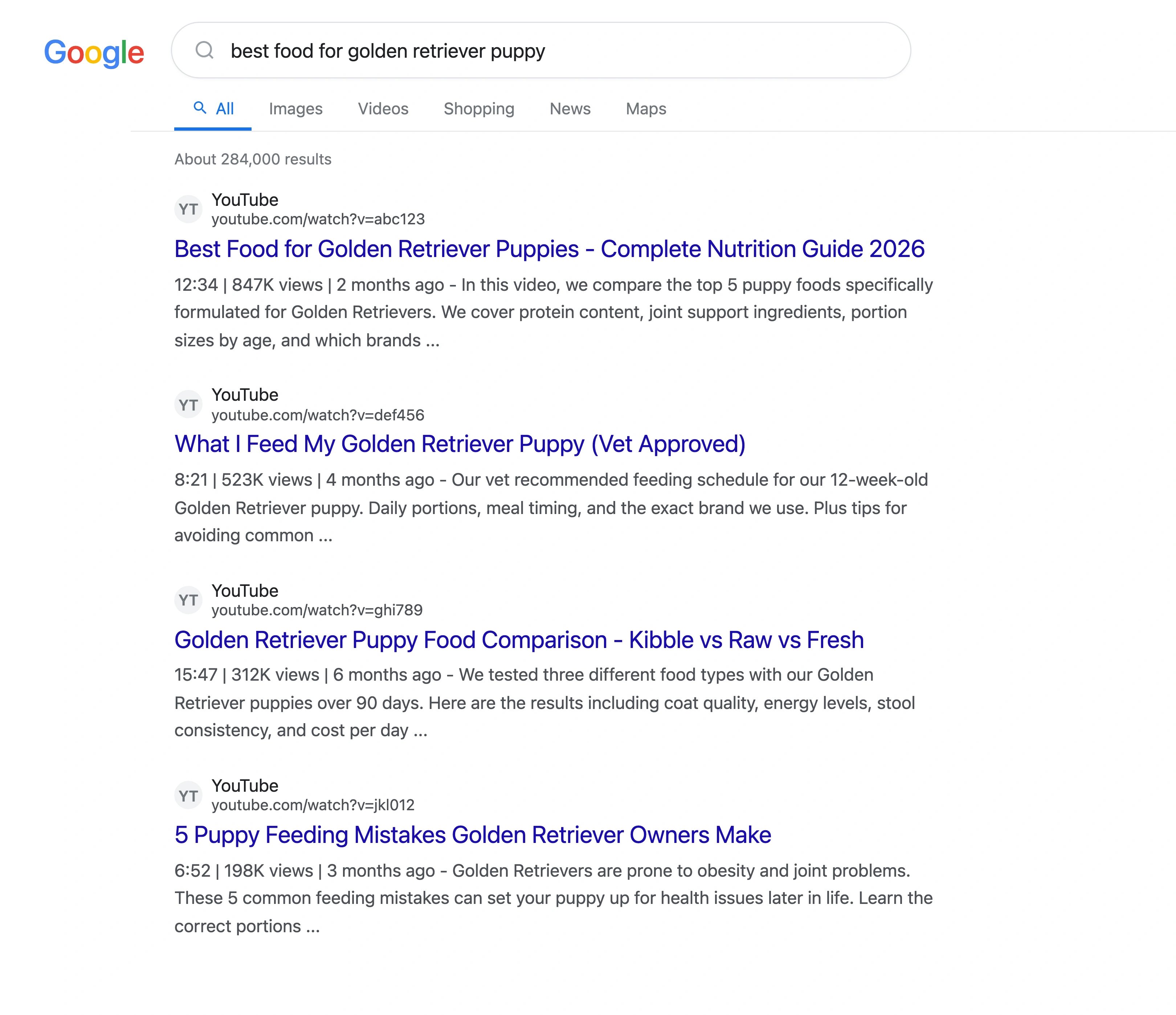
YouTube SEO works differently from Google SEO, but the core principle is the same: match your content to what people are searching for. The difference is in how YouTube measures quality. Watch time and audience retention are the top ranking factors on YouTube[5]. If viewers click on your video and watch most of it, YouTube pushes that video to more people. If they click away in the first 10 seconds, the video sinks.
For a pet store, this means creating videos that answer specific questions. "Best food for Golden Retriever puppies" gets searched on YouTube just as it gets searched on Google. But on YouTube, you can show the product, demonstrate feeding portions, and explain nutritional benefits visually - all of which keeps viewers watching longer than text ever could.
Here is a practical YouTube SEO workflow for pet stores:
- Keyword research: Use tools like TubeBuddy or Ahrefs to find what pet owners search on YouTube. Focus on questions: "how to" guides, product comparisons, breed-specific advice.
- Script from your blog content: Your existing blog articles are ready-made video scripts. A 1,500-word article on senior dog nutrition becomes a 5-7 minute YouTube video.
- Optimize the title and description: Place your target keyword in the first 60 characters of your title. Write a 200-word description that includes related keywords naturally.
- Create a custom thumbnail: Thumbnails with faces (human or animal), bright colors, and large text get the highest click-through rates. Show the product or pet clearly.
- Add chapters and timestamps: Divide your video into sections with timestamps in the description. YouTube uses these for featured snippets and AI Overviews.
- Embed on your website: After publishing on YouTube, embed the video on the corresponding blog post. Pages with embedded YouTube videos had more than double the keywords ranking on Google's first page[4].
What Makes TikTok Different for Pet Store Marketing?
TikTok is not YouTube. The platform rewards different content, uses a different algorithm, and reaches a different audience. But for pet stores, TikTok offers one advantage no other platform can match: organic reach without a following.
TikTok's algorithm does not favor established accounts[6]. A pet store with zero followers can publish a video that reaches 100,000 people if the content resonates. This is the opposite of Instagram or Facebook, where organic reach has declined to near zero for business accounts. TikTok brand follower counts rose 200% in 2025 while Instagram organic reach fell by up to 40%[7].
The results for small businesses are significant. 88% of small businesses report increased sales following TikTok activity, and 74% said they sold out of a product tied to a TikTok promotion[6]. In the pet industry specifically, TikTok Shop generates $12 million in monthly sales in the US Pet Supplies category alone[8].
Short-form videos generate 2.5 times more engagement than long-form content[9]. For pet stores, this means 30-60 second clips of products in action, pet reactions, before-and-after grooming transformations, and quick tips. You do not need professional equipment. A smartphone, natural lighting, and an actual pet are enough.
When we built Petbase, one pattern became clear from talking to pet store owners: they had no shortage of video ideas, but they lacked the written foundation to make those videos findable. A TikTok video about "best calming treats for anxious dogs" performs better when you already have a blog post ranking for that topic. The blog post feeds the video script. The video drives traffic back to the blog. Both reinforce each other in search.
Which Platform Should Pet Stores Prioritize?
Each video platform serves a different purpose in your marketing funnel. The right choice depends on your goals, resources, and where your customers spend time. Here is how the three main video channels compare for pet stores:
| Factor | YouTube | TikTok | Product Page Video |
|---|---|---|---|
| Primary goal | Search traffic and authority | Discovery and brand awareness | Conversions and sales |
| Content length | 5-15 minutes | 15-60 seconds | 30-90 seconds |
| SEO impact | High (second-largest search engine) | Moderate (indexed by Google) | High (on-page engagement signals) |
| Production cost | Medium (scripted, edited) | Low (smartphone, authentic) | Medium (product-focused) |
| Time to results | 3-6 months (compounding) | Immediate (algorithmic push) | Immediate (conversion lift) |
| Shelf life | Years (evergreen search) | Days to weeks (trend-driven) | Permanent (product lifespan) |
| Best for pet stores | How-to guides, breed advice, comparisons | Product reveals, pet reactions, tips | Demos, unboxings, reviews |
My recommendation: start with product page videos if you sell online - the conversion impact is immediate. Add YouTube next for long-term search traffic. Layer in TikTok once you have a content rhythm established.
Most pet stores with limited resources should focus on one platform first rather than spreading effort thin across all three. If you already have strong organic search traffic, YouTube is the natural extension. If you are a newer store building brand awareness, TikTok's organic reach gives you the fastest visibility.
How Do Product Page Videos Increase Conversions?
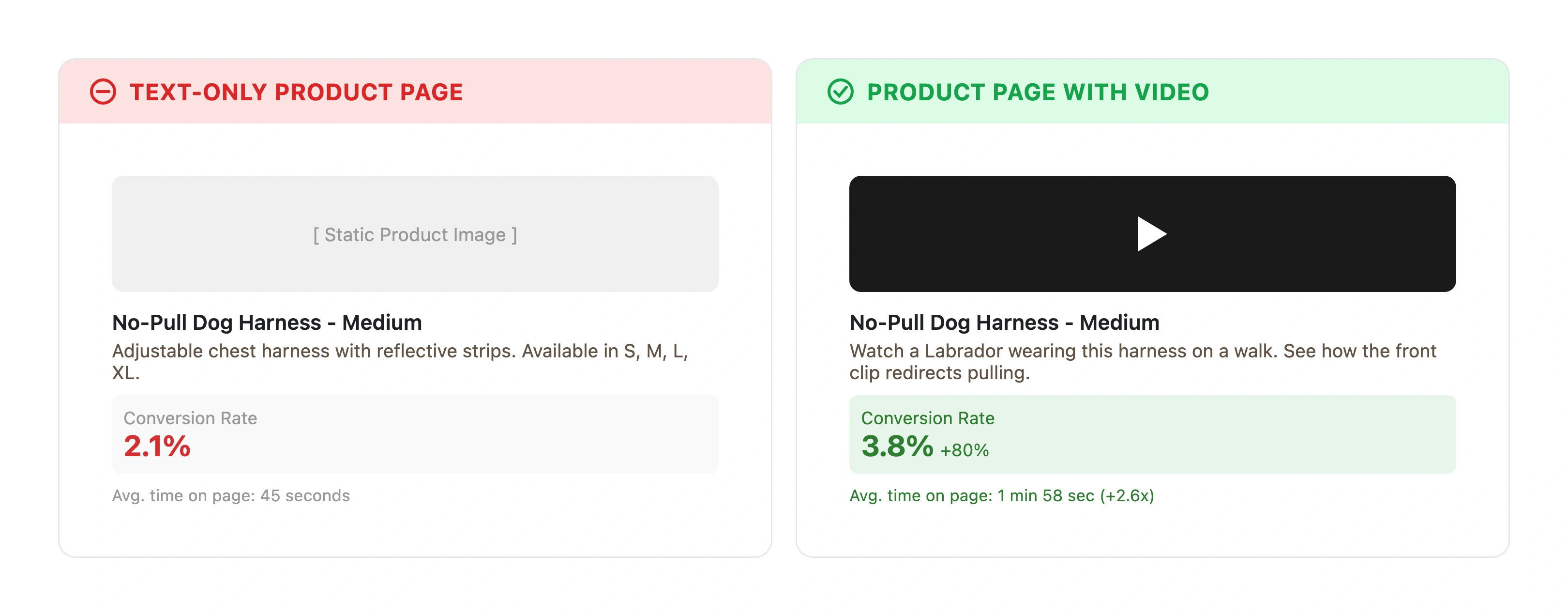
Product page videos have the most direct impact on revenue. The numbers are hard to ignore: landing pages with video see conversion increases of 80-86%[1]. Consumers who watch a product video are 144% more likely to add that product to their cart[10]. And 73% of online shoppers say they are more likely to buy after watching a video that explains how the product works[10].
For pet stores, product videos solve a specific problem: customers cannot touch, smell, or test pet products online. A static image of a dog harness tells you almost nothing about how it fits, how the buckles work, or whether it restricts movement. A 60-second video showing a dog wearing that harness on a walk answers every question the customer has.
Here are the product video types that work best for pet stores:
- Demonstration videos: Show the product in use. A cat playing with a new toy, a dog eating from a slow-feeder bowl, a groomer using a deshedding tool. Product demos achieve an average 34% conversion rate[1].
- Comparison videos: Side-by-side comparisons of similar products. "Standard leash vs. no-pull harness" or "grain-free vs. grain-inclusive kibble." These help undecided customers choose and reduce return rates.
- Size and fit guides: Pet products come in multiple sizes, and incorrect sizing is a top reason for returns. A video showing the product on different dog breeds eliminates guesswork.
- Unboxing and first impressions: Film a pet's first reaction to a new product. These are authentic, require minimal editing, and build trust because customers see a real experience.
To optimize product videos for product page SEO, add VideoObject schema markup to every page with a video. Include a text transcript below the video - this gives Google additional content to index. Keep videos under 90 seconds for product pages. Longer videos work on YouTube, but on a product page, shoppers want quick answers.
How Can Pet Stores Repurpose One Video Across Multiple Platforms?
Creating video content does not mean producing separate content for every platform. One filming session can generate content for YouTube, TikTok, Instagram Reels, and your product pages. This is the repurposing approach, and 94% of marketers already use it[11]. Content repurposing saves 60-80% of creation time while increasing reach by up to 300%[12].
Here is a practical repurposing workflow for pet stores:
- Start with a long-form YouTube video (5-10 minutes). Film a complete product review, tutorial, or breed-specific guide.
- Extract 3-5 short clips (15-60 seconds each) for TikTok and Instagram Reels. Focus on the most visual, surprising, or useful moments.
- Use the product demonstration segment as your product page video. Trim to under 90 seconds.
- Transcribe the video and use the transcript as a draft for a blog post or to enrich an existing article.
- Pull still frames from the video for social media images and product page galleries.
I have seen pet stores that film one 10-minute YouTube video per week and extract enough content to post daily on TikTok for the entire week. That is 7 pieces of content from a single filming session. Read our guide to repurposing content for the complete workflow.
The key to successful repurposing is planning your content to work across formats before you film. Write a script with natural break points. Plan visual moments that work as standalone clips. Include close-up product shots that double as product page footage.
What Are the Technical Requirements for Video SEO?
Filming the video is half the work. Making it findable requires technical optimization. Here are the video SEO fundamentals that most pet stores miss:
YouTube optimization checklist:
- Place your target keyword in the first 60 characters of the video title
- Write a 200-300 word description with primary and secondary keywords
- Add 5-10 relevant tags (mix of broad and specific terms)
- Create custom thumbnails at 1280x720 pixels minimum
- Add closed captions - YouTube auto-generates them, but editing for accuracy improves rankings
- Use end screens and cards to link to related videos and your website
- Organize videos into playlists grouped by topic (breed guides, product reviews, care tips)
On-page video SEO:
- Add VideoObject schema markup to every page with embedded video
- Include a full text transcript adjacent to the video
- Use a descriptive file name for the video ("golden-retriever-puppy-food-guide.mp4" not "video-final-v3.mp4")
- Ensure video does not slow your page load - use lazy loading for below-fold videos and host on YouTube rather than self-hosting
- Add the video sitemap entry to your existing XML sitemap
TikTok optimization:
- Use 3-5 relevant hashtags (TikTok now limits posts to a maximum of 5 hashtags)[13]
- Include your keyword in the caption text
- Post at consistent times - the algorithm rewards predictable schedules
- Engage with comments in the first 1-2 hours after posting - early engagement signals quality to the algorithm
Organic search accounts for 53% of all tracked website traffic[14]. Video gives you access to a portion of that traffic that text alone cannot capture. When you optimize your Google Business Profile with video content as well, you strengthen your local search presence on multiple fronts.
What Does a Realistic Video Content Calendar Look Like?
Consistency matters more than volume. Publishing one video per week on YouTube outperforms uploading 10 videos in one month and then going silent. Here is a realistic monthly video calendar for a pet store with limited resources:
Week 1: Product review or comparison (YouTube long-form + 3 TikTok clips). Film a detailed review of a popular product. Compare two similar products side by side. This generates your highest-converting content.
Week 2: How-to or educational guide (YouTube long-form + 3 TikTok clips). Film a tutorial: "How to measure your dog for a harness," "How to read pet food labels," or "How to introduce a new cat to your home." Educational content builds authority and earns backlinks.
Week 3: Behind-the-scenes or seasonal content (TikTok/Reels focus). Show your store, your team, new stock arriving, or seasonal displays. This content builds brand connection and performs well on TikTok without heavy editing.
Week 4: Customer or community content (YouTube + TikTok). Feature customer pet stories (with permission), host a Q&A about common pet care questions, or compile user-generated clips. Community content generates engagement signals that boost all your other content.
This calendar produces 4 YouTube videos and 12+ TikTok clips per month from approximately 4 filming sessions. Each session takes 1-2 hours. Add 1-2 hours per video for editing and optimization. Total monthly time investment: 12-16 hours.
How Do You Measure Video SEO Success?
Track these metrics to understand whether your video SEO efforts are working:
YouTube metrics:
- Impressions click-through rate (CTR): Target 4-10%. Below 4% means your thumbnails or titles need improvement.
- Average view duration: Aim for 50%+ of total video length. If viewers leave before the halfway point, your content is not matching their expectations.
- Search traffic percentage: Check YouTube Studio's traffic sources. A healthy channel gets 30-50% of views from YouTube search, which indicates your SEO is working.
- Subscriber conversion rate: Track what percentage of viewers subscribe. This signals growing authority in your niche.
Website metrics (for embedded videos):
- Time on page: Compare pages with video vs. without. You should see the 2.6x increase that industry benchmarks suggest[4].
- Ranking positions: Monitor whether pages with embedded video rank higher than equivalent pages without. Real-world experiments show a 300% increase in search impressions[4].
- Conversion rate: For product pages with video, track add-to-cart rate vs. pages without video. The 144% lift benchmark[10] is your target.
TikTok metrics:
- Views-to-followers ratio: TikTok's algorithm pushes content beyond your followers. If a video gets 10x your follower count in views, the algorithm favors your content.
- Saves and shares: TikTok weights saves and shares approximately 1.4x higher than other engagement signals[13].
- Profile visits: Track how many viewers visit your profile after watching. This indicates commercial intent.
Frequently Asked Questions
Do pet stores need professional video equipment to start?
No. A modern smartphone shoots 4K video, which is more than sufficient for YouTube and TikTok. Natural lighting near a window works for product shots. A EUR 30 tripod and a EUR 20 clip-on microphone are the only accessories you need to start. 91% of businesses use video in their marketing[1], and most started with basic equipment. Production quality matters less than content quality - authentic pet content outperforms polished corporate videos on every platform.
How long before video SEO produces measurable results?
TikTok can deliver views within hours of posting due to its algorithmic distribution. YouTube takes 3-6 months to build meaningful search traffic, similar to traditional SEO timelines. Product page videos show conversion improvements immediately - the 80-86% conversion lift[1] applies from the first day the video is live. Consistency is the critical factor: YouTube channels posting weekly for 12 months significantly outperform those posting sporadically.
Can blog content be turned into video scripts?
Yes, and this is the most efficient approach. A 1,500-word blog article contains enough material for one 5-8 minute YouTube video and 3-5 short TikTok clips. The research, structure, and key points are already done. You simply adapt the format from written to spoken. 94% of marketers already repurpose their content across formats[11], and content repurposing saves 60-80% of creation time[12].
Is TikTok worth it for European pet stores?
Yes. TikTok Shop is active in the UK and expanding across Europe. Even without TikTok Shop, 88% of small businesses report increased sales from TikTok activity[6]. The platform drives brand awareness and website traffic regardless of whether you sell directly on it. Pet content performs exceptionally well on TikTok - the #pet hashtag alone has over 318 billion views[3]. For European pet stores, TikTok is particularly valuable because the algorithm does not favor accounts from any specific region.
References
- Wyzowl (2026). Video Marketing Statistics. wyzowl.com
- Global Media Insight (2026). YouTube Users Statistics. globalmediainsight.com
- TikTokHashtags (2025). Pet Hashtag Statistics. tiktokhashtags.com
- Ranktracker (2026). Video-First SEO: How Embedding YouTube Boosts Rankings. ranktracker.com
- Backlinko (2026). How to Rank YouTube Videos. backlinko.com
- Oxford Economics / SBE Council (2025). The TikTok Boost to Small Business. sbecouncil.org
- ALM Corp (2025). TikTok Brand Follower Counts Rose 200% While Instagram Organic Reach Fell. almcorp.com
- GlobalPETS (2025). TikTok Shop: The Latest Retail Frontier for Pet Brands. globalpetindustry.com
- DemandSage (2026). Video Marketing Statistics. demandsage.com
- Invesp (2025). E-commerce Product Videos and Conversion Rate. invespcro.com
- CloudPresent (2025). The Complete Guide to Repurposing Content. cloudpresent.co
- Siege Media (2025). Content Repurposing. siegemedia.com
- Use Visuals (2025). TikTok Algorithm Explained. usevisuals.com
- BrightEdge (2025). Organic Search Traffic Share. seoinc.com