Why Topical Authority Wins for Pet Businesses (Part 1 of 2)


Table of Contents +
Why topical authority matters for pet businesses. Learn how structured content clusters build Google rankings and lasting organic visibility.
Topical authority is the practice of building comprehensive, interconnected content around a single subject so search engines recognize your site as an expert source. For pet businesses, this means covering every angle of your niche - from basic care guides to advanced product comparisons - rather than chasing isolated keywords. Sites with strong topical authority rank faster, hold rankings longer, and earn more organic traffic per published post.
Why Topical Authority Is the Defining SEO Strategy for Pet Businesses
The SEO landscape is shifting. Ranking success is no longer about stuffing keywords or collecting random backlinks. To reach the top of Google, your site must be recognized as the trusted expert in your field.
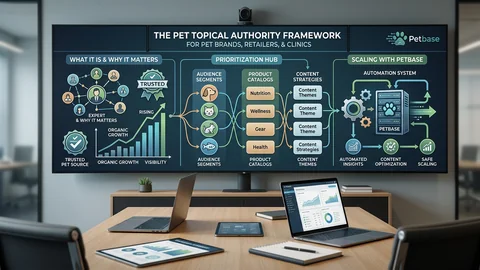
That is exactly where Petbase changes things for pet business owners. Unlike generic SEO tools that simply produce articles, Petbase builds authority. Every piece of content is part of a structured topic cluster designed to push your brand into Google rankings and establish your site as the go-to source in the pet niche.
Instead of scattering disconnected blog posts, Petbase creates content clusters that signal expertise to search engines. This systematic approach means your site is not just another pet website - it becomes an authority hub. Organic search already drives 53% of all website traffic[1], and in 2025 and beyond, topical authority is what determines whether you capture that traffic or lose it to competitors.
The global pet care market is valued at USD 273.42 billion[2], yet 61% of small businesses are not investing in SEO at all[3]. That gap is an opportunity. Pet businesses that build topical authority now will claim the organic visibility that the majority of their competitors are leaving on the table.
To make this guide easier to follow, we have divided it into two parts.
Part 1 focuses on what topical authority is, why it matters in 2025, and how Google's ranking systems have evolved.
Part 2 will cover the practical strategies, tools, and examples you can use to build and measure topical authority.
Petbase builds this SEO foundation automatically for pet businesses - 10 optimized articles published every month - start your free trial.
Introduction to Topical Authority
What Is Topical Authority?
Topical authority refers to how much credibility and expertise your website has on a specific subject. If your site covers every angle of a topic - answers every question, addresses every sub-niche, and provides in-depth value - Google sees you as a trustworthy source. That is topical authority in action.
It is not about one blog post ranking. It is about your entire content ecosystem signaling to Google that you know this topic thoroughly. For example, if you run a pet nutrition blog and cover dog food, you should not write one generic post about it. You should have articles covering puppy nutrition, grain-free options, wet versus dry comparisons, common allergens, food transition guides, and senior dog diets. The more comprehensive your topic coverage, the more authority you gain.
You do not need to be a big brand to build topical authority. Even a small site can outrank larger competitors - if it goes deep into one niche and builds high-quality, interconnected content around it.
Why It Matters More Than Ever in 2025
In 2025, Google is more focused on user experience and content quality than ever. With the rise of auto-generated content and Google's Search Generative Experience (SGE), search engines need stronger signals to determine which sources to trust.
Topical authority helps Google:
- Identify experts from noise
- Rank genuinely helpful content higher
- Filter out thin or irrelevant content
Topical authority works directly with Google's E-E-A-T framework (Experience, Expertise, Authoritativeness, and Trust). When you have deep coverage on a subject, you naturally hit all these signals.
User behavior reinforces this. When visitors spend more time on your content, click on multiple articles, and return to your site, it signals to Google that you are delivering value - and it strengthens your rankings. Companies that maintain active blogs receive 55% more website traffic than those that do not[4]. For a broader look at how content strategy ties into pet business growth, see our guide on content marketing for pet businesses.
How Google Ranks Content Today
Evolution of Google's Algorithm
Google's ranking algorithm has undergone major transformations to better understand human behavior, search intent, and content quality.
A quick timeline:
- In the early 2000s, keyword stuffing could win rankings.
- Around 2011, Panda penalized thin content.
- In 2013, Hummingbird brought semantic search into the picture.
- Then came RankBrain, BERT, and now MUM and SGE - all focused on understanding context.
Today, Google wants to rank complete content ecosystems, not one-off articles. That is where topical authority delivers. It gives Google the full picture of your expertise on a subject.
Search has moved from "strings to things." Instead of seeing "best dog food" as a string of words, Google now sees it as a topic. If your site has detailed, helpful information on all aspects of dog food, Google is more likely to push your content to the top.
The Shift from Keywords to Topics
Keywords still matter, but they are no longer the centerpiece. Google cares more about topics and how well your content covers them.
If you focus only on individual keywords, your site ends up fragmented. But when you group keywords into clusters around a single pet-related topic and build interconnected content, you start building topical authority. Long-tail keywords - the specific, multi-word phrases your customers actually type - make up 70% of all searches and convert at 36%[5]. A topic cluster approach naturally captures these long-tail searches across dozens of related articles.
Here is an example. Instead of targeting a single keyword like "dog food," you build an entire cluster:
- Best dog food for puppies
- Grain-free dog food explained
- Wet vs. dry dog food pros and cons
- Common dog food allergies
- How to transition your dog to a new food
- Best dog food brands for senior dogs
Each article strengthens your authority on dog food. Google starts to see your site as a reliable hub for pet nutrition - and rewards you with higher visibility when pet owners are searching. For a practical guide on implementing this for your pet website, read our article on content clustering for pet websites.
E-E-A-T and the Rise of Authority
E-E-A-T is Google's framework for evaluating content quality:
- Experience - Has the author actually done what they are writing about?
- Expertise - Do they have deep knowledge of the subject?
- Authoritativeness - Are they recognized as a trusted source?
- Trustworthiness - Can users rely on this content?
Topical authority feeds directly into E-E-A-T. The more content you create around a niche - and the more value it delivers - the more your site reputation grows.
Google's human quality raters use these signals when reviewing search results. If you want to pass both human and algorithmic evaluation, topical authority is the most reliable path. Pages that rank number one have on average 3.8 times more backlinks than those in positions two through ten[6], and 90% of marketers use content creation as their primary method for earning those backlinks[7]. Content with 3,000 or more words earns roughly 3,000 more referring domains on average[8]. Deep, authoritative content attracts links naturally.
Keyword-Based SEO vs. Topical Authority: A Direct Comparison
Many pet business owners start with keyword-based SEO because it is easy to understand: pick a keyword, write a post, repeat. But this approach has real limits. The table below shows how it stacks up against a topical authority strategy across the metrics that matter most.
| Factor | Keyword-Based SEO | Topical Authority |
|---|---|---|
| Content focus | Individual keywords, one post per term | Topic clusters, interconnected posts covering a full subject |
| Ranking speed | Slower - each post competes independently | Faster once cluster reaches critical mass |
| Ranking durability | Fragile - drops when competitors publish better single posts | Resilient - built on site-wide authority signals |
| Traffic pattern | Inconsistent - depends on individual post performance | Compounding - each new post lifts the whole cluster |
| Internal linking | Incidental or missing | Deliberate hub-and-spoke structure |
| Google E-E-A-T alignment | Weak - hard to signal expertise from isolated posts | Strong - depth and breadth signal domain expertise |
| Long-term ROI | Diminishing returns as competition grows | Increasing returns as authority compounds |
The takeaway: keyword-based SEO is a starting point, not a strategy. Topical authority is the approach that keeps paying off 12 or 24 months after you start - which is exactly what most pet businesses need.
The Core Elements of Topical Authority
Depth and Breadth of Content
To gain topical authority, you need both depth (how detailed each article is) and breadth (how many aspects of the topic you cover). Think of it as building a library. One shelf is not enough - you need an entire section on a subject.
Depth means:
- Covering all related questions in an article
- Providing statistics, examples, and original insights
- Going beyond surface-level answers
Breadth means:
- Covering subtopics and related angles
- Answering beginner, intermediate, and advanced questions
- Creating content for every stage of the user journey
When you combine the two, your site becomes a complete resource - and that is what Google rewards. Companies that publish 16 or more blog posts per month get 3.5 times more traffic than those publishing four or fewer[4].
Internal Linking Structure
Internal links are the structure that connects your topical authority. If you have 20 solid articles on a topic but none of them link to each other, Google struggles to understand the relationship between them.
With proper internal linking:
- Google crawls and indexes your pages more effectively
- Your content gains contextual relevance
- You increase the visibility of lower-performing pages
Use a hub-and-spoke model:
- Create a cornerstone page as the main hub
- Link supporting articles (spokes) to and from that hub
- Interlink spokes with each other where relevant
This structure does not just help Google - it improves user experience too.
Consistency and Content Frequency
Publishing one strong article is not enough. You need consistent output to build and maintain topical authority.
Google favors websites that regularly update and add content. It signals that your site is active and growing - not abandoned. Petbase delivers 10 articles per month at EUR 199/mo, which gives pet businesses the publishing consistency needed to build authority without writing a single article themselves.
Set a publishing calendar. Stick to it. Update older content regularly. Over time, this builds a content advantage around your niche - one that is difficult for competitors to replicate.
That covers the foundations of topical authority - what it is, why it matters, and how Google evaluates it.
In Part 2 of this series, we will break down the strategies, tools, and real-world examples you can use to build topical authority and turn it into long-term SEO success.
References
- SEO Inc - How Much Traffic Comes from Organic Search
- Fortune Business Insights - Pet Care Market Report
- Clutch - SEO Statistics 2025
- HubSpot - Marketing Statistics
- Embryo - Long-Tail Keyword Statistics
- BuzzStream - Link Building Statistics
- BuzzStream - Link Building Statistics
- BuzzStream - Link Building Statistics
Frequently Asked Questions About Topical Authority
What is topical authority in SEO?
Topical authority is the degree of expertise and coverage your website demonstrates on a specific subject area. Search engines measure it by looking at how many high-quality, interconnected articles you have on a topic, how thoroughly they answer user questions, and how many external sites reference your content as a source. A pet business with 40 well-structured articles on dog nutrition has stronger topical authority on that subject than a competitor with 2 generic posts - even if that competitor has more overall domain authority.
How many posts do you need for topical authority?
There is no fixed number, but most SEO practitioners find that a minimum of 8 to 15 tightly connected posts on a sub-topic creates enough signal for Google to recognize the cluster. For a broader subject like "dog care," you may need 30 or more articles covering sub-topics like nutrition, training, health, grooming, and behavior. The key is not volume alone - each post must answer a specific question well and link naturally to the others in the cluster. Quality and interconnection matter more than raw post count.
How long does topical authority take to build?
Most pet websites see measurable ranking improvements within 3 to 6 months of publishing a complete content cluster, assuming consistent publishing (at least 4 to 8 new posts per month). Full authority - where your site becomes the default reference Google surfaces for a topic - typically takes 8 to 14 months of sustained effort. Sites that already have some domain history and backlinks reach authority status faster. Starting from scratch with a new domain takes longer, but the compounding effect is just as strong once the momentum builds.
Does topical authority replace backlinks?
No, but it reduces your dependence on them. A site with strong topical authority can outrank competitors with more backlinks because Google trusts the depth and completeness of the content. That said, backlinks from relevant, authoritative sites - veterinarians, pet industry publications, breed clubs - still accelerate rankings and are worth pursuing. Think of topical authority and backlinks as complementary: authority tells Google what you know, backlinks tell Google who vouches for you. Both matter. Read more about how this fits into a complete content approach in our guide on content marketing for pet businesses.