How to Write Pet Product Descriptions That Rank and Sell

Table of Contents +
- Why Most Pet Product Descriptions Don't Rank (or Sell)
- What Makes a Great Pet Product Description?
- How to Apply the AIDA Framework to Pet Products
- How to Optimize Product Descriptions for SEO
- Real Examples: Before and After Rewrites
- How to Write for Different Pet Product Categories
- How to Handle Hundreds of Descriptions at Scale
- Product Description Mistakes That Cost Sales
- Product Description Checklist
- Frequently Asked Questions
- References
How to write pet product descriptions that rank on Google and convert visitors into buyers. AIDA framework, real examples, and SEO tips.
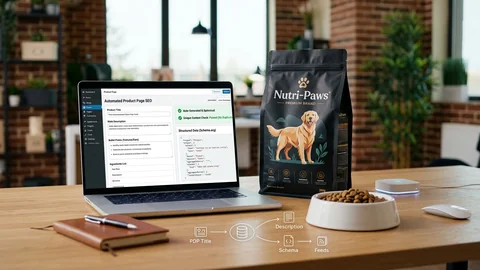
Most pet store product descriptions fail at two jobs at once. They do not rank on Google because they are copied from the manufacturer's website. And they do not convert visitors into buyers because they list features instead of solving problems. With organic search driving 53% of all website traffic[1], those two failures cost real revenue every day. This guide shows you how to fix both - with a proven framework, real before-and-after examples, and a system that works whether you have 50 products or 5,000.
If you are already working on your broader pet store SEO strategy, product descriptions are one of the highest-impact places to invest time. A well-optimized product page captures buyers who have already decided what they want and are searching for the right place to buy it.
Why Most Pet Product Descriptions Don't Rank (or Sell)
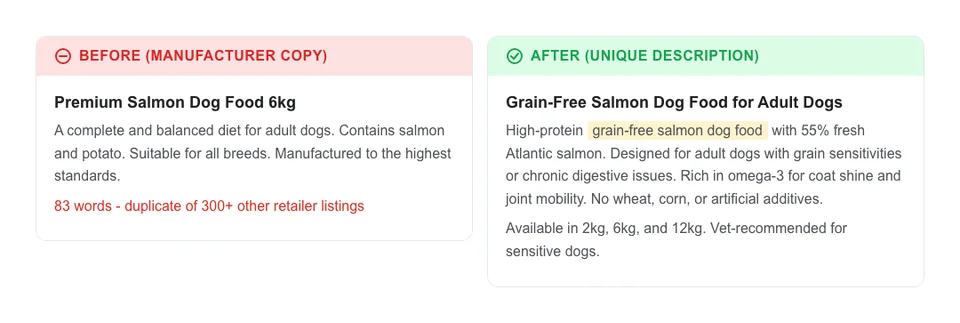
The core problem is copy-paste culture. Over 60% of independent pet stores use the manufacturer's default description - the same text that appears on dozens of competing sites. Google sees identical content across many pages and has no reason to rank yours. Shoppers see technical specs with no emotional connection and click away.
The pet e-commerce market reached USD 94.89 billion in 2024[2], and online pet retail is growing at 9% annually compared to just 1% for brick-and-mortar[3]. The stores winning that growth are not the ones with the biggest catalogs. They are the ones with the best product pages.
Here are the four reasons most pet product descriptions fail:
- Duplicate content: Copied manufacturer text appears on 20 to 50 other retailer sites. Google devalues it because it provides no unique value.
- No target keyword: Most descriptions mention the product name but ignore the phrases buyers actually search for. Long-tail keywords make up 70% of all searches and convert at 36%[4] - phrases like "grain-free puppy food for small breeds" or "cat water fountain no noise."
- Feature-focused, not benefit-focused: Listing "BPA-free plastic, 3-litre capacity, carbon filter" tells a buyer what the product is made of. It does not explain why a cat that drinks more water stays healthier and visits the vet less often.
- Wrong length: Descriptions under 100 words look thin to Google. Descriptions over 600 words bury the buy button and lose impatient shoppers. The average e-commerce title tag is just 39 characters and the average meta description only 96 characters[5] - most stores are leaving visibility on the table before the description even starts.
The fix is not complicated. You need a consistent process for writing descriptions that are unique, keyword-targeted, benefit-led, and the right length. The AIDA framework - covered in the next section - gives you that process.
Petbase automates SEO content for pet stores - publishing 10 optimized articles monthly so you can focus on running your shop - start your free trial.
What Makes a Great Pet Product Description?
A great pet product description does three things simultaneously: it ranks for the right search query, it speaks directly to a pet owner's concern, and it removes every reason not to buy. Each of these goals requires specific elements in a specific order.
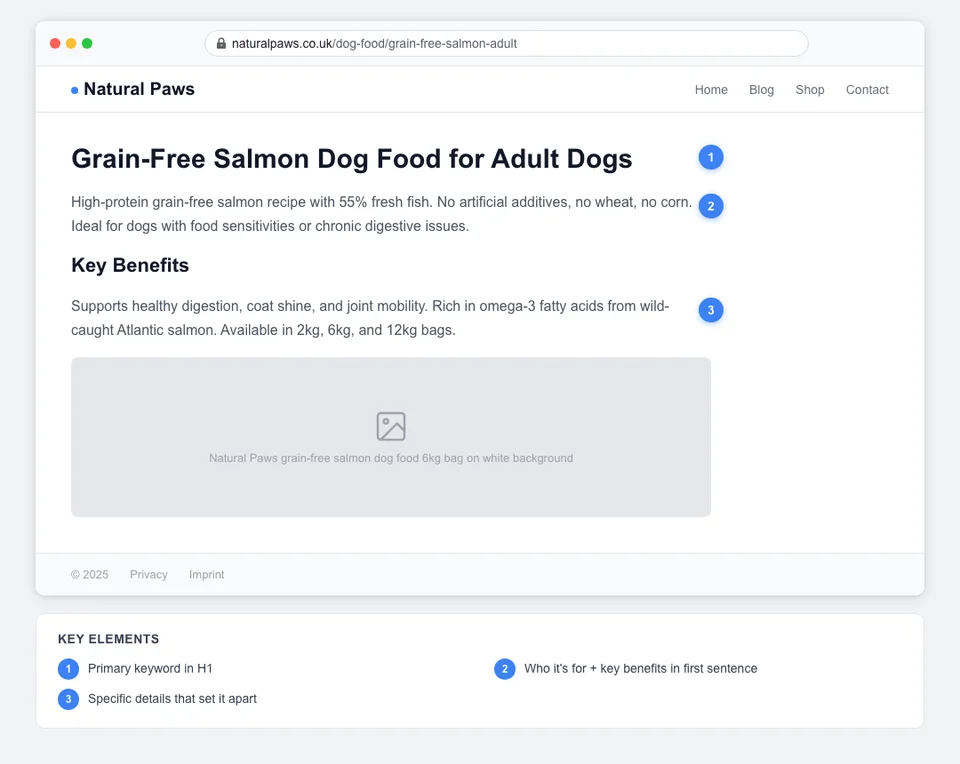
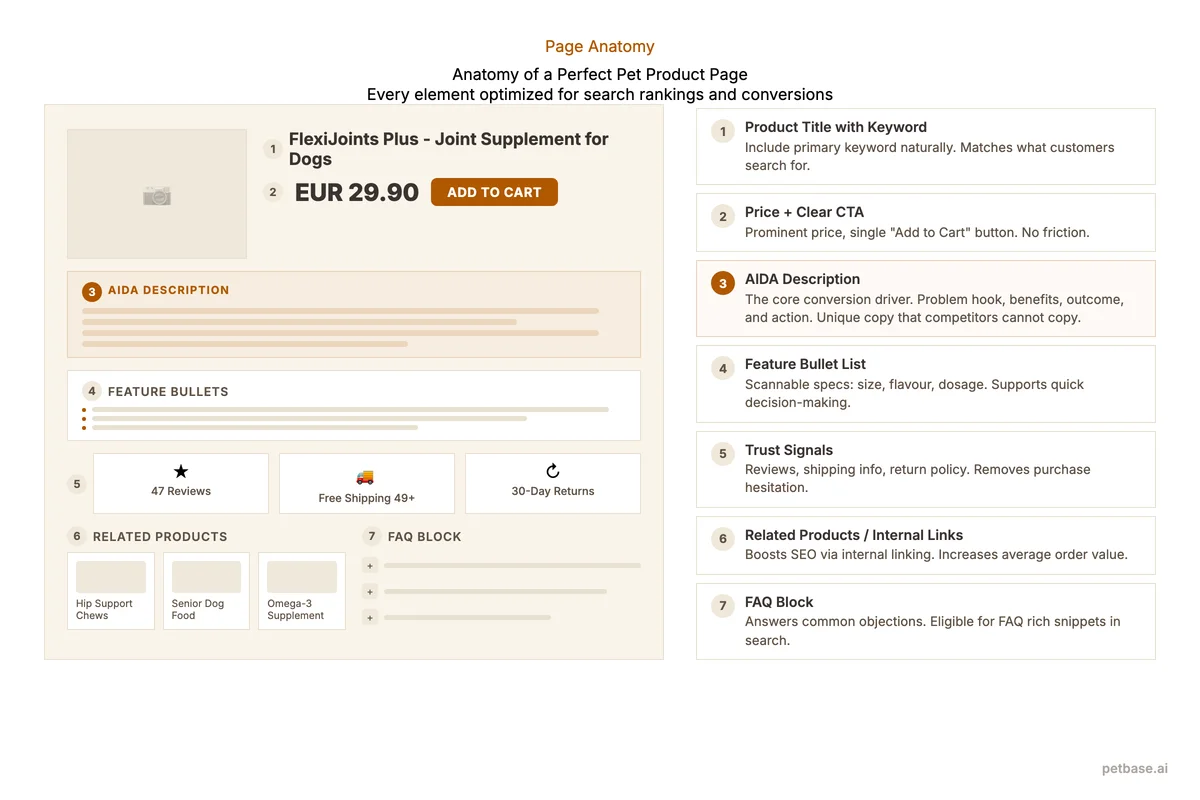
Here is the anatomy of a high-performing pet product description:
- Target keyword in the first sentence: Google reads the opening text first. Include your primary keyword naturally within the first 50 words. For a dog harness, that might be "no-pull dog harness" or "front-clip harness for dogs."
- Problem or desire statement (1 to 2 sentences): Identify what the pet owner is trying to solve or achieve. This creates an immediate connection. "If your dog pulls on every walk, a front-clip harness redirects the force sideways instead of forward - without choking."
- Benefit paragraph (50 to 80 words): Explain what the product does for the pet owner and the pet. Lead with outcomes, not specifications. Mention specific benefits: less pain, more safety, easier training, better health.
- Feature bullet list: After you have hooked the reader emotionally, give them the logical confirmation they need. List 5 to 8 specific features with numbers and measurements. This is also where you include long-tail keywords naturally.
- Use case or scenario: One or two sentences describing when and where the product is most useful. This helps shoppers picture the product working in their life.
- Trust or reassurance element: A sizing note, care instruction, or compatibility statement reduces purchase anxiety. "Fits neck sizes 35 to 55cm - measure before ordering."
The total word count should sit between 200 and 400 words for most products. High-competition products in crowded categories benefit from 400 to 600 words with an added FAQ block. Niche or highly specific products can rank with 150 to 200 well-targeted words.
For a framework that connects your product descriptions to your wider content strategy, the guide on on-page SEO for pet stores covers how descriptions, titles, and internal links work together.
How to Apply the AIDA Framework to Pet Products
AIDA (Attention, Interest, Desire, Action) is a copywriting structure that has been tested across industries for decades. Applied to pet product descriptions, it becomes a reliable formula that works whether you are selling dog food, cat toys, or bird supplements. The key is matching each stage to what a pet owner thinks and feels at that point in the buying decision.
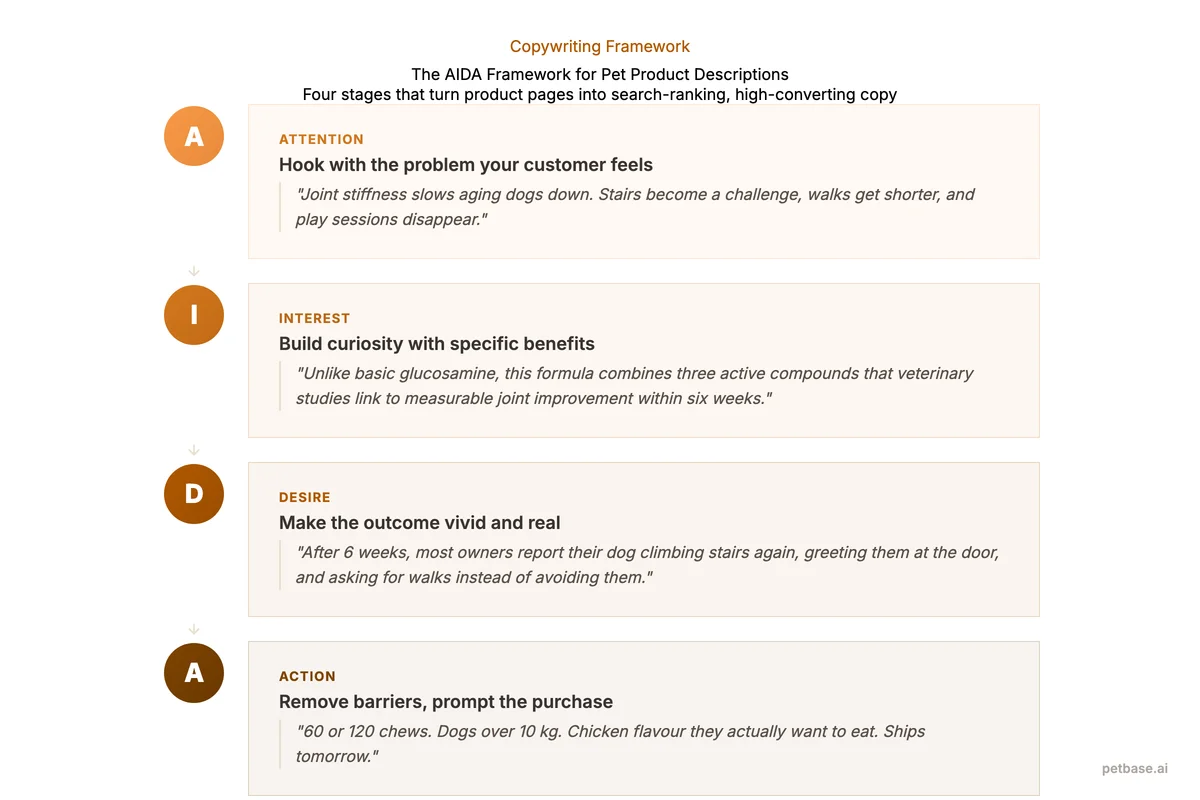
Here is how each AIDA stage maps to a product description:
| AIDA Stage | Description Goal | Pet Supplement Example | Word Count Target |
|---|---|---|---|
| Attention | Hook with the problem or outcome | "Joint stiffness slows aging dogs down. This glucosamine complex targets the root cause - cartilage breakdown - in 4 to 6 weeks." | 20 to 40 words |
| Interest | Build curiosity with specific benefits | "Unlike basic glucosamine tablets, this formula combines glucosamine sulphate, chondroitin, and MSM at clinical dosages - the combination shown to support mobility in dogs over 7 years old." | 50 to 80 words |
| Desire | Make the outcome vivid and personal | "After 6 weeks, most dog owners report their dog climbing stairs with less hesitation and showing more willingness to walk longer distances." | 40 to 60 words |
| Action | Remove final barriers and prompt purchase | "Available in 60-chew and 120-chew packs. Suitable for dogs over 10kg. Chicken-flavour - most dogs eat them as treats." | 20 to 30 words |
Notice what makes this example work. The Attention stage names a specific problem (joint stiffness) and a specific timeline (4 to 6 weeks). The Interest stage explains why this product is different from basic alternatives. The Desire stage makes the outcome concrete with a real scenario. The Action stage handles the two biggest objections - "will my dog eat this?" and "which size do I need?"
You can use the AIDA structure for any pet product category. The ingredients change but the logic is the same. For a dog leash: Attention = walking problems, Interest = material and handle comfort features, Desire = imagine a calm walk, Action = length and size options. For a cat litter: Attention = odour control frustration, Interest = how this litter traps odour differently, Desire = a consistently fresh-smelling home, Action = bag size and subscription options.
Petbase's product description feature applies this framework automatically. You connect your product catalog, and Petbase generates AIDA-structured descriptions optimized for the keywords your buyers are actually searching. The output is unique for every product - no two descriptions share the same structure, even for similar items in the same category.
For more on applying AIDA to your pet store's wider content and funnel, see the guide on AIDA in the pet business.
How to Optimize Product Descriptions for SEO
Writing a great product description and optimizing it for search are not separate tasks. They happen in the same writing pass when you follow a consistent keyword strategy. The goal is to target one primary keyword and two to three supporting keywords without forcing any of them into unnatural positions.
Here is how to approach keyword optimization for pet product pages:
Step 1: Find the right primary keyword. The primary keyword is the phrase a buyer uses when they are close to purchasing this specific type of product. Use a tool like Ahrefs, Semrush, or Google Search Console to find queries with transactional intent. For a cat water fountain, good primary keywords include "cat water fountain silent," "cat drinking fountain automatic," and "cat fountain 3 litre." Avoid broad head terms like "cat fountain" - the competition from major retailers makes these nearly impossible to rank for as a smaller pet store.
Step 2: Place keywords in the right spots. For SEO impact, keywords need to appear in four places: the page title, the meta description, the H1 (or product name heading), and the opening paragraph of the description. After that, use keyword variations naturally throughout the body copy. Google understands semantic relationships - you do not need to repeat the exact phrase ten times.
Step 3: Use long-tail variants in feature bullets. Feature bullet lists are perfect for long-tail keywords because they naturally contain product specifications. Long-tail keywords convert at 36%[4], so a bullet like "Carbon block filter removes 99% of chlorine and heavy metals" captures both "carbon filter" and "chlorine filter" searches without any awkward keyword insertion.
Step 4: Write a unique meta description. The meta description does not directly affect rankings but it heavily influences click-through rate. A good meta description for a product page is 140 to 160 characters, includes the primary keyword, and highlights the most compelling benefit or differentiator. "Silent cat water fountain with triple filtration - 3 litres, BPA-free. Free delivery over EUR 49."
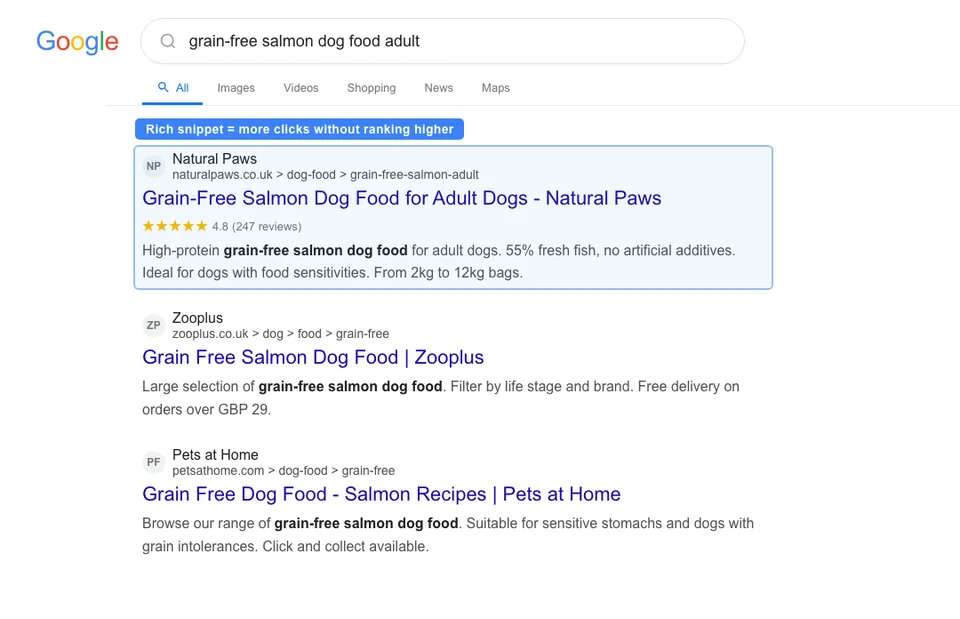
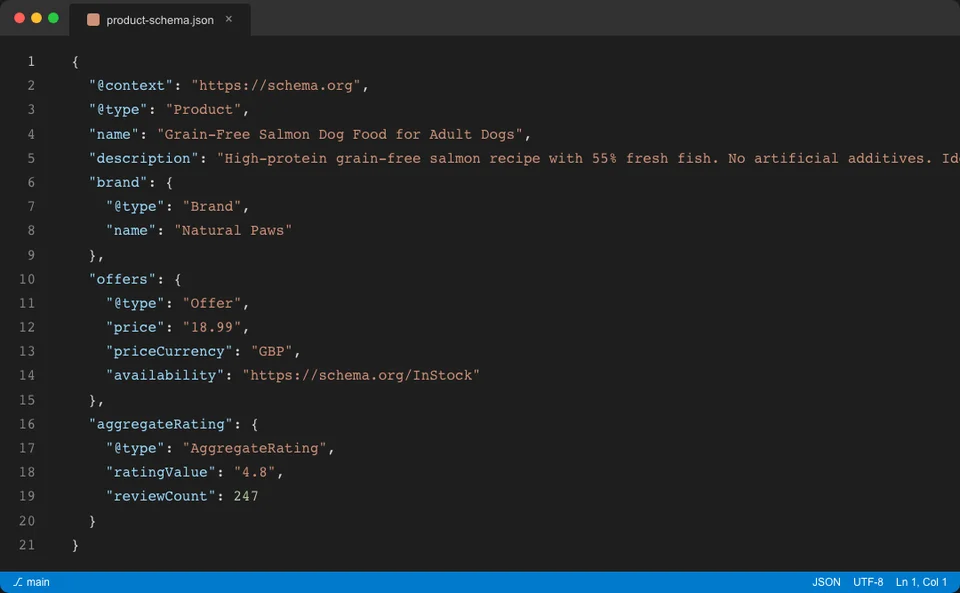
Step 5: Add Product schema markup. Structured data leads to a 30% increase in click-through rates[6], yet most pet stores skip it entirely. Product schema tells Google your price, availability, and review rating - and Google shows those details directly in search results as rich snippets. A listing with stars and a price range gets more clicks than a plain blue link. The schema markup guide for pet stores covers implementation step by step.
Step 6: Internal link from the description. Each product description should include one internal link to a related blog post or category page. This passes ranking signals between pages and keeps shoppers exploring your site. A dog supplement description might link to a guide on senior dog nutrition, or a food product page might link to your keyword research guide if you are building a content team.
That is six optimization steps per product page. A store with 300 products needs to repeat this process 300 times - researching keywords, placing them correctly, writing unique meta descriptions, adding schema, and mapping internal links. Most store owners finish the first 10 and leave the other 290 on manufacturer copy.
Petbase handles steps 1 through 5 automatically for every product in your catalog. It researches the right keywords, generates descriptions with correct placement, writes unique meta descriptions, and structures the content for schema. 10 articles per month at EUR 199/mo - less than the cost of a single freelance article. Start your free trial and see what it produces for your top 10 products.
The full technical SEO framework for product pages - including title tags, URL structure, and schema markup - is covered in depth in the guide on optimizing pet product pages for Google.
Real Examples: Before and After Rewrites
Theory becomes clear when you see it applied to real product types. The following before-and-after examples cover three common pet product categories. Each rewrite applies the AIDA framework, includes a target keyword in the opening, leads with benefits, and adds specific details that both Google and buyers respond to.
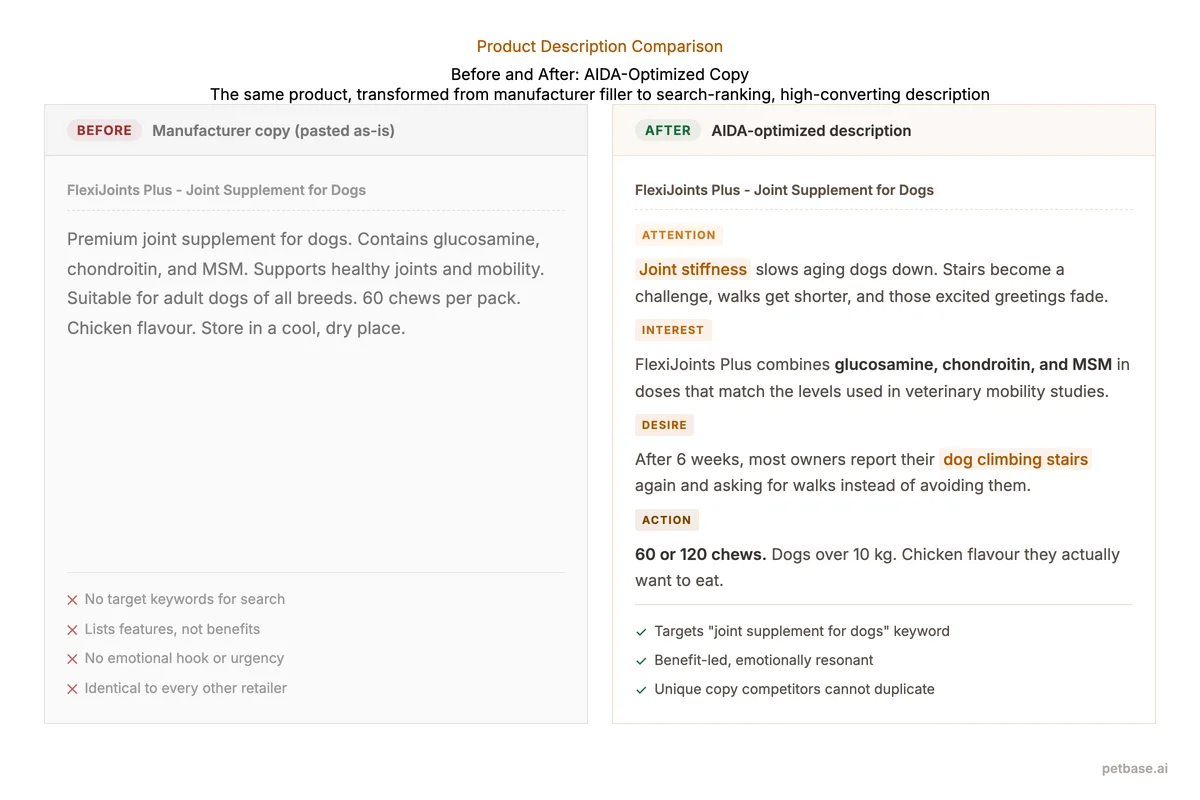
Example 1: Dog Joint Supplement
Before (manufacturer copy):
"Premium joint supplement for dogs. Contains glucosamine, chondroitin, and MSM. Suitable for adult dogs. 60 chews per pack. Chicken flavour."
After (AIDA-optimized):
"Stiff joints make aging dogs slow - this glucosamine joint supplement for dogs gives them back their stride. The triple-action formula combines glucosamine sulphate, chondroitin, and MSM at veterinarian-recommended dosages to support cartilage health and joint flexibility in dogs over 7 years old. Most dogs see noticeable improvement in mobility within 4 to 6 weeks. Soft chicken-flavour chews that most dogs eat without hesitation - no hiding tablets in food. Available in 60-chew and 120-chew packs. Suitable for dogs over 10kg. Store in a cool, dry place. Check our dosage guide for correct amounts by body weight."
Word count: 108. Keywords targeted: glucosamine joint supplement for dogs, joint supplement for dogs, dog mobility supplement.
Example 2: Cat Litter
Before (manufacturer copy):
"Clumping cat litter with odour neutraliser. 10kg bag. Suitable for all cats. Low dust formula."
After (AIDA-optimized):
"Odour-free cat litter that actually controls smell - not just masks it. This clumping cat litter uses activated carbon to absorb ammonia at the source, so your home stays fresh between scoops. Fine granules clump firmly around moisture for easy, mess-free removal. The low-dust formula is gentler on cats with sensitive respiratory systems and keeps residue off your floors. Each 10kg bag lasts approximately 4 weeks for one indoor cat. Works in any standard tray - no liner needed. Unscented version available for cats that avoid heavily perfumed litters."
Word count: 102. Keywords targeted: clumping cat litter odour control, activated carbon cat litter, low dust cat litter.
Example 3: Dog Training Treat
Before (manufacturer copy):
"Soft training treats for dogs. Made with chicken. 200g bag. Suitable for puppies and adults."
After (AIDA-optimized):
"Training sessions only work when your dog stays focused on the reward. These soft dog training treats are small (1cm), low-calorie, and made with 70% fresh chicken - which means your dog works for every one without getting full after three repetitions. The soft texture is suitable for puppies from 8 weeks and senior dogs with dental sensitivity. Each bag contains approximately 250 individual treats. Store in an airtight container after opening to maintain freshness. Pair with our behaviour training guide for faster results - or use alongside any reward-based training programme."
Word count: 102. Keywords targeted: soft dog training treats, small dog training treats, low calorie training treats for dogs.
Notice the pattern across all three examples. The opening sentence names the problem. The second sentence introduces the product as the solution using a natural keyword. The feature bullets are specific with numbers (70% chicken, 1cm size, 4-week supply). The closing sentence reduces friction or points to a next step.
How to Write for Different Pet Product Categories
Different product categories require different description angles because pet owners' buying motivations vary by category. A dog food buyer is primarily motivated by health and ingredient quality. A cat toy buyer is primarily motivated by entertainment value and whether their cat will actually use it. A bird cage buyer is primarily motivated by safety and space. Matching your angle to the category's dominant concern produces descriptions that feel relevant rather than generic.
Here is a reference table for the most common pet product categories:
| Category | Primary Buyer Concern | Description Angle | Key Detail to Include |
|---|---|---|---|
| Dog food / cat food | Ingredient quality and health outcomes | Lead with what is in it and what it does for the animal's health | Protein %, main ingredients, life stage suitability |
| Supplements | Does it actually work? | Lead with the problem it solves and the timeline to results | Active ingredient dosages, species and weight suitability |
| Harnesses / collars / leads | Control and safety | Lead with the walking problem it solves | Sizing range, adjustment points, material and weight |
| Cat litter | Odour control and convenience | Lead with the odour control mechanism | Clumping behaviour, dust level, bag weight and duration |
| Toys (dogs) | Durability and engagement | Lead with the play style it supports | Material and chew rating, size for breed, interactive mechanism |
| Toys (cats) | Cat actually using it | Lead with the hunting instinct it triggers | Movement type, catnip or no catnip, size |
| Water fountains | Getting the cat to drink more | Lead with hydration benefit | Capacity, noise level, filter type and replacement cost |
| Cages / crates / beds | Safety, comfort, and size | Lead with what the animal experiences inside it | Internal dimensions, material, cleaning method |
| Grooming products | Results without stress | Lead with the grooming challenge it makes easier | Coat type compatibility, ingredient safety, usage frequency |
| Healthcare / flea treatment | Does it work and is it safe? | Lead with efficacy and safety credentials | Species treated, weight range, duration of protection |
Each category needs a different angle because buyer motivations differ - health outcomes for food, durability for toys, odour control for litter. Switching between these angles across a catalog of 200 to 500 products is not a writing problem. It is a knowledge problem. Petbase's pet industry model already knows these distinctions and adjusts the AIDA structure, keyword targeting, and benefit framing per category automatically.
For brand-specific pages - where you carry multiple products from the same brand - the description angle shifts slightly. Brand pages benefit from a consistent voice that reflects the brand's positioning, followed by product-specific differentiation. The guide on pet product brand SEO covers this in full, including how to structure brand landing pages that rank alongside individual product pages.
How to Handle Hundreds of Descriptions at Scale
Writing one product description takes 20 to 30 minutes if you do it properly. A pet store with 300 products would need 100 to 150 hours to write descriptions from scratch. That is not realistic for most store owners. This is where a systematic approach - and the right tools - makes the difference between getting it done and leaving your catalog on manufacturer copy indefinitely.
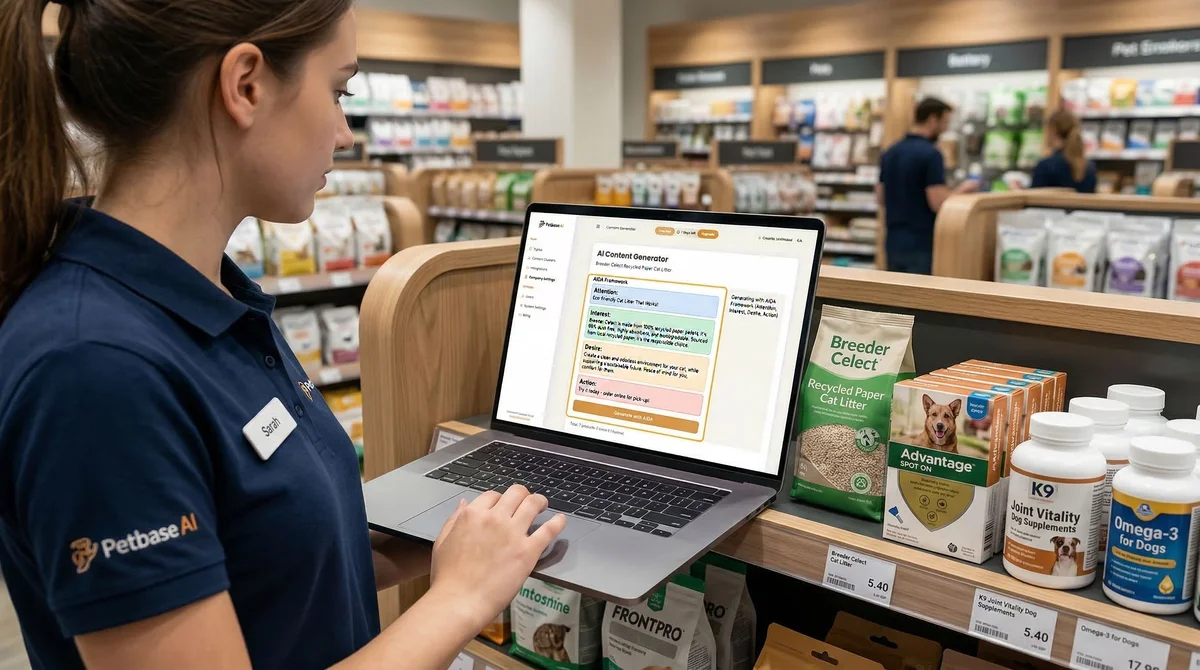
Here is a practical approach to scaling product descriptions:
Tier your catalog by revenue impact. Not all products deserve equal effort. Your top 20% of revenue-generating products (or the 20% with the highest search volume potential) should get hand-crafted, fully optimized descriptions. The middle tier (products with moderate sales and some search demand) can use template-assisted descriptions. The bottom tier (slow movers, niche items) can use a lighter version of the AIDA format at shorter length.
Build category templates. For each product category, write a template that captures the category's dominant buyer concern and description angle. The template includes placeholder fields for product-specific details: protein percentage, weight range, size options, and so on. A writer or a tool can fill in the placeholders faster than writing from scratch.
Batch by category. Writing 20 dog food descriptions in a row is faster than writing one dog food description, one toy description, and one harness description. Category batching puts you in the right mental mode and produces more consistent output.
Use Petbase for the long tail. Petbase connects to your catalog and generates AIDA-structured, keyword-optimized descriptions for every product. The descriptions are unique per product - not variations of the same template - because the model reads each product's attributes individually. EUR 199/mo covers 10 articles per month plus product descriptions across your entire catalog.
The full-scale content production approach for pet stores - including how to integrate product descriptions with your blog content calendar - is covered in the guide on how to compete with Amazon as a pet store. Content depth is one of the few genuine advantages independent pet stores have over large retailers.
Product Description Mistakes That Cost Sales
The most expensive mistakes are not the obvious ones. Missing descriptions are obvious. The subtle mistakes are the ones that look fine at a glance but consistently underperform - and most pet store owners never identify them because they never test against alternatives.
Online cart abandonment runs at approximately 70%[7]. That means for every 10 shoppers who add a pet product to their cart, 7 leave without buying. Poor product descriptions contribute to that number by failing to answer questions, build confidence, or create urgency. A 1-second improvement in page load time can increase conversions by up to 2.5x[8] - but no amount of speed helps if the description itself drives people away.
Here are the eight product description mistakes that most commonly cost sales:
1. Starting with the product name. "Ruffwear Front Range Dog Harness is a premium harness..." leads with what the buyer already knows. Start with the problem or the outcome instead. The product name belongs in the title, not the opening sentence.
2. Using passive voice for features. "The harness is designed to redirect pulling force" is weaker than "This harness redirects pulling force." Active voice is shorter and more direct.
3. Vague benefit claims without numbers. "Great for sensitive stomachs" tells a buyer nothing measurable. "Contains no wheat, corn, or soy - the three most common food allergens in dogs" gives them a specific reason to trust the claim.
4. Keyword stuffing in the feature list. "Dog food grain-free dog food adult dog food premium dog food" is a red flag to Google and an irritant to shoppers. Use each keyword variation once in a natural sentence.
5. Ignoring the closing action. The last sentence of a description should reduce a barrier to buying or prompt a next step. Sizing guidance, a care note, a "frequently bought with" mention - anything that keeps the buyer moving toward the cart.
6. Copying your own description across variants. If you sell the same harness in red, blue, and black as separate product pages, each page needs a unique description. Even changing the colour and adding one colour-specific sentence is enough to avoid duplicate content between your own pages.
7. Forgetting mobile readers. Over 60% of e-commerce browsing happens on mobile. Long unbroken paragraphs are hard to read on a small screen. Use short paragraphs (2 to 3 sentences), bullet lists, and bold text for scannability.
8. Not updating descriptions when products change. If a product's formula changes, a new size is added, or a key ingredient is updated, the description needs to reflect it. Outdated descriptions erode trust - a buyer who orders based on an ingredient list that no longer applies will not return.
A systematic audit of your existing descriptions will surface most of these issues. The pet store website audit guide includes a product page checklist you can run through to score your current catalog before you start rewriting.
Product Description Checklist
Use this checklist before publishing any new or rewritten pet product description:
| Element | Requirement | Pass Criteria |
|---|---|---|
| Primary keyword | In opening paragraph (first 50 words) | Natural placement, not forced |
| Problem or desire statement | In first 1 to 2 sentences | Speaks to a real pet owner concern |
| Benefit paragraph | 50 to 80 words, leads with outcome | No feature listed without a benefit |
| Feature bullet list | 5 to 8 bullets with specifics | Includes numbers, measurements, materials |
| Use case or scenario | 1 to 2 sentences | Helps buyer picture product in use |
| Trust or reassurance element | Sizing, care, compatibility, or safety note | Addresses at least one purchase barrier |
| Word count | 200 to 400 words (or 400 to 600 for competitive products) | Not under 150 or over 600 |
| Duplicate content check | Not copied from manufacturer or competitors | Passes Copyscape or similar tool |
| Meta description | 140 to 160 characters, includes keyword | Unique per product, readable as a standalone sentence |
| Schema markup | Product schema with price, availability, rating | Validates in Google Rich Results Test |
| Internal link | 1 link to related blog post or category page | Anchor text is descriptive, not "click here" |
| Mobile readability | Short paragraphs, bullets, bold for key points | Scannable on a 375px screen |
| Closing action | Final sentence reduces a barrier or prompts next step | Does not end on a feature bullet |
Frequently Asked Questions
How long should a pet product description be?
The recommended range is 200 to 400 words for most products. This is enough for Google to identify unique content and understand the page's topic without overwhelming the buyer with text. For highly competitive product categories - like grain-free dog food or dog harnesses where many retailers sell identical brands - going up to 600 words with an FAQ block helps differentiate the page and target additional keyword variations. For niche or highly specific items with low competition, 150 well-written words are enough to rank if the rest of the page's SEO is solid. Below 100 words, Google may treat the page as thin content and deprioritize it in rankings.
Should I use the same keywords on every product page?
No - and this is one of the most common SEO mistakes in pet e-commerce. Using the same primary keyword on multiple product pages creates keyword cannibalization: your own pages compete against each other for the same search query, splitting traffic and weakening every page individually. Each product page should target a unique primary keyword that reflects what makes that specific product different. Use broad category terms on your category pages, and use specific, long-tail variations on individual product pages. For example: the category page targets "dog harness," one product targets "no-pull front-clip harness for large dogs," and another targets "lightweight dog harness for hiking." None of them compete for the same query.
Can AI write good pet product descriptions?
Yes, if it is given the right input and trained on the right framework. Generic AI writing tools produce generic output - descriptions that sound plausible but do not target specific keywords, do not apply the AIDA framework, and cannot be told apart from 50 other stores selling the same product. Petbase is built specifically for pet stores and applies the AIDA framework with pet industry-specific language and keyword targeting. The output is unique per product, reflects the specific attributes of each item, and is optimized for the keyword combinations that pet owners actually search. The practical difference: a generic AI tool can save you time but still produces descriptions that need heavy editing. Petbase produces descriptions that are ready to publish with minimal review.
How do I make descriptions unique when selling the same brands as competitors?
Four approaches work consistently. First, write from a different angle - your competitors might lead with features, so you lead with the problem the product solves. Second, add store-specific context: your expertise on the brand, how you tested it, or why you chose to stock it. Third, include buyer guidance that only comes from knowing your customers - sizing notes based on common questions you receive, or use-case advice based on what your customers report back. Fourth, build out the supporting content around the product: a blog post on how to choose the right size, a category guide that positions the product correctly. Your product description does not need to be completely different - it needs to be different enough that Google treats your page as a distinct document, and useful enough that shoppers prefer reading yours over a competitor's generic copy. Even 40% unique content significantly improves how Google ranks your page relative to sites using 100% manufacturer copy.
Well-written product descriptions do not work in isolation. They work when they connect to a keyword strategy, a content cluster, and a store architecture that Google can navigate and trust. The starting point is picking your top 20 revenue products and rewriting their descriptions this week. The compounding effect of better descriptions, better rankings, and higher conversion rates shows up in 8 to 12 weeks - which is the same timeline as most other organic SEO investments. If you want to accelerate that process across your entire catalog, start your free trial and see how Petbase generates optimized, AIDA-structured product descriptions for every item in your store.
References
- BrightEdge (2024). How Much Traffic Comes from Organic Search. seoinc.com
- Grand View Research (2024). Pet Care E-Commerce Market Size Report. grandviewresearch.com
- Grand View Research (2024). Pet Care E-Commerce Market Growth Analysis. grandviewresearch.com
- Embryo (2024). 30 Statistics About Long-Tail Keywords. embryo.com
- Taylor Scher (2025). Ecommerce SEO Statistics. taylorscherseo.com
- Amra and Elma (2025). Top Schema Markup Statistics. amraandelma.com
- Smart Insights (2024). Ecommerce Conversion Rates. smartinsights.com
- Smart Insights (2024). Page Speed and Conversion Impact. smartinsights.com