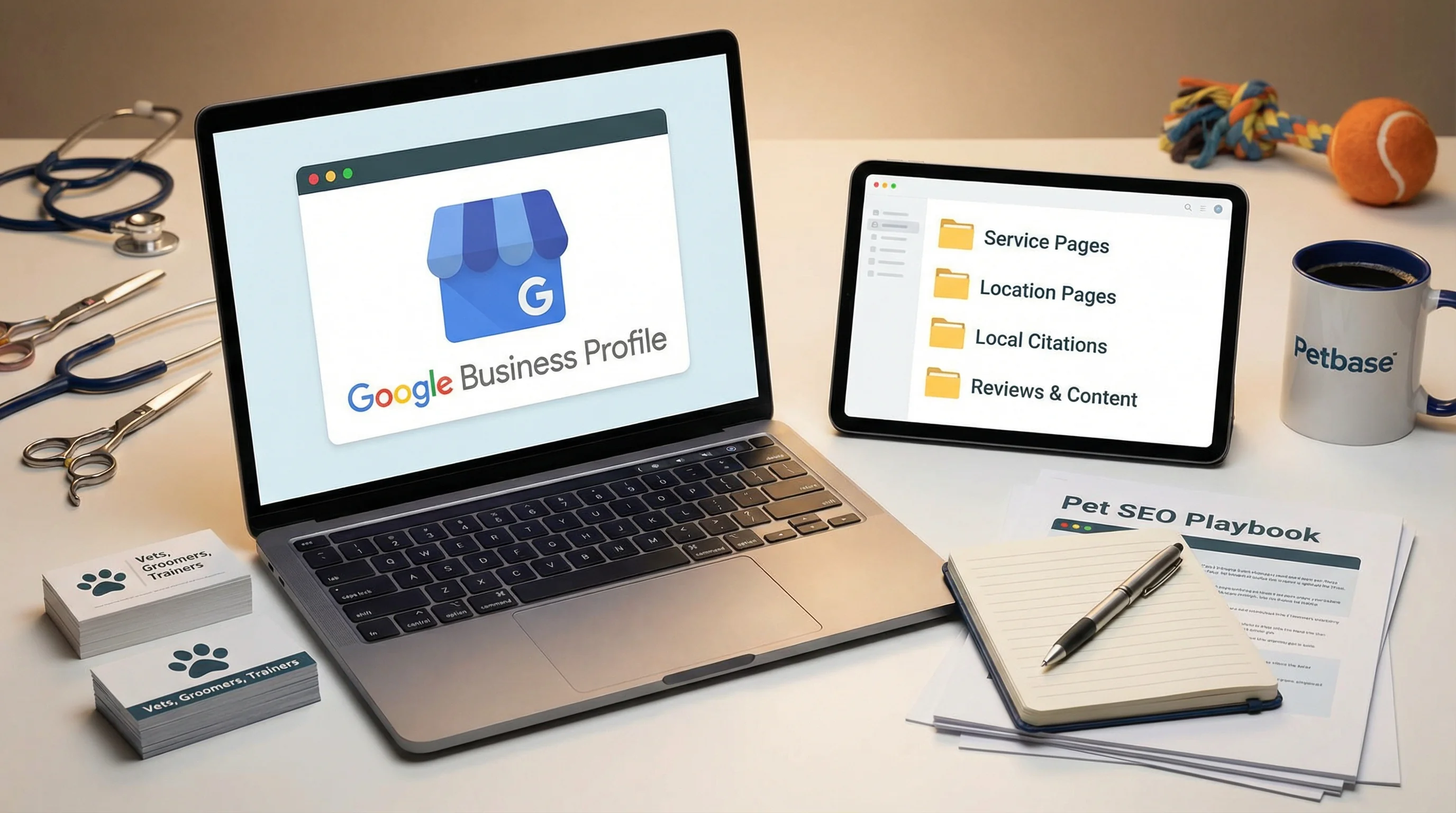
When pet owners search “near me,” they are not browsing; they are deciding. Winning those moments requires disciplined local SEO execution tailored to how people choose veterinary care, grooming, and training.
This focused guide delivers a step-by-step local Pet SEO playbook: optimizing Google Business Profile, building high-converting service and location pages, managing citations and reviews, and establishing repeatable content routines for multi-location growth. For broader strategy, see the complete Pet SEO framework.
Local SEO for vets, groomers, and trainers is about aligning intent, proximity, and trust. You need visibility in the local pack and compelling on-site content that converts. Execution is nuanced by service type and decision urgency.
Veterinary searchers often prioritize urgency, clinical credibility, and availability. Grooming prospects compare convenience, pricing, and proof of results. Training queries seek philosophies, packages, and outcomes. Your SERP footprint and on-page content must reflect these decision drivers.
Proximity influences map pack eligibility, but prominence (reviews, citations), relevance (categories, content), and behavior (clicks, calls) decide winners. Align GBP, service pages, and internal links so each reinforces local intent and user action.
Your Google Business Profile for pet services is the center of gravity for map visibility. Treat it as a living asset—categories, attributes, and media must mirror how clients search and choose.
Choose a precise primary category (e.g., Veterinary care, Pet groomer, Dog trainer), then add secondaries for specialties like Emergency veterinary hospital, Mobile dog groomer, or Pet behaviorist. Align attributes (wheelchair access, appointments) to improve discovery.
Use exact service areas for mobile providers; brick-and-mortar should set a tight radius. Keep hours accurate, including holiday schedules. Add booking links and call extensions to capture immediate intent with minimum friction.
Upload exterior, interior, team, and service outcome photos. List popular services as “Products.” Publish Posts for promotions, preventive care reminders, and seasonal grooming notes to increase engagement over time.
Seed Q&A with top FAQs, enable messaging for simple pre-visit questions, and maintain completeness across fields. Iterative profile refinements compound performance, a pattern consistent with heuristic local optimization research.[2]
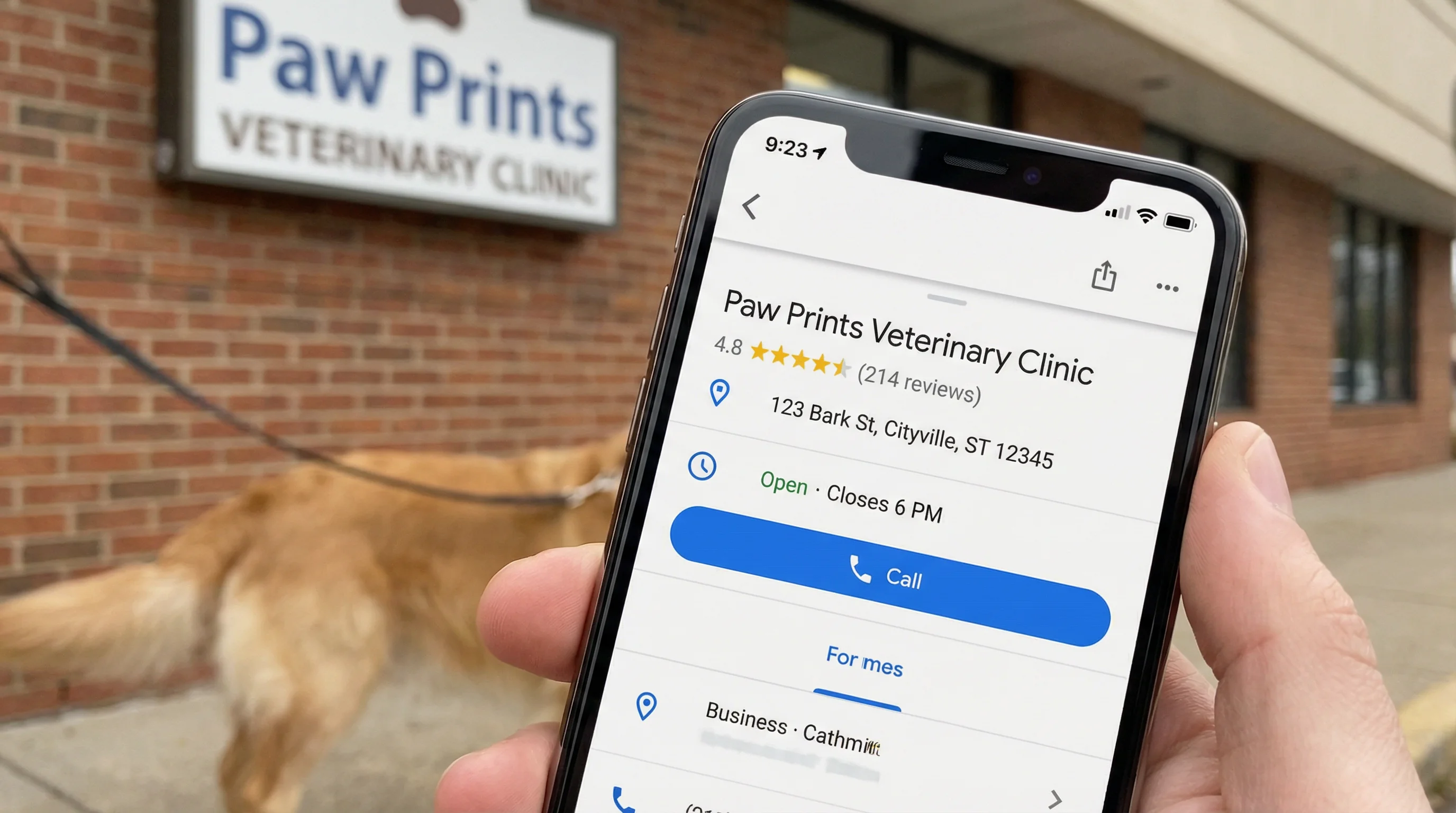
Service and location pages SEO should mirror local search intent, reinforce E‑E‑A‑T, and guide action. Build modular templates that scale across specialties and regions.
Match pages to intent clusters: 24/7 emergency care (availability), dental cleaning (preventive outcomes), mobile grooming (convenience), and puppy training (curriculum and guarantees). Link each service to its nearest location page and your store locator hub.
Use a clear H1, concise intro, scannable subheads, and clinical or procedural clarity. Add staff credentials, outcome photos, and localized FAQs. See how to build E‑E‑A‑T for veterinary medical pages for clinical services and policies.
Implement JSON‑LD for Service, subtype the LocalBusiness (VeterinaryCare, PetGroomer, or AnimalShelter/Store when needed), and embed AggregateRating. For deployment guidance, review the platform setup for local service schemas.
Location pages should stand as conversion-focused local hubs—relevant, unique, and navigationally clear for people and crawlers.
Include Name, Address, Phone; a clickable map; transit/parking notes; and neighborhoods served. Add hours, insurance or payment options, and a call-to-action with booking and phone buttons above the fold.
Prevent duplication by adding team bios, locally sourced testimonials, and FAQs referencing nearby landmarks or common seasonal conditions. This creates genuine relevance and improves user engagement signals.
Link to top services from each location page, implement breadcrumbs, and include locations in XML sitemaps. Internal links should also point to a blog hub on local care topics to support relevance and depth.
Consistency across citations strengthens trust. Audit, correct, and expand your presence across core and vertical directories for veterinary SEO local, groomer local SEO, and dog trainer SEO.
Begin with exact-match NAP on Google, Apple Maps, Bing Places, Yelp, Nextdoor, and Facebook. Keep business names uniform, including suite numbers and tracking‑free phone numbers when possible.
Add relevant verticals: AVMA or RCVS find‑a‑vet for clinical credibility, Rover for training services, and regional directories for grooming. Track submission dates and verification status for each profile.
Quarterly, run a citation audit to identify duplicates, old addresses, and phone mismatches. Prioritize corrections on high-authority platforms first. Iterative cleanup aligns with guided local search principles.[1]

Reviews drive both rankings and conversions. A structured, policy-compliant process ensures steady growth in volume, recency, and response quality.
Train staff to request feedback after successful visits via SMS or email, link directly to Google, and avoid gating. Rotate which services you prompt to represent your full offering mix.
Use a calm, compliant format: thank, acknowledge, clarify privately, and invite resolution. Clinical responses should avoid protected details and refer to general policies; non-clinical can address service recovery specifics.
Embed curated quotes and apply Review and AggregateRating schema. Place near CTAs to increase persuasion. Methodical iteration and testing of placements mirror stochastic local search best practices.[3]
Multi-location providers scale by standardizing what repeats and customizing what converts. Use an editorial cadence and programmatic components to expand efficiently.
Plan quarterly themes: preventive care by season, breed-specific grooming maintenance, and local event tie‑ins. Link new posts to related services and nearest locations to reinforce local relevance.
Automate structured blocks—common FAQs, turn‑by‑turn directions, neighborhood lists, and emergency banners. Feature selection and consistent updating can significantly improve performance when executed systematically.[4]
Build clusters around services and link to the closest locations. For content operations, many teams use tools like Start Now to publish research‑backed, product‑linked posts at scale without losing quality.
Treat local SEO as an iterative system. Instrument everything, test methodically, and keep your data clean.
Monitor queries, views, and actions in GBP Insights; map impressions and clicks in Search Console; and attribute calls and bookings with UTM parameters. For KPI structure, see Pet SEO Analytics: KPI Tree, Dashboards, and ROI Modeling for Content and Catalog.
A/B test page titles, hero photos, proof elements, and FAQ placement. Small perturbations can reveal outsized gains—consistent with stochastic local search findings in optimization research.[3]
Adopt a quarterly cadence for hours, services, and pricing updates; run biannual citation audits. Stepwise improvements, not one-time overhauls, typically generate more durable gains.[2]
Service-Intent Mapping Table
Service TypePrimary IntentKey On‑Page ElementsEmergency veterinary careImmediate availability24/7 hours, triage steps, phone CTA, map, insurance infoDental cleaningPreventive outcomesBenefits, before/after, anesthesia protocols, pricing guidance, FAQsMobile groomingConvenienceService areas, van setup photos, booking link, sanitation standardsPuppy trainingCurriculum fitMethods, package options, schedules, trainer bios, success metrics
Local performance compounds when GBP precision, authoritative service pages, and unique location content converge—reinforced by consistent citations and a disciplined review loop.
For internal linking and conversion pathways between services and locations, review From Blog to Basket: Internal Linking for Pet Product and Service Conversions.
Choose the most specific primary category (e.g., Veterinary care, Pet groomer, Dog trainer) and add relevant secondary categories. Align services to categories and keep them consistent across locations.
Create one unique page per physical location with distinct content, plus a store locator hub. Avoid thin duplicates by adding staff bios, local reviews, and area‑specific details.
Include a clear H1, service overview, indications/benefits, pricing or estimate guidance, FAQs, before/after or case snippets, staff credentials, reviews, and structured data for Service and LocalBusiness.
Start with Google, Apple Maps, Bing, Yelp, Facebook, and Nextdoor. Add pet‑vertical directories like AVMA/RCVS find‑a‑vet, and reputable local chambers or regional directories. Keep NAP consistent.
Review volume, recency, and response quality influence prominence and conversions. Prompt happy clients ethically, respond professionally, and surface reviews on service and location pages with schema.
Winning local SEO for vets, groomers, and trainers is a disciplined system: precise GBP configuration, intent-matched service pages, unique location hubs, authoritative citations, and a dependable review engine. Treat optimization as an iterative practice—measure, refine, and expand content with scalable routines. Maintain NAP discipline, enrich pages with schema, and reinforce locality through internal links and consistent publishing. When these elements align, you earn visibility in the map pack and conversions on-site—reliably, across seasons and locations.