Google Business Profile for Groomers: Map Pack Setup and Optimization

Table of Contents +
- Why groomers miss the Map Pack (and the one scenario we’ll fix)
- Set up and verify your Google Business Profile the right way
- Build out services, attributes, and booking links
- Photos and videos that influence local selection
- Posts, Q&A, and product pins for ongoing freshness
- Reviews and messaging: safe ways to increase signals
- Quick decision guide: what to do in common situations
- Monitoring: what to check at 7-14 days and 4-8 weeks
- Practical safety boundaries
- Evidence status and what the data suggests
- Implementation checklist for a single grooming location
- Frequently Asked Questions
- References
Step-by-step GBP setup for groomers. Categories, services, photos, booking, posts, and reviews to improve local Map Pack visibility with safe, tested tactics.
Your grooming salon is invisible if it never appears in the Map Pack. Clients search nearby and choose from those top three results first.
This matters because location-intent searches convert quickly. You will learn how to configure, enrich, and maintain a pet groomer Google listing. You will also learn practical steps to earn visibility, engagement, and bookings.
Why groomers miss the Map Pack (and the one scenario we’ll fix)
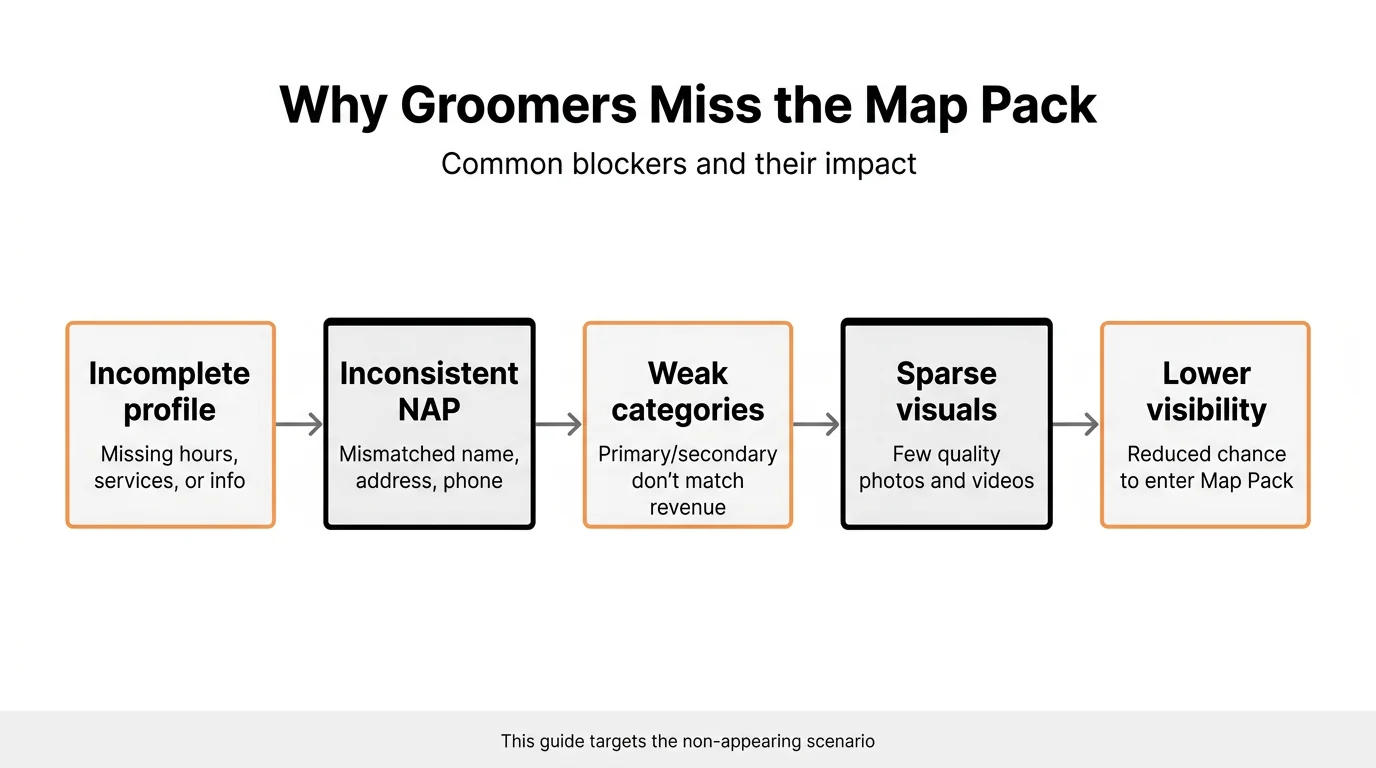
Typical visibility blockers for grooming salons
Common blockers include incomplete profiles, weak grooming service categories, inconsistent NAP, and thin photos. Proximity and reviews influence visibility. Small configuration changes may shift results in competitive areas, requiring iterative tuning of groomer local SEO signals[4].
How this guide narrows to setup and optimization of GBP
We target one scenario only: not appearing in the grooming map pack. You will configure core fields, categories, services, photos, posts, booking links, and review tactics that may lift local visibility and conversions.
Petbase builds this SEO foundation automatically for pet businesses - 10 optimized articles published every month - start your free trial.
Set up and verify your Google Business Profile the right way
Name, address, phone, hours (consistent NAP and service areas)
Use your legal business name. Keep NAP identical across your website and directories. Add accurate hours, holiday overrides, and service areas. For mobile grooming, define service-area boundaries, and avoid publishing a home address.
Primary and additional categories tailored to grooming
Select “Pet Groomer” as primary in most cases. Add secondary categories only if meaningful revenue comes from those services. Overstuffing categories may dilute relevance signals and reduce clarity to Google’s systems.
Verification paths and common pitfalls to avoid
Verification may occur by video, postcard, or phone. Ensure exterior signage and interior workspace match uploaded evidence. Avoid multiple profiles for the same location. Mismatched addresses or virtual offices typically trigger delays.
Build out services, attributes, and booking links
Service list structure (breed/coat, add-ons, pricing ranges)
Group services by coat length and size: bath, haircut, deshedding, nails, and teeth. Add optional add-ons with price ranges. Link related retail add-ons and pet product page optimization to strengthen relevance and revenue alignment.
Attributes that may support conversions (disabled access, parking)
Enable accessibility, parking, and payment attributes. Add “LGBTQ+ friendly” or “women-owned” when applicable. Attributes may not boost ranking directly, but they often influence selection and trust during comparison.
Booking integrations and UTM tracking for clarity
Connect Reserve with Google or your scheduling app. Append UTM parameters to your booking link: source=google, medium=organic, campaign=gbp. Track completed appointments and abandonment rates to refine offers and messaging.
Photos and videos that influence local selection
Photo types and EXIF/geotag considerations
Upload exterior, interior, team-at-work, equipment, and before-and-after sets. Use natural light and consistent framing. EXIF data may be stripped during upload, so consider geotagging useful but non-deterministic. Freshness and quality matter most.
Short video ideas that demonstrate handling and safety
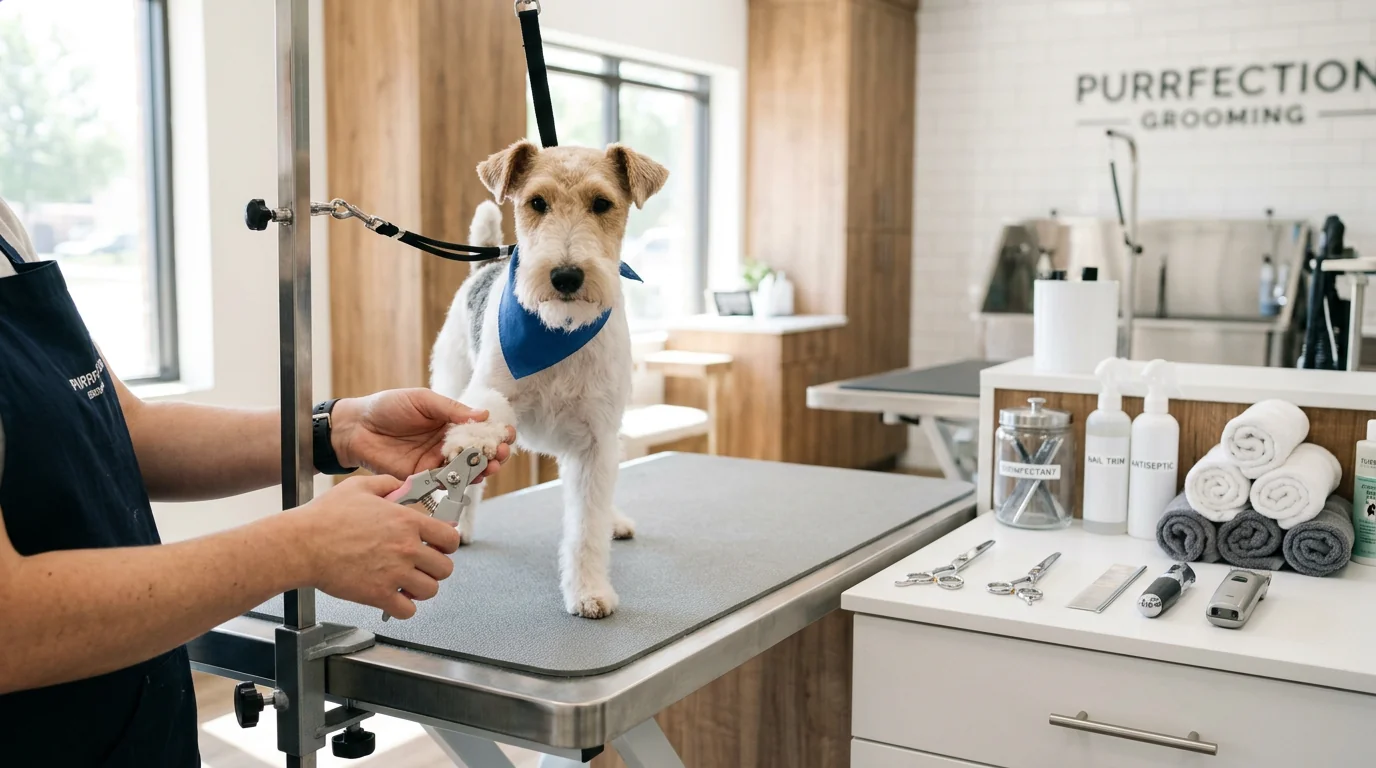
Share 15-30 second clips: intake process, gentle drying, nail trimming technique, and cleanliness protocols. Highlight safety leashes, disinfecting routines, and calm handling. Keep branding visible and captions clear for silent viewers.
Posts, Q&A, and product pins for ongoing freshness
Weekly post cadence and seasonal grooming themes
Post weekly with concise offers, seasonal reminders, and before-and-after transformations. Rotate copy and images to avoid repetition. Tools like Petbase AI may streamline consistent post creation without diverting staff from operations.
Using Q&A to pre-empt breed-specific questions
Seed Q&A with common questions: double-coat policies, matting fees, drying methods, and average appointment times. Provide ranges, not absolutes. This reduces phone calls and may improve conversion quality from searchers.
Retail add-ons: shampoos, brushes, and flea treatments
Feature retail products as GBP product pins. Outline use cases and price ranges. Connect pins to relevant services for context. Cross-sell at check-in and checkout to lift average order value and repeat visits.
Reviews and messaging: safe ways to increase signals
Review request templates that comply with guidelines
Send a neutral request within 24 hours: “Thanks for visiting. Your feedback helps neighbors choose. Would you share a Google review?” Avoid incentives or filtering. Use a short link to reduce friction.
Responding patterns that may support trust
Reply to every review within two business days. Use specifics without repeating keywords excessively. Publicly offer to resolve issues offline. This pattern may foster credibility and influence undecided searchers to call.
Enabling messaging without overpromising response times
Turn on messaging if you can respond within business hours. Set an autoresponder with a realistic time window. If volume overwhelms staff, disable temporarily rather than risk poor experiences.
For broader tactics that complement reviews, explore local SEO for pet services to align on-site content and citations with your GBP signals.
Quick decision guide: what to do in common situations
If your salon serves walk-ins and mobile grooming, then…
Create one storefront profile with published address for walk-ins. Create a separate mobile service-area listing, or consolidate under service area only. Ensure categories and hours reflect both models accurately.
If competitors outrank you within 1 mile, then…
Increase local relevance with precise categories, robust services, and fresh photos. Expand reviews velocity safely. Consider small on-page improvements and local landing pages to reinforce proximity and topical cues.
If reviews stall below 10 recent ratings, then…
Ask every client using printed QR codes and SMS links. Aim for three to five new reviews per month. Rotate request timing and wording to identify the most effective cadence.
If calls rise but bookings don’t, then…
Audit your booking link, UTM tags, and availability. Add FAQ posts addressing pricing ranges and timing. Test a limited-time introductory bath package to convert first-timers without discounting core services.
If your brand name includes keywords, then…
Use the legal name consistently, even if it contains “Grooming.” Do not add extra keywords. Name stuffing risks suspensions and trust loss that outweigh short-term visibility gains.
If photos get low engagement, then…
Test brighter lighting, human-and-pet framing, and clear branding. Post carousels on the same theme weekly. Update cover and logo images. Measure views and clicks to adjust content types and timing.
If verification fails, then…
Re-record the video with clear signage, interior workspace, tools, and street view. Ensure business documents match the profile. Request postcard verification only after fixing all address and naming inconsistencies.
Monitoring: what to check at 7-14 days and 4-8 weeks
Short-term signals in GBP Insights and Search Console
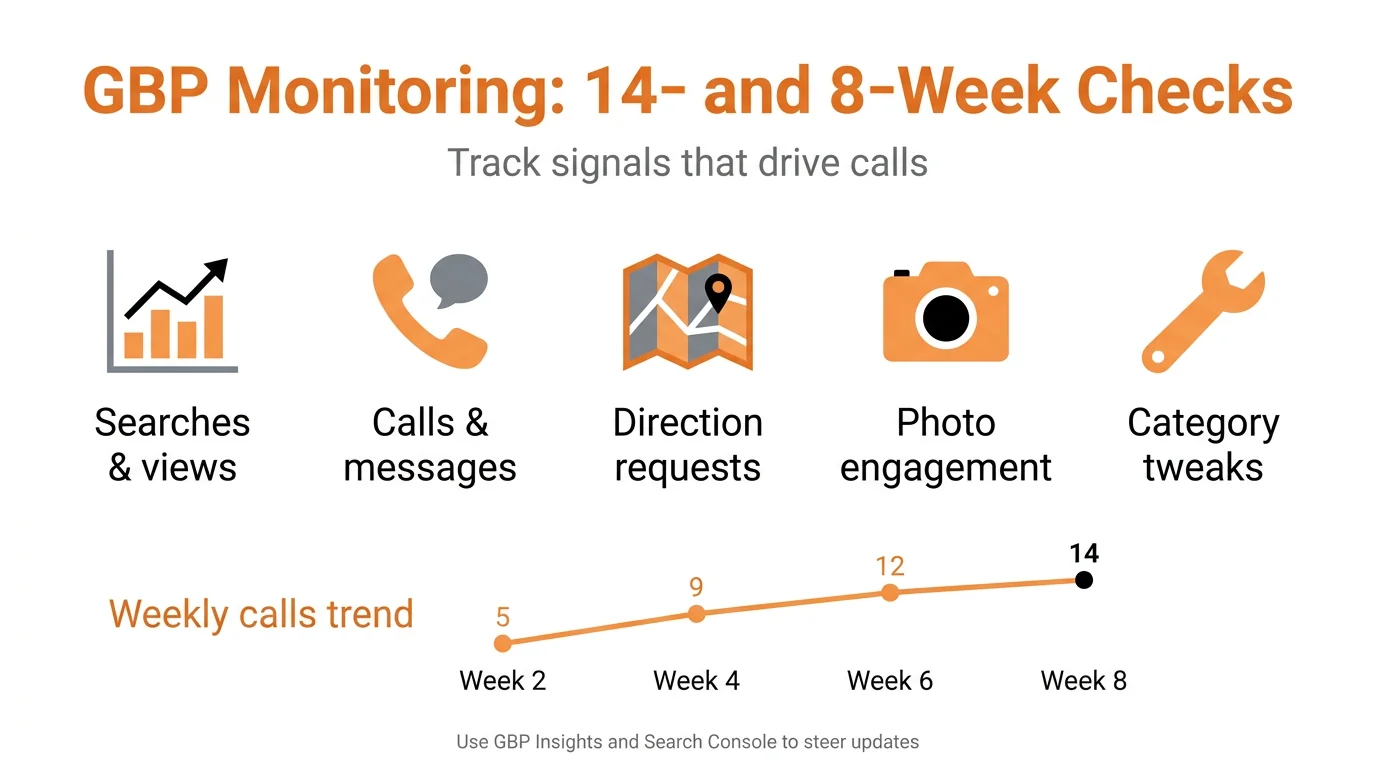
At 7-14 days, track searches, views, calls, and direction requests. In Search Console, review impressions on grooming queries. Adjust categories or posts if discovery impressions stagnate, using small, controlled experiments[3]. Learn how to report attribution in SEO KPI dashboards for grooming bookings.
Medium-term trends: discovery vs. direct, calls, and route requests
At 4-8 weeks, compare discovery versus direct searches, call volume, and routes. Evaluate which posts and photos correlate with calls. Reinforce supporting content to build topical authority pet industry relevance across your website.
Practical safety boundaries
Name stuffing, review gating, and prohibited claims
Do not add keywords to your business name. Request reviews neutrally, never incentivize or filter. Avoid unverifiable claims about outcomes. Violations may cause suspensions and long recovery times that damage revenue.
Service-area vs. storefront rules to keep intact
Storefronts serving walk-ins should show their address. Mobile-only grooming should hide the address and define service areas. Mixing models incorrectly can trigger policy flags and reduced visibility.
Evidence status and what the data suggests
What industry studies indicate about photos, reviews, and categories
Evidence from optimization research favors iterative local changes and weighted combinations of signals, which mirrors how photos, reviews, and categories interplay in practice[2]. Diversifying assets may support engagement uplifts.
Where evidence is mixed and should be tested locally
Signals like EXIF geotags or post frequency show mixed results. A guided, penalty-and-explore mindset helps find local maxima while avoiding overfitting to noisy metrics[1]. Test changes in isolation and track outcomes.
Implementation checklist for a single grooming location
Priority steps to complete in the first 48 hours
- Verify GBP and lock consistent NAP and hours.
- Set “Pet Groomer” as primary category; add only relevant secondaries.
- Publish top services with price ranges and booking link with UTM tags.
- Upload five to ten high-quality photos and a 20-second welcome video.
- Post one offer and one educational update with a clear call-to-action.
Weekly hygiene tasks to maintain relevance
- Publish one post and answer one new Q&A.
- Add two to three photos showing recent work and hygiene practices.
- Request reviews from every client; respond within two business days.
- Review Insights, adjust services or photos, and update seasonal hours.
- Audit booking completion rate and refine copy or availability.
Frequently Asked Questions
What is the best primary category for a grooming salon?
Evidence suggests most salons should use “Pet Groomer” as the primary category. Additional categories like “Dog Day Care Center” or “Pet Supply Store” may fit only if those services are significant.
How often should groomers post on their Google Business Profile?
A weekly post may support freshness signals and customer engagement. Rotate offers, seasonal tips, and before-and-after highlights to stay relevant.
Do photos help a groomer rank in the Map Pack?
Studies indicate profiles with frequent, high-quality photos may see higher engagement. While ranking impact varies, rich visuals often influence click-through and calls.
How can groomers get more Google reviews safely?
Ask every satisfied client with a neutral request and a direct link. Avoid incentives or filtering; respond to all reviews with specific, polite replies.
Should mobile groomers hide their address on Google?
If you don’t serve customers at a fixed storefront, Google guidelines suggest using a service area and hiding the exact address to prevent policy conflicts.
Appearing in the grooming map pack is a repeatable outcome when you align categories, services, media, and reviews with customer intent. Treat your pet groomer Google listing as a living asset. Iterate small improvements, measure results, and protect policy compliance. Over weeks, consistent posts, structured services, and safe review growth may lift discovery impressions, calls, and bookings. Keep your booking flow fast, your media fresh, and your messaging realistic. This disciplined approach provides durable local visibility and sustainable client growth.
References
- C Voudouris et al. (2025). Guided local search. Handbook of Heuristics. View article
- I Ahmadianfar et al. (2022). INFO: An efficient optimization algorithm based on weighted mean of vectors. Expert Systems with …. View article
- D Eriksson et al. (2019). Scalable global optimization via local Bayesian optimization. Advances in neural …. View article
- E Aarts et al. (2018). Local search in combinatorial optimization. 2018 - books.google.com. View article