How Pet Stores Use AI for Content at Scale


Table of Contents +
- What Does "Content at Scale" Actually Mean for a Pet Store?
- Why Does Volume Without Strategy Fail for Pet Stores?
- What Does a Complete AI Content Workflow Look Like?
- How Do You Maintain Quality When Scaling Content?
- What Is the Difference Between Strategic and Random Content?
- How Do You Scale Content for Different Pet Niches?
- What Does a Realistic Monthly Schedule Look Like?
- How Do You Measure Whether Scaling Is Working?
- What Mistakes Should Pet Stores Avoid When Scaling?
- Frequently Asked Questions
- References
Learn how pet stores use AI to produce 10-30 quality articles per month. Complete workflow for topic clusters, quality control, and strategic content scaling.
TL;DR: "Content at scale" for a pet store means 10-30 quality articles per month, not 1,000 thin posts. This guide covers the complete workflow: topic cluster planning, AI content generation, quality control, and publishing. Strategic scaling with topical authority beats volume-based content farming every time.
What Does "Content at Scale" Actually Mean for a Pet Store?
The phrase "content at scale" gets thrown around in marketing circles. For enterprise brands, it means hundreds or thousands of articles per month. For a pet store, the definition is different - and getting it right matters more than the volume itself.
A pet store needs 10-30 quality articles per month to build meaningful organic visibility. Companies publishing 11 or more blog posts per month gain 4x more leads than those publishing fewer than four[1]. That is the threshold. Going from 2 articles per month to 10 is transformative. Going from 10 to 100 adds diminishing returns and quality risks.
The problem is time. An average blog post takes 3 hours and 55 minutes to write[2]. At 10 posts per month, that is nearly 40 hours of writing - an entire work week. Most pet store owners do not have a spare work week every month. They are running a store, managing inventory, serving customers, and handling marketing across multiple channels.
This is where AI changes the equation. Not by producing 1,000 thin articles, but by making 10-30 quality articles achievable without dedicating 40 or more hours to writing. The key distinction: AI at scale for pet stores means strategic volume with quality controls, not volume for its own sake.
Petbase automates SEO content for pet stores - publishing 10 optimized articles monthly so you can focus on running your shop - start your free trial.
Why Does Volume Without Strategy Fail for Pet Stores?
Before diving into how to scale, it is worth understanding why simply publishing more content does not work. In my experience working with pet stores across Europe, volume-first approaches fail for three specific reasons.
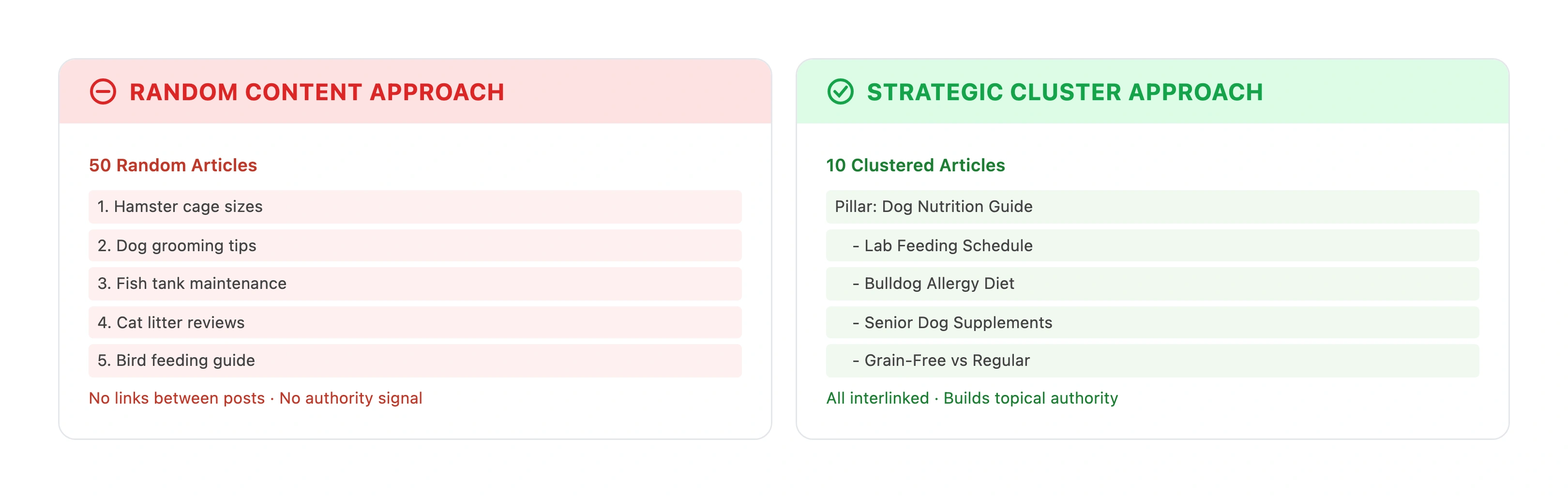
Google penalizes thin content, not AI content. Google has stated clearly that AI content is acceptable if it meets quality standards. What Google penalizes is low-quality content - thin articles that add no value, regardless of who or what produced them. A pet store that publishes 50 generic 500-word articles about "dog care" will see worse results than one publishing 10 comprehensive, breed-specific guides.
Topical authority requires depth, not breadth. Content grouped into topic clusters drives 30% more organic traffic and holds rankings 2.5x longer than standalone pieces[3]. Ten articles about German Shepherd health, nutrition, grooming, training, and breed-specific conditions build authority. Ten random articles about ten unrelated topics build nothing.
Pet content carries safety risks. Generic AI models regularly produce inaccurate pet health information. A volume-first approach increases the chance of publishing content that recommends toxic foods, incorrect dosing, or dangerous home remedies. One factually wrong article can damage your store's reputation more than fifty good ones can build it.
The stores I have seen succeed with AI content share a common pattern: they plan first and produce second. They decide which topics to cover, in which order, with which internal linking structure, before generating a single article. This is what separates content scaling from content farming.
What Does a Complete AI Content Workflow Look Like?
Here is the end-to-end workflow for scaling pet store content with AI. This process produces 10 quality articles per month with approximately 5-8 hours of total owner involvement.
Step 1: Topic cluster planning (Month 1 only, then quarterly refresh).
Start by mapping your store's expertise into 3-5 topic clusters. A typical pet store might choose:
- Dog nutrition and feeding (15-20 articles)
- Cat health and wellness (15-20 articles)
- Pet grooming and coat care (10-15 articles)
- Seasonal pet care (10-12 articles)
- Product comparisons and buying guides (10-15 articles)
Each cluster needs a central pillar article (comprehensive overview) and 10 or more supporting articles that cover specific subtopics. Businesses using structured content clusters report 3x higher lead conversion rates[4]. For a step-by-step guide on building your content calendar, see our article on building an SEO content calendar for pet stores.
Step 2: Keyword research and prioritization.
For each article in your plan, identify the primary keyword and 3-5 related long-tail keywords. Prioritize based on search volume, competition, and purchase intent. A pet store selling premium dog food should prioritize "best grain-free dog food for Bulldogs" over "what do dogs eat" because the first query signals buying intent while the second is purely informational.
85% of marketers now use AI for content creation[5], which means your competitors are likely producing content too. Keyword research helps you find the gaps they have not covered yet.
Step 3: AI content generation.
With your topic plan and keywords ready, generate content using an AI tool with pet industry knowledge. The output should include: a comprehensive article (2,500-4,000 words), proper heading structure (H2 and H3), internal links to related articles in your cluster, breed-specific details where relevant, and accurate product information.
Long-form content of 3,000 or more words generates 3x more traffic and 4x more shares than shorter posts[6]. This does not mean every article needs to be 3,000 words. Some topics (product comparisons, seasonal tips) work well at 1,500-2,000 words. But your pillar articles and comprehensive guides should aim for depth.
Step 4: Quality review and editing (15-30 minutes per article).
Every article must pass through human review before publishing. This is non-negotiable. Check accuracy of health claims, breed details, and product information. Verify that internal links point to the correct pages. Add personal observations from your store experience. Ensure the tone matches your brand. Confirm E-E-A-T signals are present (citations, author attribution, veterinary disclaimers).
Step 5: Publish and interlink.
Publish articles on a consistent schedule - spreading 10 articles across the month rather than publishing all at once. After each article goes live, verify the internal links work and the article appears in your sitemap. Over 70% of high-ranking pages belong to websites with strong internal linking and topic-based architecture[7].
Or let Petbase handle this automatically. The platform manages all five steps - from topic planning through auto-publishing - with your review as the only required input.
How Do You Maintain Quality When Scaling Content?
Quality control is where most pet stores fail at content scaling. They start strong with carefully reviewed articles, then gradually let quality slip as the volume increases. Here is a quality framework that scales.
The 3-layer quality check:
Layer 1: Automated checks (built into the process).
- Spelling and grammar (automated tools catch 95% of surface errors)
- Keyword presence and density (target keyword in title, H2, and first 100 words)
- Internal link verification (every article links to 2-3 related articles)
- Meta description length (under 160 characters, includes primary keyword)
- Reading level (aim for grade 8-10 for pet store audiences)
Layer 2: Pet accuracy review (5-10 minutes per article).
- Breed names correct and breed-specific details accurate
- Health claims medically sound (would a veterinarian agree?)
- Product names, ingredients, and specifications real and verifiable
- Seasonal and regional information appropriate for your market
- No dangerous recommendations (toxic foods, incorrect dosing, harmful home remedies)
Layer 3: SEO and E-E-A-T review (5-10 minutes per article).
- Article answers the primary search query within the first paragraph
- Headings are descriptive and keyword-relevant
- Content adds something competitors do not cover
- Experience-based observations included (your store, your customers)
- Sources cited for statistics and health claims
This three-layer approach takes 15-30 minutes per article. For 10 articles per month, that is 2.5-5 hours of review time. This is the minimum investment that protects your site's quality and E-E-A-T reputation.
What Is the Difference Between Strategic and Random Content?
This comparison illustrates why strategy matters more than volume.
| Approach | Random Content | Strategic Content |
|---|---|---|
| Topic selection | Whatever seems interesting or trending | Mapped to topic clusters with clear hierarchy |
| Keyword targeting | High-volume generic keywords | Mix of pillar keywords and specific long-tail terms |
| Internal linking | None or random | Every article links to 2-3 related cluster articles |
| Publishing schedule | Sporadic bursts | Consistent cadence (2-3 per week) |
| Content depth | 500-800 words, surface level | 2,000-4,000 words, comprehensive |
| Breed specificity | Generic "for all dogs" | Breed-specific with accurate details |
| E-E-A-T signals | Missing | Author bio, citations, veterinary disclaimers |
| Time to ranking results | Months with no guarantee | 8-12 weeks for long-tail keywords |
| 6-month traffic outcome | Flat or declining | 3x organic growth typical |
Content marketing returns $7.65 for every $1 spent[8]. But that average includes both strategic and random approaches. The strategic approach drives the ROI number up. The random approach brings it down. Every pet store owner choosing to scale content should understand that 10 strategically planned articles will outperform 50 random ones.
How Do You Scale Content for Different Pet Niches?
Different pet store specializations require different content scaling approaches. Here are practical examples for the most common pet store types.
Dog food and nutrition stores. Build clusters around specific breeds (Labrador nutrition, French Bulldog diet, Golden Retriever feeding guide) and life stages (puppy nutrition, senior dog food, pregnant dog diet). Include ingredient analysis, feeding amount calculators, and allergy guides. This niche has high search volume and strong purchase intent.
Cat specialty stores. Focus on indoor versus outdoor cat care, breed-specific health issues, and nutrition comparisons. Cat owners search for very specific information - "best food for Maine Coon with sensitive stomach" has clear purchase intent. Build clusters around breeds, health conditions, and product categories.
Aquarium and fish stores. This niche is deeply technical. Build clusters around species (freshwater versus saltwater, specific fish species), tank setup and maintenance, water chemistry, and disease identification. Aquarium content tends to be evergreen with long ranking longevity.
Multi-species pet stores. Start with your highest-revenue category and build outward. If dogs drive 60% of your revenue, start your content with dog-related clusters. Then expand to cats, small animals, and specialty pets. Trying to cover everything at once dilutes your topical authority.
One pattern I have seen repeatedly: pet stores that try to cover every species and topic from day one end up with thin coverage across everything. The stores that focus deeply on 2-3 niches first, then expand, build authority faster and rank sooner. For more on building a comprehensive content strategy, see our guide on content marketing for pet businesses.
What Does a Realistic Monthly Schedule Look Like?
Here is a month-by-month view of what scaling looks like for a pet store publishing 10 articles per month.
Week 1:
- Monday: Review and approve articles 1-2 (30-60 minutes)
- Wednesday: Articles 1-2 publish
- Friday: Review and approve article 3 (15-30 minutes)
Week 2:
- Monday: Article 3 publishes. Review articles 4-5 (30-60 minutes)
- Wednesday: Articles 4-5 publish
- Friday: Review article 6 (15-30 minutes)
Week 3:
- Monday: Article 6 publishes. Review articles 7-8 (30-60 minutes)
- Wednesday: Articles 7-8 publish
- Friday: Review article 9 (15-30 minutes)
Week 4:
- Monday: Article 9 publishes. Review article 10 (15-30 minutes)
- Wednesday: Article 10 publishes
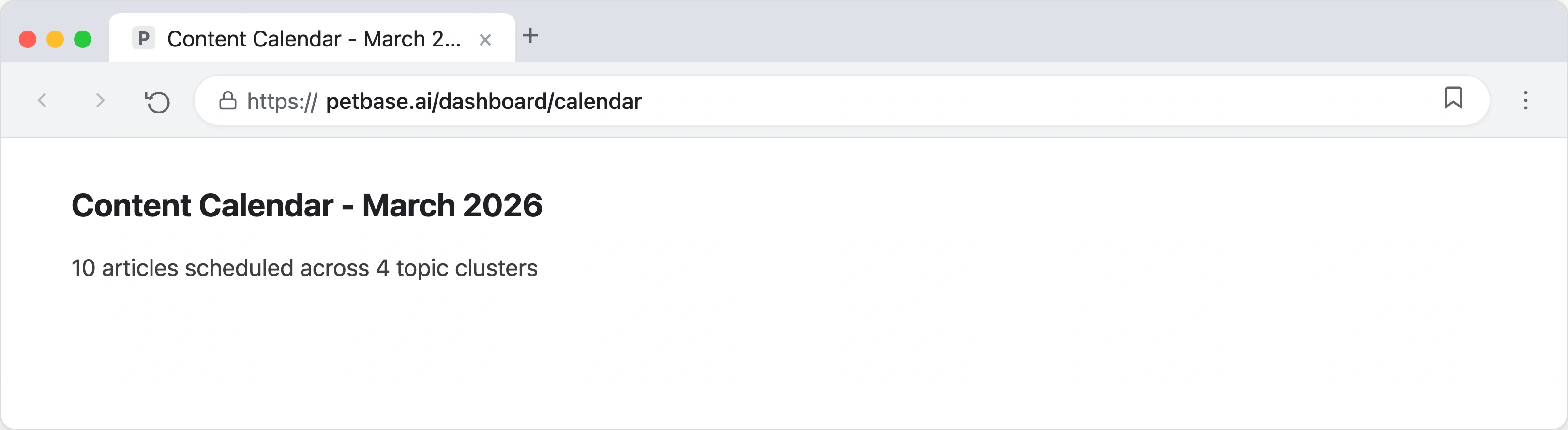
- Friday: Monthly performance review - check which articles are indexing and ranking (30 minutes)
Total monthly time investment: 5-8 hours. Compare that to 40 hours of manual writing. This is what "at scale" means for a pet store - not spending less time on quality, but spending less time on production while maintaining quality.
Updating old content is also part of the scaling workflow. Refreshing existing articles leads to a 74% spike in traffic compared to publishing only new content[9]. Dedicate 1-2 hours per month to updating your highest-performing articles with new data, product information, or seasonal content.
How Do You Measure Whether Scaling Is Working?
Scaling content without measurement is flying blind. Here are the five metrics that tell you whether your content scaling strategy is working.
1. Indexed pages. Check Google Search Console monthly. Are your new articles being indexed within 1-2 weeks? If pages are not getting indexed, there is a quality or technical issue to address.
2. Keyword rankings. Track your target keywords weekly. Look for movement from "not ranking" to page 3, then page 2, then page 1. The typical timeline for new content is 8-12 weeks for initial ranking.
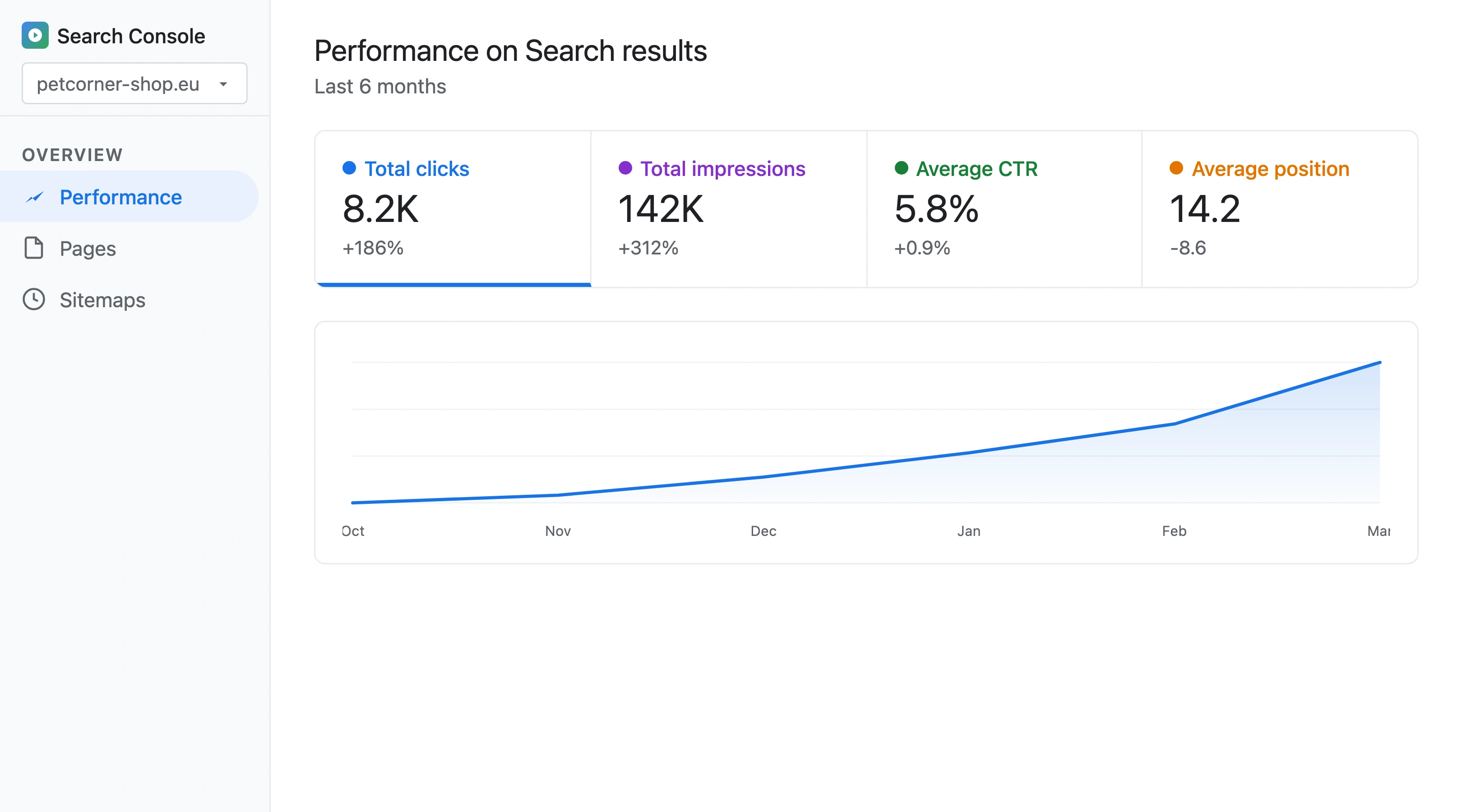
3. Organic traffic trend. Monthly organic sessions should show a consistent upward trend starting from month 3-4 of publishing. Flat traffic after 4 months of consistent publishing signals a quality or strategy problem. 68% of businesses report improved ROI after integrating AI into content workflows[10].
4. Topic cluster coverage. Measure how many articles you have per topic cluster. A cluster needs 8-10 articles minimum to signal topical authority. Track your coverage percentage for each cluster and prioritize filling gaps.
5. Content-driven conversions. Track how many leads, newsletter signups, or product inquiries come from blog content. This connects your content investment to business outcomes. Businesses using structured content clusters report 3x higher lead conversion rates[4].
Review these metrics monthly. Adjust your topic priorities based on what is working. Double down on clusters where you see early ranking signals and reconsider topics where content is not getting indexed or ranking after 3-4 months. For a complete blog strategy framework, see our guide on pet store blog strategy.
What Mistakes Should Pet Stores Avoid When Scaling?
After working with dozens of pet stores on content scaling, I see the same five mistakes repeatedly.
Mistake 1: Publishing without review. The time savings from AI content tempt some owners to skip the review step. Do not. One article recommending a toxic ingredient or stating incorrect dosing can damage your reputation and expose you to liability. Review every article, every time.
Mistake 2: Ignoring topic clusters. Publishing 10 articles about 10 unrelated topics each month builds no authority. Plan your clusters first. Build depth in 2-3 areas before expanding to new topics.
Mistake 3: Prioritizing volume over consistency. Publishing 30 articles in January and nothing in February is worse than publishing 10 articles per month, every month. Google rewards consistent publishing patterns. Consistency signals an active, maintained site.
Mistake 4: Copying competitors instead of filling gaps. If every competitor has an article about "best dog food brands," writing another one is not strategy. Find the gaps they have not covered. Breed-specific nutrition guides, regional product comparisons, and seasonal care calendars often have lower competition and higher conversion potential.
Mistake 5: Never updating published content. Content is not a "publish and forget" asset. Articles need periodic updates to maintain freshness and accuracy. Updated content gets a 74% traffic boost[9]. Schedule quarterly reviews of your top-performing articles.
Or let Petbase handle this automatically. The platform avoids these mistakes by design: built-in topic cluster planning, consistent publishing schedules, and pet-specific quality controls.
Frequently Asked Questions
How many articles per month does a pet store actually need?
The data shows that 10-12 articles per month is the threshold for meaningful organic traffic growth. Companies publishing 11 or more blog posts per month gain 4x more leads[1]. Below that threshold, you are publishing too infrequently for Google to recognize consistent topical growth. Above 15-20 articles per month, diminishing returns set in for most pet stores because the quality review workload becomes unmanageable for a single reviewer. Start with 10 per month and increase only if you can maintain quality review for every article.
Can a small pet store with no marketing team scale content effectively?
Yes. The workflow described in this guide requires 5-8 hours per month of owner time, not a full marketing team. The key is using an AI tool that handles production (topic planning, keyword research, writing, and publishing) so your time is spent only on quality review - the step that requires your pet expertise and store knowledge. A solo pet store owner managing inventory, serving customers, and running operations can realistically add 5-8 hours of content review per month. That produces 10 optimized articles - the same output a marketing agency would charge USD 5,000 or more per month to deliver.
Will Google penalize my pet store for publishing too much AI content?
Google does not penalize AI content. Google penalizes low-quality content. The distinction matters. Publishing 10 comprehensive, accurate, well-structured articles per month that are reviewed by a human with pet industry knowledge is exactly what Google rewards. Publishing 100 unreviewed, generic, thin articles per month is what Google penalizes - regardless of whether a human or AI wrote them. The risk of penalty comes from skipping quality review, not from using AI. Keep the quality high, review every article, and publish with proper E-E-A-T signals, and your content will perform well regardless of how it was produced.
References
- HubSpot (2024). Marketing Statistics. hubspot.com
- Orbit Media (2024). Blogging Statistics. orbitmedia.com
- Path Digital Services (2025). Content Clusters: The Secret to Topical Authority. pathdigitalservices.com
- Digital Applied (2026). SEO Content Clusters 2026: Topic Authority Guide. digitalapplied.com
- Arvow (2026). AI Content Marketing Statistics: 50+ Data Points on Adoption, ROI, and Trends. arvow.com
- Ranktracker (2025). Content Marketing ROI Statistics: What Actually Works. ranktracker.com
- Velir (2025). How Topical Authority Is Driving Smarter SEO Strategies in 2025. velir.com
- Genesys Growth (2024). Content Marketing ROI Stats for Marketing Leaders. genesysgrowth.com
- Ranktracker (2025). Content Marketing ROI Statistics: What Actually Works. ranktracker.com
- Loopex Digital (2026). AI Marketing Statistics: The Complete Performance Report. loopexdigital.com