Multilingual Pet SEO: Scale English Content to US/UK/DACH Without Losing Voice

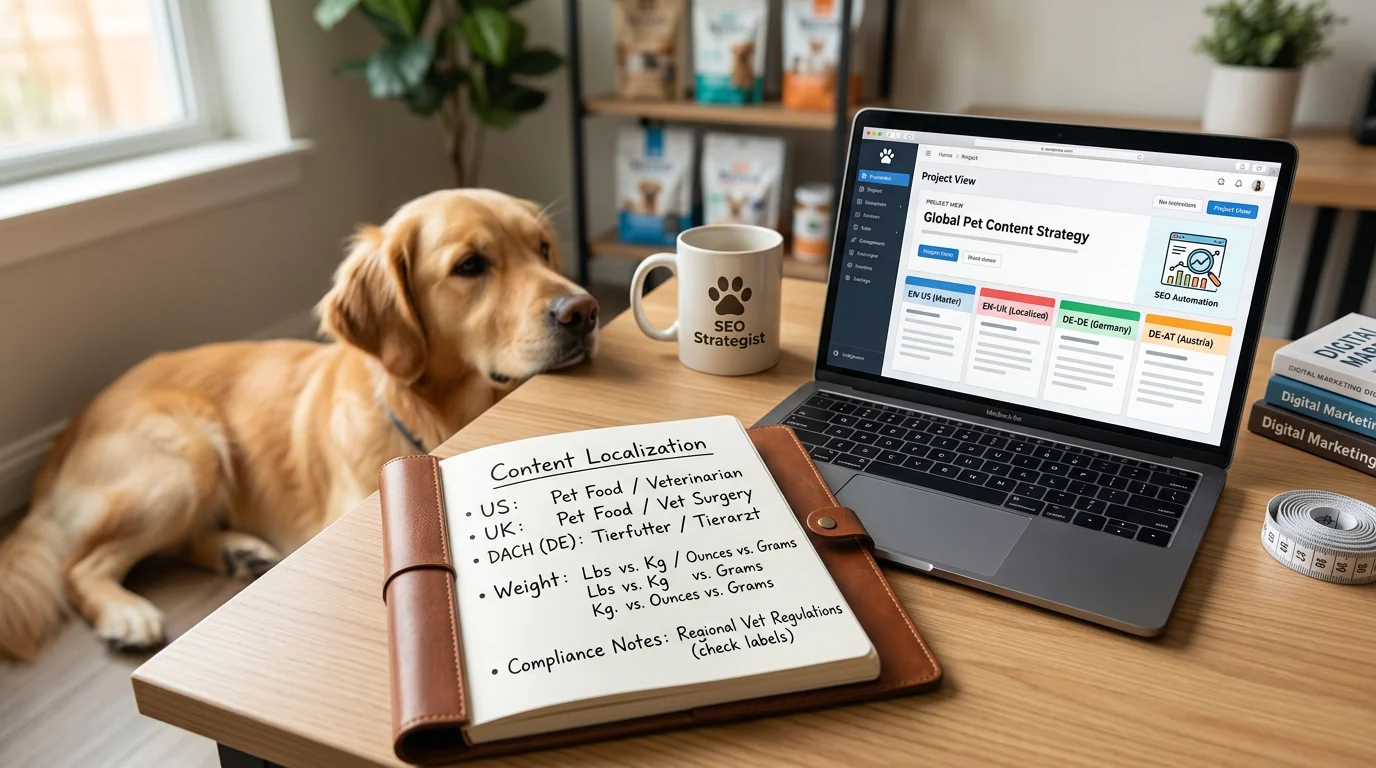
Table of Contents +
- Scenario: You need one English voice across US, UK, and DACH without duplicate content risks
- Localization blueprint: terms, measurements, compliance, and product context
- Technical SEO guardrails to avoid duplicate content
- Schnell-Entscheidung: Wenn X, dann Y (Quick decision guide)
- Monitoring: what to check at 7-14 days and 4-8 weeks
- Safety boundaries: what not to change across regions
- Evidence status: what research and platform data suggest
- Workflow with Petbase: from lexicon to publish
- Next steps and where to go deeper
- Frequently Asked Questions
- References
Localize pet terms, legal notes, and units for US/UK/DACH while preserving brand voice and minimizing duplicate content risk. Practical, scalable workflow.
Your English content can work across borders without sounding generic or risking duplication. The key is disciplined localization with consistent voice and measurable SEO safeguards.
This matters because small wording shifts change trust, compliance, and search visibility. You will learn how to localize pet terms, convert measurements, and align disclaimers. You will also see technical guardrails that reduce duplicate content risks and preserve brand equity.
Scenario: You need one English voice across US, UK, and DACH without duplicate content risks
Define a single brand voice and variable lexicon (US/UK/DACH)
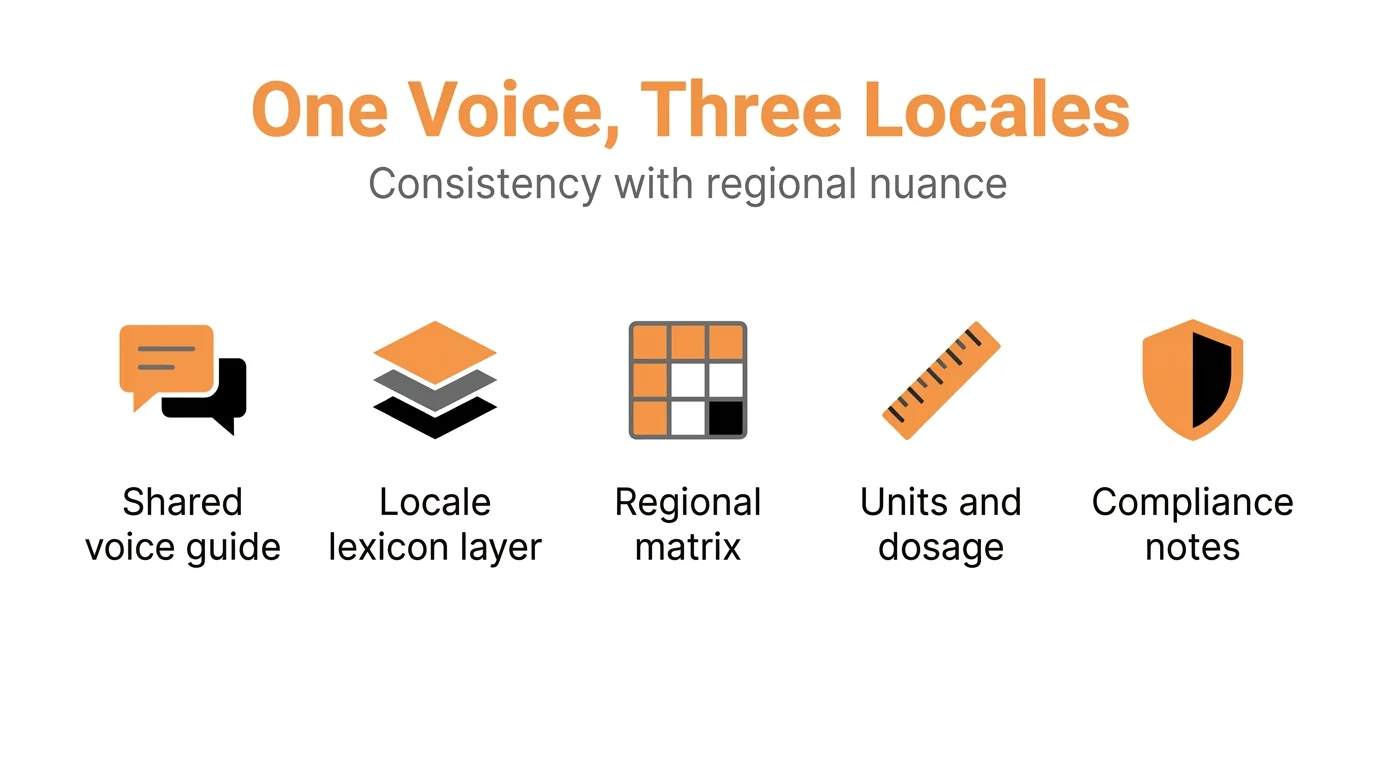
Establish one brand voice guide that governs tone, sentence rhythm, and empathy. Add a locale lexicon layer that swaps terms regionally. Document pet terminology differences explicitly, then automate replacements during publishing to maintain cohesion and avoid drift.
Map legal, unit, and care guidance deltas by region
Create a matrix of regional differences: measurement units, dosage phrasing, product labeling, and veterinary disclaimer norms. Track US, UK, and DACH deltas line by line. This supports pet content localization without rewriting entire pages or diluting brand consistency.
Petbase handles this entire content workflow automatically - 10 SEO articles published to your blog every month - start your free trial.
Localization blueprint: terms, measurements, compliance, and product context
Pet terminology dictionary (examples: leash/lead, litter/litter tray, crate/cage)
Build a reference dictionary covering core items and care tools. For example: leash (US) vs lead (UK), litter (US) vs litter tray (UK), crate (US) vs cage (occasionally UK). Specify preferred synonyms and avoidance notes to prevent style collisions.
Units and dosage language: lb/oz vs kg/g; cups vs grams
US readers expect lb/oz and cups. UK and DACH expect kg/g, milliliters, and grams. Favor one primary unit per locale to minimize confusion. Where appropriate, offer conversions in parentheses to support comparison-focused readers.
Country notes: disclaimers and veterinary guidance nuance
Disclaimers vary. US pages may emphasize FDA, AAFCO, and general guidance. UK pages may reference FSA or RCVS norms. DACH pages should reflect national and EU guidance in German, with concise, non-promotional wording to preserve neutrality.
Technical SEO guardrails to avoid duplicate content
hreflang and canonical models for en-US, en-GB, de-DE, de-AT, de-CH
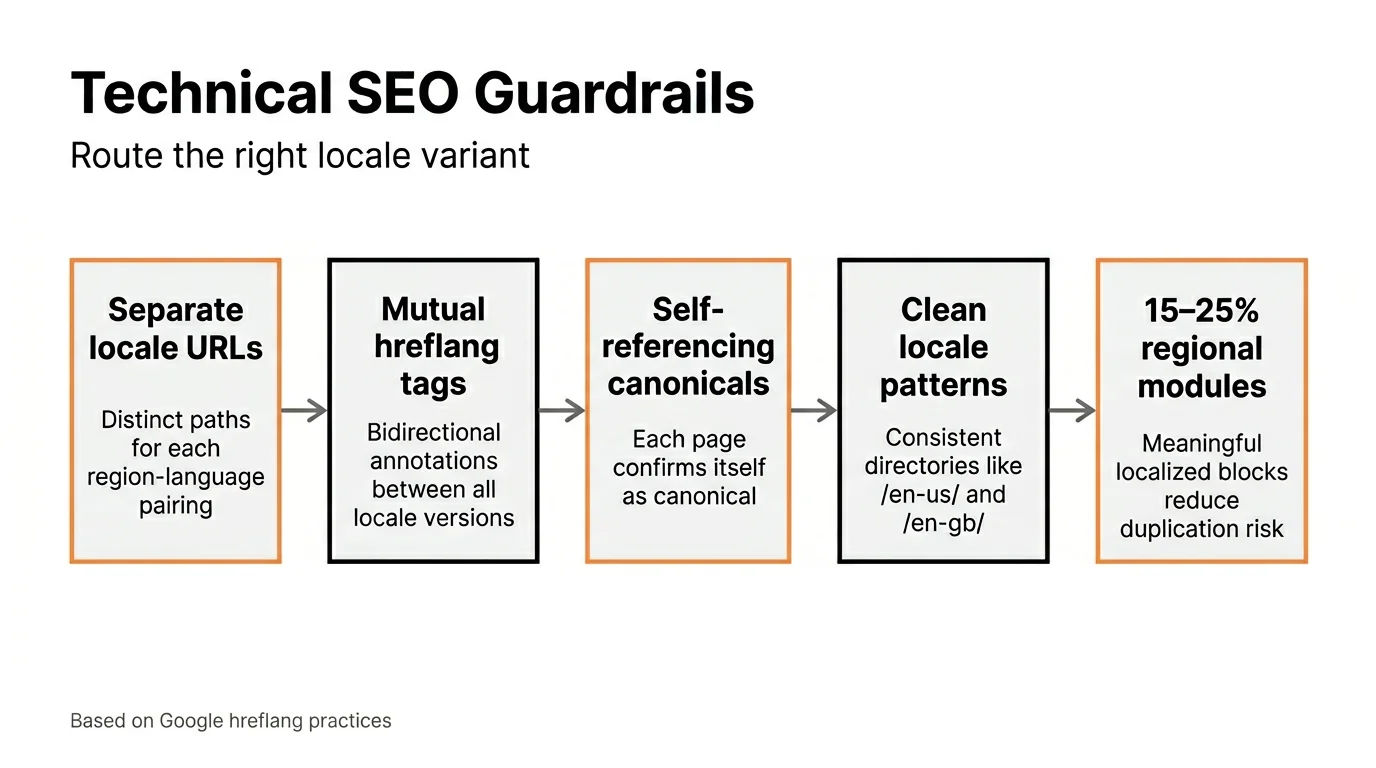
Use separate URLs per locale with mutual hreflang annotations and self-referencing canonicals. This approach may help search engines route the right language-region pair and reduce wrong-locale impressions for pet brands[1].
URL patterns and content minimum-diff strategy
Adopt clean patterns such as /en-us/, /en-gb/, and /de-de/. If English variants share structure, target 15-25% meaningful regional modules to lower duplicate content international SEO risk. Use structured rewrites when needed via evidence-based page upgrades.
Structured data variations: currency, availability, and regional pricing
Localize Offer schema with priceCurrency (USD, GBP, EUR), price, availability, and seller location. Align product identifiers while reflecting regional stock and shipping rules. Automation frameworks can generate locale-ready markup for SEO at scale[2].
Schnell-Entscheidung: Wenn X, dann Y (Quick decision guide)
If content is informational-only, then localize terms/units + region intro
Keep the same structure but swap terms and measurements per locale. Add a two-sentence regional intro to set context. This may offer enough distinctiveness to avoid duplication flags.
If content includes medical guidance, then add region-specific vet disclaimer
Include localized medical disclaimers reflecting regulatory norms. Point readers to licensed professionals for individualized advice. Keep clarity and avoid cultural idioms that may undermine comprehension across regions.
If product pages differ only in price, then separate URLs + hreflang + currency
Use dedicated URLs, localized currency, and correct hreflang for pet brands. Keep shared copy consistent and add brief locale modules. Surface shipping, returns, and support details per region.
If >70% text identical across locales, then add 15-25% regional modules
Insert localized examples, measurements, regional comparisons, and country notes. Expand FAQs or care tips reflecting local norms. This approach may help search engines classify variants distinctly.
If resources are limited, then ship US first, clone to UK with term/unit swap
Launch a US baseline, then adapt to en-GB with terms, spelling, dosage language, and compliance tweaks. Add a locale-specific intro and one short region module to diversify signals.
If targeting DACH, then translate fully to German; avoid mixed-language pages
Commit to native-quality German. Avoid split-language pages that confuse users and crawlers. Localize headings, schema, legal notes, and navigation terms consistently for a coherent DACH experience.
Monitoring: what to check at 7-14 days and 4-8 weeks
7-14 days: hreflang coverage, impressions by locale, cannibalization signals
Validate hreflang coverage in Search Console. Track impressions per locale and watch for cross-locale cannibalization. Review server logs for bot access by variant. Consider a metrics framework like the KPI ladder for pet SEO.
4-8 weeks: CTR by region, indexed variants, assisted conversions, product clicks
Compare CTR by region, check indexed counts per locale directory, and segment assisted conversions by country. Marketing platforms can automate routine checks and anomaly detection to speed iteration[3].
Safety boundaries: what not to change across regions
Do not alter core claims or safety instructions
Keep core efficacy statements and safety steps identical unless legally required. Localize labels and measurements, but preserve the original claim hierarchy and risk language across all locales.
Keep ingredient/active substance names consistent; localize only units/labels
Use globally consistent ingredient and active substance naming to avoid confusion and indexing fragmentation. Translate labels and units only, and reflect local regulations in packaging language wherever required.
Avoid cultural slang in medical contexts; maintain clarity
Steer clear of idioms, puns, or informal slang in medical or dosing sections. Aim for neutral, plain language. This supports accessibility and reduces misinterpretation risks across US, UK, and DACH.
Evidence status: what research and platform data suggest
Search behavior differences for pet terms may vary by locale sizes
Research on multilingual websites indicates that localized language support and terminology adaptation are standard practices to improve relevance and access, especially across European markets[1].
Hreflang implementation correlates with reduced wrong-locale impressions
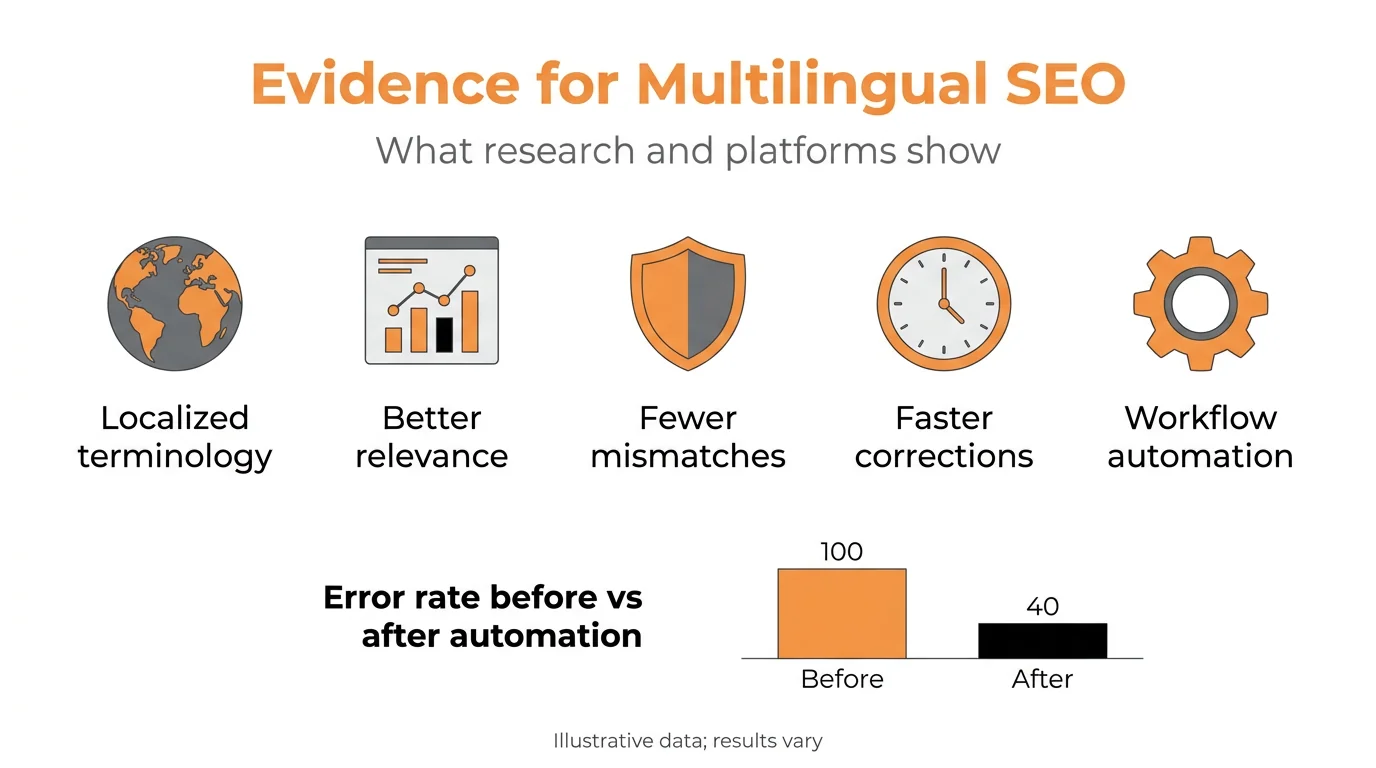
Operational SEO programs that automate international annotations, monitoring, and error detection may reduce mismatches and speed correction cycles, improving targeting accuracy over time[3].
Regional modules may support unique ranking signals
Programmatic content systems that generate locale-specific sections and structured data can create distinct relevance features while retaining core templates, supporting multi-locale visibility at scale[2].
Workflow with Petbase: from lexicon to publish
Build locale lexicon, compliance notes, and measurement presets
Start with a shared voice guide, then define locale lexicons for US/UK/DACH SEO. Add compliance notes and measurement presets. Centralize this configuration so every page inherits accurate terms and units.
Generate regional modules and product-linked blocks automatically
Create reusable modules for region intros, regulatory disclaimers, and measurement conversions. For efficient production, consider using Petbase AI to assemble modules and align product data into locale-ready blocks.
Publish with hreflang, localized schema, and minimum-diff rules
Enforce separate URLs, hreflang annotations, and localized schema offering correct currency and availability. Apply minimum-diff thresholds to guard against duplication. Maintain one voice while allowing term and compliance variance per region.
Next steps and where to go deeper
Prioritize top pet categories, confirm lexicon, roll out to US/UK/DACH
Identify high-impact categories first. Confirm your lexicon, measurement rules, and disclaimers. Launch US and UK variants, then publish a native-quality DACH version that fully reflects German terminology and compliance expectations.
Revisit the main AI Pet SEO hub for cluster alignment
Align your program with the main AI Pet SEO hub. For internal link structures that reinforce merchandising and navigation, review internal linking blueprints for pet stores to connect informational and product intent.
Frequently Asked Questions
Should UK and US English live on separate URLs for pet content?
Evidence suggests separate URLs with hreflang help search engines serve the right variant. Keep a shared brand voice but localize terms, units, and compliance notes.
How much content difference is enough to reduce duplicate risk?
Many teams target 15-25% unique, meaningful regional content. Adding localized introductions, examples, measurements, and legal notes may support distinct signals.
Do I need full German translation for DACH?
For DACH, a native-quality German version generally performs better. Mixed English/German pages may confuse users and search engines.
What metrics indicate hreflang is working?
Look for reduced wrong-locale impressions, correct country clicks, and stable indexing of each locale. Search Console hreflang reports may reveal coverage and errors.
How should measurements be handled in pet nutrition guides?
Localize units to regional norms (cups/oz in US; g/kg in UK and DACH). Provide one clear primary unit per locale and, if helpful, add a parenthetical conversion.
References
- A Vasiļjevs et al. (2024). Advancing Digital Language Equality in Europe: A Market Study and Open-Source Solutions for Multilingual Websites. Proceedings of the 25th …. View article
- A Singh et al. (2025). Enhancing Large Language Models for Real-Time, SEO-Optimized Article Generation. Intelligent Systems Conference. View article
- MC Pereira et al. (2025). AI in Search-Redefining SEO in Digital Marketing Strategy and Practices. International Conference on Business …. View article
- T Suresh (2025). Natural language processing for internal link optimisation: Automating content relationships for better search engine optimisation. Journal of Digital & Social Media Marketing.