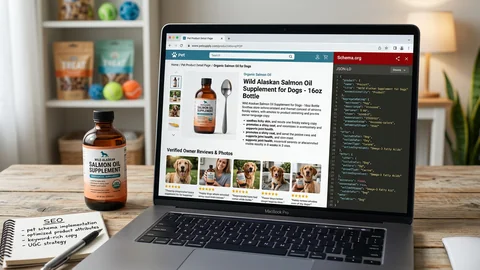
AI Page Upgrades: Rewrite and Optimize Existing Pet Product Pages

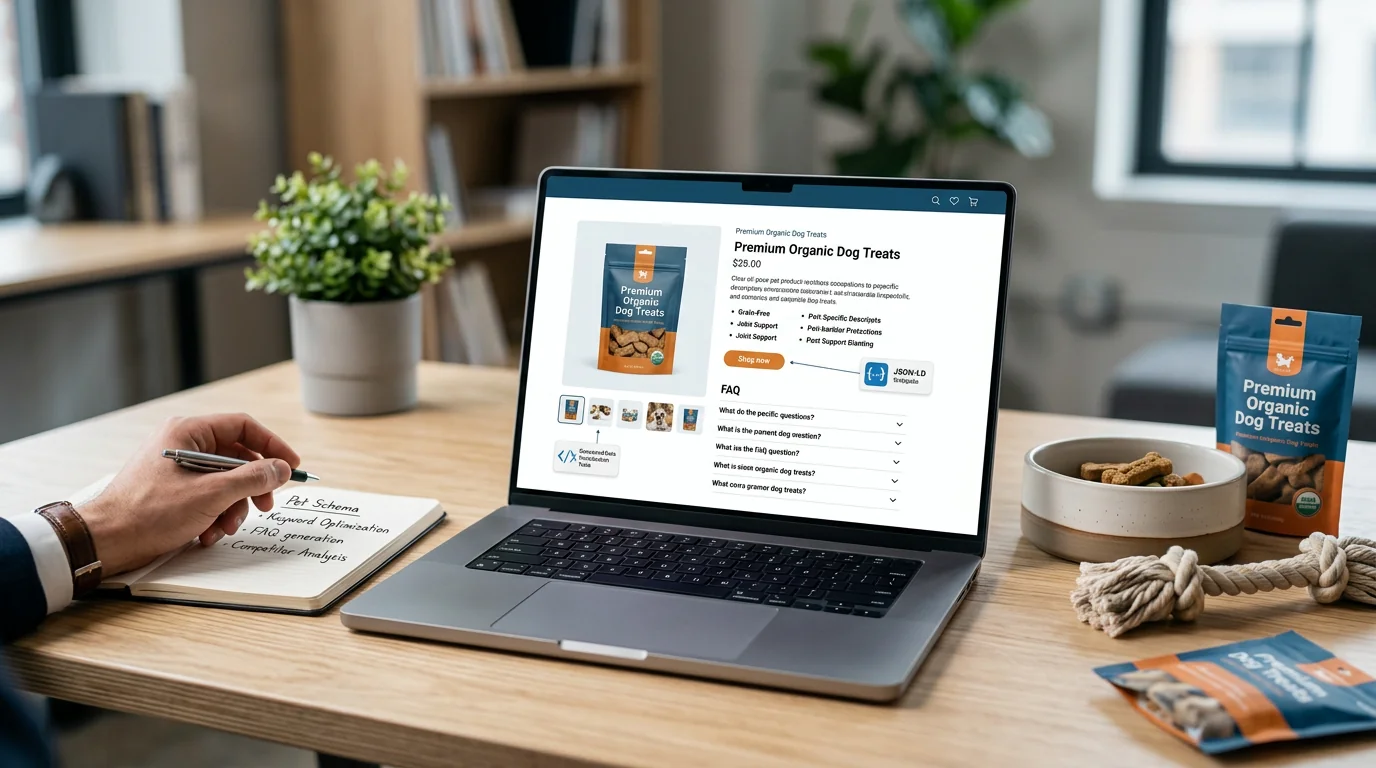
Table of Contents +
- Why upgrade existing pet product pages before creating new ones
- Quick decision guide: pick the right upgrade for each page
- Step-by-step: how to rewrite a pet product page with AI safely
- Pet-specific attributes that may lift relevance and trust
- On-page elements to prioritize for transactional intent
- Structured data and schema for pet product pages
- Monitoring: what to check after 7-14 days and 4-8 weeks
- Practical safety boundaries for AI rewrites
- Evidence status: what current data suggests
- Checklist: run this on your top SKUs first
- Frequently Asked Questions
- Conclusion
- References
Rewrite and optimize existing pet product pages with AI. Add pet-specific language, attributes, FAQs, and schema to lift rankings and conversions.
Your highest-converting growth opportunity is already live on your site. Most pet stores can unlock traffic and sales by upgrading existing product pages first. New content helps later. Upgrades help now.
Refined copy and structured data align products with real search intent. That alignment may lift visibility and conversion with less risk. In this guide, you will learn safe AI page upgrades, pet-specific attributes, on-page priorities, and monitoring steps.
Why upgrade existing pet product pages before creating new ones
The compounding effect of intent-matched rewrites
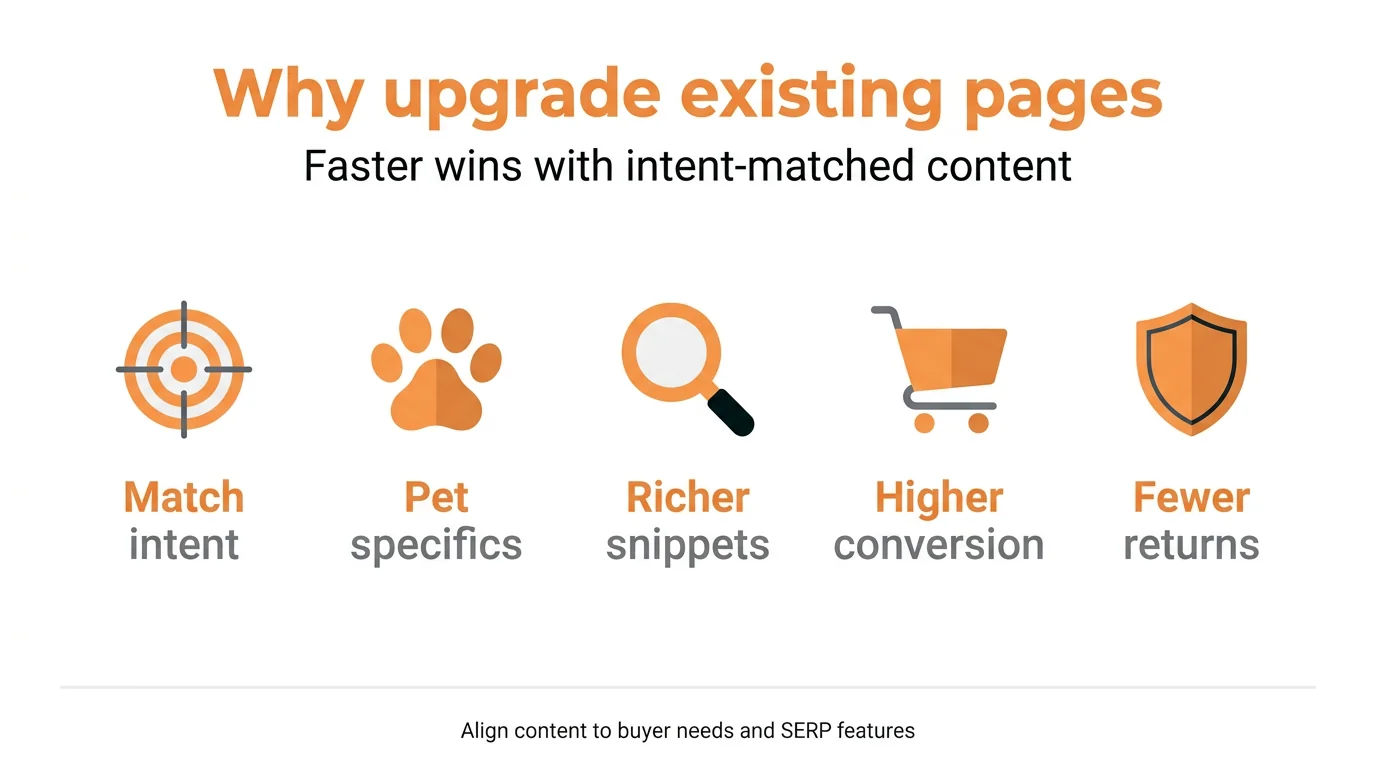
AI product page rewrite work refines language, attributes, and schema to match buyer intent. Intent-matched pages may see faster crawl, richer snippets, and better click-through. Automated generation and testing shorten iteration cycles across SKUs, improving consistency and speed at scale[1]. Evidence from eCommerce SEO suggests structured, AI-assisted optimization can improve on-page relevance and metadata quality, which may support ranking movement and richer results[2].
Where pet-specific language may close conversion gaps
Generalized copy often misses crucial purchase drivers. Pet-specific attributes and FAQs address species, breed, size, life stage, and sensitivities. These details reduce uncertainty and returns while increasing confidence. Search engines also use explicit attributes to interpret relevance, which may help pet eCommerce SEO win high-intent queries. Product schema for pets further clarifies variants and availability to crawlers.
Petbase automates SEO content for pet stores - publishing 10 optimized articles monthly so you can focus on running your shop - start your free trial.
Quick decision guide: pick the right upgrade for each page
If X situation, then Y action (5-7 scenarios)
- If impressions rise but CTR lags, then rewrite SEO title and meta description with species and size modifiers. Add price and a unique benefit in the title.
- If sessions grow but add-to-cart lags, then tighten the first 100 words. Lead with outcome-driven benefits, proof points, and a clear size/breed fit statement.
- If returns cite sizing or durability, then add size charts, durability ratings, and breed-weight ranges. Mirror this in variant names and schema.
- If reviews mention consistent pros/cons, then convert them into benefit-led bullets and a “best for” block. Address negatives directly in FAQs.
- If organic traffic is thin on head terms, then add long-tail attributes: life stage, sensitivities, and materials. Expand FAQs to target question queries.
- If crawl is slow after changes, then compress images, fix internal links to variant URLs, and resubmit sitemaps. Verify canonical tags for variants.
- If stock varies by size/color, then expose variants and availability in schema and UI. Enable back-in-stock alerts to preserve intent.
Step-by-step: how to rewrite a pet product page with AI safely
Collect inputs: reviews, Q&A, returns, breed/size data
Start with evidence. Export top customer reviews, Q&A, and return reasons. Add product specs, breed-weight fit data, and life stage recommendations. Include safety notes, materials, certifications, and care instructions. These inputs help AI generate specific, accurate copy and reduce hallucinations by anchoring prompts to verified facts[3].
Draft structure: benefit-led copy and attribute blocks
Outline a concise hero summary, outcome-first bullets, and attribute blocks. Use headings for species, breed/size range, life stage, and sensitivities. Create a short “Why it works” section using review-derived proof. For efficiency, teams may use Petbase AI to generate initial drafts from structured inputs and enforce pet-specific language consistency.
Optimize elements: titles, bullets, visuals, and schema
Refine the SEO title with primary intent and one modifier. Ensure the H1 matches user intent. Convert features into benefits with measurable outcomes. Replace generic imagery with size-scale references and callouts. Add Product, AggregateRating, FAQPage, and Breadcrumb markup aligned to visible content to support rich results[2].
Pet-specific attributes that may lift relevance and trust
Species, breed, size, life stage, sensitivities
Explicitly state species and compatible breed or size ranges. Include life stage guidance and sensitivities, such as material or ingredient constraints. Align variants to size or fit differences. For scalable pet product page optimization, consider reusable breed, size, and life stage templates that keep terminology consistent while adapting to SKU specifics.
Material, durability, vet/behavioral considerations
Highlight materials and stress-tested durability, especially where returns cite wear issues. Include any veterinary or behavioral considerations, such as enrichment goals or training suitability. These attributes reduce uncertainty, set expectations, and may reduce returns while increasing trust and conversion intent.
On-page elements to prioritize for transactional intent
SEO title, H1, and first 100 words
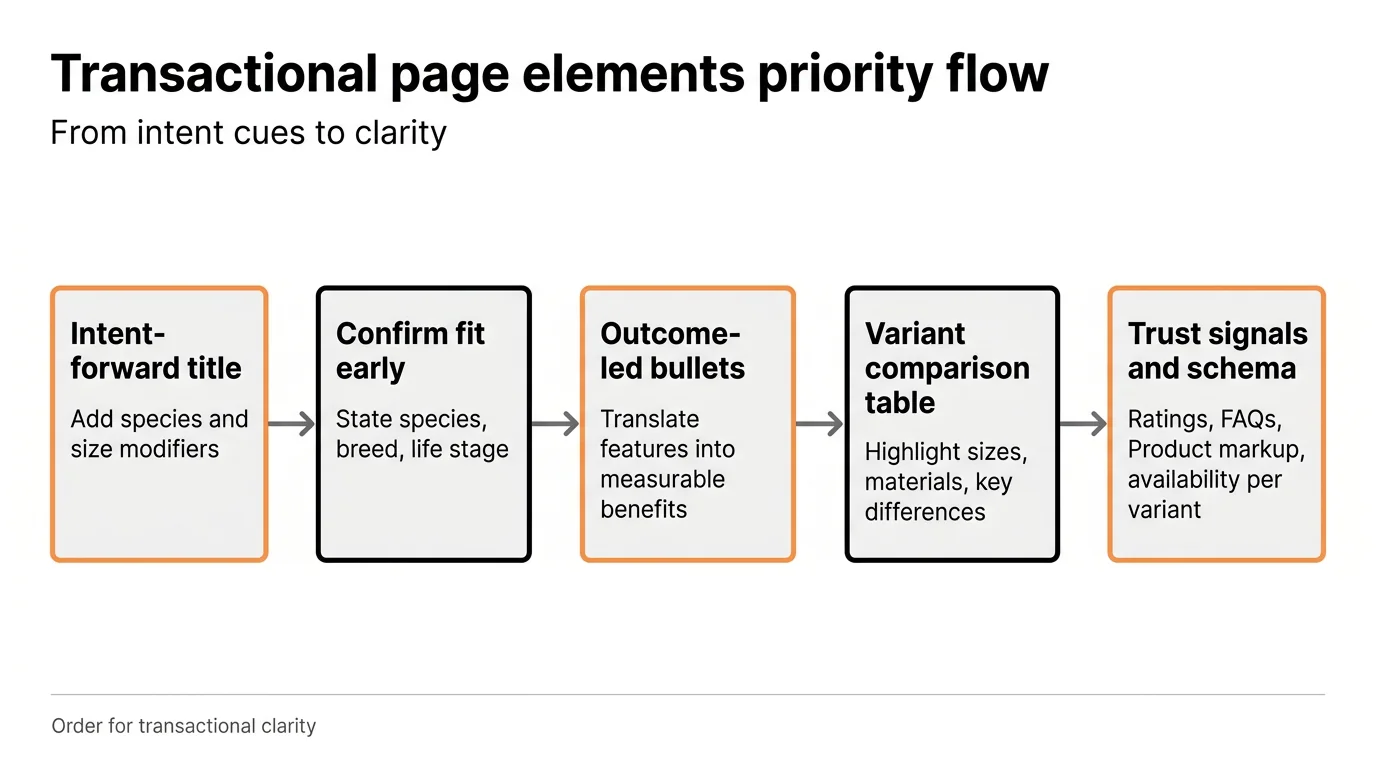
Make the title intent-forward with a species and size modifier where relevant. Keep the H1 descriptive and consistent. In the first 100 words, confirm fit, outcome, and differentiators to guide skimmers and search engines quickly.
Feature-to-benefit bullets and comparison table
Translate features into outcomes, using values or ranges when available. Add a compact comparison table to distinguish variants or alternative models. Tables support scannability and may reduce pogo-sticking for high-intent traffic.
FAQs and return/warranty microcopy
FAQs should reflect real questions from reviews, support tickets, and returns. Address sizing, cleaning, durability, and compatibility. Place microcopy for returns and warranties near the CTA to reduce friction and improve add-to-cart confidence.
Structured data and schema for pet product pages
Product, AggregateRating, FAQPage, and Breadcrumb
Implement Product with brand, SKU, material, and size. Include Offers with price, currency, and condition. Add AggregateRating from verified reviews and FAQPage that mirrors on-page content. Breadcrumb clarifies hierarchy. These rich elements may enhance visibility and CTR for pet eCommerce SEO[3]. For broader product-page strategy, see Product-Led SEO for Pet eCommerce.
Variant attributes and availability
Expose variants in schema with size, color, pattern, or pack-count attributes. Reflect availability per variant and use canonical tags appropriately. Consistent product schema for pets helps search engines index the right option and may prevent duplicate content issues[2].
Monitoring: what to check after 7-14 days and 4-8 weeks
Early signals: crawl, indexing, CTR shifts
Within 7-14 days, confirm that updated pages are crawled and indexed. Check for title and snippet changes. Watch CTR deltas for target queries and branded terms. Validate structured data status and fix warnings promptly[3].
Later signals: rankings, add-to-cart, returns, review themes
Across 4-8 weeks, watch ranking trajectories, add-to-cart rate, variant selections, and return rates. Review sentiment in new reviews and Q&A. Ensure analytics can track add-to-cart and variant selection events reliably. Attribute changes to specific releases using annotations and timestamps.
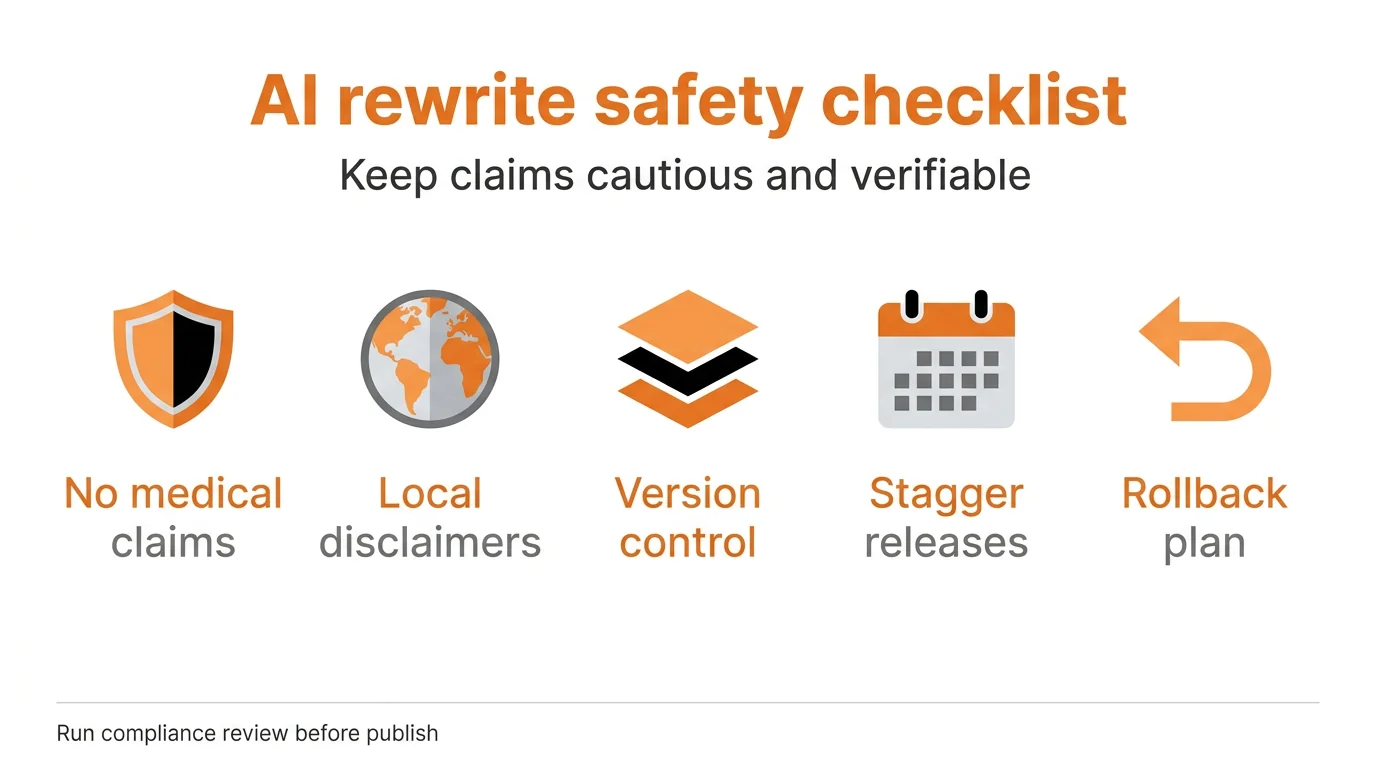
Practical safety boundaries for AI rewrites
Claims, compliance, and medical disclaimers
Use cautious, verifiable language, especially near health-adjacent statements. Avoid implying medical outcomes. Add region-appropriate disclaimers and direct customers to professional advice where necessary. Align copy with regulatory guidance and internal legal standards.
Version control and rollback
Maintain versioned drafts with change logs and publish dates. Stagger releases for high-revenue SKUs to isolate impact. Keep rollback-ready snapshots of copy, images, and schema in case metrics decline or compliance flags emerge.
Image and UGC handling
Do not alter user-generated content without permission. Tag UGC locations clearly. When using AI on images, avoid deceptive edits. Preserve size-scale cues and material textures. Compress responsibly to protect Core Web Vitals.
Evidence status: what current data suggests
Conversion patterns from intent-aligned copy
Research on AI-assisted content indicates that structured, data-informed generation can improve relevance and performance, particularly when grounded in verified inputs and user intent[1]. eCommerce studies suggest AI can streamline on-page optimization to support improved engagement and conversion outcomes when applied judiciously[2].
Impact of FAQ and Product schema on visibility
Structured data, especially Product and FAQPage, may enable enhanced snippets and richer displays. Implementations that strictly mirror on-page content tend to be more stable and crawl-friendly, supporting better SERP real estate and potential CTR gains[3].
Checklist: run this on your top SKUs first
Prioritization and implementation order
- Identify top SKUs by revenue and margin. Flag high-return or low-CTR items.
- Collect reviews, Q&A, returns, and sizing data. Create a structured brief.
- Rewrite titles, H1, and first 100 words. Add benefit-led bullets.
- Insert pet-specific attribute blocks and refine variant naming.
- Publish Product, AggregateRating, FAQPage, and Breadcrumb schema.
- QA internal links and canonical tags. Resubmit sitemaps.
- Monitor 7-14 day and 4-8 week signals with annotations.
Link back to the cluster hub
As you complete upgrades, revisit broader priorities and cross-page relationships. For orientation and next steps, go back to the AI Pet SEO hub. For interlinking patterns that move shoppers from discovery to purchase, see internal linking blueprints for pet stores. For visual search and AI Overviews opportunities, explore emerging pet query surfaces.
Frequently Asked Questions
What should I rewrite first on a pet product page?
Start with the SEO title, H1, opening summary, and benefit-led bullets. Then add pet-specific attributes (species, breed/size, life stage) and FAQs that reflect real customer questions.
How do I choose breed or size modifiers without keyword stuffing?
Select modifiers supported by search volume and your reviews or returns (e.g., durability for large breeds). Integrate naturally in headings, bullets, and schema variants instead of repeating them excessively.
Which schema may help pet product pages?
Use Product with offers, brand, material, size, and AggregateRating. Add FAQPage for common questions and Breadcrumb for context. Ensure data matches the visible page content.
How long until I see results from page upgrades?
Early signals like crawl and CTR may shift within 1-2 weeks. Ranking, add-to-cart rate, and review themes often need 4-8 weeks to show directional changes.
Can AI safely rewrite pet-health related claims?
Use cautious, verifiable language and cite sources where applicable. Add disclaimers for health-adjacent products and align copy with regulatory guidance in your regions.
Conclusion
Upgrading existing product pages with precise, pet-specific language, structured data, and intent-aligned messaging often unlocks faster gains than launching net-new content. Start with top SKUs and common friction points. Use reviews and returns to guide rewrites, and validate changes with staged monitoring. Evidence suggests AI-assisted optimization can improve on-page relevance and SERP presentation when grounded in verified inputs. With disciplined workflows, pet SEO automation can scale quality while protecting compliance and trust.
References
- M Reisenbichler et al. (2022). Frontiers: Supporting content marketing with natural language generation. Marketing …. View article
- R Macumber… (2024). Google, SEO and helpful content: How artificial intelligence can be helpful for e-commerce websites. Journal of Digital & Social ….
- TA Sjarief et al. (2024). Optimizing SEO Using OpenAI API for Content Automation on WordPress. 2024 International Conference …. View article
- T Suresh (2025). Natural language processing for internal link optimisation: Automating content relationships for better search engine optimisation. Journal of Digital & Social Media Marketing.