Product-Led SEO for Pet eCommerce: From Query to Add-to-Cart

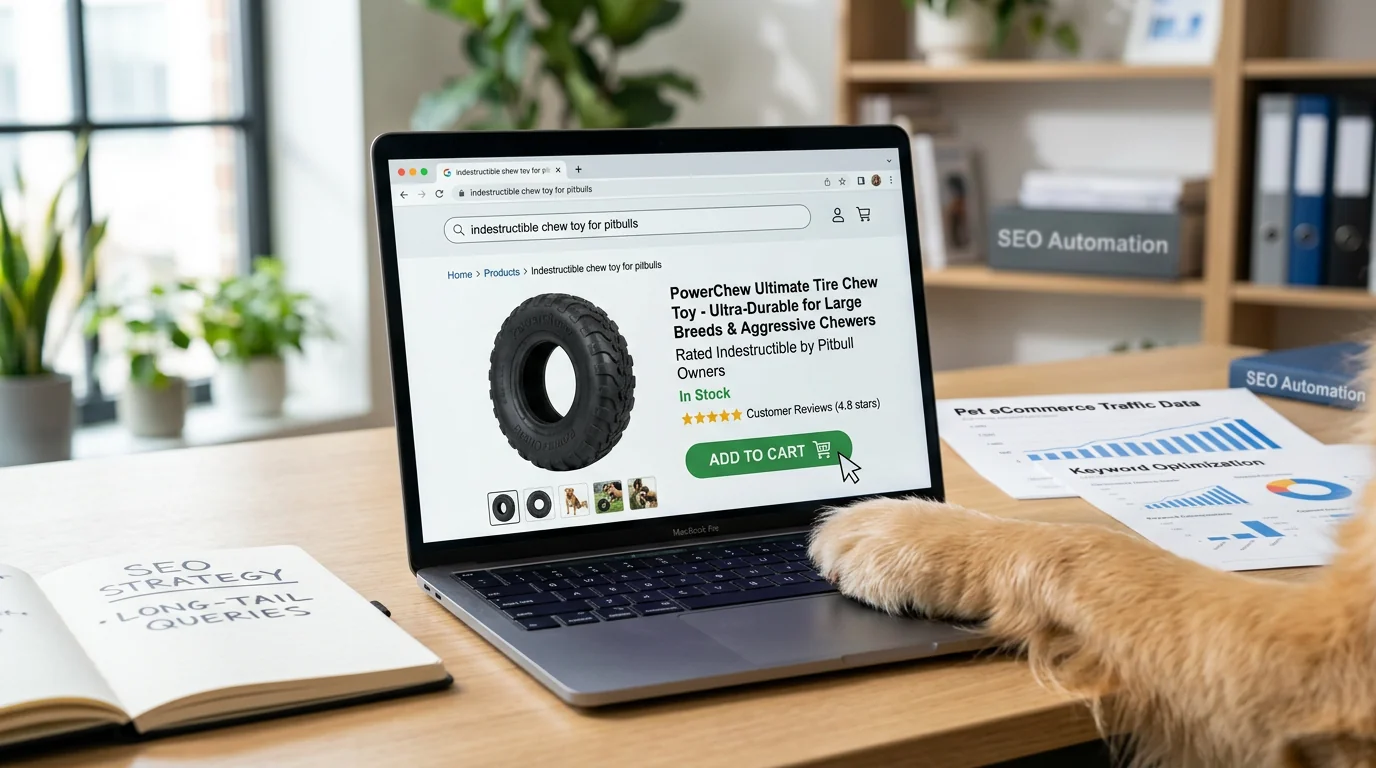
Table of Contents +
- The scenario: Connect long-tail pet intent to the right SKU
- Decision guide: If intent is X, map to Y page element
- Data model and URL architecture for intent capture
- On-page template: Category and product elements that matter
- Structured data and retrieval cues
- Monitoring: What to check after 7-14 days and 4-8 weeks
- Practical safety boundaries
- Evidence status: What research suggests vs. where to test
- Quick implementation checklist
- Frequently Asked Questions
- References
Structure pet category and product pages so AI and search engines map long-tail intent to SKUs, improving relevance and add-to-cart rates.
Shoppers type specific, high-intent queries and expect instant relevance. Search engines and AI systems reward pages that resolve intent with precise attributes and clear structure.
This guide shows how to structure pet category and product pages so long-tail intent maps to the right SKUs. You will learn template rules, attribute models, URL safeguards, schema, and monitoring steps that strengthen pet product page SEO and pet category SEO.
The scenario: Connect long-tail pet intent to the right SKU
Intent example: “indestructible chew toy for pitbulls”
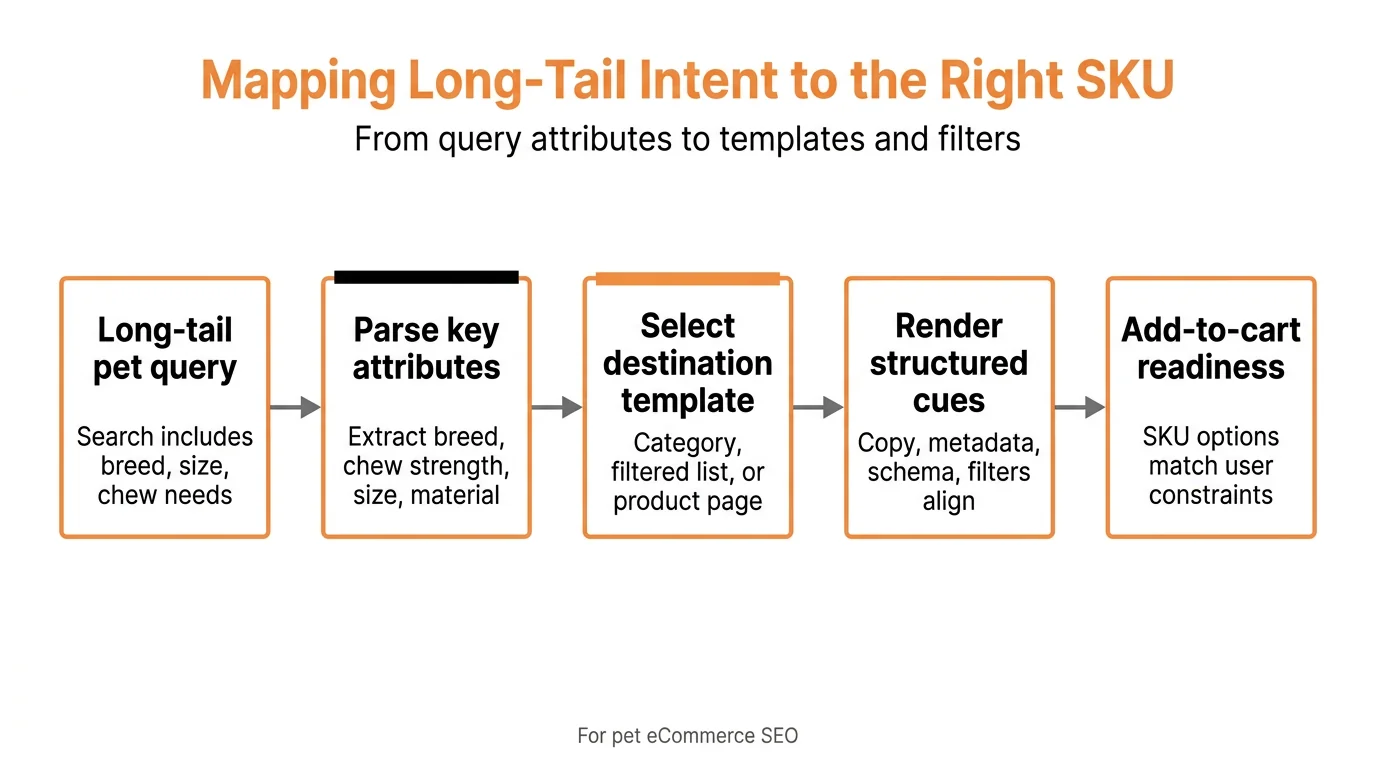
This query carries layered constraints. It signals chew strength, durability expectation, breed compatibility, and likely size and material preferences. Successful mapping means routing this intent to a filtered category view or a product detail page with explicit attributes. Both routes must display attributes and evidence supporting durability, size guidance, and suitability. Clear compatibility statements, comparison blocks, and consistent terminology reduce ambiguity. These elements also help match long-tail pet keywords that mirror real-world buyer language. The objective is not to target every variant. It is to represent attributes so any variant reliably resolves to the correct SKU or curated set.
Why category and product templates decide discoverability
Templates determine where attributes live and how they are rendered. They govern crawlable copy, metadata, schema, and filter logic. Search engines prioritize clarity, consistency, and redundancy of key signals across titles, H1s, faceted filters, and structured data. Strong templates translate intent into machine-readable cues. This increases relevance for ecommerce SEO for pet stores. For an orientation to this system thinking, see our AI-Powered Pet SEO hub, which frames navigation, content layers, and authority building for pet commerce experiences.
Petbase automates SEO content for pet stores - publishing 10 optimized articles monthly so you can focus on running your shop - start your free trial.
Decision guide: If intent is X, map to Y page element
Query pattern → template rule mapping (5-7 rules)
- If the query includes breed plus attribute (e.g., durability), route to the category with preselected filters and a descriptive intro. Reinforce with breed and attribute in H1 and copy.
- If the query names a material plus benefit, prioritize a category filter landing that sorts by that benefit. Use comparison to highlight material performance tiers and trade-offs.
- If the query uses superlatives (“strongest”, “best for heavy chewers”), route to category with “chew strength: extreme” filter and an explainer block. Offer evidence from reviews and testing notes.
- If the query names a specific product line, send to the product page with jump links to compatibility, materials, and size guide. Provide alternatives with the same attribute tier.
- If the query adds size qualifiers, enforce size filters on the category view. On product pages, display a fit matrix linking weight ranges to size variants with normalized units.
- If the query includes “vs” or comparisons, use a category comparison table anchor. Provide structured pros and cons and introduce relevant variants.
These mappings help resolve intent using structured cues. Industry analyses note that eCommerce search wins when systems align ranking with user value and conversion signals, not just text matches.[2]
Edge cases: mixed intent and ambiguous modifiers
Mixed intent appears when queries include multiple attributes with unclear priority, like “durable soft chew.” Default to the higher-risk constraint, such as chew strength, then surface soft-material alternatives. Ambiguous modifiers (e.g., “tough” versus “indestructible”) belong to canonical attribute tiers. Map both to a standardized “chew strength” scale in filters and copy. Provide a short definition tooltip. Evidence suggests this reduces zero-result states and improves downstream engagement, while avoiding brittle keyword-only routing. Broader research highlights that multi-objective relevance in eCommerce requires balancing text, behavior, and catalog structure together.[2]
Data model and URL architecture for intent capture
Attribute taxonomy: breed, size, chew strength, material, life stage
Adopt a normalized attribute set that anchors pet product page SEO. Recommended core attributes include breed, weight or neck girth ranges, chew strength tiers, primary material, secondary material, texture, life stage, and safety certifications. Use controlled vocabularies and numerical ranges for measurable fields. Chew strength should align to 3-5 tiers, such as moderate, strong, and extreme. Maintain a synonym dictionary linked to canonical attributes to support AI search optimization. Keep a content note field for testing details to support evidence in copy blocks. This structure makes attributes portable across categories and SKUs, enabling consistent filtering and reusable snippets.
Facet-safe URLs: indexable vs noindex parameters
Make single high-demand facets indexable, such as breed, size, or chew strength. Apply noindex to low-volume or overlapping combinations that inflate duplication. Permit sorting parameters as canonical variants only when default relevance is inferior. Persist only stable filters in crawlable URLs and cache frequently accessed combos. Research on search systems indicates that well-structured faceting and index policies may reduce retrieval noise and improve matching efficiency.[1]
Entity names in slugs, titles, and on-page copy
Use concise slugs reflecting entity and attribute, like /chew-toys/indestructible/pitbull. Titles should pair the category entity with the primary attribute and optional breed. On-page H1 should mirror the title with clarity. First-paragraph intros should reaffirm breed, size tier, and use case. Reuse the same attribute language in filter labels and comparison tables. This alignment reinforces long-tail pet keywords, strengthens disambiguation for AI systems, and stabilizes ranking across similar phrase variants. Avoid stuffing synonyms into titles. Instead, reflect variants in FAQs and glossary tooltips that sit below the main content.
On-page template: Category and product elements that matter
Category page: intro, filters, comparison, FAQ, schema
Effective pet category SEO depends on a scannable intro that defines the attribute logic, then clear filters with canonical attributes. Add a comparison module aligning chew strength, materials, and sizes with standardized units. Place micro-FAQs addressing durability expectations, size selection, and safety guidance. Include ItemList schema and a persistent “selected filters” strip to reinforce context. Link clusters with breadcrumbs and curated blocks. For deeper navigation tactics, review our internal linking blueprints that show how to guide users from discovery to product evaluation.
Product page: attributes, compatibility, alternatives, schema
Product pages should present a prominent attribute summary: chew strength tier, breed compatibility, material, size guide, certifications, and testing notes. Add a compatibility statement in a single standardized sentence. Insert a comparison row showing two close alternatives from the same attribute tier. Provide Review schema and structured availability and pricing. Surface a concise Q&A that mirrors common long-tail modifiers and answers directly. For global teams, ensure content is editable by language. See our approach to multi-language content creation to retain consistency across markets while honoring local phrasing.
Copy blocks for AI Overviews and visual search
Evidence suggests AI Overviews and multimodal systems prefer concise, attribute-dense statements with normalized units and explicit compatibility. Use two-sentence summaries, standardized measurement tables, and short Q&A blocks that echo common modifiers. Visual search may benefit from alt text describing material, form factor, and target breed. Teams seeking scale may consider using Petbase AI to programmatically generate structured compatibility blurbs, size tables, and micro-FAQs aligned to your taxonomy. Early studies on AI-enhanced search indicate structured attributes and learnable patterns can improve retrieval quality across varied contexts.[4]

Structured data and retrieval cues
Product, ItemList, FAQPage, and Review schema essentials
Use Product schema with name, brand, image, description, SKU, GTIN where available, size, material, audience, and offers. Add Review and AggregateRating if policy compliant. On category pages, render ItemList with position values and stable identifiers. Use FAQPage for common intent clarifications. Evidence from eCommerce research suggests aligning product metadata with user interaction goals can support ranking toward outcomes that correlate with revenue, not only clicks.[3]
Attribute-level annotations and unit normalization
Where possible, expose attribute values both in visible copy and as structured data properties or additionalProperty. Normalize units like inches and pounds, and provide metric equivalents. Keep chew strength as a standardized value, not free-text. Reinforce attribute ties between category and product via consistent names. For faceted ItemList results, use description fields to note selected filters. Search engineering research highlights that consistent attribute schemas and normalized data may improve filter efficacy and retrieval in large catalogs.[1]
Monitoring: What to check after 7-14 days and 4-8 weeks
Early signals (crawl, indexing, query matches)
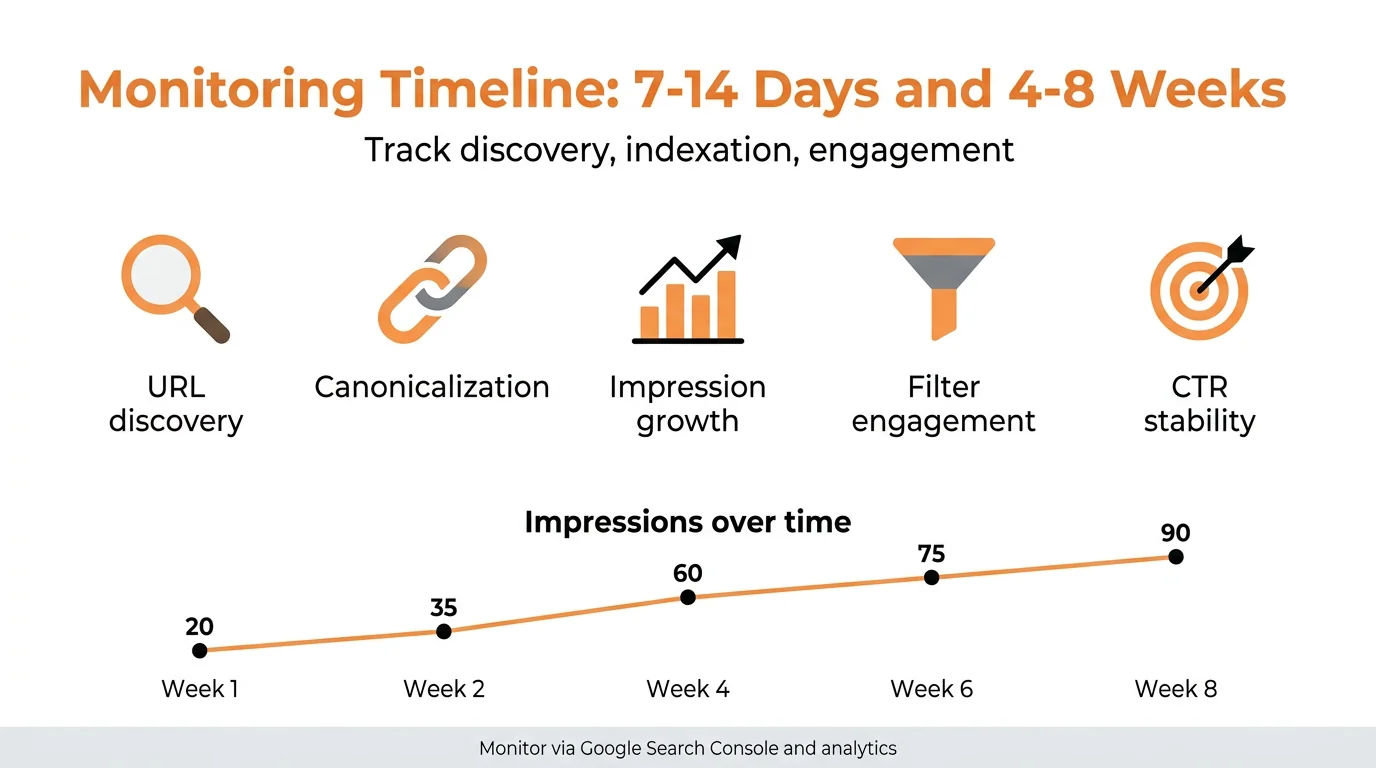
Within 7-14 days, verify that new or updated filtered category URLs are discovered, crawled, and indexed. Confirm canonicalization behaves as intended. Check query matching in Search Console for long-tail variants and attribute synonyms. Review server logs for bot behavior on filter parameters and confirm no accidental blockages. If weak impressions persist, test title adjustments with the primary attribute moved earlier. If AI Overviews appear for your terms, compare surfaced snippets with your attribute summaries and FAQs. Use lightweight rewrites to reinforce missing cues and optimize existing pages without disrupting stable URLs.
Mid-term signals (rank movement, filter usage, add-to-cart)
Across 4-8 weeks, look for rising impressions tied to target long-tail terms and stabilized average position. Monitor filter engagement and click-through from filtered category pages to product details. Evaluate comparison module interactions and exits. Track add-to-cart for products in the matched attribute tier and validate that product alternatives do not cannibalize conversion. Industry work suggests balancing ranking signals with commercial outcomes improves decision-making for search optimization cycles.[3] For a KPI framework tuned to pet commerce, see our guide on measurement at Measure What Matters: A Simple KPI Ladder for Pet SEO.
Practical safety boundaries
Indexation controls, duplication limits, and thin content guards
Index only filters with distinct demand and content strength. Apply noindex to low-signal combinations. Cap crawlable combinations per category to prevent index bloat. Set duplication thresholds by similarity score across titles, H1s, and ItemList memberships. Auto-hide pages with insufficient unique inventory or sparse copy. Avoid generating many near-duplicate variants for marginal gain. As research in eCommerce search emphasizes, excessive noise can degrade both retrieval and ranking efficiency.[2]
Compliance for materials and breed-suitability claims
Use cautious, evidence-based language for durability and compatibility. Avoid absolute terms like “unbreakable.” Reference materials and testing notes transparently. Keep safety certifications current and visible. Standardize warnings for unsuitable use cases. Ensure measurement guidance and fit recommendations are clear and standardized. Maintain a review moderation policy to reduce misleading claims. These steps help mitigate liability and strengthen consumer trust while supporting pet product page SEO signals.
Evidence status: What research suggests vs. where to test
What’s supported by industry studies
Research indicates eCommerce search benefits from structured attributes, faceted navigation, and ranking strategies aligned to commercial outcomes rather than pure lexical match.[2][3] Studies on data systems show that well-implemented indexing and facets can improve retrieval efficiency at scale, which may enhance visibility for structured category views.[1]
Areas needing site-specific experimentation
Optimal indexation of filters, copy density thresholds, and the exact placement of attribute summaries may vary by catalog size and user behavior. AI search optimization patterns are still evolving, especially around AI Overviews and multimodal retrieval.[4] Test short, standardized compatibility statements, measurement tables, and micro-FAQs. Compare their effects on query matching, engagement, and conversions across several categories before scaling templates universally.
Quick implementation checklist
Attributes, templates, internal links, and schema in one pass
- Confirm taxonomy: breed, size ranges, chew strength tiers, materials, life stage, certifications, and synonyms mapped to canonical values.
- Stabilize URLs: index only high-demand single facets; noindex overlapping combinations; verify canonical rules.
- Update templates: add attribute summaries, comparison blocks, compatibility lines, and measurement tables to category and product pages.
- Implement schema: Product, ItemList, Review, and FAQPage with normalized units and additionalProperty for key attributes.
- Strengthen navigation: apply breadcrumbs and curated blocks; follow internal linking blueprints to pass context and authority.
- Localize consistently: maintain taxonomy terms across locales using multi-language content creation workflows.
- Monitor and iterate: watch early and mid-term signals; selectively adjust titles, intros, and filter mappings.
- For AI surfaces: add concise Q&A, attribute-dense summaries, and alt text reflecting material, form factor, and target compatibility.
Frequently Asked Questions
Should I index breed-specific filtered pages?
Index high-demand, stable-intent filters like breed or size when they have unique demand and robust content. Use noindex for low-volume or overlapping combinations to avoid duplication.
What on-page elements help AI Overviews surface my products?
Evidence suggests clear attribute blocks, concise compatibility statements, and structured data may help retrieval. Add short Q&A, comparisons, and standardized measurements to improve matching.
How do I handle similar modifiers like “tough” vs “indestructible”?
Group near-synonyms under one canonical attribute (e.g., chew strength tiers) and reference variants in copy. Map the highest-volume term to the canonical URL; support others in headings and FAQs.
What metrics indicate correct intent-to-SKU mapping?
Rising impressions for target long-tail terms, higher filter engagement, improved product detail view rate from category, and incremental add-to-cart for matched segments may indicate progress.
Do I need separate pages for every breed?
Not always. Evidence suggests focusing on breeds with clear demand and unique product fit. Use dynamic modules on core category pages for lower-volume breeds to avoid thin content.
References
- VM Reddy et al. (2022). Enhancing Search Functionality in E-commerce with Elasticsearch and Big Data. International Journal of Advanced Engineering ….
- M Tsagkias et al. (2021). Challenges and research opportunities in ecommerce search and recommendations. ACM Sigir Forum. View article
- L Wu et al. (2018). Turning clicks into purchases: Revenue optimization for product search in e-commerce. … ACM SIGIR Conference on Research & …. View article
- SK Subramaniam (2025). AI-Based E-commerce Search Optimization. Journal Of Engineering And Computer Sciences. View article