Measure What Matters: A Simple KPI Ladder for Pet SEO


Table of Contents +
- Scenario: You need a lightweight KPI system across pet eCommerce and local services
- The KPI Ladder: From crawl to assisted revenue
- Quick decision guide
- Monitoring cadence: What to check at 7-14 days and 4-8 weeks
- Practical safety boundaries for pet SEO metrics
- Evidence status: What the data and industry research suggest
- Implementation notes for Petbase users
- Resources and next steps
- Frequently Asked Questions
- Conclusion
- References
A simple KPI ladder for pet SEO: track crawl, indexing, rankings, traffic, leads, and assisted revenue for pet eCommerce and local services.
Most pet businesses collect too many numbers and miss the few that drive outcomes. A compact KPI ladder focuses attention on what compounds results.
This matters because pet eCommerce and local services depend on crawl stability, findability, and revenue influence. You will learn a practical, staged system from crawl to assisted revenue with clear ranges, actions, and safety boundaries.
Scenario: You need a lightweight KPI system across pet eCommerce and local services
What this KPI ladder covers (and what it does not)
This ladder tracks essentials from crawl health to assisted revenue tracking. It aligns pet eCommerce SEO metrics and veterinary SEO KPIs without building a complex dashboard. It does not model lifetime value, advanced media mix modeling, or multi-touch probabilistic attribution.
The framework offers directional guardrails and pragmatic ranges. It is intentionally minimal to reduce noise. Teams can start with weekly checks, then deepen where evidence suggests value. Consider it a dependable baseline, not a final analytics architecture.
How to map store vs. clinic goals without overcomplicating data
Map store goals to product discovery and add-to-cart surrogates. Map clinic goals to local visibility and appointment intent events. Maintain separate funnels and shared technical underpinnings.
Use a single SEO measurement framework with two conversion end-states. Keep shared metrics at the top of the ladder. Split downstream metrics by commerce and services to ensure clarity across teams.
Petbase builds this SEO foundation automatically for pet businesses - 10 optimized articles published every month - start your free trial.
The KPI Ladder: From crawl to assisted revenue
Level 1: Crawl health (log hits, crawl stats, robots hygiene)
Track bot log hits, crawl rate by host, and error spikes. Confirm robots.txt and meta robots hygiene, including disallow rules and noindex scope. Crawl consistency often precedes visibility gains, so validate stability before content acceleration.[4]
Healthy range: week-over-week crawl hits within ±15% for stable sites. Alert if 404/5xx exceed 3% of crawled URLs or if sitemap fetch fails. For migrations, expect temporary volatility for 3-7 days.
Level 2: Indexation (valid pages, canonical alignment, product variants)
Monitor Search Console coverage, valid pages, and canonical match rate. For product variants, prioritize unique value or consolidate. Ensure XML sitemaps focus on indexable, profitable URLs rather than near-duplicates.
Healthy range: 90%+ canonical self-reference on core templates. Alert if new content indexation lags 10-14 days absent technical blockers. Reduce thin variants or use canonicalization to reallocate crawl budget.
Level 3: Visibility (rank buckets, SERP features, breed/condition terms)
Use rank buckets (Top 3, 4-10, 11-20, 21-50) to track directional coverage. Compare impressions with CTR by intent. Layer SERP features such as AI Overviews, images, and local packs for context.[4]
Build topical depth for breed and condition terms with safe templating approaches in programmatic pet SEO, and consider visual search surfaces in AI overviews and visual search. Link to the AI-Powered Pet SEO orientation hub when aligning broader planning.
Level 4: Qualified visits (non-brand sessions, landing page mix, local intent)
Segment non-brand sessions to verify net-new discovery. Track landing page mix by template: product, category, services, and guides. For local pet services SEO, monitor impressions and clicks from localized queries, including proximity modifiers and map packs.
Healthy range: non-brand share above 55% for growth programs. Alert if landing mix skews over 80% to blog posts without downstream engagement, suggesting insufficient product or service linkage.
Level 5: Engagement signals (add-to-cart, appointment intent, micro-CRO)
Instrument add-to-cart, appointment intent clicks, and micro-CRO events such as size guide opens or financing modal views. These signals may bridge earlier visibility gains to commercial proof, especially for long-consideration categories.
Healthy range: add-to-cart rate 4-10% on high-intent product landings; appointment intent rate 2-6% on service pages. Strengthen internal linking using pathways like From Blog to Basket: internal linking blueprints and add contextual anchors such as “indestructible dog toy for power chewers.”
Level 6: Revenue influence (assisted conversions and AOV context)
Use assisted conversions by channel/page group and annotate attribution windows. Pair with AOV and category margin context to avoid overweighting low-profit products. Validate uplift by comparing tagged journeys against baselines.
Healthy range: 10-30% of organic revenue showing assistance from content-led paths within 30-90 days. Evidence indicates AI-driven workflows can streamline metric tracking and reduce latency to insight.[2]
Quick decision guide
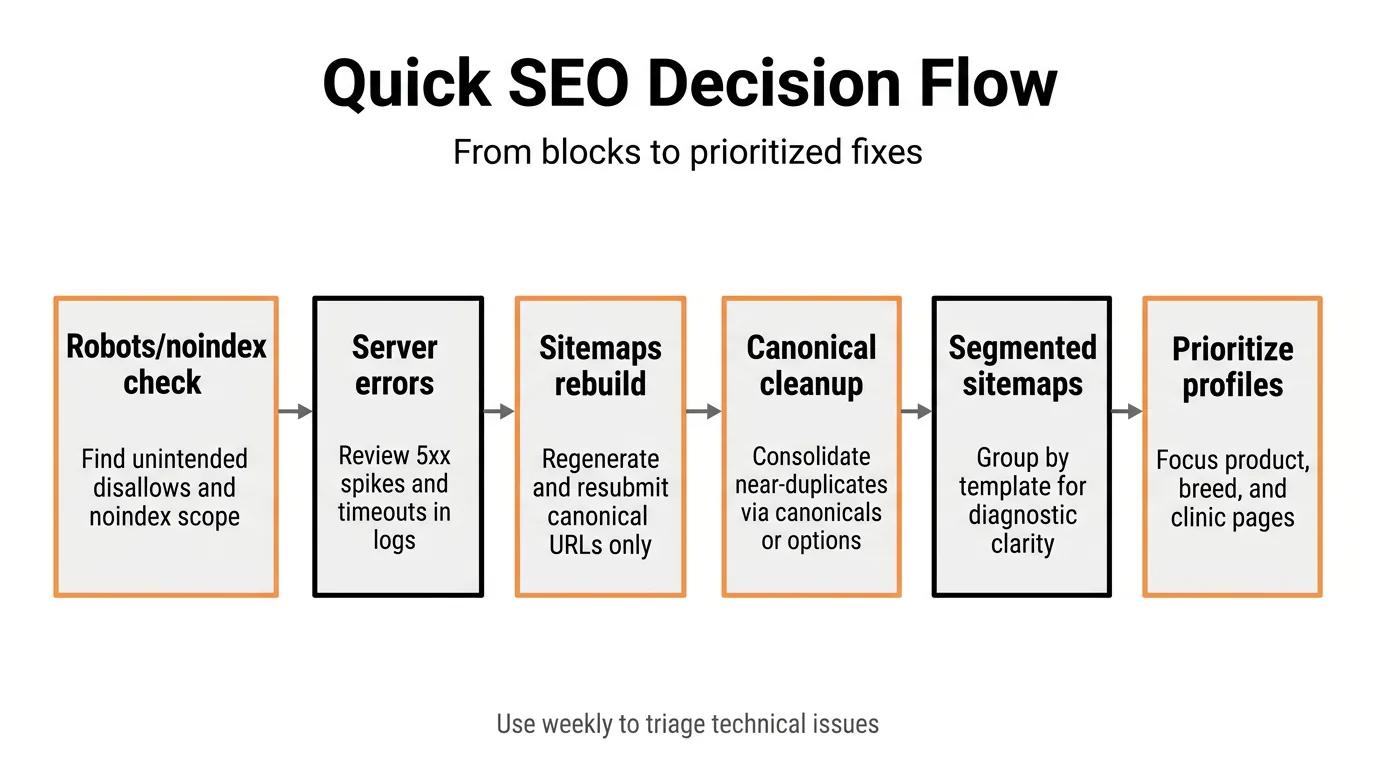
If crawl hits drop >25% week-over-week, then check robots, server errors, and sitemaps
Confirm no unintended disallows or noindex rules. Review server logs for 5xx spikes and timeouts. Rebuild and resubmit sitemaps to isolate canonical, indexable URLs and restore predictable crawl access quickly.
If index coverage stalls, then reduce thin variants and submit focused XML sitemaps
Audit near-duplicate variants and consolidate through canonicalization or structured options. Generate segmented sitemaps by template. Prioritize profitable, unique pages to guide bots toward the most valuable inventory.
If rankings improve but clicks do not, then test titles/meta for intent and SERP features
Revise titles for promise clarity, price or availability cues, and local modifiers. Add rich results where applicable. Monitor CTR shifts by device and bucket to attribute improvements to message-market fit.
If traffic rises without add-to-cart or calls, then refine internal linking and on-page offers
Strengthen pathways from informational pages to shoppable or service intent. Test trust badges, size guidance, trial packs, or service guarantees. Validate through uplift in micro-CRO and intent events before revenue changes.
If local pages get impressions but few calls, then enhance GBP, NAP, and local schema
Align name, address, phone across directories. Expand services, attributes, and Q&A on GBP. Add localBusiness schema with geocoordinates. Encourage fresh reviews and photos to support conversion cues from search.
If assisted revenue is flat, then retag journeys and evaluate attribution windows
Ensure UTMs, content groups, and product link parameters persist across sessions. Test 7-, 30-, and 90-day lookbacks. Compare pre/post internal linking to estimate influence without asserting strict causality.
Monitoring cadence: What to check at 7-14 days and 4-8 weeks
7-14 days: technical confirmation and early visibility signals
Validate crawl stability, error remediation, and sitemap ingestion. Confirm new pages indexed or queued. Watch for impressions in mid-tail and local packs. Automate checks when possible to reduce manual overhead and drift.
At this stage, small title/meta tests may yield early CTR cues. For content deployment rhythm and linking automation options, see Your 30-Day AI Content Plan for Pet Brands and AI Page Upgrades: Rewrite and Optimize.
4-8 weeks: intent validation, conversion pathways, and revenue influence
Assess rank bucket migration and non-brand session growth. Review add-to-cart, appointment intent, and micro-CRO trends. Begin assisted revenue analysis with conservative windows and category segmentation to reflect margin differences and AOV variance.
AI-enabled measurement and reporting may enhance decision speed and accuracy when responsibly configured.[2]
Practical safety boundaries for pet SEO metrics
Healthy ranges and alert thresholds
Crawl: ±15% WoW; alert at 25% drops. Indexation: 90%+ canonical alignment. Visibility: grow Top 10 share 10-20% over 8 weeks. Qualified visits: non-brand above 55%. Engagement: add-to-cart 4-10%, appointment intent 2-6%.
Revenue influence: aim for 10-30% content-assisted share over 90 days. Treat these as directional; category seasonality, inventory cycles, and clinic scheduling gaps may shift what “good” looks like month to month.
Avoiding false positives and seasonal noise
Beware campaign spillover, out-of-stock pages, and review bursts skewing CTR or conversion. Compare year-over-year where feasible. Use holdout content groups or staggered internal linking to infer influence without overclaiming causation.
Automated evaluation tools can differ in scoring emphasis, so triangulate with multiple sources to reduce tool bias and false confidence.[3]
Evidence status: What the data and industry research suggest
Signals with stronger support
Foundational technical factors-crawl accessibility, clean canonicals, and structured data-consistently correlate with findability across studies and practice.[4] Responsible AI workflows may improve measurement cadence, anomaly detection, and content iteration speed.[2]
Content automation aligned to search demand may support scalable gains when paired with governance and QA, as indicated by emerging AI-SEO research.[1] For practical pathways that convert, examine patterns in product-led SEO for pet eCommerce.
Areas where evidence is mixed or context-dependent
AI Overviews influence and local pack volatility remain uneven across categories and regions. CTR improvements from titles and rich snippets vary widely by query intent and competitor messaging. Attribution windows shape perceived assistance substantially.
Given this, triangulate signals across rank buckets, micro-CRO, and revenue assistance before scaling bets. Maintain annotations for merchandising, clinic hours, and promotional shifts that may confound interpretation.
Implementation notes for Petbase users
Mapping Petbase outputs to each KPI level
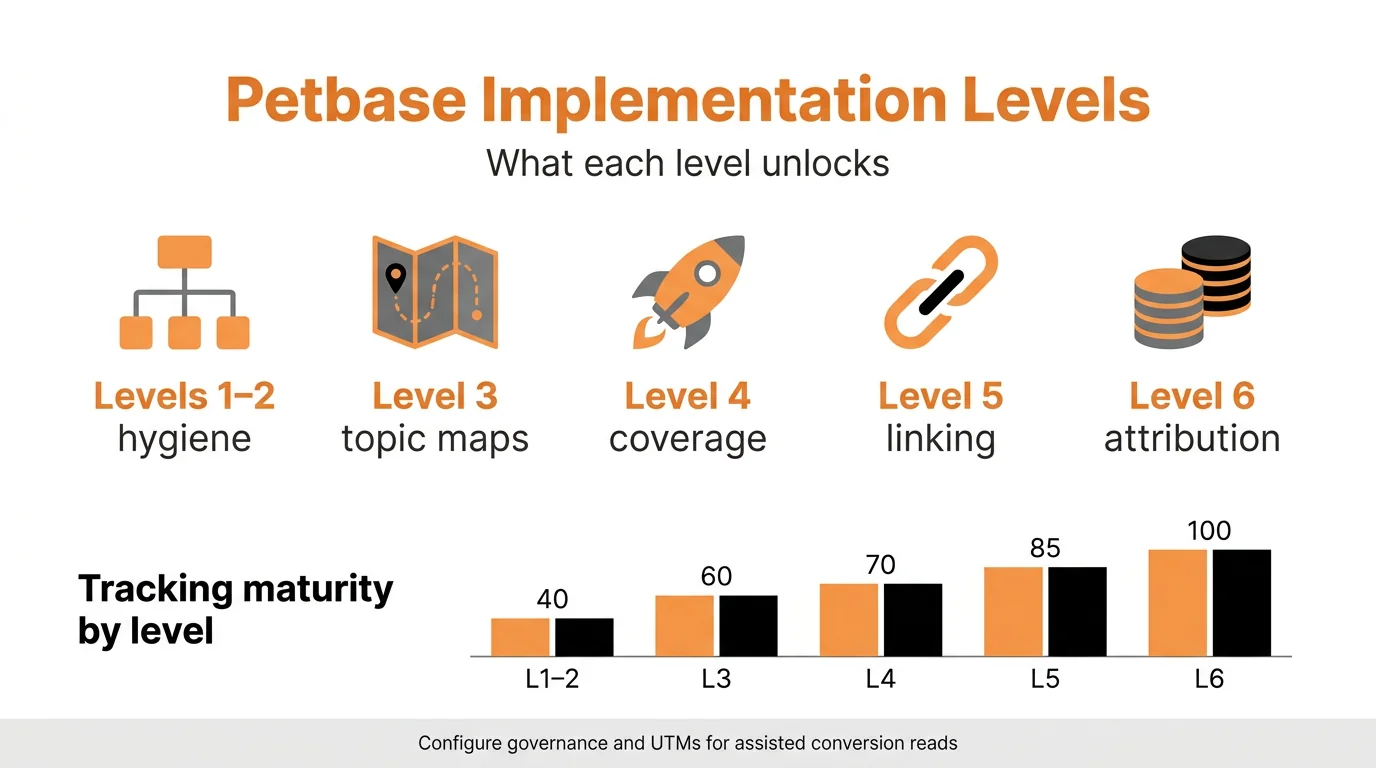
Levels 1-2: audit outputs flag robots, canonical, and sitemap issues for remediation. Level 3: topic maps expand breed, size, and condition coverage. Levels 4-5: internal linking blueprints route informational demand to shoppable or service pages.
Level 6: content groups and UTM governance enable assisted conversion reads. For cadence and publishing automation, many teams use Petbase AI to research, schedule, and iterate while keeping tagging consistent.
Data sources to connect (Search Console, Analytics, GBP, POS/eCom)
Connect Search Console for coverage, indexation, and query visibility. Use Analytics for sessions, events, and assisted conversions. Link GBP for local impressions, calls, and direction requests. Integrate POS/eCommerce data for AOV and margin context.
AI-powered SEO suites may consolidate these metrics, improve audit velocity, and surface anomalies more reliably than manual workflows.[1]
Resources and next steps
Where this ladder fits in your broader strategy
Use the ladder to stage priorities and preserve signal integrity. Align planning, content velocity, and technical hygiene within an outcomes-first approach. When expanding coverage or internationalizing, consult the broader hub at AI-Powered Pet SEO: The Orientation Hub.
Templates and checklists to replicate
Create a one-page dashboard: crawl stats, indexation deltas, rank buckets, non-brand sessions, engagement events, and assisted revenue. Add weekly annotations. Pair with internal linking SOPs informed by From Blog to Basket to connect discovery with action.
Frequently Asked Questions
What is a KPI ladder in pet SEO?
It is a staged measurement framework that moves from technical crawl and index basics up to visibility, qualified traffic, engagement, and assisted revenue. It may help teams focus on the next best metric rather than chasing vanity numbers.
How long before pet SEO metrics show meaningful change?
Technical and indexing shifts can appear within 1-2 weeks, while rankings and qualified traffic often need 4-8 weeks. Revenue influence typically needs stable tagging and longer windows due to seasonality and consideration cycles.
Which metrics matter most for local pet services?
Local impressions, calls, direction requests, and appointment intent events often signal progress. Evidence suggests consistency on GBP, NAP, reviews, and localized content may support these outcomes.
How do I track assisted revenue for pet eCommerce?
Use analytics-assisted conversion reports, UTM governance, and product-page linkage from content. Comparing pre/post internal linking and attribution windows may clarify influence without overclaiming causality.
Should I track rankings or just traffic and revenue?
Rankings can guide intent and coverage, especially for breed, size, and condition queries. They should be paired with click-through, landing page quality, and downstream events to avoid overemphasis on position alone.
Conclusion
A lean KPI ladder helps pet stores and local services measure what matters without drowning in dashboards. Start with crawl and index reliability, progress to visibility and qualified visits, then validate engagement and assisted revenue. Maintain cautious attribution, seasonal awareness, and clear annotations. Evidence suggests AI-enabled workflows may accelerate learning cycles when paired with governance and human judgment. With disciplined measurement, every optimization gains a traceable business purpose.
References
- R Sivahari (2025). A STUDY ON AI-POWERED SEO OPTIMIZATION: TRANSFORMING SEARCH ENGINE RANKINGS AND ORGANIC TRAFFIC GROWTH IN DIGITAL MARKETING. JOURNAL OF ADVANCE AND FUTURE RESEARCH. View article
- U Sarkar et al. (2024). Optimizing SEO with AI: Achieving Success Through Responsible Innovation. International Conference on …. View article
- A Kwangsawad et al. (2019). The performance evaluation of a website using automated evaluation tools. 2019 4th Technology …. View article
- A Gopalakrishna (2024). SEO-Oriented Web Applications: A Comprehensive Guide. INTERNATIONAL JOURNAL OF COMPUTER …. View article