Programmatic SEO for Large Pet Catalogs: Safe Templates by Breed and Use-Case

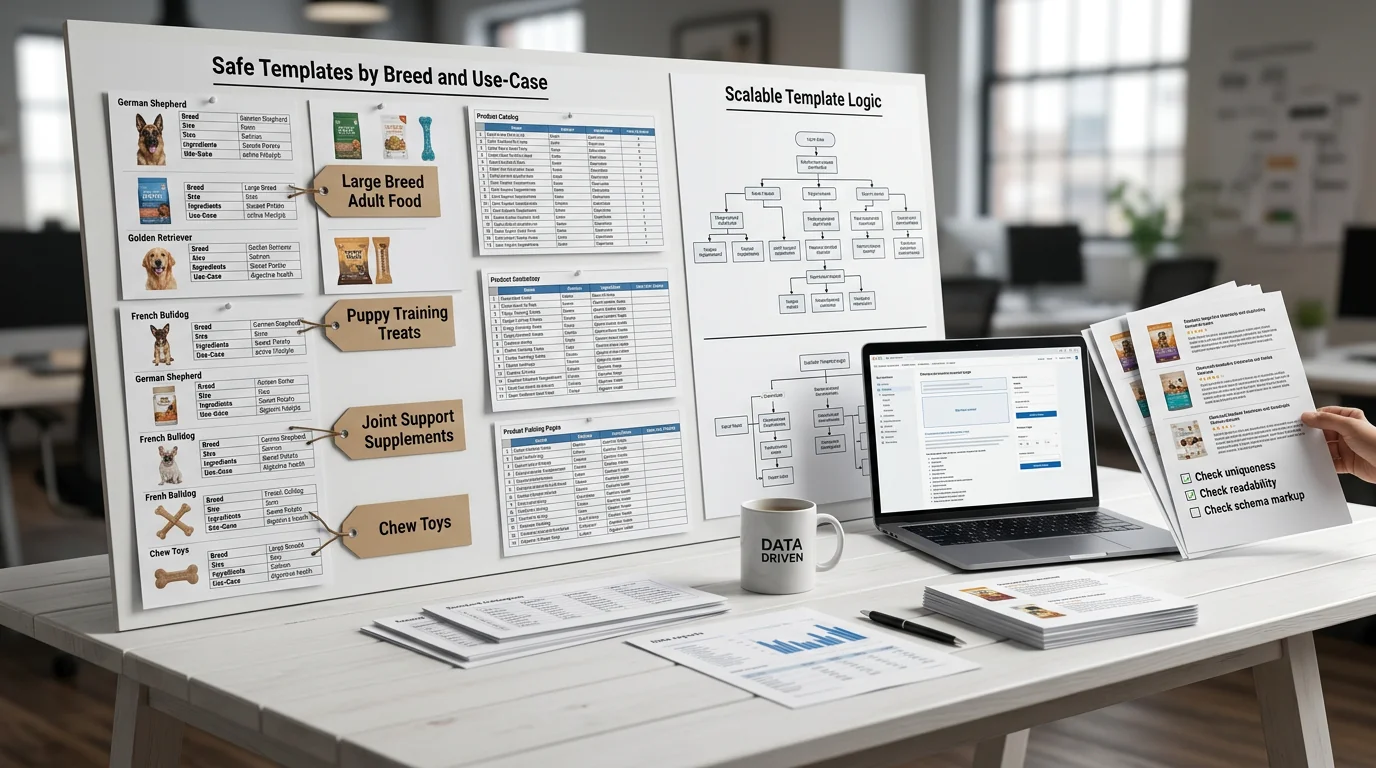
Table of Contents +
- Context: One problem this article solves
- Template blueprint: Breed × Use-case without spam
- Quick decision guide (if X then do Y)
- Practical safety boundaries for templates
- Monitoring: What to check after 7-14 days and 4-8 weeks
- Evidence status: What is known vs. emerging
- Annotated example: Safe template for “Pitbull power chewer toys”
- Frequently Asked Questions
- Conclusion
- References
Design scalable, non-spammy templates by breed and use-case. Learn patterns, safety bounds, de-duplication, and monitoring for large pet catalogs.
Scaling breed and use-case pages promises significant traffic. It also invites duplication risks and quality penalties. Many catalogs repeat similar claims across hundreds of combinations. Search engines may treat this as thin or redundant.
This article shows how to design safe templates. You will learn how to structure data, set canonical logic, and tune on-page blocks. You will also see practical thresholds that minimize duplication and protect rankings.
Context: One problem this article solves
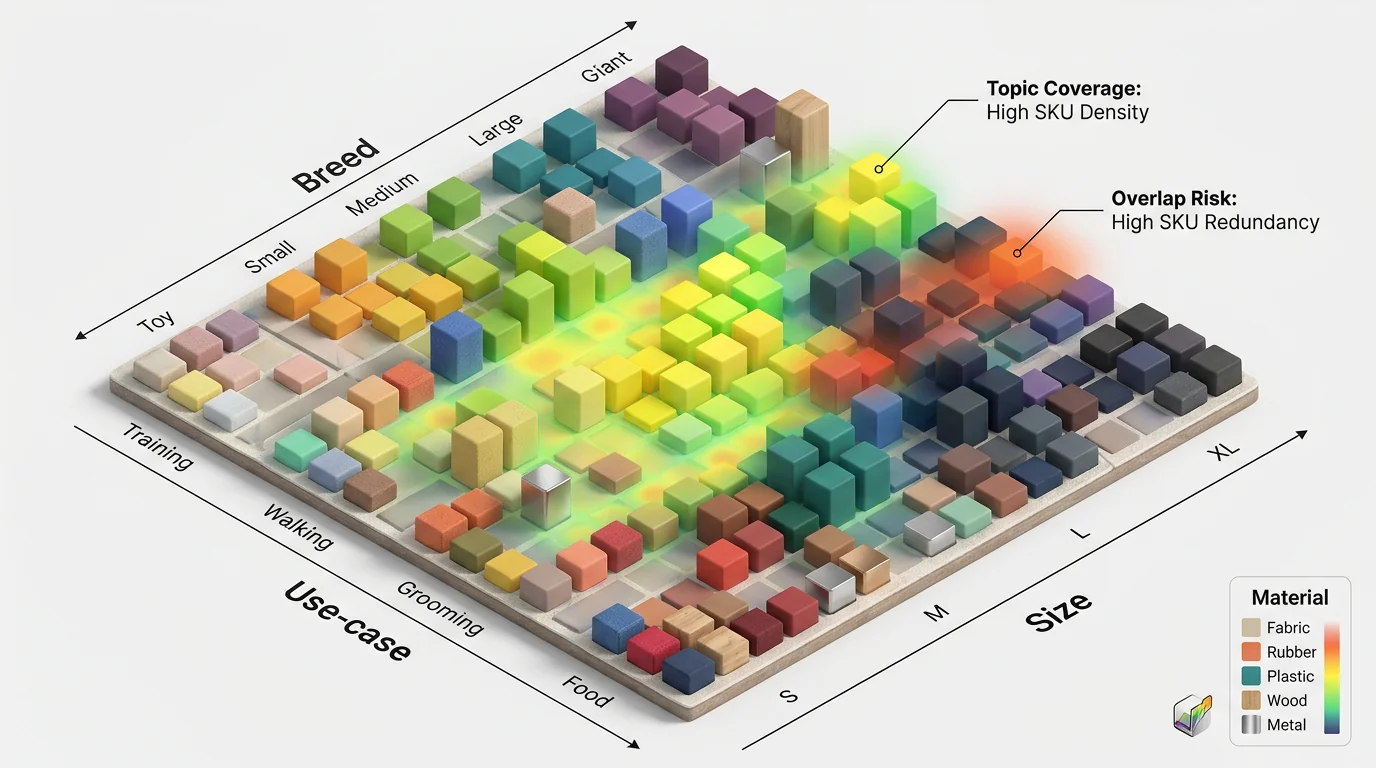
Pet catalogs expand quickly when you multiply breeds, sizes, ingredients, and scenarios. The upside is topic coverage and SKU exposure. The downside is near-duplicate pages that differ only by tokens, such as breed names or ingredient toggles.
Why breed and use-case templates risk duplication at scale
Breeds may share care standards, bite-force ranges, or ingredient tolerances. Use-case SEO pages often recycle the same advice. Parameterized content repeats language structures, causing algorithmic similarity and cannibalization across clusters.
What a “safe” template looks like for pet catalogs
A safe template enforces data-driven, attribute-level variation. It ties guidance to measurable differences, such as bite force, jaw shape, or allergen prevalence. It also defines canonical consolidation paths and clear noindex conditions for borderline overlaps.
Petbase automates SEO content for pet stores - publishing 10 optimized articles monthly so you can focus on running your shop - start your free trial.
Template blueprint: Breed × Use-case without spam
Start with a schema-like data model, then render unique blocks that map to that model. Add explicit canonical rules for adjacent variants. Tools such as Petbase AI may accelerate templating and governance for pet eCommerce SEO.
Data model: attributes, constraints, and merge rules
Model attributes across four pillars: Breed (jaw shape, average bite force, known sensitivities), Size (weight bands, toy dimensions), Ingredient/Material (protein source, allergen flags, hardness), and Use-case (chewing, digestion, enrichment). Encode constraints and fallbacks to prevent empty states.
Define merge rules for overlapping intents. For example, “large chewer” and a specific strong-jaw breed may share thresholds. In those cases, set primary intent, then inherit secondary facets to reduce redundancy. Knowledge-graph approaches may improve consistency and disambiguation[4].
On-page layout: sections that add real variation
Prioritize blocks that change meaningfully by attribute. Examples include bite-force-aligned material guidance, SKU lists filtered by size and hardness, common owner scenarios, and vet-reviewed safety notes for ingredient flags. Use breed-specific SEO templates only when measurable deltas exist.
Implement Product and ItemList structured data. Align availability, price, and attribute annotations with rendered content to reduce ambiguity and support parsers that extract product details[1].
Canonical and indexing rules for similar variants
When similarity across variants exceeds chosen thresholds, consolidate with canonicals to the dominant intent page. For near-identical size variants, canonicalize to breed if SERPs prefer breed, or vice versa. Use noindex for sparse inventory or weak query fit.
NLP-assisted clustering may help identify overlapping pages that compete for the same queries, informing canonical directions and internal linking flows[3].
Quick decision guide (if X then do Y)
If the keyword is “{breed} + {use-case}” with >150 monthly searches and low cannibalization, publish a full template
Launch a complete template with data-driven blocks and SKU modules. Validate uniqueness against adjacent size or material pages. Add clear internal links to the parent use-case hub for context and navigation.
If intent is mixed informational (how-to + products), create a hybrid guide with product modules
Lead with guidance, then surface curated SKUs and filters. Keep product blocks strictly relevant to the use-case. Separate safety notes, benefits, and owner scenarios to preserve scannability and depth.
If there is high overlap with “{size} + {use-case}”, prioritize size and reference the breed internally
Publish the size page as primary when SERPs cluster by size. Mention the breed within content and FAQs. Canonicalize breed duplicates to the size page to avoid parallel targeting.
If inventory has fewer than three relevant SKUs for the combination, use an informational page with a limited dynamic list
Render a guidance-first page with a constrained product carousel. Mark it noindex until inventory meets thresholds. Expand to full indexable template when availability stabilizes.
If the SERP shows veterinary guides, add a safety section and citations from recognized sources
Insert vet-reviewed disclaimers and contraindications for sensitive ingredients. Use conservative language. Ensure product claims align with safety notes to reduce perceived spam and improve trust signals.
If sibling pages compete, consolidate and apply a canonical to the highest-demand version
Measure impressions, CTR, and conversions. Keep the page that best matches dominant intent and has stronger performance. Redirect or canonicalize weaker variants, and merge unique content blocks.
If the query includes sensitive ingredients (grain-free, chicken), add disclaimers and filter by label
Gate products with explicit labels and allergen tags. Add a short risk statement referencing typical sensitivities. Provide toggles for alternative materials or proteins to improve user control.
Practical safety boundaries for templates
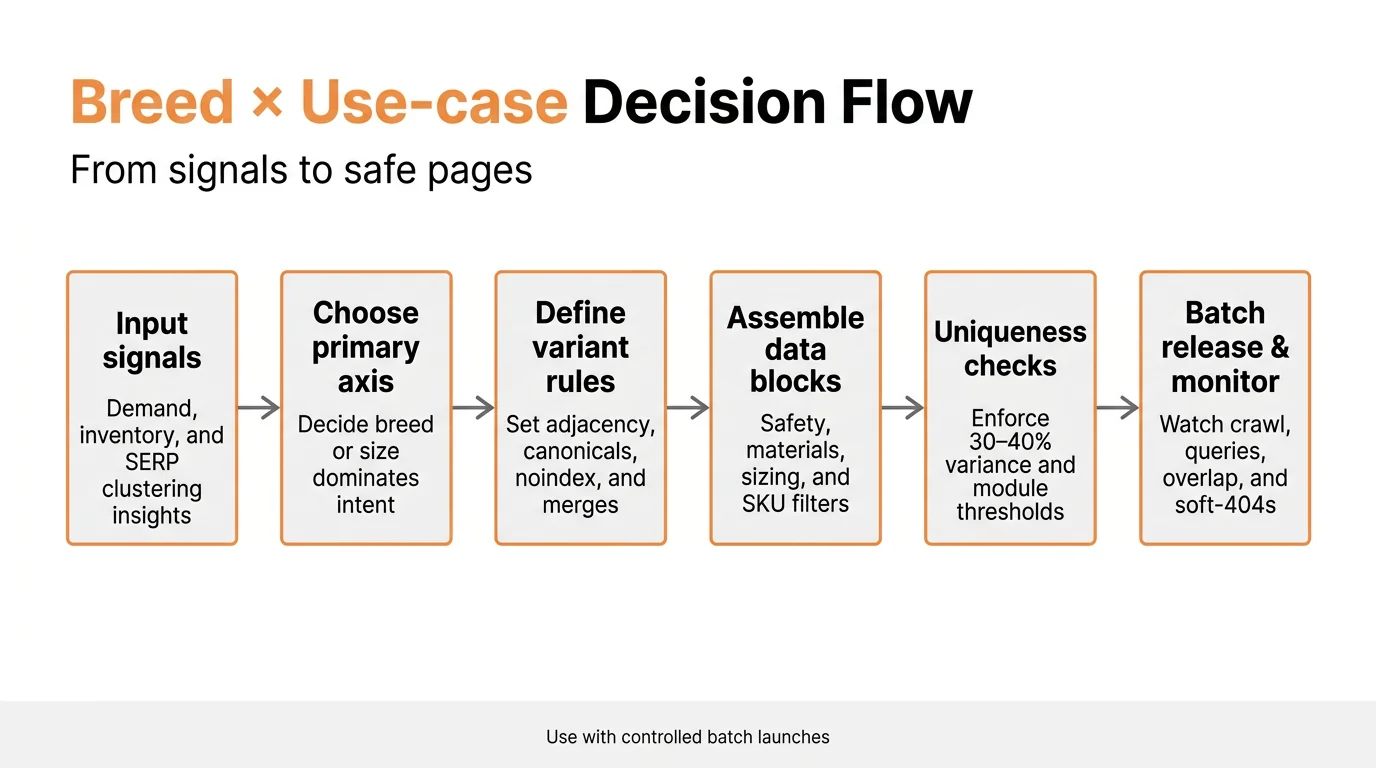
Adopt conservative thresholds and escalation paths. Enforce minimum uniqueness and inventory rules to avoid thin content. Document conditions for noindex and consolidation in your governance playbook.
Minimum viable uniqueness thresholds
Target at least 30-40% block-level variance across sibling pages. Require two or more unique, data-backed modules per combination. Examples: breed-specific bite-force guidance and SKU availability filtered by dimension and hardness.
Content blocks that must be data-driven, not spun
Safety notes, material suitability, and owner scenarios should reference attributes and metrics, not synonyms. Parameterized content must change recommendations, thresholds, or filters-not only wording. Maintain a changelog to trace attribute-to-text logic.
When to noindex or consolidate
Noindex when inventory falls below three qualifying SKUs, when similarity exceeds defined thresholds, or when intent mismatches observed queries. Consolidate to the highest-demand page with the clearest engagement and revenue alignment.
Monitoring: What to check after 7-14 days and 4-8 weeks
Release pages in controlled batches. Inspect crawl behavior, query capture, and overlap signals early. Then evaluate rankings, CTR, and SKU fit over longer windows.
7-14 days: crawl health, duplication, and query mapping
Check indexation coverage, canonical respect, and soft-404 incidence. Review clustering of queries to detect cannibalization. NLP-assisted internal linking may improve discovery and distribute equity to primary hubs[3]. Align observed queries to your declared intents.
4-8 weeks: rankings, CTR deltas, and inventory fit
Track position trends, refine titles and descriptions, and compare CTR against baselines. Validate that listed SKUs stay in stock and fit the page’s attributes. AI-supported optimization may enhance eCommerce competitiveness when guided by demand signals[2]. Consider reporting via KPIs and dashboards.
Evidence status: What is known vs. emerging
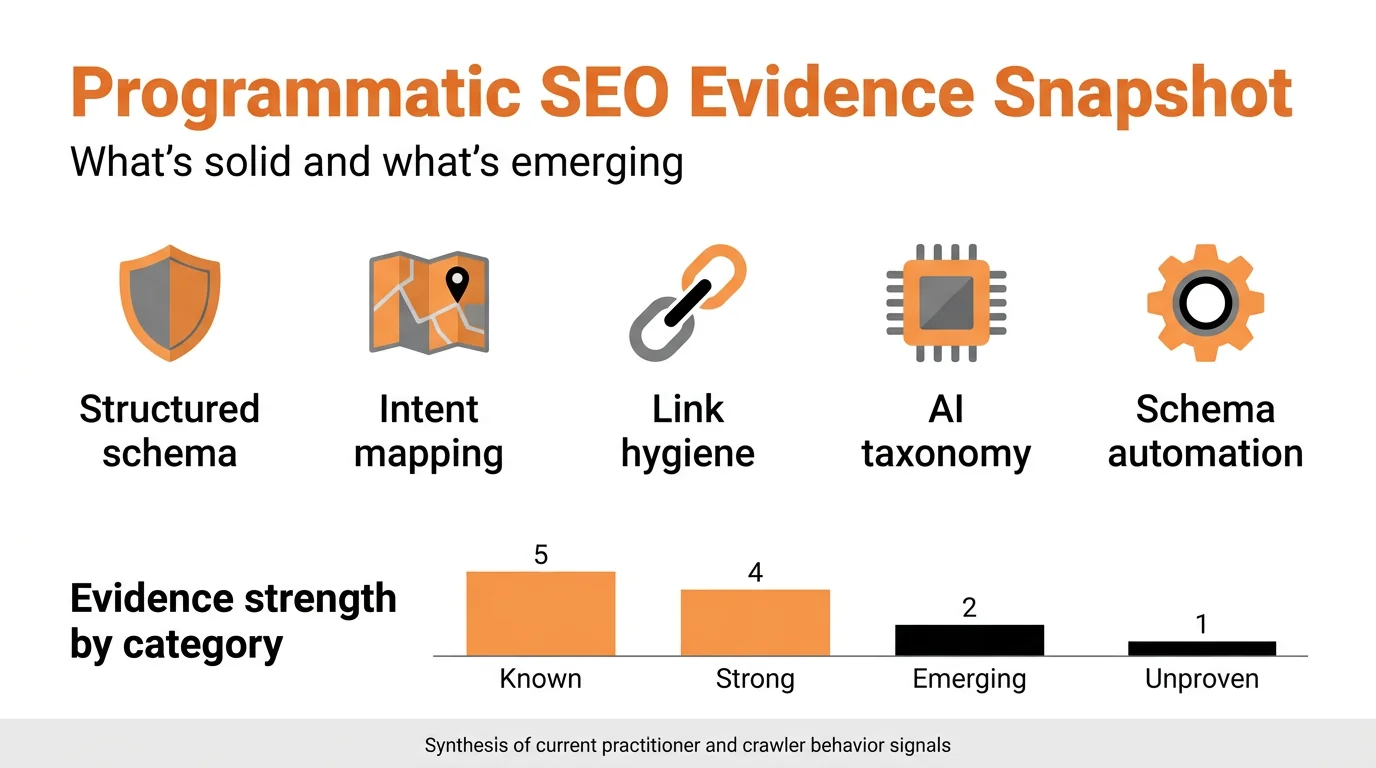
Template governance benefits from structured data, clear intent mapping, and internal link hygiene. Evidence for AI-assisted taxonomy and schema automation is promising, though practical results vary by site scale and data quality.
Signals that may support template indexing
Consistent Product and ItemList schema aligned with visible content may aid clarity for crawlers and knowledge extraction[1]. Ontology-driven attribute models can reduce ambiguity and support intent resolution at scale[4].
Areas with mixed or evolving evidence
Automated internal linking via NLP shows potential but requires careful evaluation to avoid link flooding[3]. AI-driven SERP intent prediction may help prioritization, though outcomes depend on competitive dynamics and content freshness[2].
Annotated example: Safe template for “Pitbull power chewer toys”
This example illustrates a breed × use-case page with strong attribute-level variation. It references materials, toughness, and sizing validated against bite-force ranges. It also prevents duplication with size and material siblings using explicit rules.
Field-by-field specification
Title: “Best Durable Toys for {Breed} Power Chewers.” Intro: Two-sentence summary on durability and safety. Safety Block: Vet-reviewed notes on supervision and wear checks. Material Guidance: Rubber hardness ratings, nylon durability, stitch density.
SKU Module: Filtered by hardness ≥X, size ≥Y, warranty flag. Owner Scenarios: Indoor chew sessions, crate-safe options, supervised tug. FAQ: Sizing, replacement cadence, cleaning. Internal Links: Point to the use-case hub and sibling materials such as internal linking blueprints and to Product-Led SEO: Mapping Breed, Size, and Life-Stage Queries to Pet SKUs.
De-duplication logic with size and material facets
If the size-intent page outperforms, canonicalize breed duplicates to the size page. If the material-intent page dominates (e.g., “durable rubber toys”), reference breed within content and set breed pages as secondary. Merge unique FAQs and safety notes.
Include breadcrumb links back to the parent use-case hub, such as “chew toys,” and forward links to sibling facets like “durable rubber toys for power chewers.” Add a body link to the pillar, AI Content for Pet Brands: Strategy, Priorities, and Playbooks, for strategic context.
Frequently Asked Questions
How many breed × use-case pages can I launch without risking duplication?
Evidence suggests starting with the top 20-50 combinations filtered by demand and inventory fit. Expand in batches after monitoring overlap, crawl stats, and early query capture.
Should I canonicalize size pages to breed pages or the other way around?
It depends on intent. If SERPs cluster around size for your niche, make size primary and reference breed variants. If breed intent dominates, canonicalize similar size variants to the breed page.
What content blocks add enough uniqueness at scale?
Data-driven blocks such as SKU availability by attribute, vet-reviewed safety notes, material suitability per bite force, and owner scenarios may provide substantive variation across pages.
How do I avoid thin pages when inventory is low?
Gate template generation with inventory thresholds, enrich with guidance modules, and use noindex until SKU count and supporting media meet predefined minimums.
Do I need structured data on each template?
Product and ItemList schema may help discovery and clarity. Ensure consistency with on-page content and avoid marking unavailable items as InStock.
Conclusion
Scalable breed and use-case templates succeed when data models drive real variation, and consolidation rules prevent overlap. Start conservatively, enforce uniqueness and inventory thresholds, and monitor early signals. Pair structured data with disciplined internal linking to strengthen clarity and resilience. For broader systems thinking, align templates and governance with your organizational playbooks and measurement frameworks.
References
- BUD Abbasi et al. (2022). Autonomous schema markups based on intelligent computing for search engine optimization. PeerJ Computer ….
- R Hasan (2025). Enhancing Market Competitiveness Through AI-Powered SEO And Digital Marketing Strategies In E-Commerce. ASRC Procedia: Global Perspectives in …. View article
- T Suresh (2025). Natural language processing for internal link optimisation: Automating content relationships for better search engine optimisation. Journal of Digital & Social Media Marketing.
- E Gjorgjevska et al. (2026). SEOntology: Writing the Future of SEO. semantic-web-journal.net. View article