Product-Led SEO: Mapping Breed, Size, and Life-Stage Queries to Pet SKUs


Table of Contents +
- The One Problem This Guide Solves
- Data Model: Turn Query Patterns Into SKU Attributes
- Template System: Landing Pages That Align to SKUs
- Query → Page Mapping Examples
- Quick Decision Guide
- Monitoring and Iteration
- Practical Safety Boundaries
- Evidence Status and What We Know So Far
- Technical Checklist
- How This Supports Your AI Content System
- Frequently Asked Questions
- References
Learn how to convert breed, size, and life-stage search queries into SKU-backed landing pages that rank and drive revenue for pet brands.
Shoppers type with intent, not categories. “Best indestructible dog toys for Pitbulls” signals specific needs and immediate purchase potential. Generic pages rarely satisfy such layered expectations.
This matters because intent-matched pages may lift relevance, click-through, and conversion without paid spend. You will learn a practical mapping method that translates nuanced queries into SKU-backed landing pages, safe copy, and measurable results.
The One Problem This Guide Solves
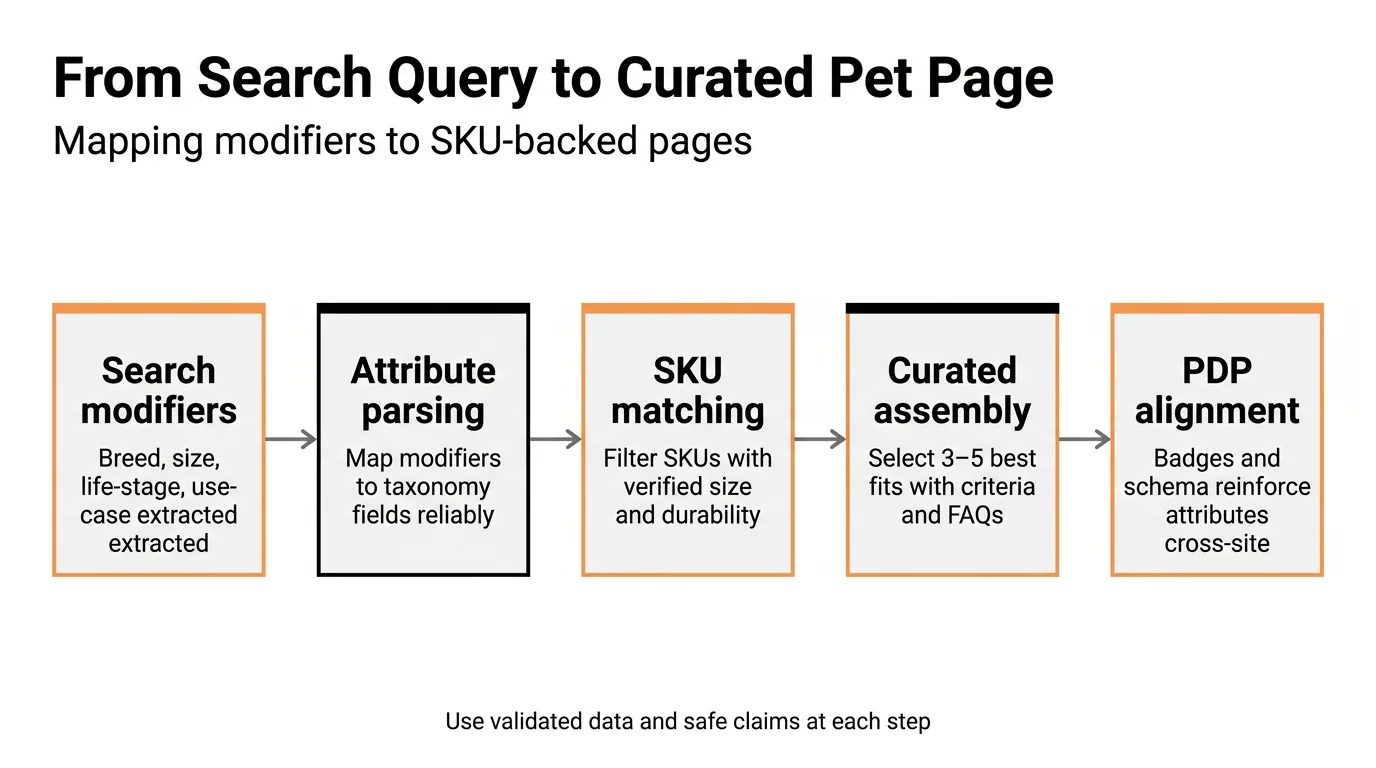
High-intent pet queries combine breed, size, life-stage, and use-case. Most catalogs are not structured to answer them. The solution is a page system tied to SKU attributes that reflects real shopper intent.
From intent like “indestructible toys for Pitbulls” to a buyable page
Parse the query into attributes. Match to SKUs with verified durability and size data. Assemble a curated page with 3-5 options, buying criteria, FAQs, and filters connected to inventory.
Why generic product pages miss breed/size/life-stage demand
Generic category pages lack attribute depth and proof. They often cannot filter by breed or life-stage, which weakens relevance signals and forces users to research elsewhere before purchasing.
Petbase automates SEO content for pet stores - publishing 10 optimized articles monthly so you can focus on running your shop - start your free trial.
Data Model: Turn Query Patterns Into SKU Attributes
Strong eCommerce SEO for pet brands starts with data. Build a taxonomy that aligns search modifiers to product attributes. Precision in structure may improve retrieval and reduce noise in ranking signals.[2]
Map intent → attributes: breed, size, life-stage, material, use-case
Extract modifiers systematically. Store breed, size, life-stage, material, and use-case as discrete fields. Structured, taxonomy-driven metadata may enhance indexing and relevance scoring for layered intents.[1]
Normalize your catalog: required vs optional attributes
Define required attributes for each category. For toys: size, chew-strength, material, safety notes. Set optional fields, like noise level or floatability. Consistency improves filters and site-wide query resolution.
Attribute coverage audit: detect gaps that block rankings
Audit SKUs for missing attributes by category. Flag low coverage areas. Prioritize updates where demand is evident and metadata is sparse. Evidence suggests better attribute density improves retrieval precision.[2]
Template System: Landing Pages That Align to SKUs
Templates convert intent into navigable, SKU-backed landing pages. This is programmatic SEO for pets, but with stricter safety and quality controls than generic faceted browsing.
URL and slug conventions (breed/size/life-stage/use-case)
Adopt consistent slugs: /dogs/toys/indestructible/pitbull/ or /cats/food/senior/grain-free/sensitive-stomach/. Keep lowercase, hyphenated, and stable. Use canonical tags to avoid duplicates from filter permutations.
On-page blocks: filters, top picks, buying criteria, FAQs, schema
Use a curated “Top Picks” list, filter panel for attributes, concise buying criteria, and an FAQ block. Implement ItemList and Product schema, and ensure crawlable PDP links with clear anchor text.
Evidence-driven copy: durability claims, testing notes, care tips
Support claims with testing context. Indicate chew tests, material specs, and supervision tips. Use cautious wording. Evidence-aligned narratives may enhance trust and reduce returns from mismatched expectations.
For scalable safe patterns, see Programmatic SEO for Large Pet Catalogs: Safe Templates by Breed and Use-Case.
Query → Page Mapping Examples
Translate real modifiers into structured SKU-backed landing pages. Keep curation tight and copy grounded in attributes, not hype. Align PDP badges to reinforce page intent and reduce choice friction.
“Best indestructible dog toys for Pitbulls”
Attributes: breed, size=large, use-case=power chewer, material=reinforced rubber or nylon. Page includes 3-5 SKUs, chew-strength scale, safety notes, and care tips. Internal badges link back to the curated hub.
“Grain-free senior cat food for sensitive stomachs”
Attributes: species=cat, life-stage=senior, dietary=grain-free, sensitivity=stomach. Add digestibility notes, kibble size, and transition guidance. Include clear disclaimers for health-related claims and vet-reviewed annotations where available.
“Harness for small dogs that pull”
Attributes: size=small, use-case=pulling control, features=front-clip, padding, escape resistance. Provide measurement guide, chest girth ranges, and care instructions. Explain fit trade-offs for stability versus comfort.
Reinforce pathing with internal links from educational content; see From Blog to Basket: Internal Linking Blueprints for Pet eCommerce.

Quick Decision Guide
Use these fast rules to decide when and how to publish intent-aligned, SKU-backed landing pages without bloating your index or confusing users.
If the query names a breed + use-case, create a breed-use template
Ship a curated page mapped to that combination. Emphasize attribute fit and testing evidence. Add PDP badges linking back to consolidate relevance and conversions.
If volume is thin but variants exist, cluster to nearest parent intent
Group under “power chewer” or “small pullers.” Mention the variant in copy and FAQ. Split later if impressions and conversions justify a dedicated page.
If SKUs lack matching attributes, expand metadata before publishing
Do not ship a page that cannot be curated credibly. Complete attributes and testing notes first. Staged publishing may protect crawl budget and user trust.
If many SKUs match, curate 3-5 with distinct reasons to choose
Cover different materials, price tiers, and fit. Provide clear selection criteria. Offer filters for the rest to prevent decision overload and maintain relevance.
If medical terms appear, add medical disclaimers and vet-review
Use cautious language and avoid diagnostic claims. Seek expert review when possible. Link to PDP details that clarify nutrition, dosing, or usage constraints.
If seasonality spikes, pre-render pages and refresh inventory
Prebuild for holidays or summer activities. Auto-refresh stock status and recommendations. Avoid last-minute indexation delays and out-of-stock disappointments.
If duplicates compete, canonicalize and consolidate internal links
Choose a primary page. Point variations with canonicals and harmonized anchors. Remove redundant facets that fragment equity and confuse crawlers.
Monitoring and Iteration
Observe early technical signals, then shift to behavior and outcome metrics. Use ranges and modifier-level tracking to isolate lift from intent alignment rather than category noise.
7-14 days: crawl health, indexation, logs, first-click data
Check crawl stats, index coverage, and server logs. Validate canonicals and schema. Review first-click heatmaps and bounce. Early friction suggests template or attribute clarity gaps.
4-8 weeks: rankings by modifier, add-to-cart rate, return rate
Track rankings for breed, size, and life-stage modifiers. Compare add-to-cart and return rates versus category baselines. Lift may indicate better attribute-solution matching.
Iterate: refine attributes, FAQs, filters, internal links
Expand attributes where queries concentrate. Update FAQs with real objections. Strengthen crosslinks from blogs, categories, and PDPs to reduce orphaning and stabilize relevance. See KPIs and dashboards for proving ROI.
Practical Safety Boundaries
Pet SEO automation must balance growth and responsibility. Err toward caution in claims, curation, and page volume. Safe templates protect users, rankings, and long-term brand trust.
No overpromising durability; use cautious language
Durability depends on behavior and supervision. Describe materials, tests, and limitations. Encourage inspection and replacement if damaged. Favor measured language over absolutes.
Avoid medical claims; cite sources and add disclaimers
Nutrition and health-adjacent topics require prudence. Avoid therapeutic claims. Add disclaimers and expert review where possible. Link to manufacturer guidelines and authoritative resources.
Respect breed sensitivities; avoid stereotyping
Frame content around needs and attributes, not stereotypes. Use inclusive language. Emphasize size, energy level, and behavior tendencies without generalizing individual animals.
Only mark inventory as suitable if attributes truly match
Tag suitability based on verified data. If a SKU lacks testing or size guidance, remove “best for” badges until validated. Integrity reduces returns and safety risk.
Cap template expansion to crawl budget and UX limits
Prefer depth over breadth. Sunset underperforming variants. Consolidate near-duplicates. Healthy indexing beats thin, sprawling template networks.
Evidence Status and What We Know So Far
Taxonomy-aligned approaches in adjacent domains show precision gains when concepts and attributes are explicitly modeled, suggesting similar benefits for intent-resolved eCommerce pages.[2]
What evidence suggests about intent-aligned templates
Taxonomy-driven systems may increase precision of retrieval and ranking alignment, especially with multi-attribute queries and structured catalogs, according to studies in knowledge graph construction.[2]
Where claims are weaker and should be tested
Direct causality between template structure and conversion remains context-dependent. Controlled tests across categories are advisable. Taxonomy methods show promise but require domain calibration.[3]
Metrics that may indicate causality vs correlation
Track modifier-specific CTR, filtered engagement, PDP dwell time, and return rate shifts. Taxonomy-guided routing in other domains supports structured attribution and labeling rigor.[4]
Technical Checklist
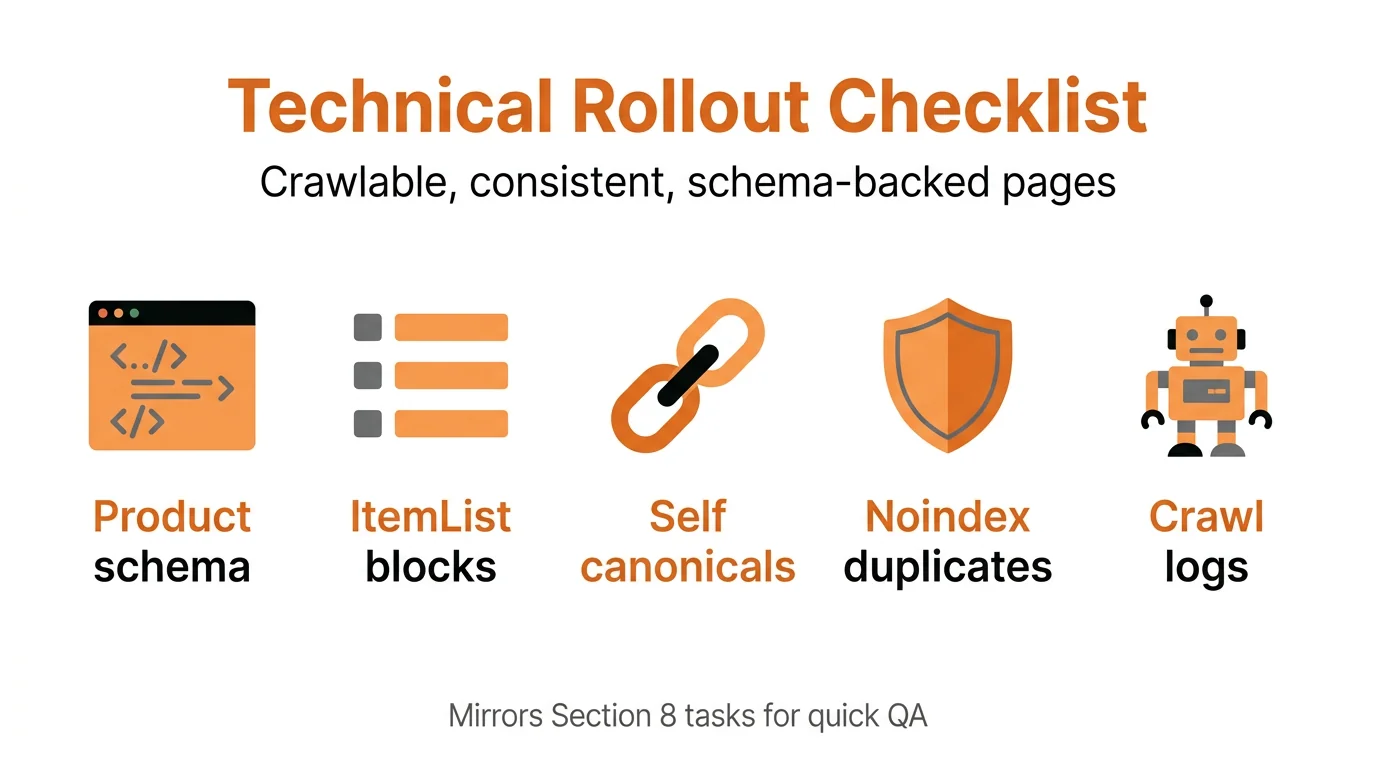
Ground your template rollout in robust technical hygiene so crawlers and shoppers can navigate attributes efficiently, and PDPs inherit and reinforce landing-page intent.
Product + ItemList schema, faceted canonicals, pagination
Mark curated blocks with ItemList. Ensure Product schema on SKUs. Use self-referencing canonicals on primary pages and careful noindex for thin or duplicative facet states.
Breed/size/life-stage facets in product feed and PDPs
Expose attributes in feeds and on PDPs. Include structured bullets and badges. Ensure consistency between feeds, PDP content, and landing-page filters.
Internal link modules from blogs and categories
Add contextual modules pointing to breed-specific SEO hubs. Use anchors mirroring modifiers. Place modules above the fold on category pages for faster discovery by users and crawlers.
How This Supports Your AI Content System
Product-Led SEO improves automation outcomes when your AI has clean attributes and clear templates. This structure guides planning, drafting, and page assembly with minimal human patchwork.
Feed attributes to automated planners and writers
Provide a stable attribute ontology and SKU metadata. Systems can plan breed- and life-stage content reliably when taxonomy and coverage are explicit and machine-readable.
Sync inventory signals to auto-refresh recommendations
Connect stock, returns, and review sentiment to rotate top picks and FAQs. Auto-refresh helps maintain topical freshness and conversion relevance without manual rewrites.
Connect to the pillar: AI Content for Pet Brands: Strategy, Priorities, and Playbooks
Embed this template strategy into your broader content operations. For governance and cross-channel cohesion, see AI Content for Pet Brands: Strategy, Priorities, and Playbooks. For streamlined execution, many teams use Petbase AI.
Frequently Asked Questions
Should I build a page for every breed and size combination?
Start with high-intent combinations where you have strong SKU coverage and distinct benefits. Evidence suggests clustering long-tail variants under a parent page may support faster traction.
How many products should I feature on a breed-specific page?
Featuring 3-5 curated SKUs with clear selection criteria may help decision clarity. Larger lists can be offered via expandable filters without overwhelming users.
What schema should these pages use?
Use ItemList for curated picks and Product schema on each SKU. Add FAQ and HowTo where relevant, and ensure canonicalization handles filters cautiously.
How do I handle thin search volume for niche breeds?
Cluster into a broader template (e.g., “strong chewers”) and reference the niche breed within copy and FAQs. Monitor impressions; spin out a dedicated page if demand grows.
How can I avoid overclaiming durability or health outcomes?
Use cautious wording, cite testing methods, and add care or supervision guidance. For health-adjacent products, include disclaimers and, where possible, expert review.
Conclusion
Turning layered pet queries into SKU-backed landing pages is practical and measurable. Model attributes, build safe templates, and monitor modifier-level outcomes. With disciplined curation and taxonomy, pet SEO automation may compound traffic and revenue while protecting trust.
References
- Y Wang et al. (2025). Finauditing: A financial taxonomy-structured multi-document benchmark for evaluating llms. arXiv preprint arXiv …. View article
- A Assadihaghi et al. (2025). Dynamic taxonomy Construction and Thematic Filtering for Financial Knowledge Graphs with LLMs. 2025 - openreview.net. View article
- A Ferencek et al. (2025). Open government data topic modeling and taxonomy development. Systems. View article
- H Shen et al. (2026). Two-Stage Recruitment Text Labeling via Lexicon-Guided Routing and Retrieval-Augmented Large Language Models. Journal of Visualized Experiments (JoVE). View article