From Blog to Basket: Internal Linking Blueprints for Pet eCommerce

Table of Contents +
- Scope and Scenario: Turn informational posts into shoppable journeys
- Blueprint 1: Intent-mapped anchor modules inside the blog body
- Blueprint 2: Breed/Size decision bars that route to tailored products
- Blueprint 3: Collection bridges via “care routine” clusters
- Blueprint 4: Dynamic related content that ladders up and down the funnel
- Quick decision guide
- Monitoring guidance
- Practical safety boundaries
- Evidence status and what the data suggests
- Implementation checklist for Petbase users
- Related reading
- Frequently Asked Questions
- Conclusion
- References
Actionable internal linking patterns that guide pet blog readers to products, collections, and breed/size guides to lift add-to-cart and AOV.
Informational posts win traffic but often miss the final step. Readers leave without discovering the exact product they need. That gap costs add-to-cart actions and average order value.
This guide shows practical internal linking for pet ecommerce SEO. You will learn how to route readers from care advice to relevant products, collections, and breed size guides. You will also see monitoring tactics, safety boundaries, and implementation checklists.
Scope and Scenario: Turn informational posts into shoppable journeys
Our focus is precise: convert educational traffic into product discovery with minimal friction. We prioritize blog to product linking, collection page linking, and smarter breed size guides to support AOV optimization without overwhelming readers.
Problem definition: Traffic lands on care guides but stalls before product pages
Readers find hygiene, training, or nutrition guidance. They rarely move into buying paths. The missing bridge is clear, intent-matched links that present relevant choices without cognitive overload or dead ends.
Assumptions and inputs: catalog, top posts, breed/size attributes
You have a structured catalog, trending blog topics, and clean metadata. Breed, size, age, weight, and life stage attributes are consistent. Collections and PDPs include filters or variants for fast matching.

Petbase writes and publishes this kind of content automatically - 10 SEO articles per month for pet businesses - start your free trial.
Blueprint 1: Intent-mapped anchor modules inside the blog body
Insert compact modules that transform symptoms into logical product paths. These modules should look native to the article, use descriptive anchors, and sit close to the sentence that frames the reader’s need.
Pattern: Symptom → Solution → Product/Collection
Map each symptom to a solution theme and a product path. Example: “intense chewing” → “enrichment and durable chews” → filtered durable chew collection or a best-seller PDP with toughness validation.
Anchor text rules and placement density
Use precise, non-salesy anchors. Place 1-2 contextual links per 150-250 words, prioritizing the first above the fold. Keep one primary commercial target per section to minimize decision fatigue and exit friction.
Blueprint 2: Breed/Size decision bars that route to tailored products
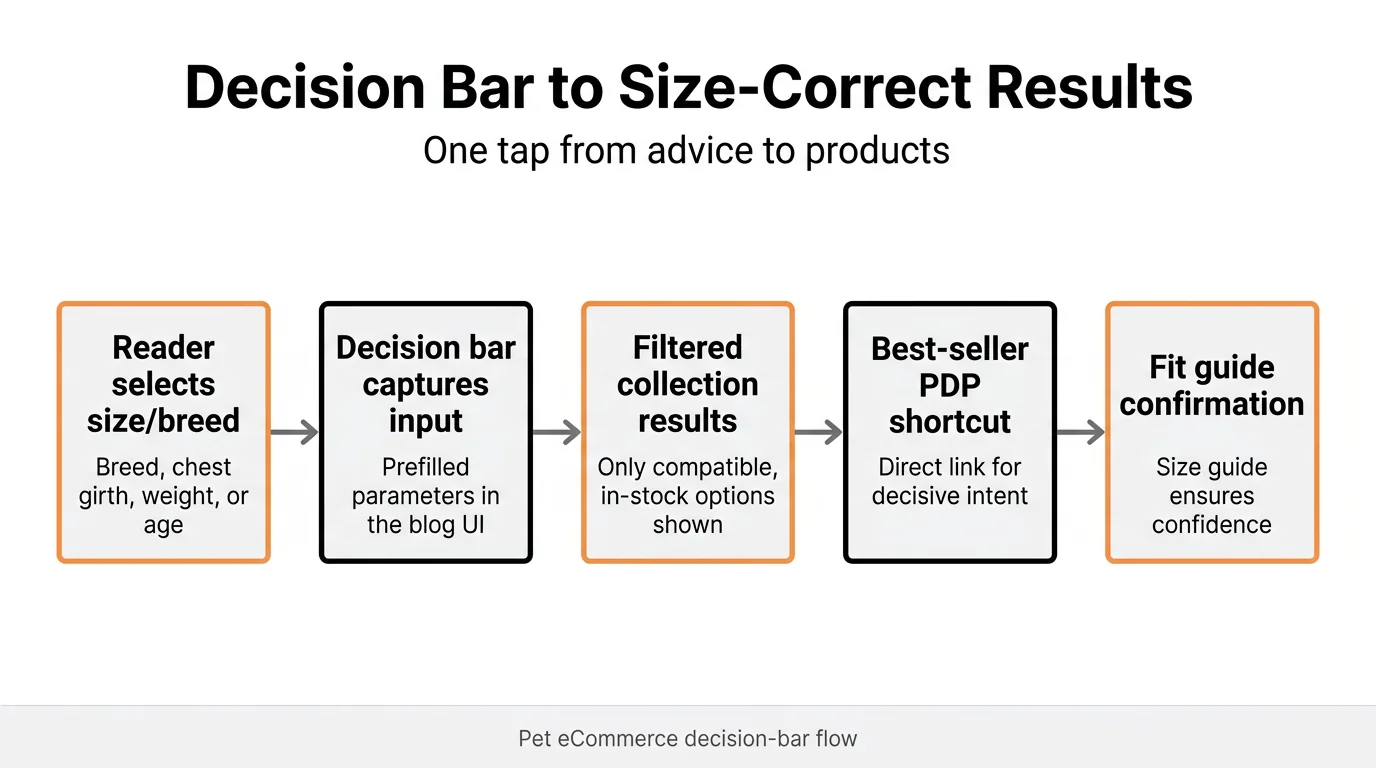
Decision bars reduce guesswork. A single interaction moves the reader from advice to a prefiltered result. They should persist across scroll or reappear after key sections for consistent visibility.
Pattern: ‘Select breed/weight/age’ micro-filter
Embed a concise selector with prefilled parameters-breed, chest girth, weight range, or age. Immediate links take users to size-correct options, which may improve click-through and reduce fit uncertainty in pet ecommerce SEO.
Link targets: variant-prefilled PDPs and size guides
Point to variant-prefilled PDPs and a relevant size guide for reassurance. AI-supported service automation keeps stock and variant data in sync, reducing mismatch risk for shoppers and teams.[3]
Blueprint 3: Collection bridges via “care routine” clusters
Group tasks into understandable routines. This raises perceived completeness, steers bundling behavior, and may lift AOV when the set is coherent and clearly described by outcome rather than SKU jargon.
Pattern: Task bundle (e.g., ‘Puppy teething kit’)
Build bundles from the steps your article recommends. Present a lean three-to-five item set labeled by task, not brand names. Clarify outcomes like “reduce destructive chewing” or “ease teething discomfort.”
- Seasonal teething collection
- Freezer-safe teether for soothing comfort
- Long-lasting natural chew for persistent gnawers
- Enrichment puzzle to redirect chewing energy
Mapping blog themes to seasonal collections
Translate spikes in “allergy season,” “heat safety,” or “winter coat care” searches into seasonal collections. Automation may streamline creation and updates, compressing cycle times for merchandising refreshes.[2]
Blueprint 4: Dynamic related content that ladders up and down the funnel
Use dynamic blocks to connect strategy and action. Present one upstream educational asset and one downstream commercial target, keeping both tightly aligned to the paragraph’s topic.
Upward link: pillar alignment
Align each blog with your strategic pillar to preserve topical authority and crawl clarity. For integrated planning guidance, see AI Content for Pet Brands: Strategy, Priorities, and Playbooks.
Downward link: PDP and size/breed guide pairing
After each how-to step, link to the required tool’s PDP plus a breed or size guide. This pairing reassures fit and function, preventing backtracking that commonly erodes intent and click-through.
Quick decision guide
Use these fast rules to assign the lowest-friction next step from any informational paragraph. Keep the reader’s mental model simple, and limit alternatives when intent appears decisive.
If the post solves a symptom → link to solution collection
Route to a filtered solution collection as the primary choice, then offer one verified best-seller PDP. Use descriptive, non-promotional anchors. durable chews for heavy chewers and durable XL chew for heavy chewers.
If the post compares options → link to top 3 PDPs with spec anchors
Show three PDPs with quick spec anchors and distinct strengths. Avoid fourth options. no-pull harnesses, M-XL and no-pull harness with padded chest, XL.
If the post mentions breed/size → link to size guide + filtered collection
Prioritize fit certainty. Send readers to the correct size guide, then a prefiltered collection. harness size guide by chest girth and XL harnesses for large breeds.
If the post is seasonal → link to seasonal collection + top bundle
Surface a seasonal collection and a curated bundle to raise AOV. Keep copy outcome-led. winter safety essentials and winter walk bundle for icy conditions.
If the post is how-to → link step-wise to tools PDPs
Attach the relevant tool after each procedural step. This avoids generic “shop now” traps. beginner-friendly clippers and quiet grooming clipper with guards.
If the post targets new owners → link to starter kits
Starter kits reduce overwhelm and increase completeness. Present as one decision. puppy starter kits by size and home essentials starter bundle.
If the post drives medical caution → link to vet-approved products and info page
Use conservative guidance and disclaimers. Surface vetted options and an informational hub. vet-approved supplements by condition and EPA/DHA omega-3 supplement.
Monitoring guidance
Measure early engagement, then commercial impact. Use consistent tags on modules and link variants to compare patterns and isolate wins without over-attributing uplift to a single change.
After 7-14 days: click-through and dwell patterns
Track module CTR, time on page near modules, and scroll depth. AI-augmented BI tools may reveal micro-segment differences faster, supporting quicker iteration on anchors and placements.[1] For KPI alignment, see dashboards and ROI considerations.
After 4-8 weeks: add-to-cart, AOV, and assisted revenue trends
Evaluate add-to-cart rate shifts from blog traffic, bundle attach rates, and AOV. Automation in ecommerce operations may also influence fulfillment reliability, affecting return rates and satisfaction metrics.[4]
Practical safety boundaries
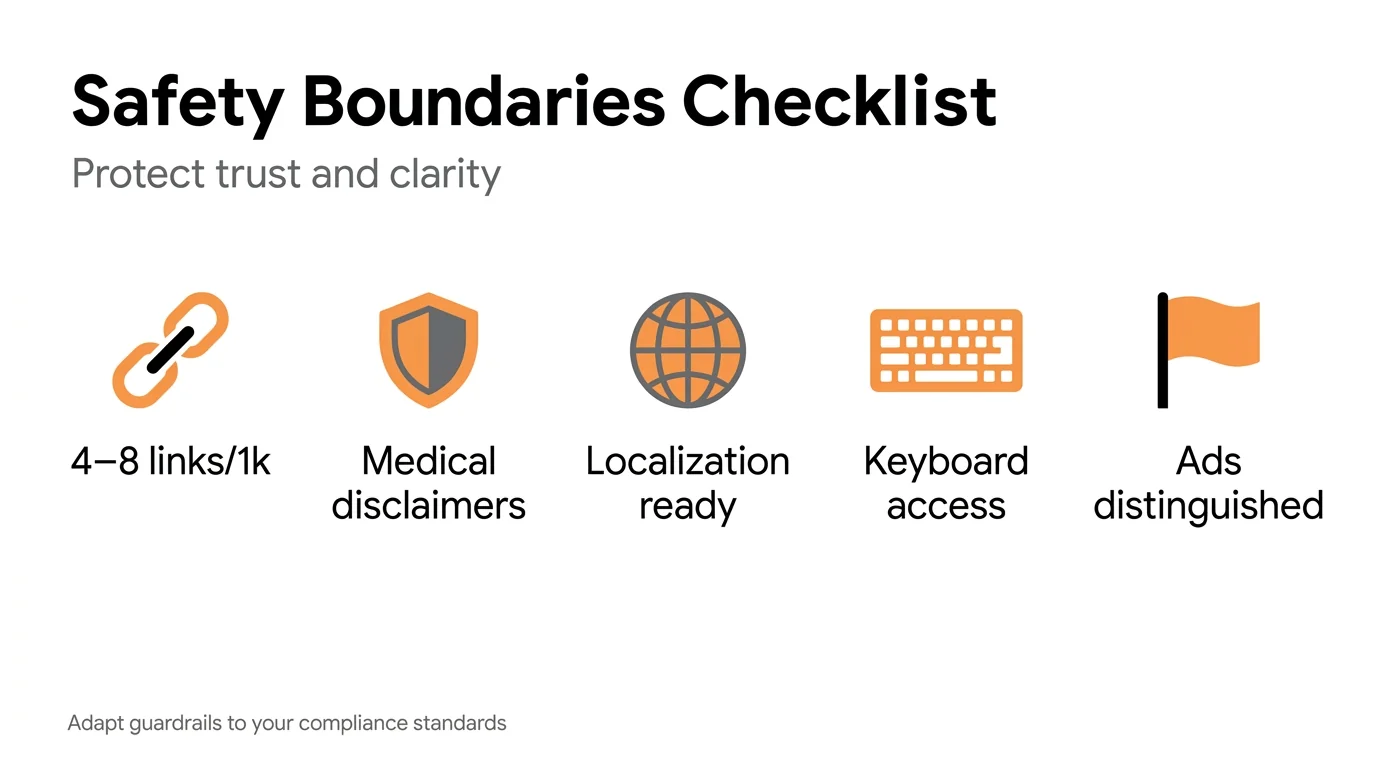
Protect user trust and site clarity by setting guardrails on density, medical messaging, and localization. The goal is helpful relevance without coercion or confusion.
Link density, medical disclaimers, and UX safeguards
Stay near 4-8 contextual links per 1,000 words. Add clear medical disclaimers where appropriate. Distinguish ads from native modules. Ensure keyboard navigation and touch targets meet accessibility expectations across devices.
Avoiding deceptive anchors and ensuring locale accuracy
Use descriptive anchors that reflect the landing page exactly. Respect locale preferences for currency, availability, and shipping. Service automation may help keep availability and variant data consistent across regions.[3]
Evidence status and what the data suggests
Research supports using AI and automation to improve ecommerce execution. Still, outcomes vary by catalog quality, demand seasonality, and user interfaces, so treat these blueprints as testable hypotheses.
Behavioral signals that may support CTR and conversion lift
Evidence suggests data-driven optimization can improve retail performance via faster insight cycles and better decisioning.[1] Operational AI may also bolster fulfillment predictability, indirectly affecting satisfaction and conversion stability.[4]
Attribution caveats and confounding factors
Cross-channel promotions, inventory swings, and template changes confound attribution. Automation can reduce manual error and cycle time, yet testing should isolate variables where possible to confirm true lift drivers.[2]
Implementation checklist for Petbase users
Translate strategy into enforceable rules. Use intent tags, consistent UTM parameters, and content modules that your CMS can render automatically within relevant sections.
Mapping intents in Petbase
Tag paragraphs by intent: symptom, comparison, how-to step, seasonal, or new owner. Tie each tag to a default collection, PDP fallback, and size guide. Store breed/size context to drive decision bars.
Automating anchors to products, collections, and size guides
Configure rules to inject modules after headings or step boundaries, using variant-prefilled URLs where available. For teams seeking automation at scale, consider Petbase AI for synchronized blog and PDP linking updates.
For templating large catalogs with consistent breed/size logic, see programmatic SEO by breed and use-case to complement these blueprints.
Related reading
AI Content for Pet Brands: Strategy, Priorities, and Playbooks (pillar link placement guidance)
Strengthen the strategic backbone of your content hub and ensure each blog ladders to a clear pillar for authority. Start with AI Content for Pet Brands: Strategy, Priorities, and Playbooks.
Breed/size guide schema and PDP enrichment references
Improve PDP clarity with structured attributes and concise copy that supports decision bars and filters. Explore methods in AI Rewrites That Rank: Rescuing Underperforming Pet Product Pages.
Frequently Asked Questions
How many internal links should a pet blog post include?
Evidence suggests 4-8 contextual links per 1,000 words may balance relevance and UX. Prioritize one primary product or collection link per major section to limit choice overload.
Should I link to products or collections from informational posts?
Start with collections when intent is exploratory and add 1-2 standout PDP links for decisive intent. Size or breed guides can serve as intermediaries when fit is critical.
Do breed and size filters improve conversion from blog traffic?
Data from retail tests suggests targeted filters may increase click-through and reduce returns. Results vary by catalog depth and how clearly the options are labeled.
Where should internal links be placed for best impact?
Place the first contextual link above the fold, then within problem/solution sections and at step boundaries. Avoid clustering multiple commercial links in a single paragraph.
How long until internal linking changes affect SEO?
Search impact may take 4-8 weeks as crawlers reprocess pages. Engagement and add-to-cart signals can be visible within 7-14 days in analytics.
Conclusion
Turn advice into action with clear, minimal-choice paths. Use intent-mapped anchors, decision bars, and care-routine bundles to guide shoppers confidently. Monitor early engagement, then evaluate add-to-cart and AOV.
To reinforce fit certainty, end journeys with a trusted guide and a single collection: harness size guide by chest girth and hero no-pull harness collection. Keep exits simple to preserve momentum.
References
- MA Islam et al. (2025). AI-Augmented Business Intelligence for Campaign Performance Optimization in US Retail and e-Commerce: A Mixed-Methods Study of Marketing ROI. American Journal of Scholarly …. View article
- G Nicola et al. (2024). Creating competitive advantage through digital innovation: Insights from startupreneurs in e-commerce. Startupreneur Business Digital (SABDA …. View article
- YM Tang et al. (2023). Data-intensive inventory forecasting with artificial intelligence models for cross-border e-commerce service automation. Applied Sciences. View article
- G Malhotra et al. (2025). Elevating logistics performance: harnessing the power of artificial intelligence in e-commerce. The International Journal of Logistics …. View article