From Blog to Basket: Internal Linking Blueprints for Pet eCommerce

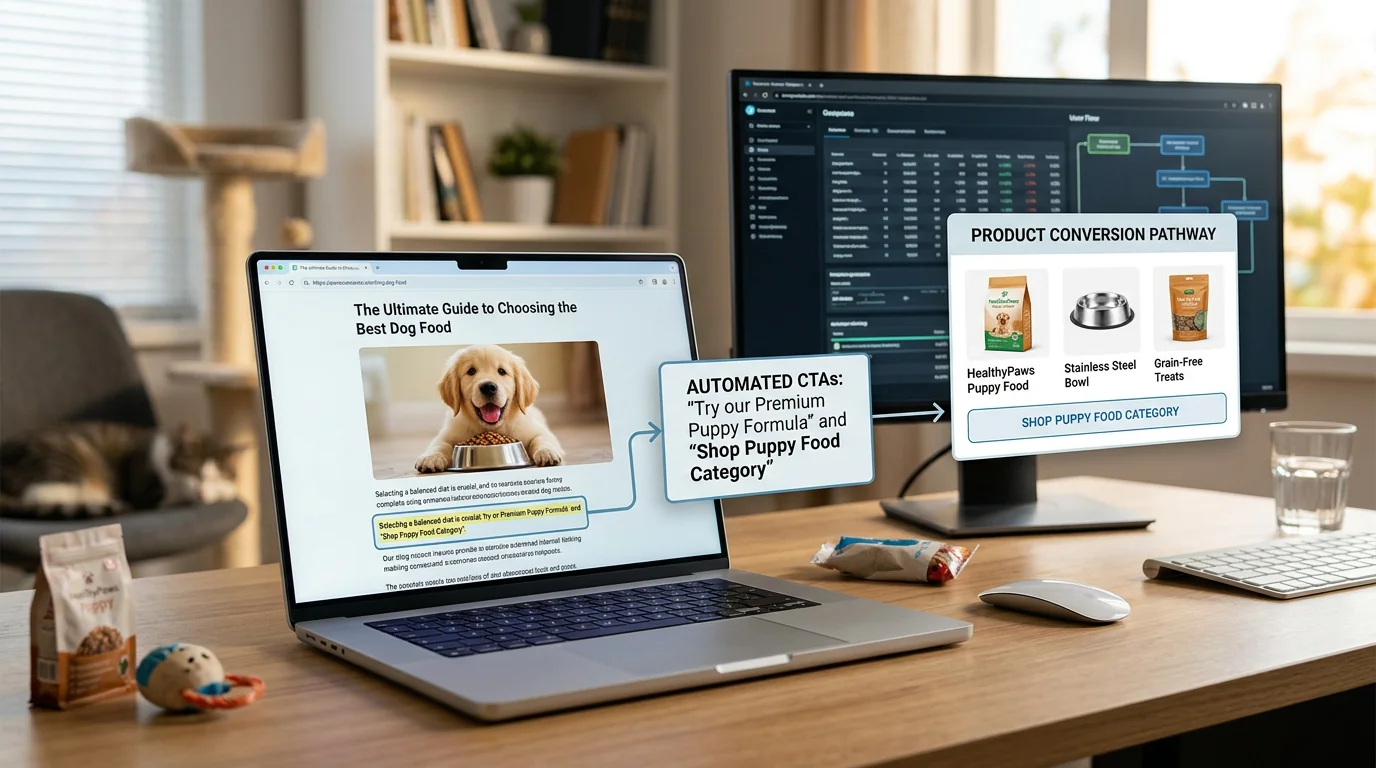
Table of Contents +
- The specific scenario: turning educational traffic into product views
- Blueprint 1: Automated anchor mapping from topic entities to SKUs
- Blueprint 2: Contextual CTAs that match reader intent
- Blueprint 3: Category-first linking to reduce product mismatch
- Quick decision guide: if X, then Y
- Monitoring timeline: what to check after 7-14 days and 4-8 weeks
- Practical safety boundaries for internal linking automation
- Evidence status: what current data suggests
- Implementation checklist for Petbase users
- Where this fits in your AI visibility strategy
- Frequently Asked Questions
- References
Blueprints to move readers from pet blog posts to product and category pages using automated links and contextual CTAs. Evidence-aware and actionable.
Educational articles often attract meaningful traffic. Yet many readers leave before viewing a single product. This gap wastes intent and content investment. It also hides profitable paths from search engines.
Bridging that gap requires subtle linking and precise prompts. You need to guide readers without disrupting learning. This post shows how to connect pet ecommerce SEO content to high-intent category and product pages. You will learn automated internal linking rules, contextual CTAs, and safe measurement practices tailored to pet catalogs.
The specific scenario: turning educational traffic into product views
Why informational posts stall before the basket
Readers arrive to solve a question, not to shop immediately. Hard-sell banners often repel them. Unstructured links scatter attention and dilute intent. Product mismatches erode trust when sizes, life stages, or conditions are unclear. Subtle, context-aware prompts may preserve attention and guide discovery.
Link types that may influence intent without disruption
Use three layers: inline entity anchors, a soft inline CTA, and a compact “Related products” module. Add breadcrumbs from product pages back to the original hub. This structure guides exploration while protecting readability and learning flow throughout blog to product linking.
Petbase writes and publishes this kind of content automatically - 10 SEO articles per month for pet businesses - start your free trial.
Blueprint 1: Automated anchor mapping from topic entities to SKUs
Entity-to-URL rules (breed, life stage, condition, size)
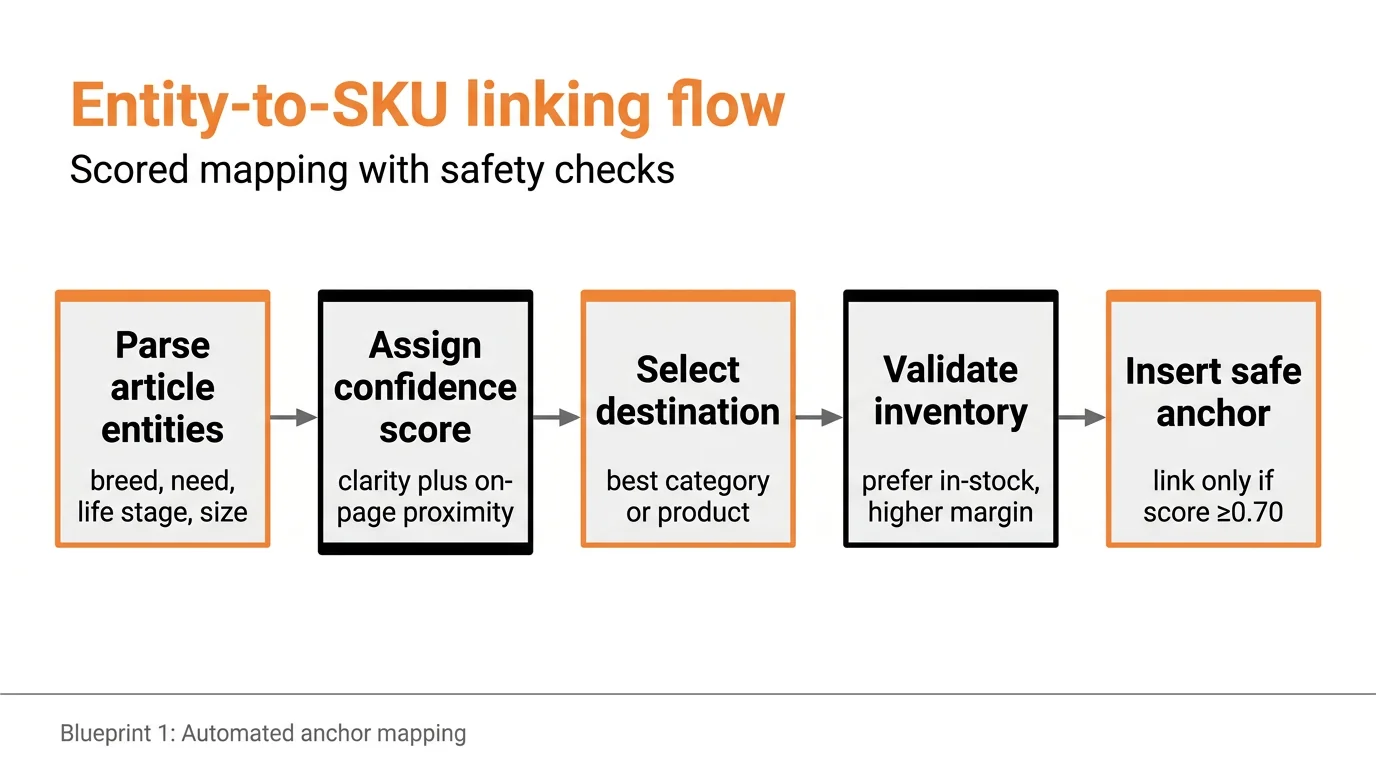
Parse article entities and map to the tightest safe destination. Example: map {breed: “French Bulldog”, need: “sensitive skin”} to a filtered category URL. Prioritize rules in order: condition → life stage → size → breed. When coverage is unclear, default to category over product for category page SEO.
Confidence thresholds and conflict resolution
Assign scores by entity clarity and on-page proximity. Link only when confidence ≥0.70. If multiple rules trigger, prefer the destination with in-stock variants and higher margin. If scores tie, send to category. Structured automation improves speed and consistency at scale while retaining editorial oversight.[4] Consider programmatic catalog templates by breed, size, and life stage to standardize filters.
Blueprint 2: Contextual CTAs that match reader intent
CTA microcopy patterns for pet buyers
Match the reader’s stage. Example: “After bathing, a hypoallergenic conditioner may help.” Keep CTAs single-sentence, needs-focused, and free from urgency language. Use nouns that mirror category names. Example: “Explore unscented training pads” or “See vet-formulated joint chews.” Maintain neutral, advisory tone.
Placement rules by scroll-depth and paragraph sentiment
Follow these placement rules. Insert one commercial link in paragraph two or three, above the first H2 when it fits naturally. Surface the first link on mobile within 300-400 words. Add a “Related products for [topic]” module after 40-60% scroll depth. Suppress sticky footer chips on screens under 360px.

Blueprint 3: Category-first linking to reduce product mismatch
When to link to categories vs. products
Favor category links when intent is broad, inventory fluctuates, or variant choice matters. Link directly to products only for known, named formulas, exact sizes, or accessories with low variability. Category-first linking may stabilize UX under shifting stock and preserves intent breadth.[4]
Faceted category links (size, flavor, breed-safe)
Generate pre-filtered category URLs that respect size, life stage, condition, and flavor. Rotate anchor variations sitewide to avoid repetition. Pass UTM parameters to attribute referring content. Ensure canonicalization to prevent thin indexation. Hand off context to PDPs aligned with product page schema and conversion best practices.
Quick decision guide: if X, then Y
Traffic source, device, and intent signals
- If search query is broad, link to a filtered category.
- If query names a formula or size, link to that SKU.
- If mobile with low scroll, place one early inline category link.
- If repeat visitor or time-on-page is high, show a compact “Related products” module.
Inventory, margin, and seasonality signals
- If stock is uncertain, route to the parent category.
- If two SKUs tie, prefer higher-margin, faster-shipping items.
- If seasonal content peaks, prioritize in-stock, evergreen categories.
- If price changes rapidly, reduce direct SKU links and favor categories.
Monitoring timeline: what to check after 7-14 days and 4-8 weeks
Early indicators (crawl, CTR, scroll to first link)
Within 7-14 days, review crawl patterns for new internal paths. Track article-to-category click-through rate and time to first commercial click. AI-assisted sales enable faster discovery loops when integrated with measurement dashboards.[3] Use event tracking for “scroll to first link” and module impressions.
Mid-term indicators (assist rate, category entrance rate)
Across 4-8 weeks, watch assisted conversions, category entrance rate from articles, and product detail page sessions originating from content. AI-augmented BI may improve decision cycles when teams iterate on signals and margins.[2] Consider multi-touch attribution before adjusting caps or placements. See measurement strategies beyond rankings.
Practical safety boundaries for internal linking automation
Caps, exclusions, and UX safeguards
Cap 2-4 commercial links per 1,000 words. Keep total links under 100 per page. De-duplicate anchors within a post. Suppress SKU links if inventory is zero. Avoid over-optimized anchors. Test sticky chips sparingly and exclude screens under 360px.
Compliance notes for veterinary advice and affiliate disclosures
Use cautious phrasing for health-related CTAs and route to educational disclaimers where appropriate. Display affiliate disclosures near monetized links. Transparent, consistent patterns help distinguish trustworthy commerce from deceptive experiences in e-commerce ecosystems.[1]
Evidence status: what current data suggests
Observed impacts on click-through and basket adds
Retail research indicates that AI-supported sales and BI systems may enhance path-to-purchase efficiency when aligned with human oversight and feedback loops.[3][2] In practice, teams often observe rising category entrance rates and earlier commercial clicks when contextual CTAs and entity links complement strong content.
Limitations and confounders to consider
Seasonality, promotions, and ad bursts can inflate intermediate metrics. Out-of-stocks or price swings may depress product CTRs. Content quality remains a prerequisite. Attribution models matter; assisted revenue may be undercounted with last-click views.[2]
Implementation checklist for Petbase users
Data needed to start
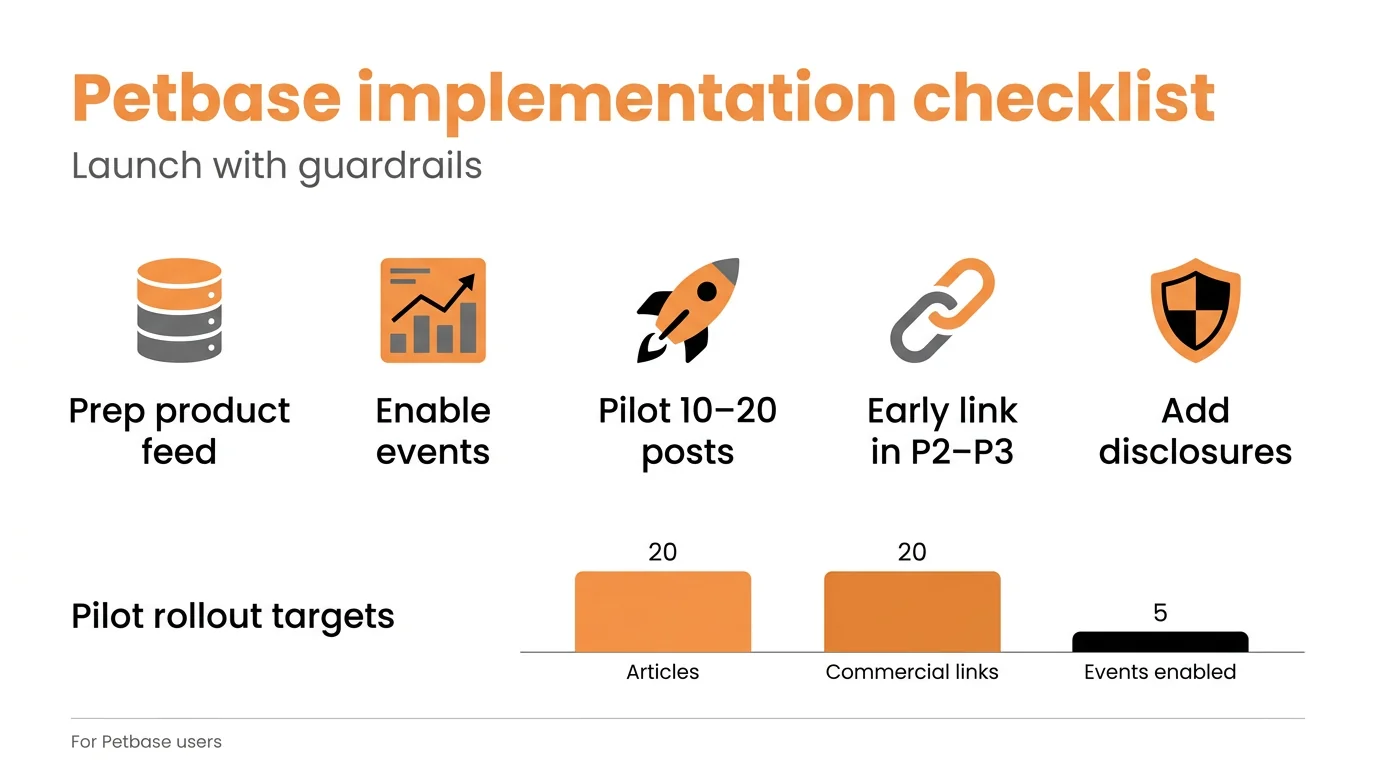
Prepare a product feed with attributes: breed, life stage, size, condition, flavor, stock, and margin. Enable analytics events for first commercial click and module impressions. Maintain a rules table mapping entities to URLs with confidence scoring and fallbacks.
Rollout plan and fallback rules
Start with 10-20 articles. Place one link in paragraph two or three pointing to the most relevant category. Add a “Related products” module after 40-60% depth, capped at three SKUs. Consider using Petbase AI to automate entity extraction and link placement across pet ecommerce SEO content.
Where this fits in your AI visibility strategy
Hand-off to the AI visibility master guide
Internal linking is a bridge between education and commerce. It should synchronize with content planning, product feed hygiene, and PDP optimization. Align roadmaps with your broader visibility framework and iterate placements as new entities and categories emerge.
Frequently Asked Questions
Should I link to category pages or individual products from blog posts?
Evidence suggests category links may perform better when intent is broad or inventory fluctuates. Link to specific products when the article addresses a concrete need like a named formula or size.
How many internal links per blog post are reasonable?
A cautious cap of 2-4 commercial links per 1,000 words may preserve readability. Keep total links under 100 per page and prioritize the first contextual link above the fold where it fits naturally.
Do automated internal links hurt SEO?
If anchors are relevant and not over-optimized, automation may support crawl paths and discovery. Avoid keyword stuffing, ensure diversity of anchors, and respect UX to reduce risk.
What metrics indicate my linking is working?
Look for rises in article-to-category click-through rate, category entrance rate, product detail page sessions from blog, assisted conversions, and time to first commercial click.
How do I handle out-of-stock products in automated links?
Route to the closest in-stock variant or parent category when stock is zero. Set automated fallbacks and suppress direct product links when back-in-stock dates are uncertain.
Conclusion. Moving readers from education to commerce requires measured, context-aware prompts. Start with entity-based anchors, soft CTAs, and category-first routing. Monitor early and mid-term indicators, then iterate. For strategic alignment, see the AI visibility master guide and coordinate roadmaps across content, catalogs, and PDPs.
References
- P Kotzias et al. (2023). Scamdog millionaire: Detecting e-commerce scams in the wild. Proceedings of the 39th …. View article
- MA Islam et al. (2025). AI-Augmented Business Intelligence for Campaign Performance Optimization in US Retail and e-Commerce: A Mixed-Methods Study of Marketing ROI. American Journal of Scholarly …. View article
- R Agnihotri (2021). From sales force automation to digital transformation: how social media, social CRM, and artificial intelligence technologies are influencing the sales process. A research agenda for sales. View article
- Z Kremez et al. (2021). Ecommerce structures for retail and service franchises: Ecommerce implementation in mature franchise systems. Asia Pacific Journal of …. View article