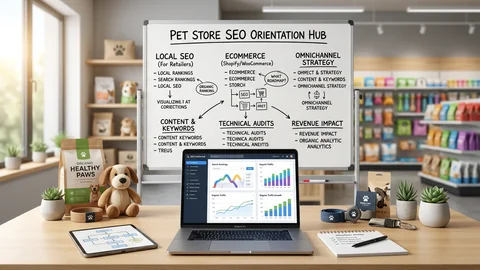
AI Visibility for Pet Brands: A Practical Orientation Hub


Table of Contents +
- Why AI visibility matters now for pet brands
- What to prioritize first: foundations before scale
- Start with an AI visibility audit
- Compete in AI Overviews and product discovery
- Scale safely with programmatic and content-to-commerce bridges
- Local and multilingual reach: services and international growth
- Measurement, common mistakes, and how we built these recommendations
- Frequently Asked Questions
- References
A strategic overview for pet brands to win search, AI overviews, product discovery, and local results-what to prioritize, when to deploy, how to measure.
Organic growth is shifting from ten blue links to AI-generated answers and discovery modules. Pet brands that adapt early will capture compounding attention and revenue. Competitive advantage now depends on structured signals and complete topical coverage.
This guide orients pet manufacturers, retailers, and service providers to AI visibility. You will learn what to prioritize first, where brands commonly stall, and how to measure results. Expect practical decision rules for pet brand SEO, not tactics in isolation.
Why AI visibility matters now for pet brands
Where attention is shifting: search, AI answers, and discovery
Search experiences increasingly synthesize multiple sources into instant answers. Discovery flows blend product modules, reviews, and local packs. Winning presence requires entity clarity, structured data, and topical completeness across surfaces, not a single ranking.
Marketing teams that harness automation can scale structured content and metadata reliably, aligning with how platforms compute relevance and authority at speed.[4]
What changes for pet manufacturers, retailers, and services
Manufacturers must codify product attributes and use cases so AI systems can match needs to formulations. Retailers need content that maps to intents and internal paths that flow to conversion. Service providers compete on local signals and reputation strength.
AI overviews SEO introduces summarizer-first design. Content and data must be extractable, consistent, and backed by authoritative internal links and schemas to surface in AI answers and product discovery experiences.[1]
Petbase writes and publishes this kind of content automatically - 10 SEO articles per month for pet businesses - start your free trial.
What to prioritize first: foundations before scale
Management: own your analytics, crawl health, and brand voice
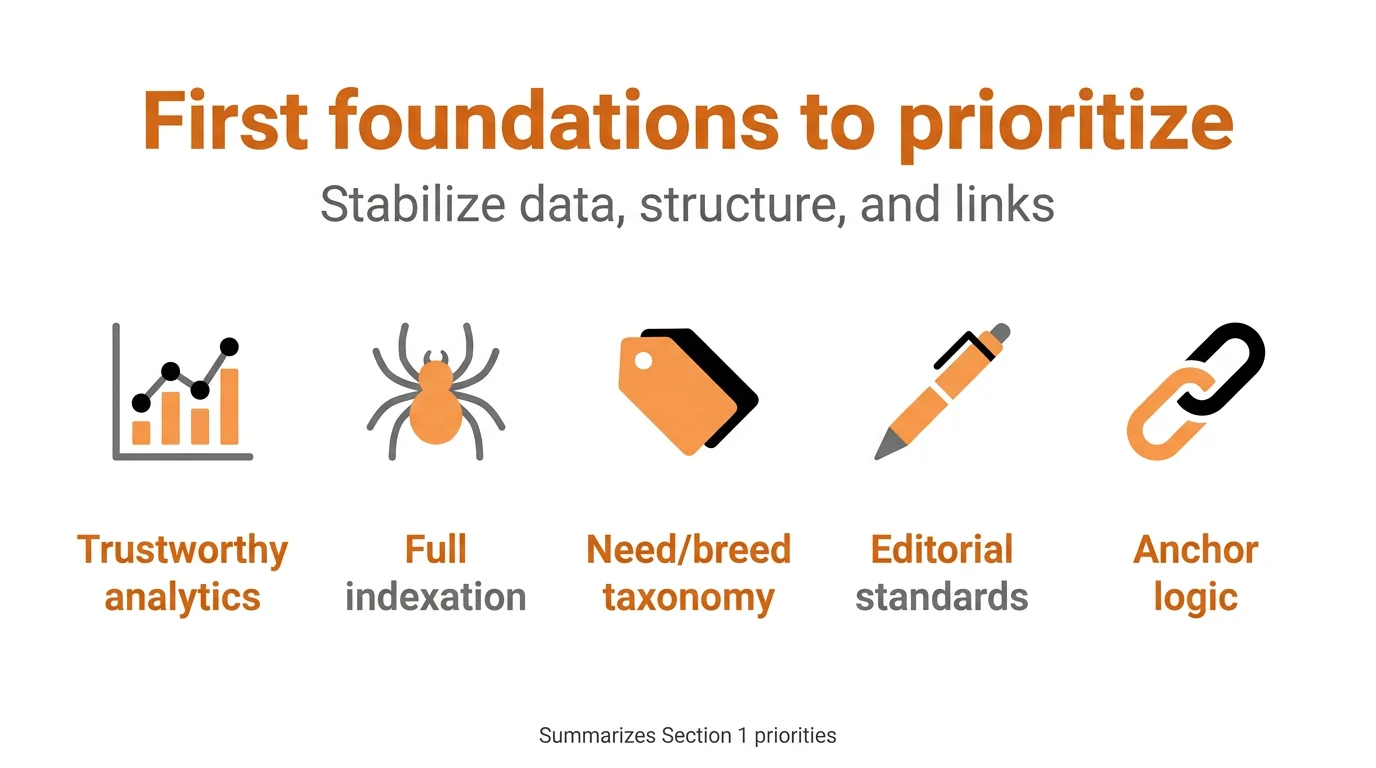
Before producing more, validate measurement, crawling, and editorial standards. You need trustworthy analytics, complete indexation for revenue pages, and a codified brand voice that keeps outputs consistent across educational and commercial surfaces.
Forage: capture demand with topic clusters and internal paths
Organize content by need, breed, and life stage. Connect each guide to category and product destinations with explicit anchor logic. Automation can assist with consistent outlines and metadata when it follows clear editorial constraints.[2]
Basic nutrition: product data, local listings, and schemas
Ensure product attributes, availability, pricing, and reviews are structured and current. Keep local listings synchronized for hours, services, and coverage areas. Apply schemas for products, FAQs, and organizations to reinforce entity understanding.
With these foundations set, scale with purpose using Editorial calendar automation aligned to seasons and launches for consistent coverage that matches demand cycles.
Start with an AI visibility audit
Audit your pet SEO gaps automatically to baseline coverage and pinpoint next steps.
Map your current coverage across search, AI answers, and local
Inventory where your brand appears: traditional SERP positions, AI-generated answer boxes, product carousels, and local panels. Classify the surfaces by intent type-educational, commercial, and navigational-to reveal underrepresented opportunities.
Identify gaps by breed, need, life stage, and service area
Segment your catalog and content against the taxonomy that buyers use. Note thin topics, missing FAQs, and weak internal links for high-value intents. For services, compare coverage by city, neighborhood, and procedure.
Compete in AI Overviews and product discovery
Align content with need- and breed-based intents
Design clusters that answer specific needs with clear qualifiers. Map each page to a distinct intent and connect it to relevant product or service destinations. This supports both AI overviews SEO and traditional results.
Capture AI Overviews for breed- and need-based queries with content that is comprehensive, consistent, and easy to summarize.
Structure answers for summarizers, not just blue links
Use explicit headings, concise definitions, pros/cons, and scannable lists. Reinforce answers with schema, internal references, and authoritative sources. Summarizers favor clarity, stability, and strong entity linking across related pages and products.[1]
Scale safely with programmatic and content-to-commerce bridges
Programmatic templates for breeds, sizes, and life stages
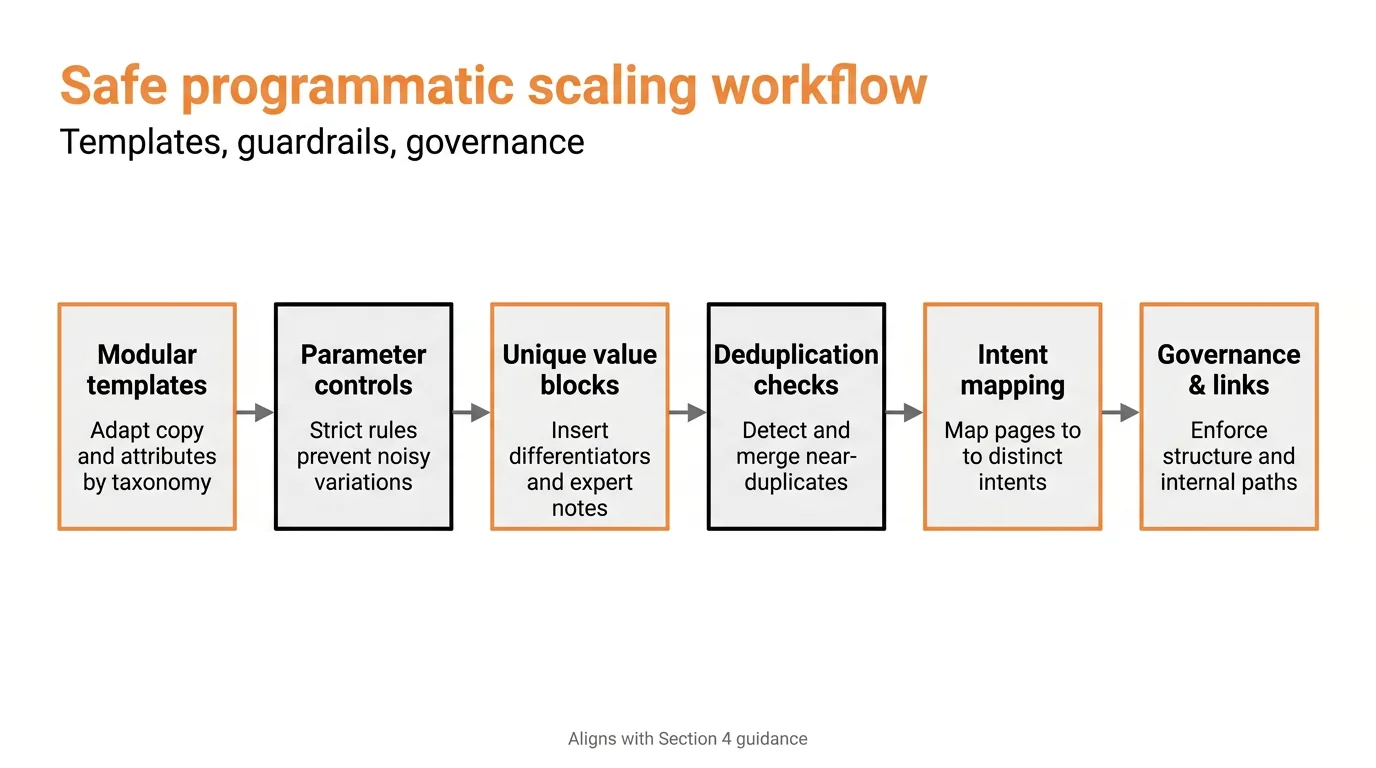
Create modular templates that adapt copy and attributes by taxonomy. Guardrails include unique value sections, strict parameterization, and deduplication checks to avoid cannibalization. Enforce editorial quality while benefiting from automation at scale.[2]
When building safely at volume, use governance that enforces structure, intent mapping, and internal links. Programmatic pages for breeds, sizes, and life stages-safely protect quality while expanding coverage.
For best results, consider using Petbase AI to automate research, content generation, and publishing workflows for pet SEO automation, then Optimize product pages with pet-specific schema and copy to ensure conversion readiness.
Internal linking patterns that move readers to product pages
Define consistent in-article anchors to categories, compare pages, and top SKUs. Use navigational blocks and related links that match the reader’s stage. NLP-driven mapping helps maintain relevance across a growing content graph.[3]
Turn blog traffic into product page clicks with internal links using proven patterns that respect intent and hierarchy.
Local and multilingual reach: services and international growth
Local visibility for vets, groomers, trainers
Emphasize service pages with clear procedures, coverage areas, pricing signals, and reputation elements. Keep profiles synchronized and post updates consistently. Automate routine updates for scalable local SEO for pet services across locations.
Use Local SEO automation for vets, groomers, and trainers to standardize data, services, and review workflows.
Roll out languages for US, UK, and DACH without duplication
Plan regional dictionaries, measurement partitions, and hreflang hygiene. Align catalog availability and compliance by market. Avoid duplication by differentiating content purpose and ensuring unique metadata across locales.
Follow the guardrails in Multilingual rollout for US, UK, and DACH without duplicating risk to protect indexation and relevance.
Measurement, common mistakes, and how we built these recommendations
Top 3 actions highlight box
Top 3 actions to start this quarter
- Establish foundations: analytics trust, crawl health, product schemas, and synchronized local listings.
- Build two high-value clusters by need and life stage, each with clear internal paths to products.
- Ship one programmatic template and measure assisted conversions from informational to product pages.
KPIs beyond rankings and frequent misconceptions
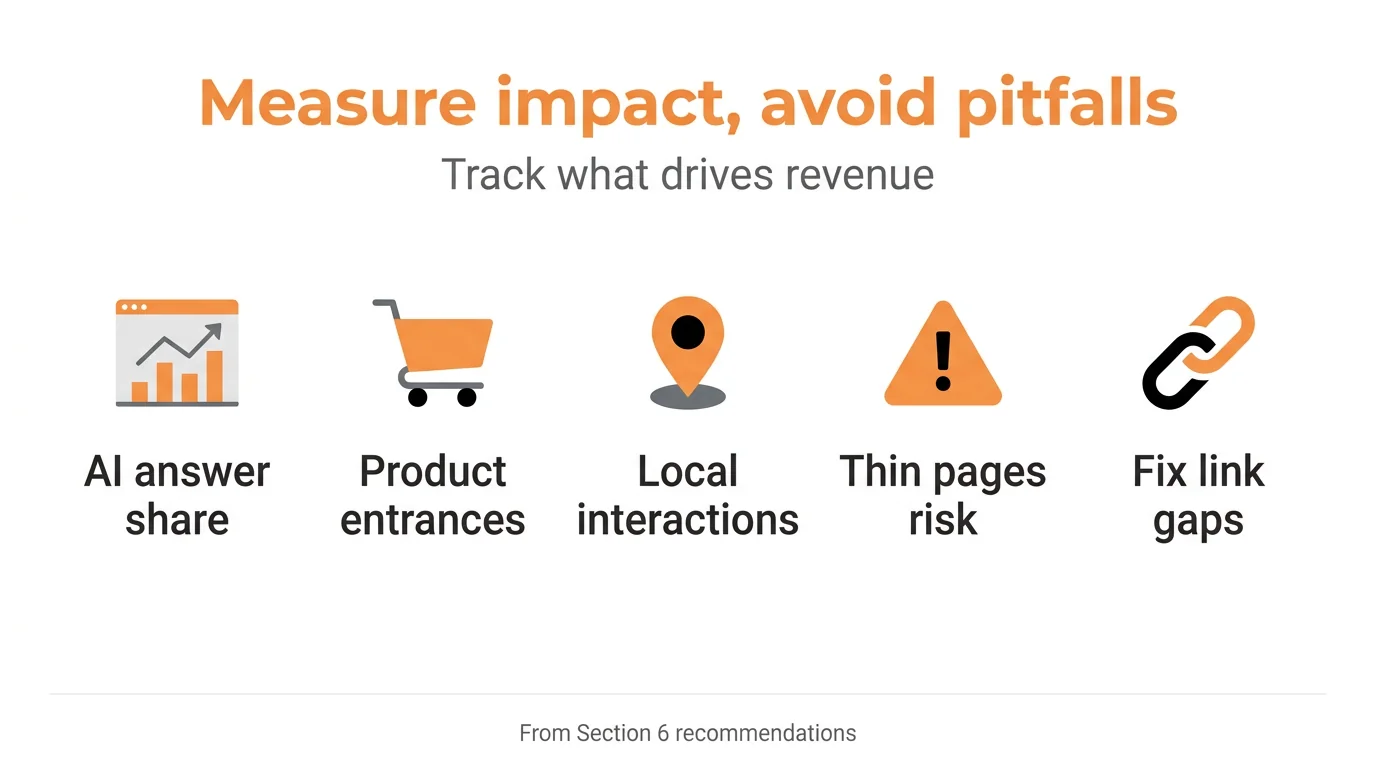
Track impression share in AI answer features, product module entrances, local interactions, and assisted revenue from content-to-commerce paths. Pair these with content coverage and crawl health to interpret changes coherently.
Avoid common pitfalls: publishing thin programmatic pages, over-optimizing for one keyword, and neglecting internal links. Another misconception is that AI overviews SEO ignores schemas; structured data and entity coherence are critical enablers.[4]
Adopt a measurement framework that includes query-set visibility, feature-specific impressions, and assisted conversions, guided by change logs. Start with Measure AI visibility beyond rankings to calibrate goals across AI answers, product discovery, and local.
Frequently Asked Questions
What is AI visibility for pet brands?
AI visibility is your brand’s findability across search engines, AI-generated answers, product discovery modules, and local results. It aligns structured data, content, and entity signals so AI systems can surface your brand for relevant pet needs.
How is AI visibility different from traditional SEO?
Traditional SEO focuses on ranking pages; AI visibility extends to how your entities, products, and answers are summarized by AI. It prioritizes structured data, topical completeness, and clear relationships between products, content, and locations.
Where should a pet retailer start?
Begin with an audit to confirm analytics, crawl health, product data quality, and local listings. Then build breed- and need-based topic clusters linked to relevant product pages before scaling with programmatic templates.
Do I need different strategies for vets, groomers, and trainers?
Yes. Service providers rely more on local signals, procedure/service pages, and reputation. Product-led retailers focus on product schema, category depth, and internal linking from educational content.
How do I measure AI overview wins?
Track query sets aligned to intents, impression share in search features, product page entrances from informational content, local panel interactions, and assisted conversions. Use change logs to attribute shifts to deployments.
References
- G Chodak et al. (2023). Large language models for search engine optimization in e-commerce. International Advanced Computing Conference. View article
- M Reisenbichler et al. (2022). Frontiers: Supporting content marketing with natural language generation. Marketing …. View article
- T Suresh (2025). Natural language processing for internal link optimisation: Automating content relationships for better search engine optimisation. Journal of Digital & Social Media Marketing.
- D Dumitriu et al. (2020). Artificial intelligence solutions for digital marketing. Procedia Manufacturing. View article