AI SEO Gap Audit for Pet Brands: Find Quick Wins in 7 Days


Table of Contents +
- Scenario: A pet brand needs quick SEO wins without a full rebuild
- Day 1-2: Collect data and map the content inventory
- Day 3: Run automated keyword gap analysis against real competitors
- Day 4: Diagnose weak product pages with intent-to-attribute mapping
- Day 5: Expose internal link gaps and build bridges to products
- Day 6: Draft fixes-briefs, on-page updates, and link modules
- Day 7: Implement and ship the highest-impact 20%
- Quick decision guide
- Monitoring: what to observe after 7-14 days and 4-8 weeks
- Practical safety boundaries
- Evidence status and uncertainty notes
- How this audit fits the AI Visibility for pet brands strategy
- Frequently Asked Questions
- Conclusion
- References
Run a 7-day AI SEO gap audit for pet brands. Spot missing topics, weak product pages, and internal link gaps to uncover fast, defensible wins.
Search demand moves faster than most pet eCommerce teams can publish. A targeted AI SEO gap audit delivers quick wins without a redesign. It prioritizes what matters now.
This approach matters because missed topics, weak product pages, and internal link gaps quietly drain revenue. In one week, you can identify and resolve high-impact issues. You will learn how to surface missing demand, patch product content, and create bridges that move readers to SKUs through a focused, seven-day cadence aligned with the AI Visibility for Pet Brands hub.
Scenario: A pet brand needs quick SEO wins without a full rebuild
Constraints and assets you likely have this week
Expect limited developer time, an existing CMS, and analytics access. You also likely have product data, category structures, and a mix of evergreen and seasonal blog posts. Use these assets decisively.
How a 7-day AI audit narrows the scope to high-leverage fixes
The audit targets missing topics, weak product attributes, and internal link gaps. It ranks opportunities by intent and revenue proximity. You execute only the highest-yield actions, reducing risk and time investment.

Petbase builds this SEO foundation automatically for pet businesses - 10 optimized articles published every month - start your free trial.
Day 1-2: Collect data and map the content inventory
Export pages and categorize by type (product, category, blog, help)
Export a full URL list, then assign each to product, category, blog, or help. Build a simple table with status, traffic, and SKU ties. This enables inventory-level prioritization.
Crawl essentials: indexability, canonicals, status codes, schema
Run a focused crawl for index tags, canonical consistency, 4xx/5xx errors, and schema presence. Automated audit tools can accelerate detection of algorithm-modeled risk signals.[1]
Traffic and revenue overlays to prioritize
Overlay sessions, impressions, and revenue by URL. Flag product pages with views but low conversions. Highlight high-traffic blogs with minimal product click-through. These are immediate linkage and copy targets.
Day 3: Run automated keyword gap analysis against real competitors
Pick 3-5 competitor sets by sub-vertical (food, toys, health)
Select three to five domains per sub-vertical that already rank for your intended queries. Include at least one marketplace and a niche specialist for breadth and relevance.
Cluster missing queries by breed, life stage, and use case
Use AI-assisted clustering to group gaps by breed, size, life stage, and conditions. LLM-enabled auditing supports semantic grouping and editorial direction at scale.[2]
Score gaps by potential: intent, difficulty, and SKU relevance
Score each cluster for commercial intent, ranking difficulty, and SKU fit. Favor queries with modifier-rich intent and direct product mapping. This drives immediate pet brand SEO outcomes.
Day 4: Diagnose weak product pages with intent-to-attribute mapping
Match query modifiers to product attributes and facets
Map breed, size, life stage, and condition modifiers to structured attributes. Ensure filters, facets, and attribute copy reflect how shoppers describe needs, improving pet eCommerce SEO alignment.
Identify thin areas: benefits, ingredients, sizing, care, safety
Audit content depth across benefits, ingredient details, sizing guidance, care instructions, and safety notes. Prioritize pages where thin or missing attributes block informative, trust-building answers.
Evidence-based enhancements: FAQs, media, and review markup
Add concise FAQs, comparison visuals, ingredient tables, and review markup. Structured enhancements may support engagement and rich results, within policy limits.[1] For implementation patterns, see Pet product page optimization techniques.
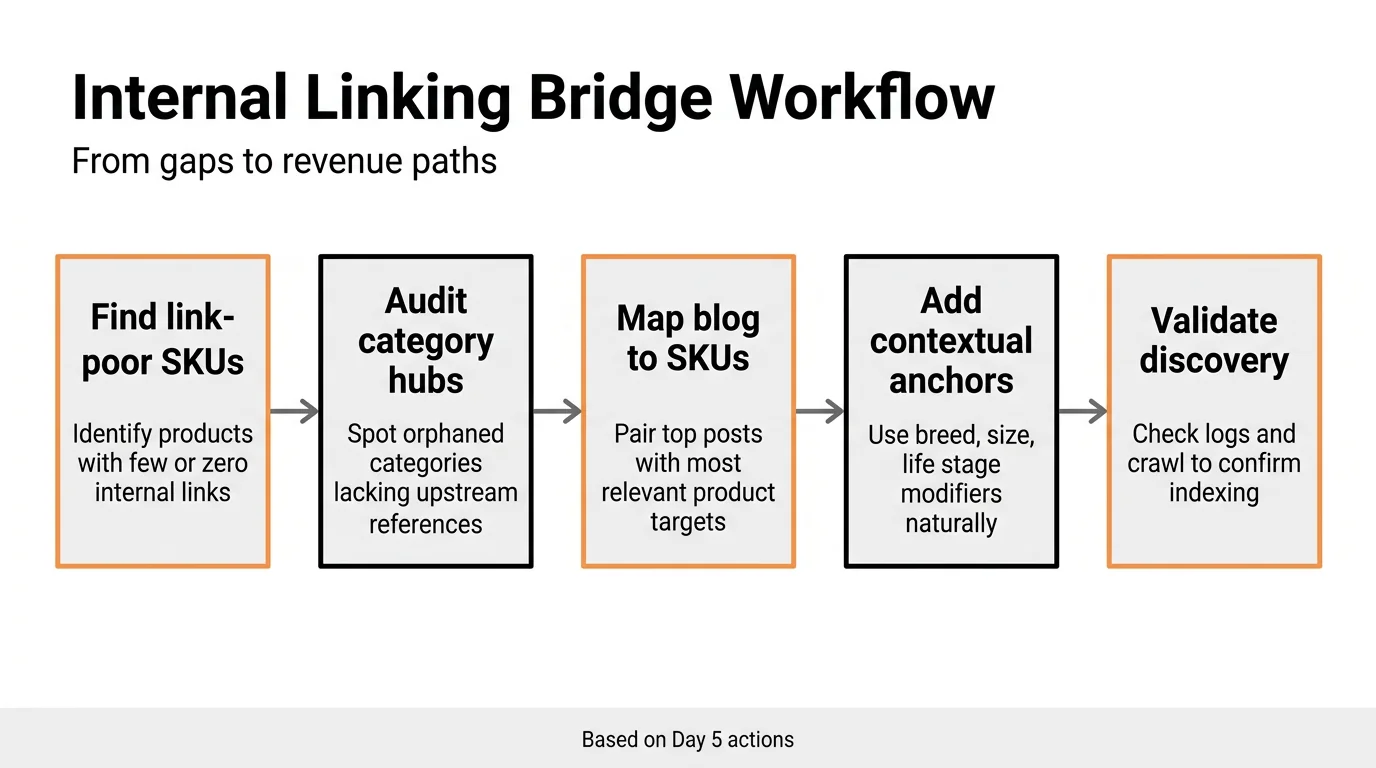
Day 5: Expose internal link gaps and build bridges to products
Find orphaned and underlinked SKUs and categories
Identify SKUs with zero or few internal links and categories lacking upstream references. Use crawl data and logs to confirm discovery issues. Reconnect them via contextual anchors and breadcrumbs.
Create contextual link blocks from high-traffic posts
From each top blog, add three contextual links to the most relevant SKUs and one category page. Use natural modifiers reflecting breed, size, or life stage. See internal linking blueprints.
Anchor text patterns: breed, size, life stage, condition
Prefer anchors like “chew toys for large breeds” or “grain-free food for seniors.” Internal links may support faster discovery and modest ranking gains, varying by authority.[3]
Day 6: Draft fixes-briefs, on-page updates, and link modules
One-page briefs for the top 10 gap clusters
Create concise briefs with target intent, questions to answer, product tie-ins, and internal link targets. Emphasize pet-specific terminology and FAQs matching observed search language.
Structured product enhancements using reusable components
Use reusable blocks for ingredients, sizing, care, and safety. Pair with Q&A snippets and review summaries. Teams sometimes accelerate this step with Petbase AI to turn audit outputs into drafts efficiently.
Internal link injection plan by URL and anchor
Document source URLs, destination SKUs, and exact anchor patterns. Add breadcrumb links to parent categories and brand collections; ensure HTML rendering. Include “Related guides” modules on category pages.
Day 7: Implement and ship the highest-impact 20%
Ship list: top 5 product page rewrites and 20 strategic links
Publish five prioritized product rewrites covering attributes and FAQs. Deploy twenty internal links from high-traffic posts to mapped SKUs and one category per post.
Publish 2-3 quick answers for missing intent clusters
Ship concise, authoritative posts to capture high-intent gaps immediately. Link to pre-filtered category views matching modifiers and include return links to the guide for context reinforcement.
Validate with a recrawl and analytics annotations
Run a partial recrawl, validate structured data, and annotate deployments. Algorithm audits benefit from careful change tracking and staged rollouts to isolate effects.[4]
Quick decision guide
If traffic concentrates on 10 blog posts but product views lag, add 3-5 contextual links per post to the most relevant SKUs and one category hub.
Prioritize the top ten blog posts by traffic. Add three to five links per post to mapped SKUs and one category hub. Maintain natural language anchors consistent with user intent.
If category pages rank page 2 for generic terms, add comparison FAQs and link to 3 bestsellers; adjust H1 to include primary modifier (e.g., “grain-free dog food”).
Augment category pages with comparison FAQs and bestseller links. Update H1 to reflect the dominant modifier. This may clarify relevance signals without complex template work.
If product pages have high impressions but low CTR, test titles with breed/size modifiers and surface review count in meta where supported.
Run controlled title tests introducing breed or size terms. Add review count snippets where policy allows. Monitor CTR and impressions to validate gains over two to four weeks.
If many SKUs are near-duplicate, consolidate to canonical parents and differentiate variants via structured attributes and internal anchors.
Use canonical consolidation for near-duplicates. Differentiate variants with structured attributes and targeted internal links using specific modifiers to maintain discoverability and avoid dilution.
If competitor wins on “best for [breed/condition]” terms, publish a short buying guide and link to filtered category views that match the modifier.
Create a concise buying guide addressing the modifier. Link to corresponding filtered category URLs. Include a return link to the guide to complete the navigational loop.
If crawl shows orphaned SKUs, add links from relevant blog posts and category filters; ensure breadcrumbs render crawlable HTML.
Reconnect orphaned SKUs with contextual blog links and category filters. Verify breadcrumbs are server-rendered HTML, not JS-only, to guarantee consistent crawlability and discovery.
If blog traffic is seasonal, pre-link evergreen SKUs and add seasonal comparison blocks (e.g., winter coats for small dogs).
Anticipate seasonal demand by embedding evergreen SKU links ahead of time. Add seasonal comparison blocks to capture intent surges and guide users into relevant product paths.
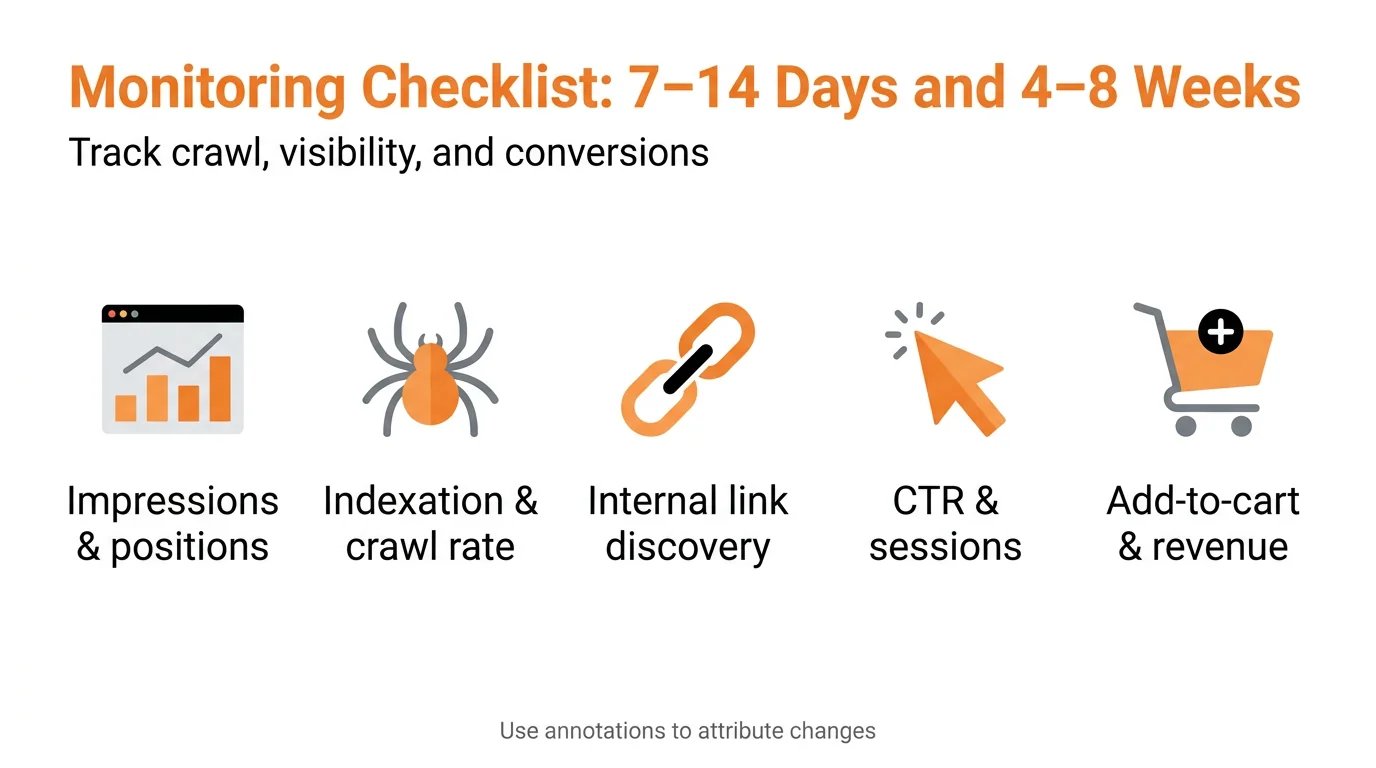
Monitoring: what to observe after 7-14 days and 4-8 weeks
7-14 days: impressions, average position for targeted clusters, crawl/indexation, internal link discovery in logs
Check impressions and positions for new clusters, crawl stats, and indexation. Review server logs for internal link discovery. Multi-method audits strengthen early interpretation of signals.[3]
4-8 weeks: CTR lifts on updated titles, product page sessions from blog referrers, add-to-cart rate on enhanced SKUs, assisted revenue from linked content
Evaluate CTR on updated titles, sessions from blog referrers, and add-to-cart changes on enhanced SKUs. Attribute assisted revenue from content bridges to confirm business impact, not just rankings.
Practical safety boundaries
Avoid large-scale title rewrites in one batch; phase changes and annotate.
Stagger title updates across templates and categories. Annotate changes in analytics. This supports attribution and reduces risk if volatility appears following algorithmic updates.
Do not remove variant pages without checking internal/external links and sales data; use canonicals or 301s carefully.
Audit inbound links and revenue for each variant before consolidation. Prefer canonicals first. Use 301 redirects when deprecating URLs to preserve equity and customer bookmarks.
Keep anchors natural; avoid repetitive exact-match linking that may appear manipulative.
Vary anchors around real modifiers and benefits. Excessive exact-match repetition may signal manipulation. Use pattern ranges and rotate phrasing while protecting clarity.
Preserve medical disclaimers for health-related products; add veterinarian review where appropriate.
Maintain compliant disclaimers on health pages. Where possible, add expert review notes. These steps support user trust and align with cautious content standards.
Validate structured data with testing tools before deploying templates sitewide.
Test schema for errors and conflicts in staging. Deploy progressively and monitor Search Console. Evidence indicates structured accuracy supports eligibility for enhanced displays.[1]
Evidence status and uncertainty notes
Internal links may support faster discovery and modest ranking improvements; effects vary by site authority.
Internal linking often correlates with faster crawl and discovery. Ranking impact varies by domain strength, topical depth, and competition. Expect measurable but uneven results across categories.[3]
Adding attribute-rich content (ingredients, sizing, care) often correlates with better engagement; causality can be confounded by brand strength.
Enhanced product attributes may lift engagement metrics and conversions. However, attribution can be confounded by brand affinity and promotions. Use controlled tests when possible to isolate effects.
Keyword gap exploitation can yield new impressions; conversion depends on product-market fit and pricing.
Targeting missing queries tends to generate impressions and clicks. Conversions still rely on SKU relevance, availability, and price positioning relative to competitive offerings and marketplaces.
Schema enhancements may improve rich result eligibility; displays are subject to search engine policies.
Accurate schema increases eligibility for rich features. Display and persistence remain controlled by search engine policies, vertical norms, and evolving interfaces, especially during algorithm changes.[4]
How this audit fits the AI Visibility for pet brands strategy
Connects missing demand to products using pet-specific language models
The 7-day process captures modifier-rich demand and connects it to SKUs. AI-assisted audits can operationalize semantic matching efficiently across pet sub-verticals.[2]
Builds topical authority via targeted clusters tied to SKUs
Focused clusters reinforce topical depth in pet brand SEO. Refer to the AI Visibility orientation hub for broader governance and how to align clusters with merchandising priorities.
Creates a repeatable 7-day cadence for incremental gains
This cadence establishes continuous improvement. Pair with seasonal planning and SKU-aware content from automated editorial calendars to maintain momentum as demand cycles shift.
Frequently Asked Questions
What is included in a 7-day AI SEO gap audit for pet brands?
It typically covers keyword gap analysis, content inventory mapping, product page diagnostics, and internal linking opportunities. The outcome is a prioritized fix list for quick wins.
How do I choose competitors for a keyword gap analysis?
Select 3-5 domains that rank for your target pet sub-verticals and share intent with your pages. Include at least one marketplace and one niche specialist for breadth.
How soon can product page updates impact rankings?
Discovery may occur within days if crawlable and linked. Measurable ranking or CTR shifts often require 2-8 weeks, depending on site authority and competition.
What internal linking anchors work best for pet products?
Anchors that reflect real modifiers-breed, size, life stage, and condition-tend to map better to intent while remaining natural within the content.
Should I create new pages or optimize existing ones first?
Evidence suggests optimizing existing pages with clear demand and near-page-1 potential can yield faster gains; create new pages for high-intent gaps with no suitable target.
Conclusion
A focused AI SEO gap audit delivers measurable gains within a week by diagnosing missing topics, shoring up product attributes, and stitching content to SKUs with precise links. Start with inventory visibility, use competitive gaps to steer topics, and prioritize on-page substance before scale. Maintain disciplined monitoring and safety boundaries to separate signal from noise. As wins accrue, expand templates and internal linking modules to compound value. For deeper link architecture and product optimization practices, consult blog-to-basket linking patterns and product page optimization guidelines. Consistency converts quick wins into durable pet eCommerce SEO momentum.
References
- KI Roumeliotis et al. (2023). A machine learning python-based search engine optimization audit software. Informatics. View article
- K Król et al. (2024). SEO auditing using large language models as a key university marketing strategy component. Scientific Papers of Silesian …. View article
- K Król (2025). Evaluating local SEO quality of municipal geoportals: a multi-method approach integrating automated, link, and AI-based analysis. Acta Scientiarum Polonorum Administratio …. View article
- D Metaxa et al. (2021). Auditing algorithms: Understanding algorithmic systems from the outside in. … and Trends® in …. View article