AI-Powered Pet SEO: Orientation Hub for Pet Brands, Retailers, and Services


Table of Contents +
- What AI-powered pet SEO is (and why it’s different)
- Where to start: a simple path for brands, retailers, and services
- Prioritize first: management, forage, and basic nutrition of your SEO
- Common mistakes and misconceptions to avoid
- Pathways by business type: ecommerce, local services, and brands
- Scale intentionally: regions, features, and safe programmatic moves
- Measurement and governance: keep it simple and compounding
- Frequently Asked Questions
- References
Understand AI-powered SEO for pet brands, retailers, and services. Learn what to prioritize, avoid, and how to route efforts for fast, compounding gains.
Pet search demand is exploding while algorithms evolve weekly. You need focus, not guesswork. AI-powered pet SEO turns volatility into a system, so your content, products, and services earn compounding visibility.
This hub aligns priorities for pet brands, retailers, and service providers. You will learn where to start, what to avoid, and how to scale responsibly. Use it to choose confident next steps.
What AI-powered pet SEO is (and why it’s different)
How AI changes keyword research, content, and internal linking for pet niches
AI compresses research cycles by classifying web pages, clustering intent, and surfacing opportunities at scale. This reduces manual churn and improves content relevance for pet-specific queries.[2]
Natural language generation supports consistent, on-brand articles and product copy without sacrificing quality signals when governed well. It can accelerate content marketing outcomes tied to SEO goals.[1]
In pet niches, AI also maps internal links from education to commerce. It connects topical authority to product, category, and service pages, which elevates discoverability and conversions when executed with intent.
What this hub will and won’t cover today
This hub guides prioritization and decision rules for pet brand SEO, pet retailer SEO, veterinary SEO, and pet eCommerce SEO. It avoids deep implementation steps.
Expect orientation, common pitfalls, and scalable pathways. For execution playbooks, follow the linked deep dives in each relevant section.
Petbase automates SEO content for pet stores - publishing 10 optimized articles monthly so you can focus on running your shop - start your free trial.
Where to start: a simple path for brands, retailers, and services
Fix what you have before adding more
Start by uplifting your highest-traffic and highest-margin pages. Clean metadata, clarify messaging, and align search intent to on-page structure before scaling content.
Upgrade existing product pages with AI rewrites and schema to convert intent efficiently, then expand your cluster. Teams that automate research and drafting with Petbase AI often sustain quality while shipping consistently.
Choose one publishing lane for 30 days
Pick a single lane to establish signal clarity. For example, prioritize an advice hub, a product comparison series, or a local services guide set.
Commit to consistent scope and cadence. Let analytics validate your lane before broadening. Narrow focus builds faster topical authority than scattered publishing.
Prioritize first: management, forage, and basic nutrition of your SEO
Management: site health, measurement, and governance
Treat site health as non-negotiable. Ensure crawlability, index hygiene, and coherent templates. Governance disciplines AI output, prevents duplication, and protects brand voice.
Track a few leading indicators, then ladder to commercial impact. Rankings, coverage, and click-through rates should precede revenue attribution for earlier clarity on progress.[3]
Forage: consistent content that feeds topical authority
Publish content that answers persistent customer questions tied to your catalog or services. Use mirrored structures and reusable components to speed delivery without losing nuance.
Establish a publishing cadence that compounds. A focused, time-bound plan helps you build momentum; see the 30-day AI content plan for pet brands for cadence patterns.
Basic nutrition: internal linking to product and service pages
Every informative piece should guide readers to relevant product, category, or service pages. This bridges education to commerce and clarifies signals for crawlers.
Adopt repeatable internal link patterns across templates. Learn the traffic-to-revenue bridge with Internal linking from blog to product/category pages.
Top 3 actions to prioritize now
- Stabilize site health and measurement fundamentals before scaling content.
- Pick one publishing lane for 30 days to build topical authority.
- Systematize internal links from education to product and service pages.
Common mistakes and misconceptions to avoid
Misreading AI as a shortcut to thin content
AI is leverage, not a license for duplication. Thin, near-duplicate pages dilute authority and harm conversions. Use structured templates that add genuine differentiation and utility.
Adopt safe programmatic patterns via Breed, size, and life-stage templates without thin content to scale without risking index bloat.
Ignoring local intent for services and in-store retail
Service and store discovery relies on local intent. Over-investing in broad national terms while neglecting local signals yields weak returns.
Prioritize map-pack readiness, service area clarity, and consistent NAP data alongside educational content that supports local relevance.
Pathways by business type: ecommerce, local services, and brands
Ecommerce and marketplaces
Anchor your pet eCommerce SEO in product-led architecture. Cluster educational content around category value propositions and comparison intent to guide buyers toward conversion.
Set up product-led SEO for pet eCommerce to connect informational demand with merchandising logic and on-page trust elements.
Clinics, groomers, trainers, and local services
For veterinary SEO and service providers, align pages to services, locations, and FAQs that patients actually search. Strengthen E-E-A-T with practitioner profiles, clear policies, and proof of expertise.
Map-pack visibility benefits from content that reinforces proximity, relevance, and prominence. See Local SEO automation for vets, groomers, and trainers to structure pages and signals without busywork.
Manufacturers and consumer brands
Pet brand SEO should emphasize education-led authority, product science narratives, and retailer support assets. Build buyer guides and specification clarity that distributors and retailers can reference and link to.
Pair this with brand safety guidelines for AI output to maintain consistency across agencies, marketplaces, and regional teams.
Scale intentionally: regions, features, and safe programmatic moves
Scale to regions and languages
Expand only after core markets show compounding traction. Localize not just language, but sizing conventions, regulations, and retailer availability for authenticity and conversion lift.
Plan phased rollouts with Multilingual SEO for US/UK/DACH expansion to preserve brand voice while adapting to regional nuance.
Target 2026 SERP features with restraint
Design content for evolving SERP features, including AI Overviews and visual search, without chasing every novelty. Align features to business value and user intent first.[4]
Use structured data and media-rich assets wisely; explore Win AI Overviews and visual search for pet queries for guardrails.
Programmatic content without thin pages
Template at the attribute level, not the article level. Merge structured attributes, expert commentary, and proprietary data to avoid near-duplicates. De-duplicate aggressively across filters and variants.
Set publication thresholds that require uniqueness and utility before a page launches. This protects crawl budget and preserves authority signals.[1]
Measurement and governance: keep it simple and compounding
A simple KPI ladder
Measure pet SEO impact with a simple KPI ladder that moves from indexing and rankings to clicks, assisted revenue, and margin. This aligns stakeholders while keeping analysis actionable.
Emphasize leading indicators early. They forecast ROI while campaign-level conversions accumulate, matching best practices for disciplined SEO programs.[3]
Editorial guardrails and brand voice
Document tone, claims policy, and review workflows. Require source-of-truth alignment for any AI-generated assertions. This protects trust and reduces rework.
Govern templates, internal link rules, and schema patterns centrally. Machine learning supports classification and QA at scale, but standards must lead execution.[2]
Frequently Asked Questions
What makes AI-powered pet SEO different from generic AI content?
It uses pet-trained language models, product-aware linking, and topic selection tuned to pet-owner search patterns. The goal is compounding topical authority tied to products and services.
Should a pet retailer start with content or product pages?
Start by improving existing product and category pages, then publish supporting content that links back. This builds relevance and conversion potential together.
How fast can AI-powered pet SEO show results?
Timelines vary by domain strength and competition. Focus on consistent publishing and internal linking for steady gains rather than expecting immediate spikes.
Is local SEO still important for clinics and groomers?
Yes. Local intent drives discovery for services. Content should support map-pack visibility and service pages while maintaining accurate business data.
When should we expand to multiple languages or regions?
After core markets show reliable growth and the KPI ladder confirms traction. Then localize high-impact pages first before scaling widely.
References
- M Reisenbichler et al. (2022). Frontiers: Supporting content marketing with natural language generation. Marketing …. View article
- G Matošević et al. (2021). Using machine learning for web page classification in search engine optimization. Future Internet. View article
- M Iqbal et al. (2022). Search engine optimization (seo): A study of important key factors in achieving a better search engine result page (serp) position. Sukkur IBA Journal of …. View article
- S Das (2021). Search engine optimization and marketing: A recipe for success in digital marketing. 2021 - api.taylorfrancis.com. View article
Related Reading
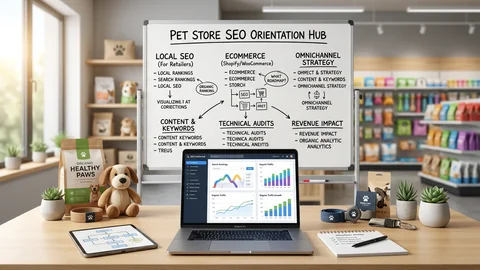
Pet Store SEO: The Complete Orientation Hub for Retailers, eCommerce, and Local Services

Pet Blog Automation: The Complete Orientation Hub for Pet Brands, Retailers, and Services

Pet Page SEO Optimization: The Complete Orientation Guide for Pet Brands, Retailers, and Services