Local AI SEO for Pet Services: Automate Pages, GBP Posts, and Schema

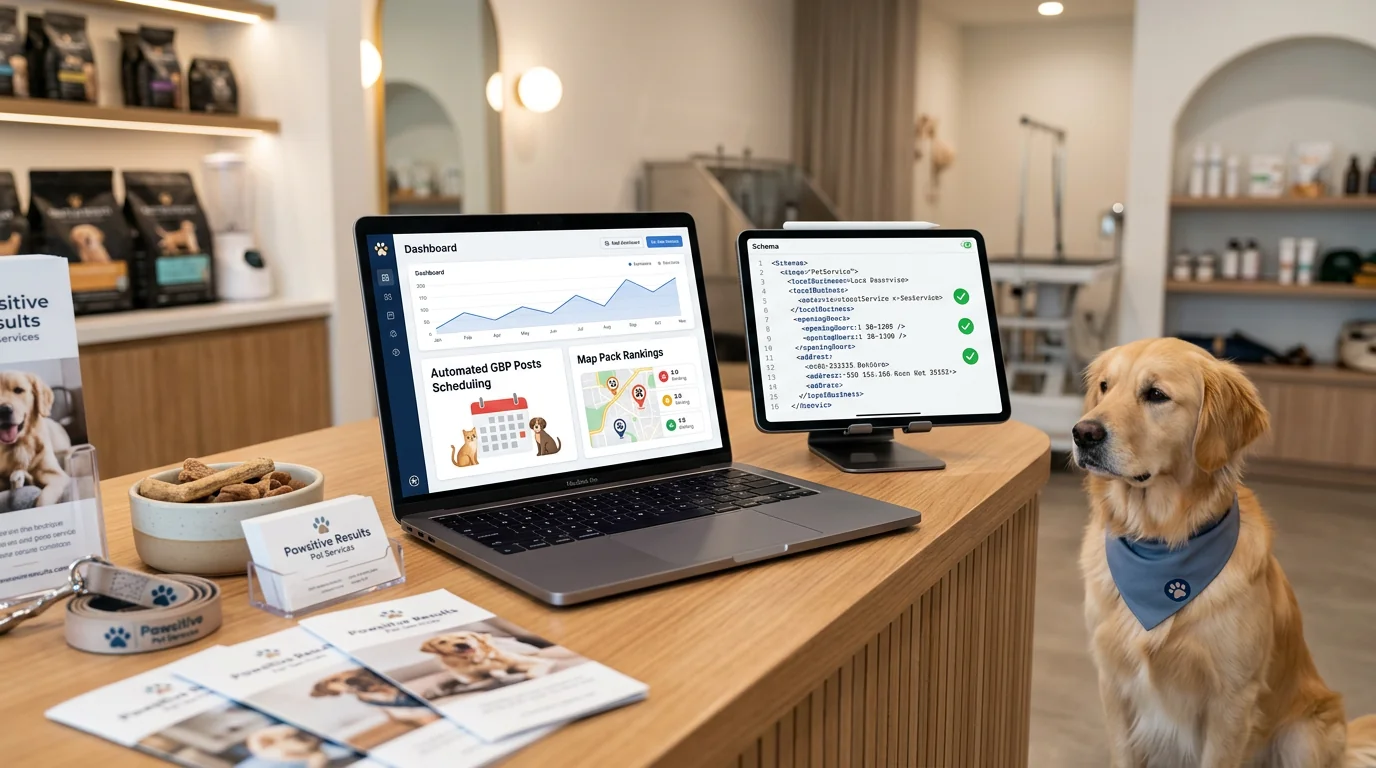
Table of Contents +
Automate local pages, Google Business Profile posts, and services schema for vets, groomers, trainers, and daycare. Win more map packs with less effort.
Local visibility wins bookings for pet services. Yet manual updates to city pages, Google Business Profile posts, and schema drain time. Automation can help without sacrificing quality.
This guide explains how to automate local assets with precision. You will learn a reusable template strategy, variable-driven prompts, and publishing cadences. You will also see monitoring checkpoints, safety boundaries, and evidence-informed expectations.
The specific decision: How to automate local SEO assets without losing quality
Define one service-area template for vets, groomers, trainers, daycare
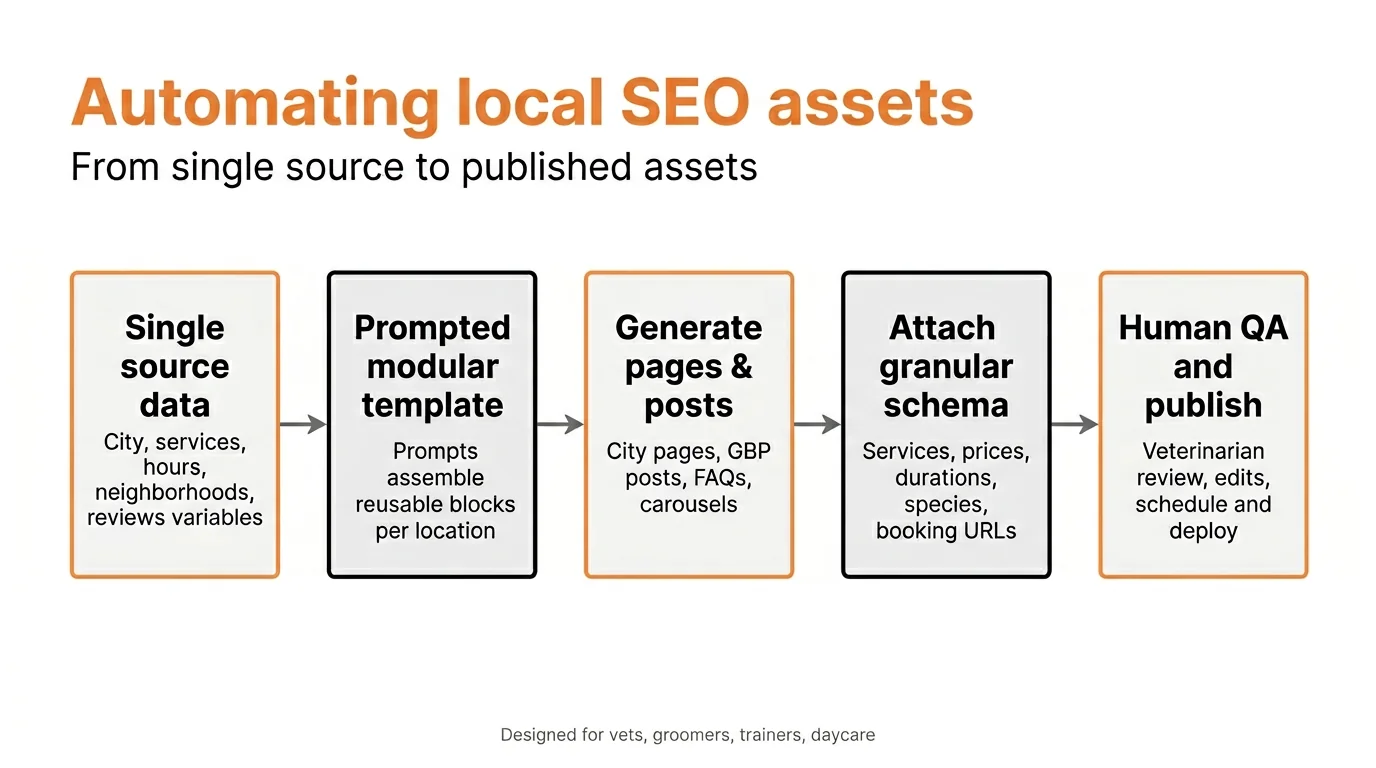
Create one modular template that fits veterinary local SEO, groomer SEO automation, dog trainer local SEO, and pet daycare SEO. Separate universal blocks from localized proof. Keep hero, value proposition, service list, FAQs, testimonials, and CTAs consistent. Localize introductions, pricing notes, and map sections.
Map prompts to local variables: city, neighborhood, services, hours, reviews
Design prompts that ingest variables for city, neighborhood, offered services, opening hours, and selected reviews. Use a single source of truth to populate all assets. Include optional variables for seasonal demand, parking details, and nearby landmarks. Log outputs to track changes and avoid repetition.
Set publishing cadences for pages, GBP posts, and Q&A
Plan monthly updates for city pages, weekly Google Business Profile for vets and other services, and rolling Q&A additions. Rotate prompts across topics and formats. Calibrate to staffing capacity and review cycles. Modular automation in large-scale systems may outperform static schedules when optimized iteratively.[4]
Petbase builds this SEO foundation automatically for pet businesses - 10 optimized articles published every month - start your free trial.
Quick decision guide
If targeting multiple neighborhoods, then use one dynamic city-page template with neighborhood blocks
Build a single city page with expandable sections for each neighborhood. Include micro-maps, parking notes, and local testimonials. Avoid dozens of thin pages. One page can rank broadly and still satisfy neighborhood intent.
If services differ by location, then generate per-location services schema with offer-specific details
Attach a location’s exact services and offers to its schema. Include price ranges, durations, species limits, and booking URLs. This granularity may aid relevance. Keep schema synchronized with on-page copy and Google Business Profile categories.
If you lack fresh photos, then prioritize GBP post automations using review snippets and seasonal tips
Use text-first GBP posts that highlight review quotes, limited-time offers, or seasonal care checklists. Pair with simple graphics or badges. Rotate narrative formats to sustain engagement when image supply is constrained.
If rankings stall in the map pack, then rotate post topics: service, offer, FAQ, before/after, community
Diversifying topics may expand query coverage and recover stalled discovery. Alternating formats can mimic exploration steps that escape local optima in optimization research.[2] Track which themes drive calls and directions.
If duplicate content risk arises, then add local proof layers: landmarks, team names, UGC quotes
Enrich templates with local anchors. Mention intersections, rescue partners, team certifications, and user-generated quotes. Thin boilerplate may underperform. Robust local proof gives search engines more distinctive signals.
If hours vary weekly, then sync structured data and GBP hours via a single source of truth
Maintain hours in one master schedule. Push updates to schema.org and GBP simultaneously. Mismatched hours can hurt trust and conversions. Use alerts for holiday exceptions and inclement weather.
Implementation blueprint for pet services
Local service pages: structure, on-page signals, and internal links
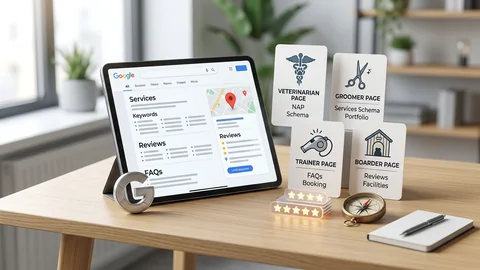
Use a clear hierarchy: H1 with city, intro proof, service modules, pricing notes, FAQs, map embed, and review carousel. Add crawlable NAP data and appointment CTAs. Build contextual internal links from breed or condition pages to city sections. Reference the AI Pet SEO orientation hub for broader positioning with the orientation hub for pet brands.
GBP posts and Q&A: cadences, topics, assets, and UTMs
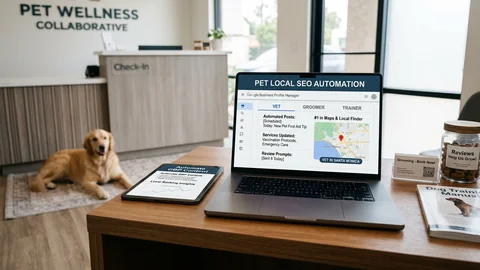
Post weekly with rotating formats: service spotlight, limited-time offer, review highlight, before/after, and community involvement. Tag URLs with UTM_source=GBP, medium=post, campaign=topic. Automate Q&A based on call transcripts and chat logs. For scalable research, many teams use a topical explorer to seed ideas.
Services schema: Vet, Groomer, Trainer, and PetDayCare schema patterns
Use LocalBusiness subtypes with Service and Offer nodes. Add service-specific details like duration, price range, and service area. For “Google Business Profile for vets,” align categories with VeterinaryCare and core services. Keep markup consistent with visible content and update programmatically.
Monitoring and iteration
What to watch after 7-14 days
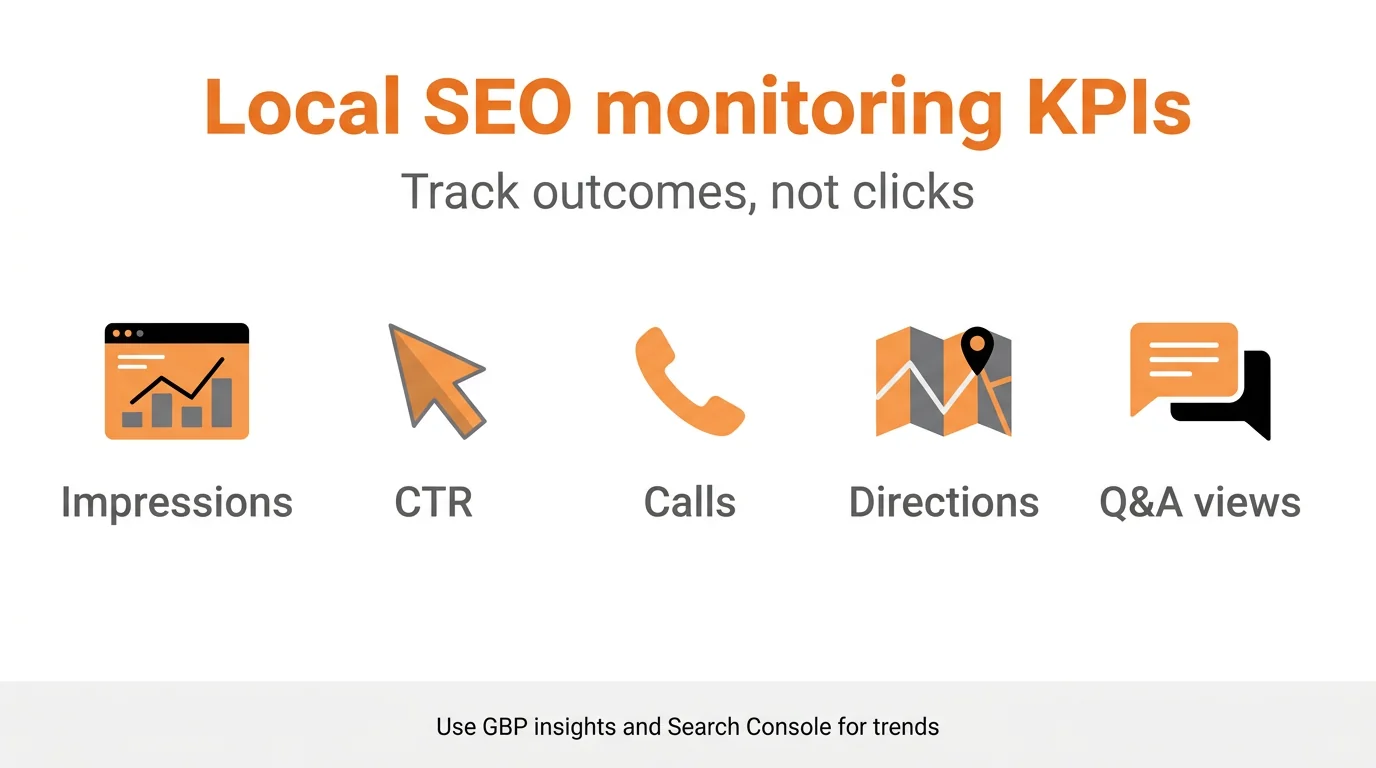
Check GBP post impressions, click-through rates, and new Q&A views. Review Search Console for city-page impressions and queries. Sample map-pack rank for five priority terms. Early feedback supports fast adjustments, balancing exploration and focus.[3]
What to assess after 4-8 weeks
Evaluate discovery searches, direction requests, calls, and UTM-tagged clicks. Compare neighborhoods and services for lift. Identify cannibalization or under-indexed blocks. Roll learnings into the next template update cycle or topic rotation slate.
Diagnostic prompts when impressions plateau
Ask: Are categories and services schema aligned? Are reviews fresh and location-specific? Are posts repeating topics? Are hours and attributes current? Would new neighborhoods benefit from distinct proof layers and inbound links from internal linking blueprints?
Practical safety boundaries for automation
Medical accuracy and scope-of-practice for veterinary content
Keep clinical copy within licensed scope. Route AI drafts through veterinarian review. Include bylines, credentials, and last-reviewed dates. Avoid diagnosing in GBP posts. Differentiate general wellness education from condition-specific guidance.
Image rights, review consent, and location claims
Use images with clear rights and model consent. Attribute review snippets accurately and avoid editing meaning. Claims about neighborhoods or partnerships should be verifiable. Misdirected claims may erode trust and invite moderation.
Rate limits to avoid spam signals in GBP and site
Stagger updates: one GBP post weekly, one Q&A addition weekly, and one city-page revision monthly. Batch-queue safely. Rapid, repetitive edits may trigger filters. Vary topics and structures to reduce perceived redundancy.
Evidence status and expectations
What current evidence suggests about map pack factors
Map-pack visibility appears sensitive to proximity, category fit, and engagement signals. Adaptive automation that tunes cadence and content mix may support performance when guided by iterative optimization principles from automation research.[4]
Where data is mixed or inconclusive
Impact estimates for GBP posts vary, and schema changes may take weeks to reflect. Rotating topics can help escape local performance plateaus, although outcomes differ by market dynamics.[2]
How to run lightweight A/B comparisons responsibly
Split neighborhoods or service lines into test and control cohorts. Adjust one element at a time: post topic, CTA, or schema offer detail. Adaptive approaches may reduce bias and avoid premature convergence on suboptimal tactics.[1] For DACH/UK expansions, align tests with multilingual SEO practices.
Frequently Asked Questions
How often should pet services publish Google Business Profile posts?
Evidence suggests weekly GBP posts may support freshness signals and engagement. Many teams rotate topics every 7-10 days to avoid repetition and track which formats earn clicks.
Do city-specific service pages risk duplicate content penalties?
Search engines tend to handle templates well if pages include unique local proof such as neighborhood mentions, team photos, pricing nuances, FAQs, and review snippets. Thin boilerplate may underperform.
Which schema types fit vets, groomers, trainers, and daycare?
LocalBusiness subtypes like VeterinaryCare, PetGroomer, SportsActivityLocation or LocalBusiness for trainers, and AnimalShelter or LocalBusiness for daycare can be adapted. Include Service and Offer where relevant.
What metrics indicate progress in the map pack?
GBP impressions, discovery searches, direction requests, and call clicks may indicate traction. Pair with local pack rank sampling and UTM-tagged clicks to gauge movement.
Can AI write medical content for veterinary pages safely?
AI may assist drafts, but clinical guidance should be reviewed by licensed veterinarians. Add bylines, credentials, and review dates to support accuracy and trust.
Return to broader strategy
How this automation connects to topical authority and seasonal demand
Automated local modules free time for deeper expertise pages and seasonal campaigns. The same variable-driven system can surface high-intent neighborhoods and expand service lines. For teams consolidating research and publishing, consider integrating Petbase AI into your workflow. Align this local framework with your broader KPIs and growth roadmap documented in your internal strategy and the AI Pet SEO orientation hub.
References
- AG Hussien et al. (2022). A self-adaptive Harris Hawks optimization algorithm with opposition-based learning and chaotic local search strategy for global optimization and feature selection. International Journal of Machine Learning and …. View article
- S Gao et al. (2019). Chaotic local search-based differential evolution algorithms for optimization. IEEE Transactions on …. View article
- Y Cao et al. (2018). Comprehensive learning particle swarm optimization algorithm with local search for multimodal functions. IEEE Transactions …. View article
- F Hagebring et al. (2022). On optimization of automation systems: Integrating modular learning and optimization. … on Automation …. View article