From Blog to Basket: Internal Linking Blueprints for Pet Stores

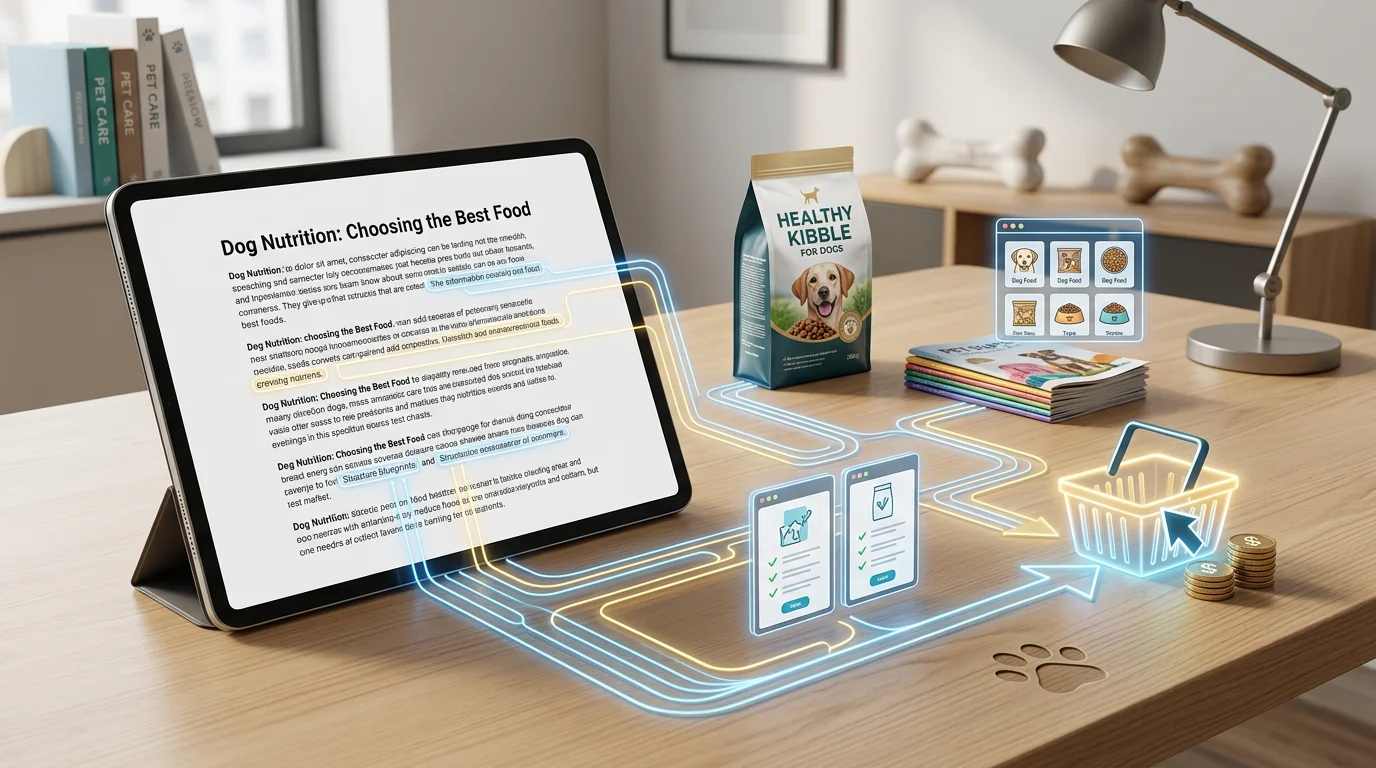
Table of Contents +
- Scenario focus: Linking care guides to product, category, and comparison pages
- Blueprints: Reusable link modules for pet store blogs
- Quick decision guide
- Monitoring: What to check after 7-14 days and 4-8 weeks
- Safety boundaries: Keep links useful and compliant
- Evidence status: What current data suggests
- Implementation checklist
- Where this fits in your cluster
- Frequently Asked Questions
- Conclusion
- References
Concrete internal linking patterns that connect educational posts to product, category, and comparison pages to lift CTR and assisted revenue.
Educational posts can spark purchase intent, yet many readers stall before they reach the right product. Strategic internal linking turns that curiosity into action. Well-placed links guide readers to relevant product, category, and comparison pages without friction.
This matters because intent is fragile. A clear path may convert interest into clicks and assisted revenue. In this deep dive, you will learn repeatable link modules, anchor patterns that attract clicks, and safe limits. You will also get measurement tips and a simple decision guide.
Scenario focus: Linking care guides to product, category, and comparison pages
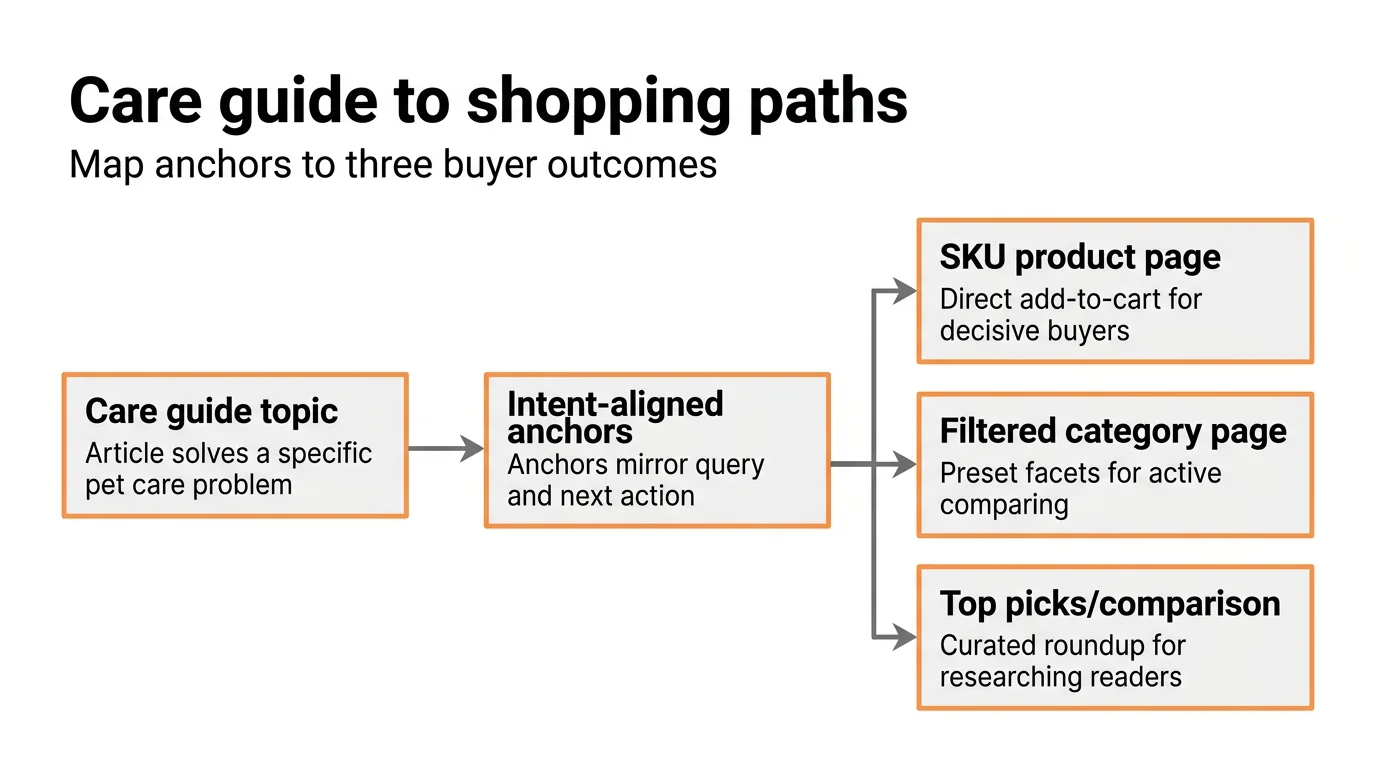
Reader journey to basket: one guide, three pathways
A single care guide often supports three outcomes. A direct SKU for decisive buyers, a filtered category for shoppers still comparing, and a top picks comparison for evaluators. For example, a stress-handling guide can link to calming chews for dogs alongside a single recommended product and a “best of” comparison. This blog to product linking pattern respects intent stages and reduces choice overload.
Anchor text patterns that signal intent without over-optimization
Use anchors that mirror intent and next action. Prefer “grain-free senior kibble 5 lb” over generic “see options.” Vary close synonyms naturally across modules. Avoid repetitive anchors in the same post. Hypertext links help users traverse related resources, and anchor clarity improves navigation cues for both readers and systems[1].
Petbase automates SEO content for pet stores - publishing 10 optimized articles monthly so you can focus on running your shop - start your free trial.
Blueprints: Reusable link modules for pet store blogs
Module A - Treatment trio: product + category + comparison
After the first actionable tip, insert a concise three-link unit. One SKU for a decisive buyer, one filtered category for browsing, and one comparison for validation. Keep copy neutral and problem-oriented. Example trio:
- Product: vet-strength calming bites
- Filtered category: small-breed calming chew category
- Comparison: top calming chews compared
Place this “Treatment trio” mid-article for visibility without interruption. Treat it as a skimmable decision aide, not an ad. Route readers by likely “cost” of next step-directness for committed, breadth for undecided-akin to path selection concepts in routing research[3].
Module B - Breed/size switcher to category facets
When sizing matters, add a switcher that jumps to pre-filtered facets. Keep 2-4 prominent links. Example:
- XS harnesses for small breeds
- M harnesses for medium builds
- XL harnesses for large builds
This category page linking strategy reduces pogo-sticking and narrows choice quickly. Use clear descriptors, not cryptic filter codes.
Module C - Seasonal insert with rotating product picks
In time-sensitive guides, embed a seasonal block with two rotating picks and a stable category fallback. Example: “Summer relief” with a cooling mat SKU, a sun-safe balm SKU, and a link to summer care category. Rotate SKUs monthly, leave the category as the evergreen anchor. This supports freshness while preserving stable discovery paths.
Module D - Problem-solution table with SKU deep links
Summarize typical problems with one SKU and one category alt per row. Keep rows scannable, and cap at five.
| Problem | Direct Product | Browse Alternative |
|---|---|---|
| Over-chewing during crate time | durable calming chew toy | high-durability chew toys |
| Anxious pacing at night | melatonin soft chews | melatonin calming options |
| Heat discomfort indoors | gel cooling mat | cooling beds and mats |
Readers who scan tables are primed to act. Provide one-tap routes.
Module E - How-to steps with context anchors
Place SKU links on the exact step where the item is used. Keep anchors descriptive and intent-led. Example for low-stress training:
- Define a short, consistent cue in a quiet room.
- Mark the behavior and reward immediately with soft puppy training treats.
- Increase complexity slowly, then generalize to busier settings.
Context anchors outperform generic CTAs because the product is functionally necessary in that moment.
Quick decision guide
If X situation, then Y action (5-7 practical rules)
- If a guide names a precise product type and size, link a SKU first.
- If readers must compare features, prioritize a filtered category link.
- If social proof is critical, add a top five comparison with clear criteria.
- If sizing determines success, include a breed/size switcher facet block.
- If seasonality drives urgency, insert a rotating seasonal picks module.
- If the tip describes a tool mid-step, anchor the SKU at that step.
- If uncertainty remains, offer the “Treatment trio” to serve all intents.
For broader strategy alignment, see product-led patterns in product-led SEO for pet ecommerce.

Monitoring: What to check after 7-14 days and 4-8 weeks
Early signals (7-14 days)
Look for qualified click-through from the modules. Monitor scroll-depth at insertion points, link CTR by anchor type, and time on destination page. Assess if readers choose SKU versus category links. In large navigation graphs, small link placement changes can shift path flows considerably, which supports testing early and often[2]. If CTR is under 1% for a module, test anchor clarity or proximity to problem statements.
Mid-term signals (4-8 weeks)
Track assisted conversions, add-to-cart rate on linked pages, and bounce on arrival. Compare posts with modules versus similar posts without modules. Use UTM parameters or event labels for module type. Networked content benefits when links convey clear relationships; better semantic cues may improve traversal and engagement over time[1]. For KPI framing, align with the ladder in measuring what matters for Pet SEO.
Safety boundaries: Keep links useful and compliant
Relevance, density, and UX limits
Keep links tightly relevant to the problem at hand. Evidence suggests 3-6 contextual links per guide section is usually sufficient. Avoid stacking multiple SKUs for the same use case. Space modules at natural breakpoints for readability. Balance navigation so category and comparison page links do not overwhelm decisive buyers. Excessive linking can degrade comprehension and distract from the primary action.
Structured data and disclosure considerations
Use Product and ItemList markup on destination pages, not in the article body. Label sponsored or affiliate placements if applicable. Maintain least-privilege access to link editing and publishing workflows to reduce errors and misuse, consistent with broader zero trust principles in systems governance[4]. Maintain a change log for link edits and seasonal rotations to support audits.
Evidence status: What current data suggests
What we know with moderate confidence
Anchors that reflect intent may improve click appeal and downstream engagement. Clear internal pathways support navigation by clarifying document relationships, which can aid both users and systems in discovery[1]. Structured modules like the “Treatment trio” tend to concentrate clicks where decisions are most likely, often mid-article.
Areas where evidence is limited
Exact optimal link counts vary by topic, layout, and audience. The relative lift of SKU versus category links fluctuates with price sensitivity and seasonality. Route-optimization analogies suggest path costs influence choices, but human behavior introduces variability beyond network models[3]. Test locally and monitor trends, not anecdotes.
Implementation checklist
Editorial workflow and templates
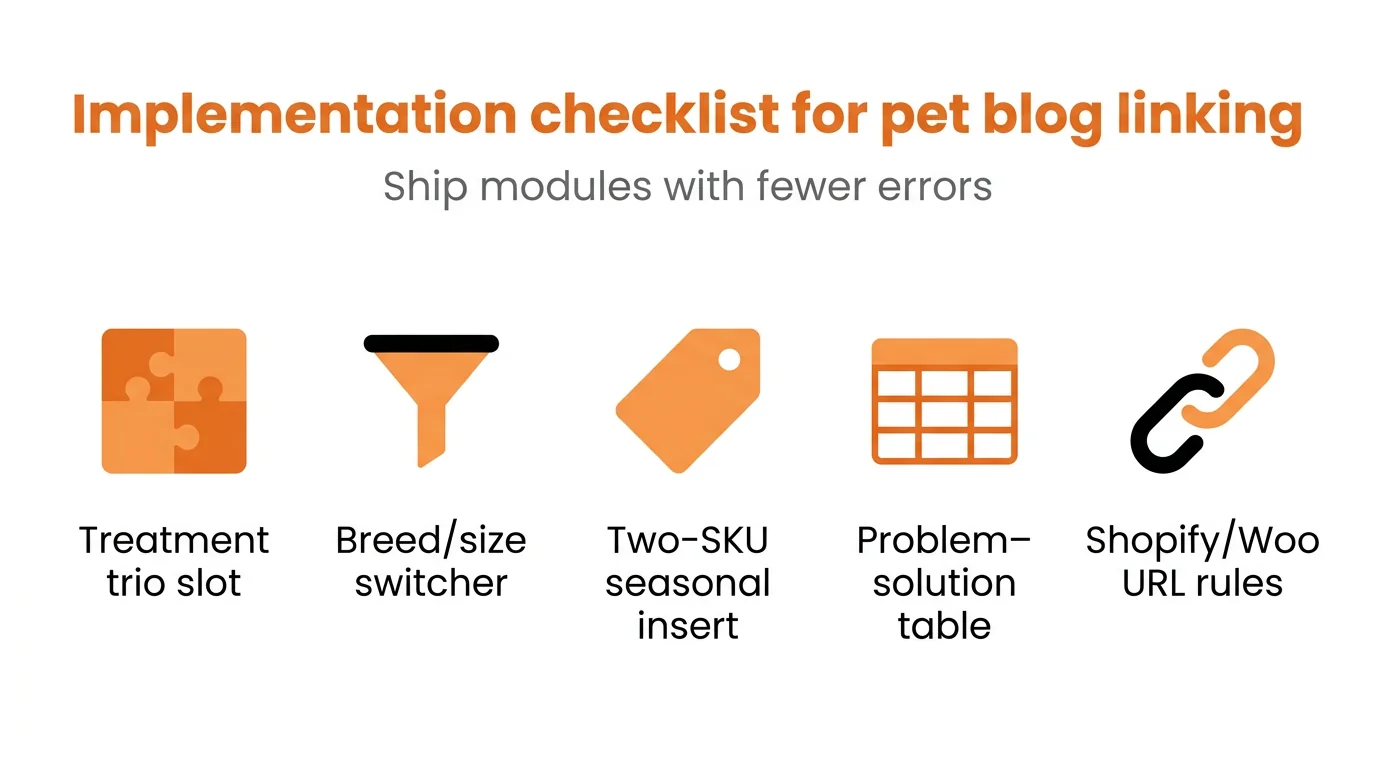
Create a blog template with placeholders for the Treatment trio, a breed/size switcher, and a two-SKU seasonal insert. Add a problem-solution table component and a how-to steps block. Maintain a per-guide intent map that assigns SKU, filtered category, and comparison page links. For scale, content teams sometimes use Petbase AI to generate pet ecommerce internal links and keep modules consistent across posts.
Shop platform notes (Shopify, Woo, custom)
On Shopify, use collection filters in URLs for facets and preserve canonical category targets. On Woo, prebuild product attribute archives and friendly query parameters. For custom stacks, enforce a link component with analytics parameters and role-based approvals. Validate that comparison page links resolve fast and are mobile-friendly.
Where this fits in your cluster
Connect to the AI-powered Pet SEO guide
These blueprints focus on converting educational intent through pet SEO internal linking. For strategy context and navigation standards, see the AI-powered Pet SEO guide. Pair this post with product-page improvements and programmatic facets to unlock consistent, compounding performance.
Frequently Asked Questions
How many internal links should a pet store blog post include?
Evidence suggests 3-6 highly relevant links may support discoverability and clicks without overwhelming readers. Prioritize one product, one category, and one comparison link when they clearly match the problem described.
Should I link directly to SKUs or to category pages?
If intent is specific (e.g., a named product type or size), a SKU link may help. If readers still need to choose among options, a filtered category link often performs better for engagement.
Does repeating the same anchor text help SEO?
Overusing identical anchors can look unnatural. Vary anchors with close variants that reflect user intent, which may support topical relevance and improve click appeal.
Where should internal links appear in the article?
Links near problem statements, step-by-step instructions, and comparison sections tend to attract more qualified clicks. A concise end-of-post module can capture late-stage intent.
How do I measure assisted revenue from internal links?
Use analytics with UTM parameters or event tracking, then review assisted conversions and path reports. Compare linked posts versus controls over 4-8 weeks for directional impact.
Conclusion
Internal links turn guidance into action when they match intent and timing. Use modular patterns-Treatment trio, breed/size switchers, seasonal inserts, problem-solution tables, and context anchors-to guide readers confidently. Monitor early CTR and mid-term assisted conversions, then iterate. Keep links relevant, annotated, and reader-first. With disciplined execution, your educational content can reliably support click-through and assisted revenue while preserving trust and usability.
References
- C Bizer et al. (2023). Linked data-the story so far. Linking the World's Information …. View article
- G Dai et al. (2018). GraphH: A processing-in-memory architecture for large-scale graph processing. … on Computer-Aided …. View article
- R Van Meter et al. (2022). A quantum internet architecture. 2022 IEEE …. View article
- Y He et al. (2022). A survey on zero trust architecture: Challenges and future trends. … and Mobile Computing. View article