Your 30-Day AI Content Plan for Pet Brands

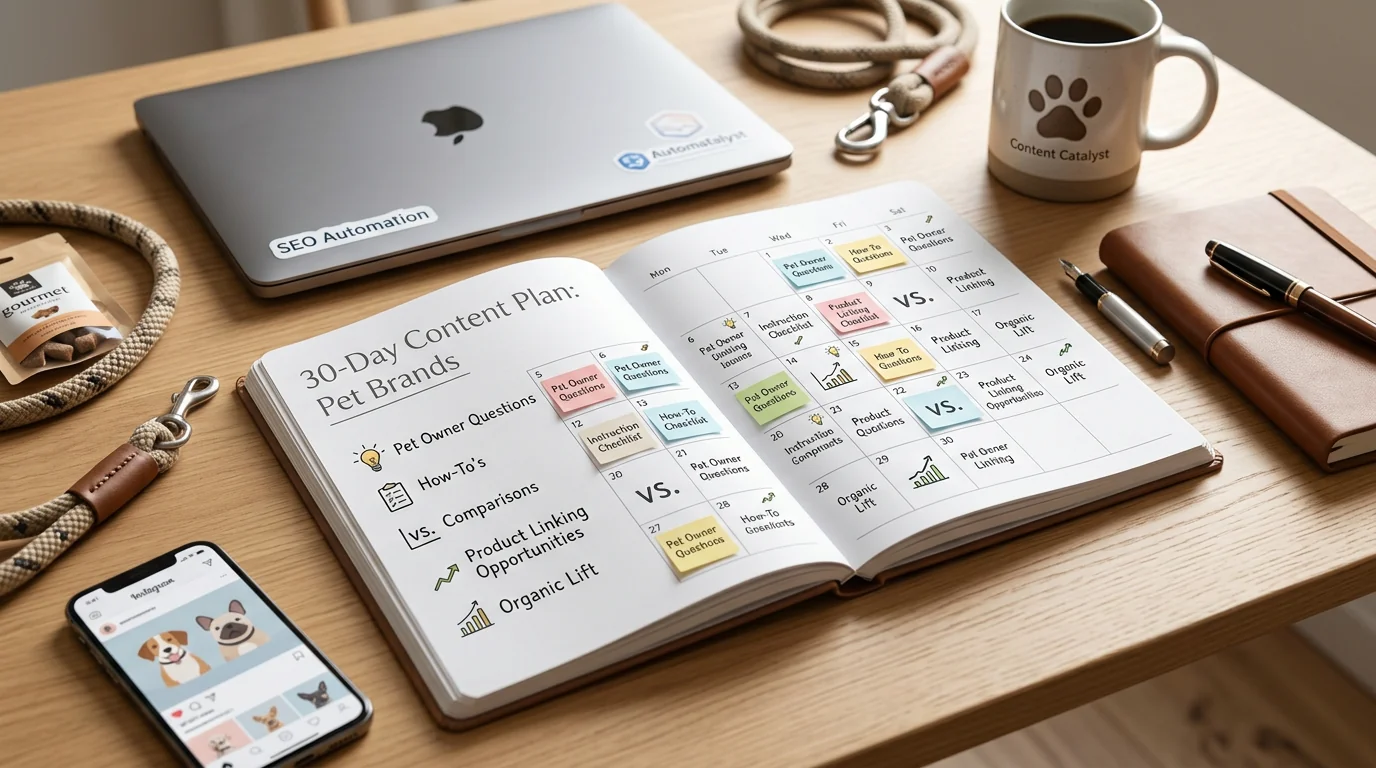
Table of Contents +
- Scenario: Publish 30 days of product-led, pet-owner content with AI
- The 30-day cadence: questions, how-tos, and comparisons
- Internal linking and product mapping rules
- Quick decision guide
- Monitoring guidance
- Practical safety boundaries
- Evidence status: what research and benchmarks suggest
- How this connects to your AI-powered pet SEO orientation hub
- Frequently Asked Questions
- References
A focused 30-day AI content plan for pet brands with day-by-day topics, product linking cues, and monitoring steps to lift organic traffic safely.
Thirty days of consistent, product-led content can unlock quick organic lift. It guides shoppers from questions to confident selections without friction.
This matters because search journeys are fragmented and impatient. Owning consideration queries builds trust and revenue. In this guide, you will learn a proven cadence, internal linking rules, schema tactics, and measurement guardrails.
Scenario: Publish 30 days of product-led, pet-owner content with AI
Audience and catalog prerequisites
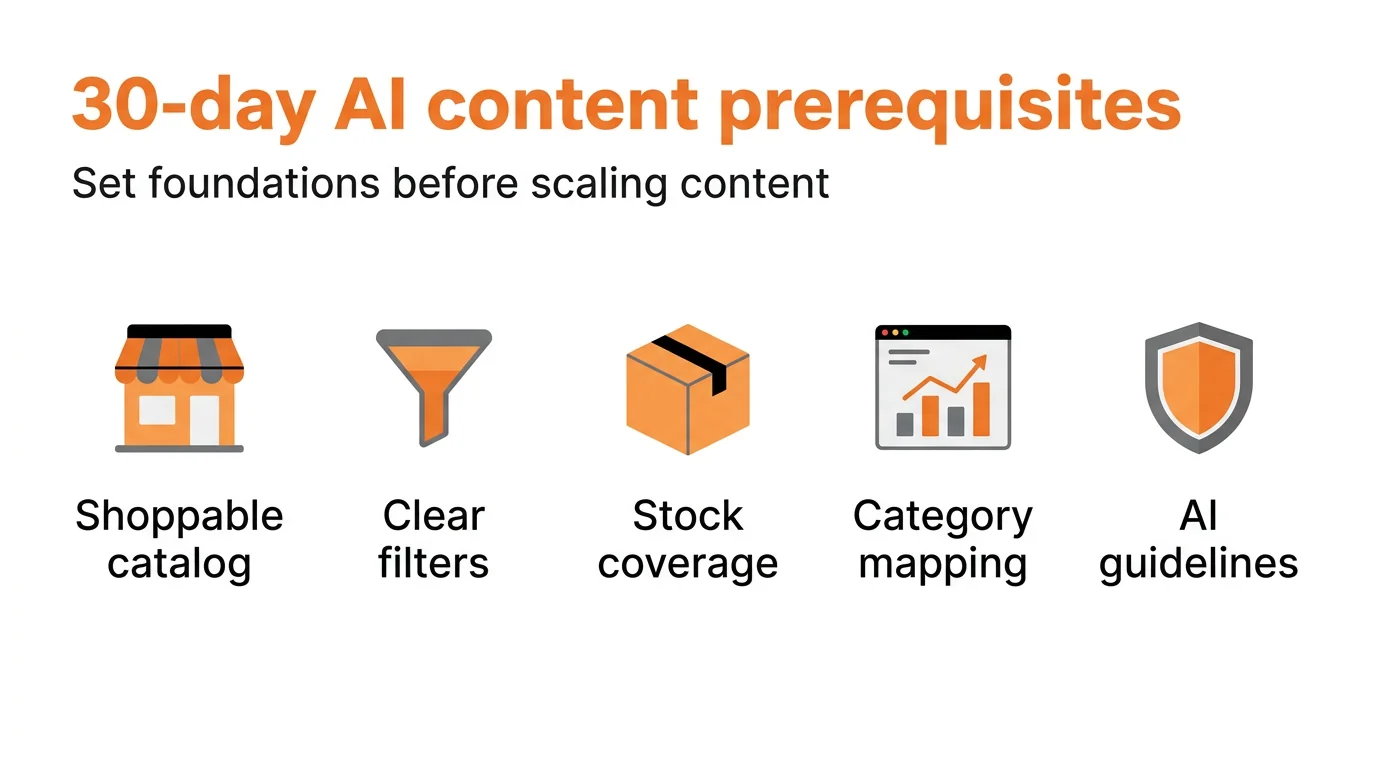
Ensure you have a shoppable catalog with clear categories, filters, and stock coverage. Map top categories, seasonal priorities, and margin leaders. Define audience segments by life stage, size, sensitivities, and task intent.
AI content for pet brands may accelerate production and reduce repetitive workload when paired with documented guidelines and review steps, improving throughput responsibly.[3]
How this supports consideration-stage search intent
This plan targets questions with clear problem signals, hands-on how-tos, and side-by-side comparisons. Each post aligns to a purchase path using product-led SEO for pets.
Position the plan within your AI-powered pet SEO orientation hub to reinforce topical breadth and help users navigate from guidance to products with minimal friction.
Petbase writes and publishes this kind of content automatically - 10 SEO articles per month for pet businesses - start your free trial.
The 30-day cadence: questions, how-tos, and comparisons
Days 1-10: Problem questions linked to essentials
Publish one owner question daily that reveals an immediate need. Examples include nutrition basics, cleaning approaches, odor control, stain removal, and grooming frequency.
Editorial logic: lead with a concise answer. Add a short checklist. Place one primary product or category link above the fold. Insert two contextual links mid-article using descriptive anchors like “grain-free senior dog food.”
To protect trust, use AI as a drafting assistant and keep human editors in the loop, as full automation may reduce perceived brand authenticity.[1]
Days 11-20: How-tos mapped to usage and bundles
Ship one tutorial per day that solves a repeatable task. Prioritize routines tied to replenishable goods, tools, or accessories. Include step counts, time ranges, and care cautions.
Mapping guidance: connect steps to products used at that moment. Suggest compatible bundles and refills. Add an in-content module with breed, size, and life-stage filters. This strengthens pet SEO automation signals and aids discovery.
Days 21-30: Comparisons and buyer’s guides with schema
Launch three to five comparison posts and four to six focused buyer’s guides. Cover popular materials, feature sets, form factors, and price tiers.
Include a comparison table linking to two or three relevant product pages and one category page. Conclude each section with a “Why we mapped this product” note that aligns features to needs.
Use Product, FAQ, and Review schema where appropriate. This structure may enhance clarity and relevance in search. For a deeper framework, see product-led SEO for pet eCommerce strategies in product-led SEO for pet eCommerce.
For operational efficiency across drafting, briefs, and publication, teams often benefit from streamlined automation like Petbase AI.
Internal linking and product mapping rules
Anchor strategies by query type
- Problem questions: one primary category anchor early, then two contextual anchors using exact, descriptive phrases that mirror searcher vocabulary.
- How-tos: map each procedural step to a product with action-oriented anchors, such as “enzymatic cleaner for fresh stains.”
- Comparisons: use table rows as anchors. Link the model name to product pages and the feature column header to a category or buyer’s guide.
For architecture patterns and modules, reference internal linking blueprints for pet stores.
Navigation, related products, and breadcrumbs
Maintain breadcrumbs from homepage to subcategory to product for crawl clarity. Add “related items” tuned to compatibility and life stage. Include a sticky “Compare” CTA on comparison pages.
Sidebars and in-content chips that link to breed, size, and life-stage categories deepen topical coverage and encourage discovery paths that reduce pogo-sticking.
Quick decision guide
If X situation, then Y action (5-7 routes)
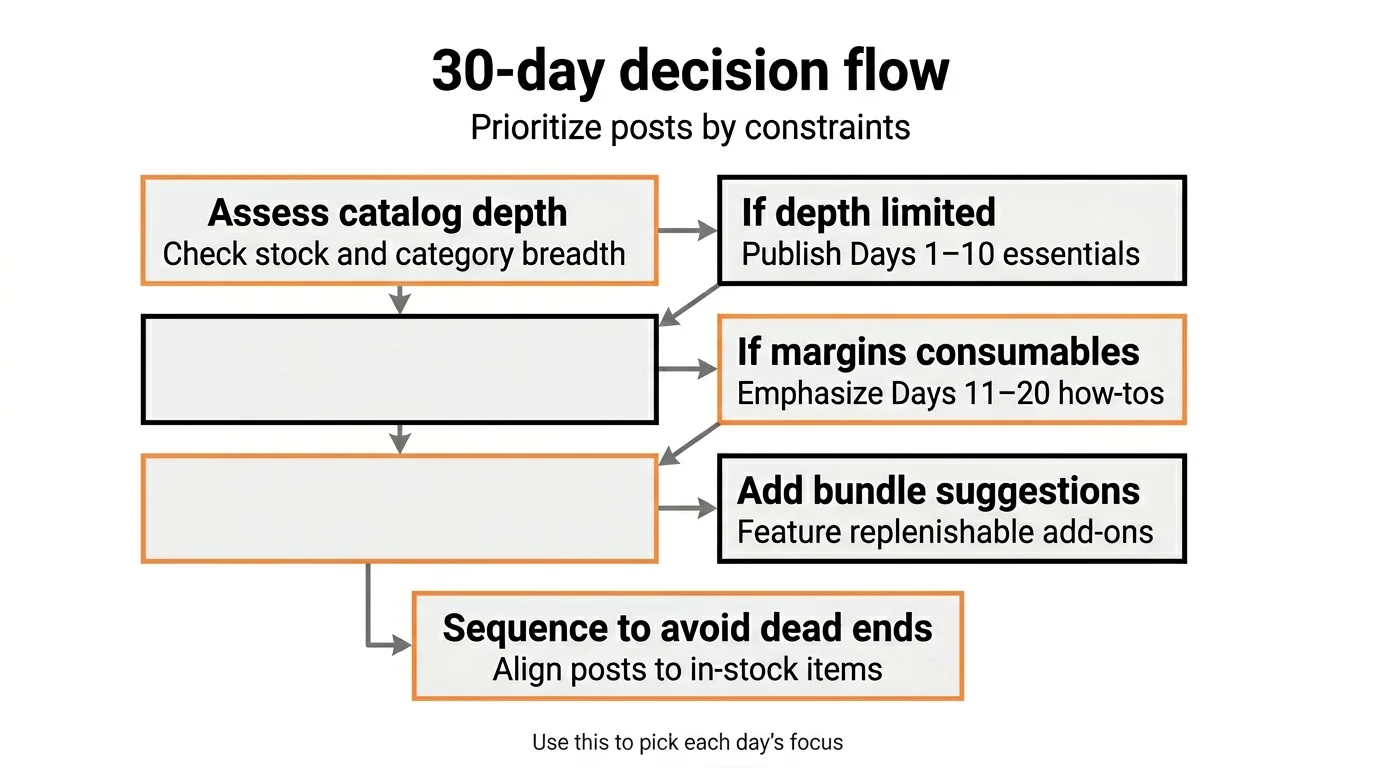
- If catalog depth is limited, prioritize Days 1-10 questions tied to stocked essentials to avoid dead ends.
- If margins depend on consumables, emphasize Days 11-20 how-tos that feature replenishable products and bundle suggestions.
- If traffic exists but conversions lag, accelerate Days 21-30 comparisons with clear, scannable tables and price-to-value framing.
- If crawl budget is thin, consolidate overlapping topics and publish fewer, stronger pages with canonical rules.
- If ad costs are rising, shift to long-tail how-tos that capture intent with lower competition and stronger internal linking.
- If seasonality is approaching, schedule time-sensitive guides first and reference evergreen posts contextually.
- If authenticity risk is a concern, embed editor notes, author bios, and product testing context to reinforce trust.[1]
Monitoring guidance
What to observe after 7-14 days
Expect early impressions for long-tail questions and how-tos. Review indexing status, crawl coverage, and query clustering. Track anchor text distribution and above-the-fold product link clicks.
Monitor titles and meta descriptions for alignment to surfaced queries. Consider gentle updates to headings, FAQs, or schema if snippets underperform. Use the KPI ladder outlined in Measure What Matters: a simple KPI ladder for pet SEO.
What to observe after 4-8 weeks
Look for stable rankings in intent-matched clusters, growing internal PageRank to categories, and increased assisted conversions. Evaluate comparison table engagement and time-on-section improvements.
AI-driven personalization and structured automation may support better relevance and efficiency when governed by clear policies and oversight, enhancing campaign outcomes over time.[2]
Practical safety boundaries
Medical, behavior, and product-safety disclaimers
Use cautious language and avoid medical diagnoses. Advise readers to consult qualified professionals for clinical or behavioral concerns. Highlight safety warnings, contraindications, and age or size limitations on relevant products.
Do not imply guaranteed outcomes. Clearly flag when demonstrations are illustrative. Maintain separate guidance for household safety, cleaning agents, and tool usage to minimize misuse risks.
Data, images, and claims hygiene
Restrict claims to substantiated facts and manufacturer specifications. Keep images accurate, non-misleading, and free of unsafe demonstrations. Disclose affiliate relationships where applicable.
Implement a human-in-the-loop editorial review. This approach may mitigate AI hallucinations, preserve brand voice, and safeguard authenticity perceptions in content streams.[1]
Evidence status: what research and benchmarks suggest
Topical authority and internal link effects
Consolidated, interlinked content clusters often help search engines interpret expertise and coverage. While outcomes vary, internal linking discipline and structured publishing may improve crawl efficiency and engagement with targeted segments.
AI-supported workflows can enhance productivity and personalization, provided teams manage governance, transparency, and ethics to maintain trust and relevance.[2][3]
Structured data and click-through impacts
Accurate schema for HowTo, FAQ, and Product may support richer result types that improve visibility and click quality. Consistency and fidelity between markup and content are essential for sustained benefits.
Emerging frameworks for automatic content optimization emphasize measurement loops and fidelity to source information, which may improve output coherence and user trust when applied thoughtfully.[4]
How this connects to your AI-powered pet SEO orientation hub
Prerequisites and next steps in the pillar system
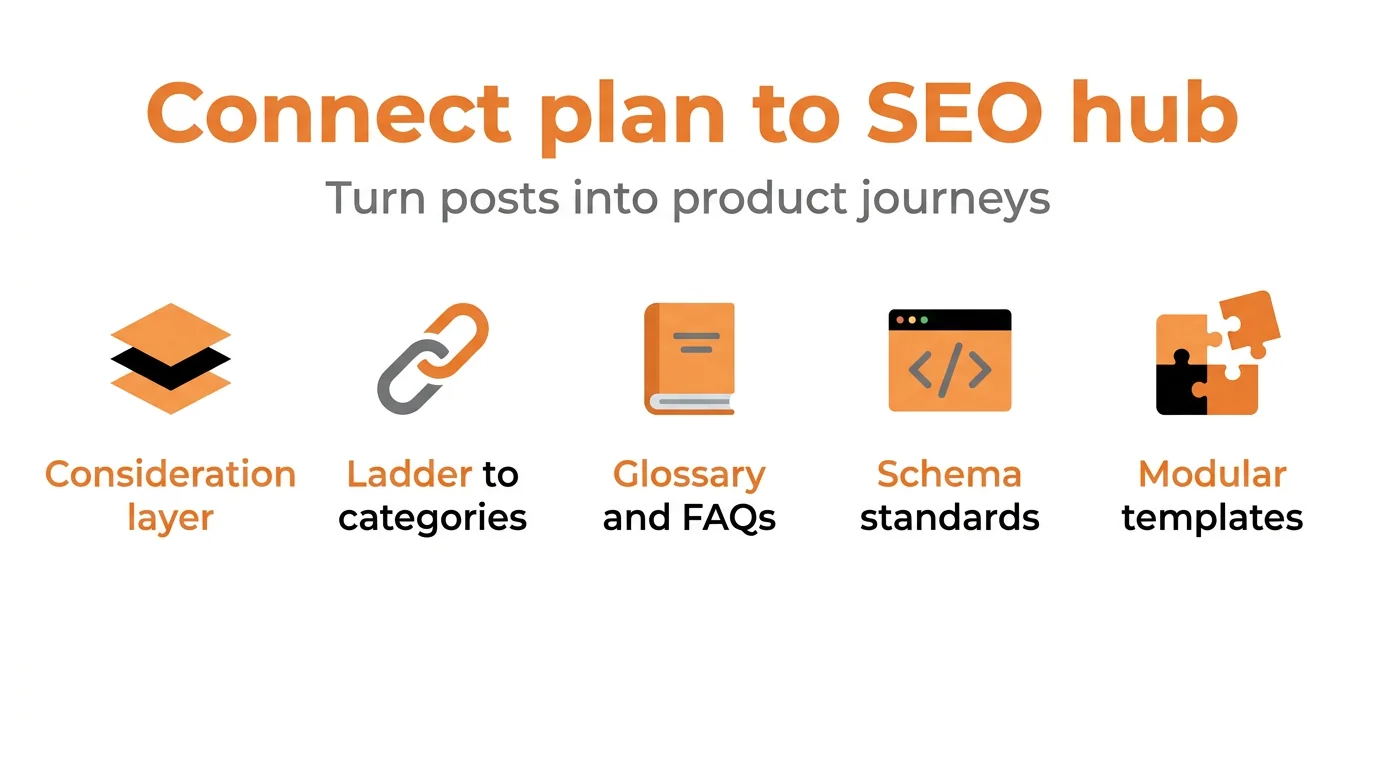
Use this 30-day cadence to populate your consideration layer, then ladder users to category and product pages. Centralize glossary terms, FAQs, and templates inside your AI-powered pet SEO orientation hub for governance.
Next, standardize schema snippets, anchor taxonomies, and editorial QA. Expand with modular, safe templates for size and life-stage categories to scale coverage without duplicating intent or cannibalizing rankings.
Frequently Asked Questions
What types of posts should a pet brand publish in 30 days?
A balanced mix may include pet owner questions, step-by-step how-tos, and product comparisons. Align each post to a relevant product or category for internal linking.
How many words should each AI-generated post be?
Evidence suggests 900-1,400 words often covers search intent for long-tail queries. Brevity can work for simple questions; complex comparisons may require more depth.
How do I choose products to link within posts?
Map each post to one primary product or category that solves the described problem. Use descriptive anchors, add related items, and include breed or life-stage filters where relevant.
When will SEO impact show from a 30-day plan?
Early impressions may appear in 1-2 weeks for long-tail terms. More stable rankings and conversions commonly emerge over 4-8 weeks as internal links and crawl frequency improve.
Should I add schema to these posts?
Yes, adding FAQ, HowTo, and Product schema where appropriate may support rich results. Keep markup accurate and aligned with on-page content.
Conclusion
This 30-day cadence focuses on predictable buyer journeys: problems, procedures, and choices. It aligns every post to a near-term purchase path while maintaining safety and authenticity. Use careful internal linking, accurate schema, and measured iteration. Evidence-informed governance, human editorial review, and consistent taxonomy work together to produce sustainable, product-led lift in organic search for pet eCommerce SEO.
References
- JD Brüns et al. (2024). Do you create your content yourself? Using generative artificial intelligence for social media content creation diminishes perceived brand authenticity. Journal of Retailing and Consumer Services. View article
- B Gao et al. (2023). Artificial intelligence in advertising: advancements, challenges, and ethical considerations in targeting, personalization, content creation, and ad optimization. Sage Open. View article
- J Ribeiro et al. (2021). Robotic process automation and artificial intelligence in industry 4.0-a literature review. Procedia Computer Science. View article
- Z Yu et al. (2023). A novel automatic content generation and optimization framework. IEEE Internet of Things …. View article