AI Content for Pet Brands: Strategy, Priorities, and Playbooks

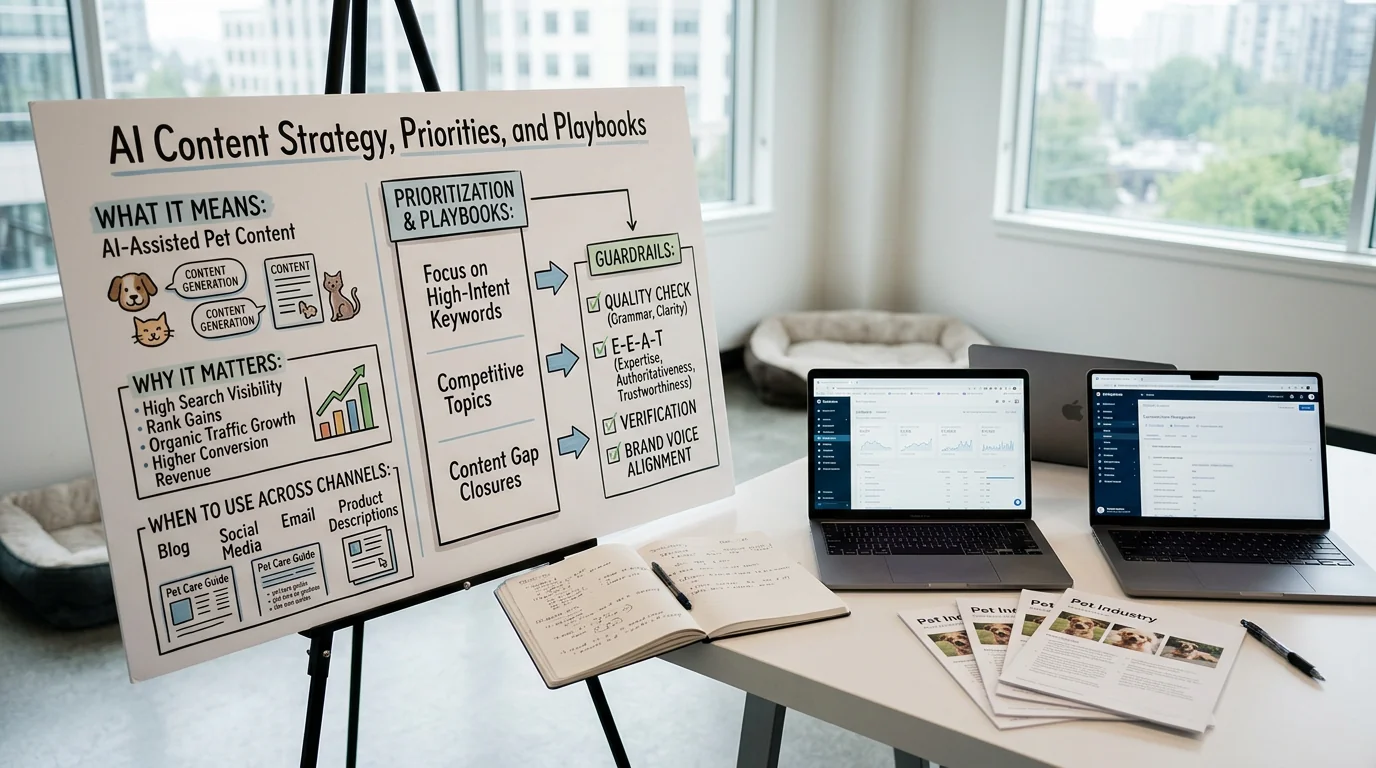
Table of Contents +
- Why AI content matters for pet brands now
- What to prioritize first: management, forage, and basic nutrition of your content
- Guardrails: quality, E-E-A-T, and brand voice
- Where AI content fits across channels
- Conversion architecture and internal linking
- Templates, optimization, and scaling safely
- Measurement, quick wins, and how we built these recommendations
- Frequently Asked Questions
- References
What AI content means for pet brands, why it matters for search and revenue, and how to prioritize safely with guardrails for E-E-A-T and brand voice.
AI content has crossed from novelty to necessity in pet eCommerce. Search, social, and marketplaces now reward consistent, expert-driven coverage that answers buyer needs across the journey.
This matters because competition grows while attention fragments. Teams need a scalable, reliable approach to content quality and distribution. In this guide, you will learn where AI fits, what to prioritize first, and how to protect brand trust while scaling.
Why AI content matters for pet brands now
Understand: market shifts, search features, and buyer journeys
Pet demand is durable, yet discovery has changed. Shoppers research across blogs, rich snippets, and social before committing to a basket. The US pet industry alone recorded USD 123.6 billion in 2021, underscoring the stakes for pet brand SEO and content operations.[2]
Europe’s market also continues to expand, intensifying competition for organic visibility and loyalty. This landscape rewards brands that build topical authority and connect content to products with product-led SEO for pets.[3]
Modern SERP features favor precise answers, structured data, and experience-backed guidance. A strong pet content strategy therefore maps buyer journeys to hubs, supporting posts, and clear pathways to SKUs.
Do not implement yet: full automation without guardrails
Avoid turning on unreviewed, fully automated publishing. Do not let AI speculate on health, nutrition, or training. Do not skip schema, internal linking, or source attribution. These missteps erode trust and waste crawl budget.
Route: See Measurement and ROI for KPI definitions (link to “Measure AI content impact with pet-specific KPIs”)
For scorecards and dashboards that separate noise from signal, see Measure AI content impact with pet-specific KPIs.
Petbase writes and publishes this kind of content automatically - 10 SEO articles per month for pet businesses - start your free trial.
What to prioritize first: management, forage, and basic nutrition of your content
Understand: governance (management), evergreen topic forage, and core page nutrition
Treat your content like a living system. Governance is the management layer: roles, approvals, and E-E-A-T for pet brands. Forage is your evergreen topic backlog: recurring buyer questions, care considerations, and product use-cases.
Basic nutrition covers core pages: category, product, and flagship hubs that anchor your topical authority. Start by securing these elements before scaling pet SEO automation into advanced templates or broader channels.
Top 3 actions to take now
- Define governance: owners, reviewers, and an approved brand voice/glossary.
- Build a 30-60 topic evergreen backlog tied to products and FAQs.
- Strengthen core pages with clear pathways, schema, and supporting content.
Do not implement yet: advanced templates, multilingual rollouts, or heavy programmatic pages
Delay large template libraries, multi-language launches, and sweeping programmatic builds. Validate quality, internal linking, and editorial cadence first. Expand only after your baseline performs reliably.
Route: Start with “Launch a 30-day AI blog plan for pet brands” for the first month roadmap
Kick off with a practical starter plan: Launch a 30-day AI blog plan for pet brands.
Guardrails: quality, E-E-A-T, and brand voice
Understand: human oversight, source attribution, reviewer roles, and voice consistency
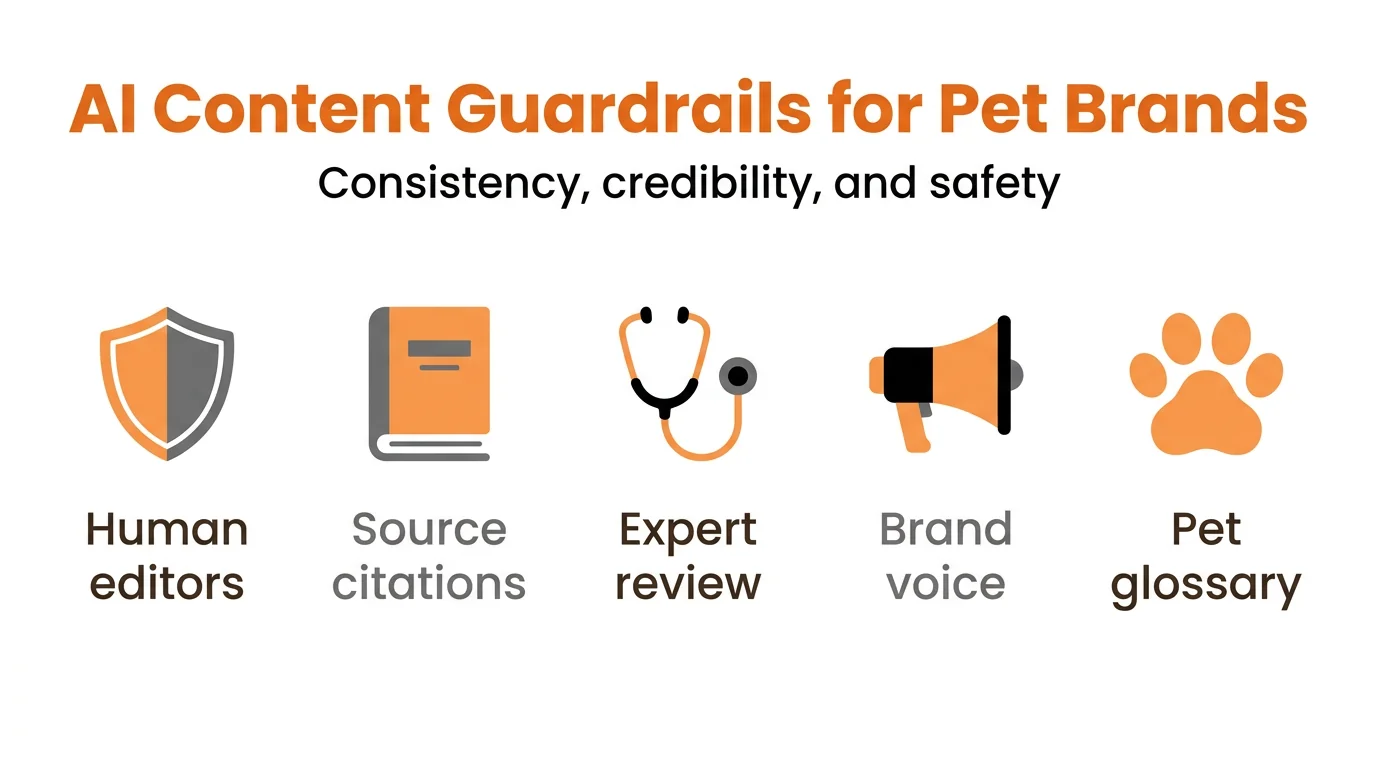
Assign human editors and domain reviewers. Require source attribution in drafts. Maintain a style guide and pet-specific glossary to ensure voice consistency and factual integrity across AI outputs.
Content that integrates with owned social and community channels can amplify reach and signal credibility. Inbound social activity is associated with higher sales in pet SMEs, underscoring the value of quality content distribution.[1]
Common mistakes and misconceptions: “AI replaces experts,” “speed beats accuracy,” and “one voice fits all channels.” In reality, expert review, precise claims, and channel-appropriate tone underpin durable performance.
Do not implement yet: medical or training claims without expert review
Prohibit unvetted medical, nutrition, or behavioral advice. Require credentialed reviewers to approve any sensitive claims to protect users and brand reputation.
Route: Read “Maintain brand voice with AI safely” for glossaries, tone profiles, and approval flows
Establish your safeguards with Maintain brand voice with AI safely.
Where AI content fits across channels
Understand: blog hubs, product-led posts, FAQs, local/service pages, and email/social repurposing
Use AI to draft blog hubs that answer buyer questions, then connect to product-led posts. Map breed, size, and life-stage needs to SKUs to operationalize product-led SEO for pets.
Repurpose high-performing articles into email sequences, social threads, and FAQs to reinforce discovery. Social amplification can support sales outcomes when aligned with buyer intent and value-adding content.[1]
For SKU-led topic ideation, see Turn breed- and life-stage searches into product-led content. For geographic demand capture, reference Local SEO content for vets, groomers, and trainers.
Do not implement yet: channel expansion without measurement or internal linking plans
Do not overextend into every channel at once. Expand only with clear KPIs, tagging, and internal linking blueprints that tie discovery assets to commerce pages.
Route: For SKU-led ideas, see “Turn breed- and life-stage searches into product-led content”
Blueprint examples and query-mapping live in Turn breed- and life-stage searches into product-led content.
Conversion architecture and internal linking
Understand: reader-to-product pathways, supporting content, and schema basics
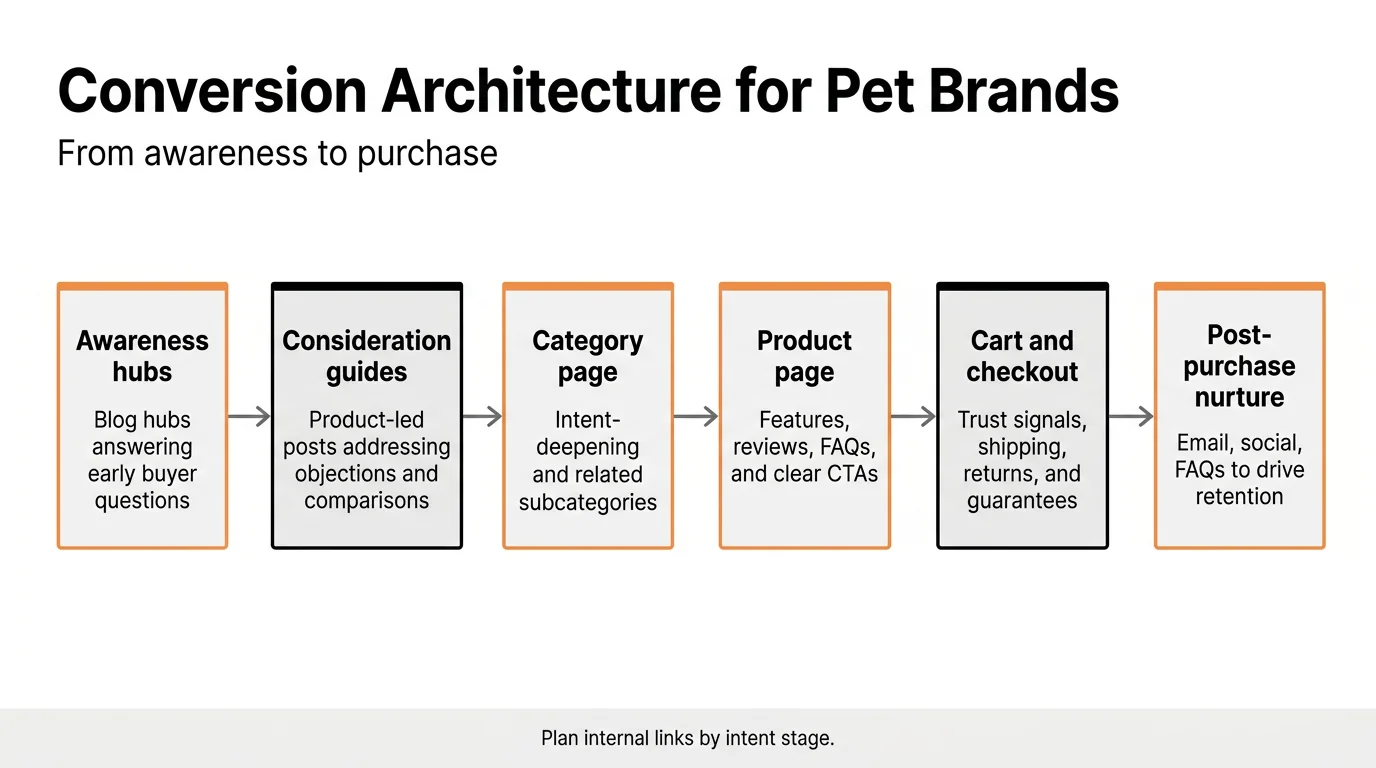
Design for momentum. From article to category to product, every page should present the next best step. Use supporting content to answer objections and apply schema to enhance eligibility for rich results.
Plan internal links by intent stage: awareness to consideration to purchase. This approach compounds non-brand clicks and assisted conversions over time in pet brand SEO.
Do not implement yet: sitewide link injections or complex dynamic blocks
Avoid indiscriminate, sitewide link insertions. Do not install dynamic blocks that disorient readers or dilute relevance. Keep links purposeful, contextual, and measured.
Route: Follow “Internal linking that moves readers to product pages” for frameworks
Adopt proven pathways with Internal linking that moves readers to product pages.
Templates, optimization, and scaling safely
Understand: when to refresh vs. create net-new, and safe programmatic patterns
Prioritize optimization where you already have impressions but weak clicks or conversions. Create net-new content to close topical gaps identified in your pet content strategy. Use programmatic patterns cautiously, with strict QA.
For operations, many teams centralize research, briefs, drafts, and QA in a single workflow to sustain pace and consistency. Platforms purpose-built for pet SEO automation can reduce overhead while preserving governance.
Do not implement yet: large-scale template rollouts without testing
Do not deploy hundreds of template pages at once. Test on small cohorts, validate indexation and engagement, then scale incrementally to protect domain health.
Route: Use “Rewrite underperforming product pages with AI” and “Programmatic templates for large pet catalogs”
Recover revenue with Rewrite underperforming product pages with AI, then expand sensibly with Programmatic templates for large pet catalogs. For repeatable execution, teams often complement these playbooks with Petbase AI when consolidating research, drafting, and publishing at scale.
Measurement, quick wins, and how we built these recommendations
Understand: impact metrics, first-30-day wins, and evidence base
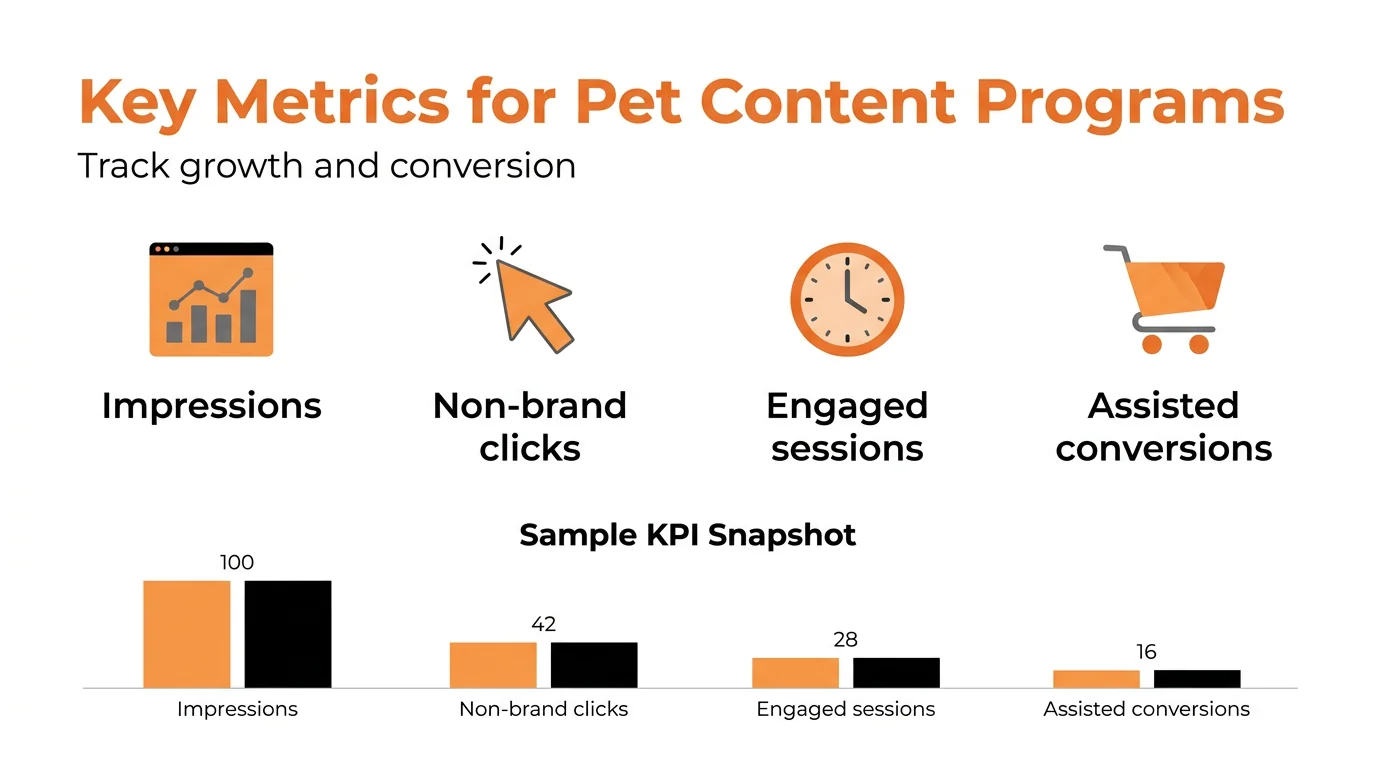
Track impressions, non-brand clicks, engaged sessions on hubs, and assisted conversions to SKUs. Quick wins typically come from refreshing high-intent pages and standing up hub-and-spoke clusters that match search demand.
The pet sector’s size and competitiveness heighten the need for rigorous measurement and continuous improvement, not one-off campaigns.[4]
Consistent, inbound content also correlates with stronger commercial outcomes for SMEs in the pet niche, reinforcing the strategic value of always-on publishing.[1]
Do not implement yet: cross-border localization before proving the model
Hold international expansion until your primary market shows reliable traction and governance discipline. Translate success, not guesses, and localize terminology, compliance, and schema thoughtfully.
Route: Track with “Measure AI content impact with pet-specific KPIs” and expand via “Scale multi-language pet SEO (US, UK, DACH)”
Instrument dashboards via Measure AI content impact with pet-specific KPIs, then expand smartly with Scale multi-language pet SEO (US, UK, DACH).
Frequently Asked Questions
What types of pet businesses benefit most from AI content?
Pet brands, retailers, and service providers benefit-especially those with recurring product lines or procedures. AI helps scale topical coverage and connect content to products and services.
How do we keep AI content on-brand and trustworthy?
Use a brand voice guide, pet-specific glossary, and human editorial review. Cite credible sources and add expert review for medical or training topics to reinforce E-E-A-T.
Where should we use AI content first?
Start with evergreen blog hubs answering buyer questions, refresh underperforming product pages, and build internal links to key product and category pages for measured impact.
How do we measure success from AI content?
Track impressions, non-brand clicks, assisted conversions to product pages, and engaged time on topic hubs. Monitor indexation, internal link paths, and revenue influenced by content.
Is multilingual AI content worth it early on?
Prove the model in your primary market first. Then localize high performers with regional terminology and schema to scale into the US, UK, or DACH effectively.
Adopt a governance-first approach, map AI use to the right channels, and build conversion architecture deliberately. With disciplined measurement and thoughtful scaling, AI content becomes a durable growth engine for pet brands.
References
- BJ Vasquez-Reyes et al. (2024). Inbound social media marketing and increased sales in SMEs: a correlational study in the pet food industry. Innovative Marketing. View article
- H Church (2024). Market research, solution design & implementation plan for an integrated pet care platform “Petventure”. 2024 - titula.universidadeuropea.es.
- GS Mudaliar (2024). Market research, solution design & implementation plan for an integrated pet care platform “Petventure”. 2024 - titula.universidadeuropea.es.
- N Mendonça Jr (2024). Market research, solution design & implementation plan for an integrated pet care platform “Petventure”. 2024 - titula.universidadeuropea.es.