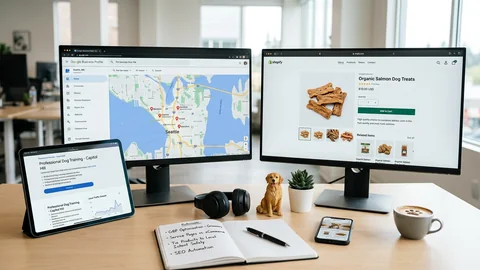
Local SEO with AI for Vets, Groomers, and Trainers: A Focused Workflow


Table of Contents +
- Scenario: Generate compliant city, service, and procedure pages at scale
- Step-by-step workflow (from data collection to publish)
- Quick decision guide
- Monitoring: what to watch at 7-14 days and 4-8 weeks
- Practical safety boundaries
- Evidence status: what is known, emerging, and uncertain
- Template blueprints (copy-ready variables)
- Frequently Asked Questions
- Conclusion
- References
A practical AI workflow to build compliant local pages for vets, groomers, and trainers. Create service, procedure, and city pages that may rank locally.
Local pages win bookings when they are fast to build and trusted by readers. For orientation, see AI Content for Pet Brands: Strategy, Priorities, and Playbooks for the high-level strategy.
This guide shows a precise workflow for compliant city, service, and procedure pages. You will learn how to map pages, create safe templates, and publish quickly. You will also learn how to monitor performance and iterate responsibly.
Scenario: Generate compliant city, service, and procedure pages at scale
Local SERPs reward specificity, proximity, and proof of capability. Scale demands strong inputs, controlled generation, and expert oversight. The goal is repeatable pages that demonstrate authority while reflecting true availability.
Scope the pages: city + service + procedure mapping
Start with a matrix. Rows are cities or suburbs you genuinely serve. Columns are services and procedures. Prioritize high-intent terms for veterinary SEO, grooming business SEO, and dog trainer SEO.
Sources of truth: policies, credentials, and clinical accuracy
Collect licensure, bios, consent policies, insurance notes, and emergency protocols. Add equipment lists, facility capabilities, and coverage zones. Use these as non-negotiable facts that anchor every variation.
AI prompts and variables to standardize output
Define variables for city, neighborhood, NAP, unique proof points, contraindications, and aftercare. Use guardrails for terminology, disclaimers, and availability. Research shows local search paradigms reduce premature drift in optimization[1].
Petbase automates SEO content for veterinary clinics - so you can focus on patients, not blog posts - start your free trial.
Step-by-step workflow (from data collection to publish)
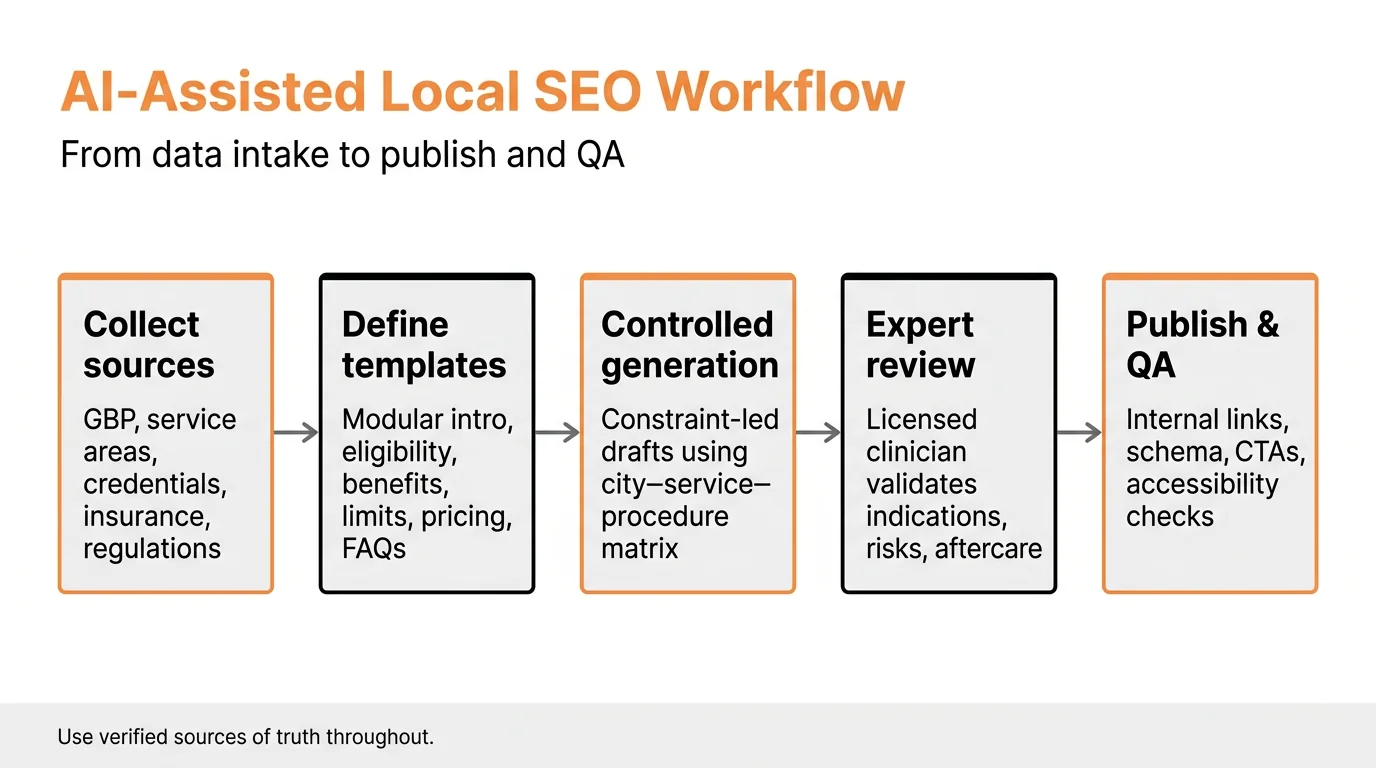
Collect facts and constraints
Gather Google Business Profile details, service area pages coverage, clinician credentials, and insurance requirements. Document photo rights and consent. Capture differentiators like mobile service windows, parking, or species limitations.
Design reusable page templates
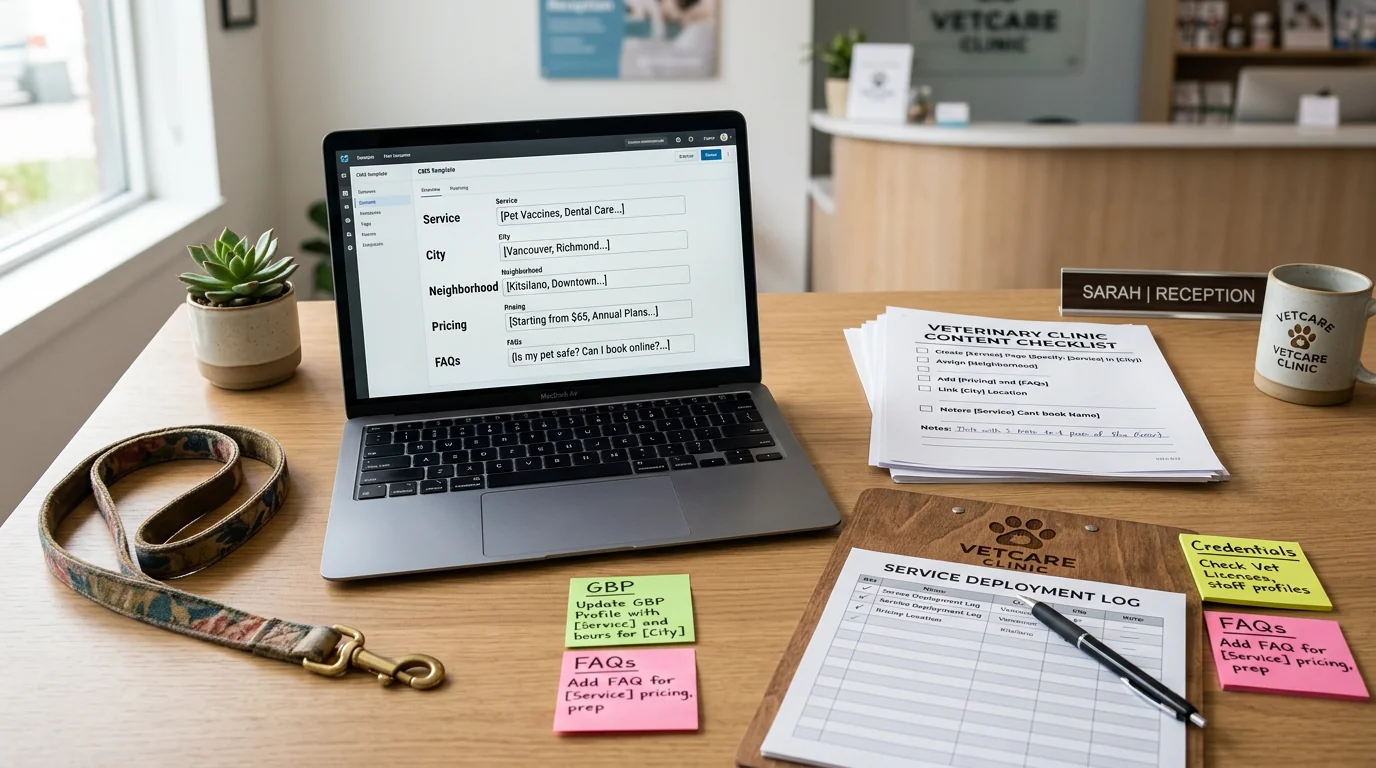
Create modular sections: intro, eligibility, benefits, limitations, pricing notes, FAQs, and CTAs. Distinguish procedure pages SEO from service and city pages. Add placeholders for reviews and local landmarks.
Generate drafts with guardrails
Feed verified facts, target city, and constraints into your prompt. Require neutral claims, contraindications, and appointment flow. For efficiency, consider using Petbase AI to standardize variables across pages.
Human review for expertise and compliance
Assign licensed reviewers for clinical content. Validate indications, aftercare, and emergency guidance. Enforce brand tone and glossary. See Guardrails for Brand Voice: Style, Glossary, and Review Loops for AI Content.
On-page SEO, schema, and internal links
Include city in H1, title, and meta description. Add LocalBusiness schema with areaServed and Service. Link related services and nearby locations. Connect blogs that answer intent gaps and seasonal searches.
Publish, interlink, and request indexing
Launch pages in logical batches. Link from navigation, footers, and city hubs. Submit to Search Console. Track impressions and calls. Review ROI signals using the framework in Proving ROI: KPIs and Dashboards for AI Content in Pet eCommerce.
Quick decision guide
If you have multiple locations vs. one location
Use a parent location hub with unique child pages per address. For single sites, prioritize city and top two suburbs with distinct proof of proximity and coverage.
If services are mobile vs. in-clinic/studio
Highlight service windows, transit constraints, and on-site requirements. Emphasize convenience and sterilization protocols for mobile. Emphasize facility equipment and recovery areas for in-clinic services.
If procedures are medical vs. cosmetic/care
Medical pages require indications, contraindications, licensure, and disclaimers. Cosmetic or care pages emphasize outcomes, maintenance intervals, and satisfaction policies. Separate contact flows accordingly.
If you lack reviews vs. have steady review flow
With few reviews, use staff bios, case photos with consent, and outcome metrics. With steady reviews, showcase recency, city tags, and service-specific snippets in marked-up testimonials.
If you target one city vs. many suburbs
One city: go deep with neighborhoods and nearby landmarks. Many suburbs: standardize structure while varying availability, travel fees, and hyperlocal cues to avoid duplication.
If pages are new vs. existing
New pages: launch minimal viable content, then expand FAQs. Existing pages: audit cannibalization and consolidate thin sections. Use structured comparisons to differentiate overlapping services.
If you offer emergencies vs. appointment-only
Emergency pages need bold contact, triage steps, and after-hours fees. Appointment-only pages emphasize scheduling, preparation, and cancellation policies. Keep both pathways clear and separated.
Monitoring: what to watch at 7-14 days and 4-8 weeks
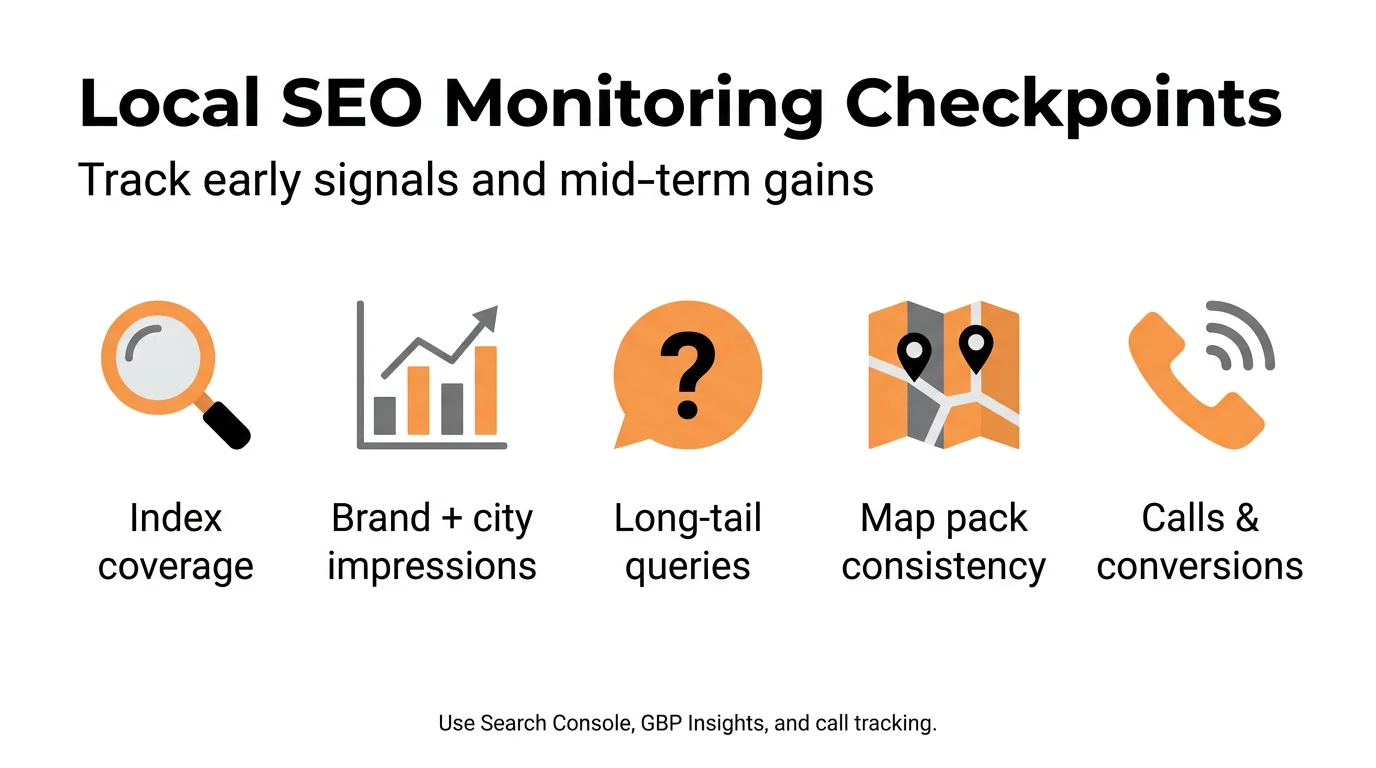
Early signals (7-14 days)
Check indexing coverage, brand plus city impressions, and long-tail query discovery. Validate map pack consistency and NAP accuracy. Confirm calls, direction requests, and appointment starts from page-specific CTAs.
Mid-term signals (4-8 weeks)
Watch rankings for “service + city” and “procedure + city.” Evaluate scroll depth, FAQ expands, and CTA conversion rates. Local search methods that focus on high-reward segments support iterative improvements[4].
How to iterate with AI safely
Adjust headlines, intro clarity, and city cues. Expand contraindications or aftercare where confusion appears. Consider Multilingual Pet SEO: US/UK/DACH Localization Without Losing Voice when regional expansion needs localized terminology and compliance references.
Practical safety boundaries
Clinical accuracy and disclaimers for veterinary content
State that content is informational and not medical advice. Require licensed review for indications, risks, and aftercare. Add local regulation notes and emergency escalation steps. Keep contact pathways unambiguous.
Representation, pricing, and availability claims
Use ranges and “from” pricing. Avoid guarantees. Clarify if availability varies by clinician or location. Update out-of-stock equipment or limited anesthesia windows rapidly to prevent misrepresentation.
Review gating, testimonials, and policy compliance
Do not gate or filter reviews. Attribute testimonials with location and date when permitted. Avoid incentives that violate platform policies. Mark testimonials as opinions, not clinical outcomes or guarantees.
Image, before/after, and consent considerations
Obtain written consent for identifiable images. Remove metadata as needed. Avoid graphic content without warnings. Ensure before/after sets are representative and note that results may vary by case.
Evidence status: what is known, emerging, and uncertain
What evidence suggests is effective
Structured, constraint-led generation paired with expert review reduces drift and errors. Hybrid search approaches balance exploration and exploitation in optimization workflows, supporting guardrailed content systems[1][2].
What is promising but variable
Programmatic internal linking and adaptive templates may accelerate discovery. Results vary with content uniqueness, reviewer rigor, and popularity of queries across veterinary SEO and procedure pages SEO categories.
What remains uncertain
The marginal benefit of ultra-fine city variations is unclear in low-density areas. Aggressive automation without local proof may underperform. Evidence on schema granularity thresholds remains mixed across markets.
Template blueprints (copy-ready variables)
City service page (groomer/trainer)
Title: [Service] in [City], [Neighborhood] - Availability and Pricing
Intro: We provide [Service] across [AreaServed]. Sessions are [Mobile/In-Studio]. Licensed staff: [Credentials].
What to expect: [Assessment steps], [Duration], [Equipment].
Who it’s for: [Breeds/Sizes accepted], [Limitations].
Pricing: From [Price Range]. Travel fee: [If applicable].
Local proof: Near [Landmark]. Parking: [Notes].
CTA: Book [Link] | Call [Phone].
Veterinary procedure page
Title: [Procedure] in [City] - Indications, Risks, Aftercare
Intro: Performed by [DVM Name], [Licenses]. Suitability depends on [Criteria].
Indications: [List]. Contraindications: [List].
Procedure overview: [Steps], [Anesthesia], [Monitoring].
Risks: [Common], [Rare].
Aftercare: [Instructions], [Red flags], [Follow-up plan].
Disclaimer: Informational only. Seek professional advice.
CTA: Schedule exam [Link] | Call [Phone].
Location page for multi-location practices
Title: [Practice Name] - [City] Location
Address/NAP: [Street], [City], [Phone], [Hours].
Team: [Clinicians], [Credentials], [Languages].
Services: [Top Services] with links.
Service area: [Neighborhoods/Suburbs].
Access: Parking, transit, accessibility details.
CTAs: Book [Link], Call [Phone], Directions [Map].
Frequently Asked Questions
How many city pages should a local pet business create?
Evidence suggests focusing on areas where you have real service coverage and unique value. Start with 3-5 priority cities, ensure each page has distinct details, and expand gradually based on impressions and conversions.
Can AI write veterinary procedure pages safely?
AI may assist with structure and drafting when fed verified sources. A licensed professional should review for accuracy, include disclaimers, and align with local regulations before publishing.
What schema helps local ranking for pet services?
LocalBusiness subtypes (VeterinaryCare, PetGrooming, or SportsActivityLocation for training) with precise NAP, openingHours, areaServed, Service, and FAQPage may support visibility and rich results.
How long until new local pages start ranking?
Early impressions may appear within 1-3 weeks. More stable rankings often take 4-8 weeks, depending on competition, internal linking, reviews, and Google Business Profile consistency.
Should each procedure have its own page?
For vets, evidence suggests individual pages for high-intent procedures (e.g., spay/neuter, dental cleaning) may capture demand. Lower-volume topics can be grouped in a hub until data supports a split.
Conclusion
Local SEO with AI works best when it mirrors real operations and credentials. Use standardized templates, strong sources of truth, and expert review. Iterate with measurable signals. For broader planning context, revisit AI Content for Pet Brands: Strategy, Priorities, and Playbooks. When legacy pages underperform, structured rewrites may help; see AI Rewrites That Rank: Rescuing Underperforming Pet Product Pages. Expand methodically, validate claims, and keep compliance central to every page.
References
- K Rajwar et al. (2023). An exhaustive review of the metaheuristic algorithms for search and optimization: taxonomy, applications, and open challenges. Artificial Intelligence Review. View article
- M Kaveh et al. (2022). Application of meta-heuristic algorithms for training neural networks and deep learning architectures: A comprehensive review. Neural Processing Letters. View article
- AA Movassagh et al. (2023). Artificial neural networks training algorithm integrating invasive weed optimization with differential evolutionary model. Journal of Ambient …. View article
- M Kim et al. (2024). Local search gflownets. International …. View article