Guardrails for Brand Voice: Style, Glossary, and Review Loops for AI Content


Table of Contents +
- Context: One governance kit to keep AI outputs on-brand
- Build the style spine: Tone, format, and risk boundaries
- Glossary and taxonomies: Species, breeds, and product attributes
- Human-in-the-loop review loops
- Quick decision guide
- Practical safety boundaries
- Monitoring and iteration
- Evidence status: What we know and where it’s emerging
- Implementation walkthrough for pet categories
- Setup reference and next steps
- Frequently Asked Questions
- References
Set brand-safe AI content guardrails for pet categories using style guides, species glossaries, and human review loops. Practical steps and monitoring tips.
AI can scale pet content fast. It can also drift off-brand just as quickly. Guardrails keep voice, terminology, and safety intact while you publish at pace.
This matters because pet shoppers notice inconsistent tone and incorrect species terms. Compliance teams notice risky phrasing. You will learn a practical governance kit using brand voice guidelines, a glossary for pet brands, and human-in-the-loop QA.
Context: One governance kit to keep AI outputs on-brand
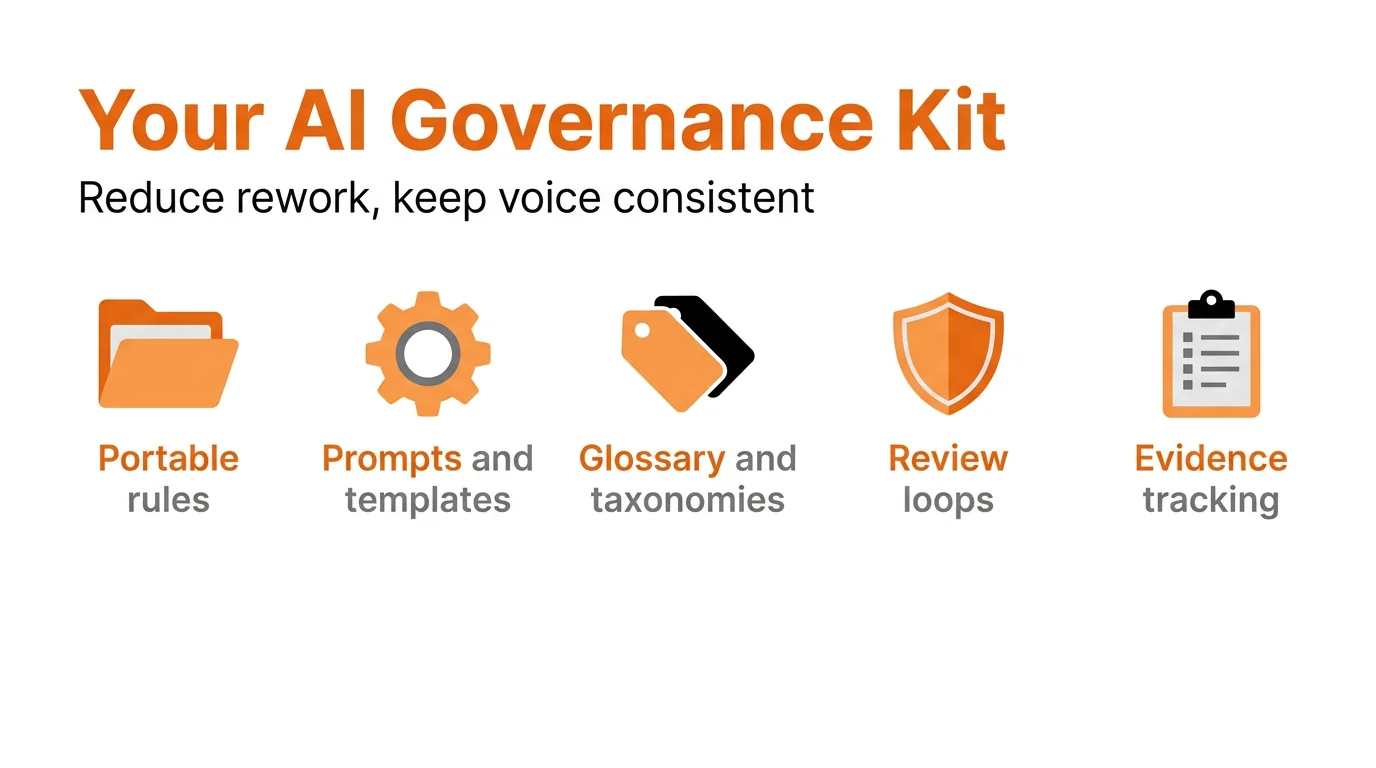
Treat governance as a reusable kit. It travels with your prompts, templates, and publication workflows. It reduces rework and creates evidence for safer publishing at scale.
Scenario focus: Scaling breed/category pages without drifting voice
When you multiply pages by breed, species, and life stage, tiny errors compound. A central style guide for AI and taxonomies may prevent tone creep and term confusion over hundreds of listings.
Outcomes to aim for: consistent tone, correct species terms, safer publishing
Target measurable results: stable voice scores, higher term accuracy, and fewer compliance flags. Aim for lower edit rates, faster approvals, and predictable throughput under AI content governance.
Petbase writes and publishes this kind of content automatically - 10 SEO articles per month for pet businesses - start your free trial.
Build the style spine: Tone, format, and risk boundaries
A strong style spine anchors every generation. Document tone, point of view, structure, and risk thresholds. Evidence suggests clear, codified brand rules improve consistency and decision-making across teams.[1]
Tone and POV rules (per audience segment)
Define voice traits in measurable terms: confident, empathetic, and factual. Specify POV per segment, such as retailer, clinic, or trainer. Include positive and negative examples. Add reading-level and sentence-length targets.
Formatting and compliance rules (claims, medical and safety disclaimers)
Prescribe headline and paragraph formats, bulleted benefits, and callouts. Require disclaimers for nutrition, behavior, and safety. Set boundaries for claims: avoid cure language. Mandate country-specific labeling for regulated categories.
Red-flag list: words, clichés, and off-brand phrases to block
Maintain a blocklist: exaggerated superlatives, medical certainties, and anthropomorphic clichés. Flag risky verbs (“treats,” “guarantees”) and ambiguous terms. Provide sanctioned alternatives and a rationale for each blocked phrase.
Glossary and taxonomies: Species, breeds, and product attributes
Glossaries reduce ambiguity. Taxonomies guide structured generation and metadata tagging. Computational approaches to style show that defined vocabularies help systems interpret and reproduce brand patterns consistently.[2]
Canonical names, aliases, and regional variants
Map each entity to a canonical label, with aliases and regional names. Provide spelling variants and abbreviations. Indicate preferred usage by market to avoid mixing terms across English locales.
Attribute dictionaries (size, life stage, material, diet)
Create attribute tables with allowed values and synonyms. Include size ranges, life stages, materials, and diet patterns. Attach validation notes and unit standards to prevent incompatible combinations during generation.
Disambiguation patterns and examples for AI prompts
Supply prompt snippets that resolve ambiguity: “If ‘senior’ appears, map to ‘7+ years’ unless category states otherwise.” Provide examples showing correct and incorrect mappings for common edge cases.
Human-in-the-loop review loops
Human oversight remains essential where risks run high. Align reviewers to the brand’s personality targets and audience expectations to support engagement and trust at scale.[4]
Tiered QA: high-risk vs low-risk content
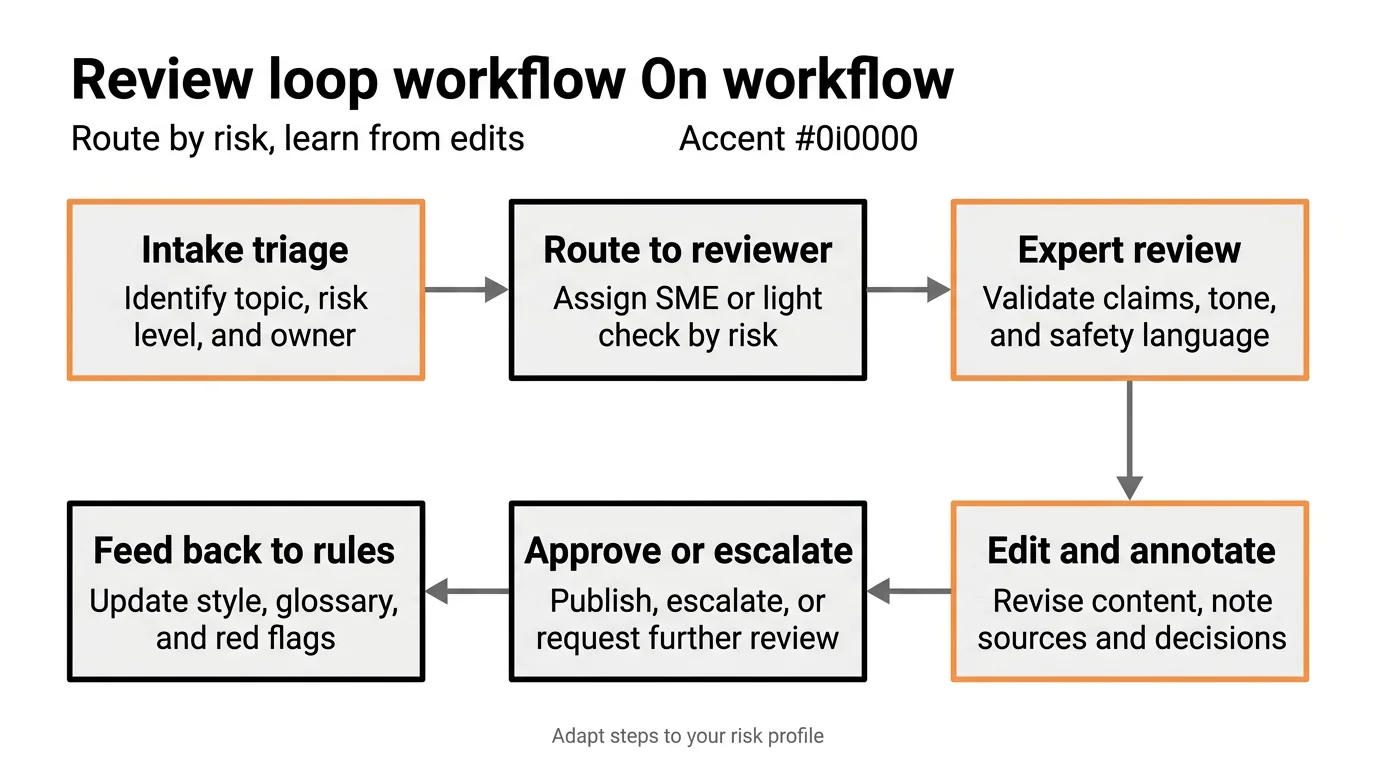
Route medical, nutrition, and behavior topics to expert reviewers. Use lighter checks for basic catalog copy. Escalate when new claims, unfamiliar breeds, or imported attributes appear.
Checklists and rubrics for faster approvals
Adopt short rubrics: voice fit, term accuracy, compliance, and readability. Score on a three-point scale. Evidence suggests standardized checklists may reduce rework and accelerate throughput.
Feedback capture: turning edits into training data
Log edits as structured data: before, after, rule triggered, and reviewer note. Sync insights to prompts, blocklists, and glossaries. Platforms like Petbase AI may help operationalize these loops in production.
Quick decision guide
If X situation, then Y action (5-7 common cases)
- If the draft includes medical claims, then require expert review and insert jurisdiction-specific disclaimers.
- If breed names conflict across regions, then apply the market’s canonical variant and revalidate attributes.
- If tone deviates from guidelines, then rewrite using the closest approved example as a reference.
- If product attributes appear incompatible, then block publish and trigger taxonomy validation.
- If a new term repeatedly appears, then propose glossary addition with examples and market notes.
- If edit rates exceed threshold, then tighten prompts and expand the red-flag list.
- If readers flag confusion, then add disambiguation rules and test with sample content.
Practical safety boundaries
Medical, nutrition, and behavioral guidance constraints
Ban deterministic outcomes and diagnosis language. Require evidence-backed phrasing, risk warnings, and care-seeking guidance. Avoid dosage specificity unless sourced and reviewed. Prefer conditional framing and benefit ranges.
Data sourcing and citation practices
Specify approved sources, dates, and update thresholds. Cite primary research or authoritative bodies. Track claim lineage through notes. Use consistent citation style and maintain a change log for revisions.
Monitoring and iteration
What to check after 7-14 days
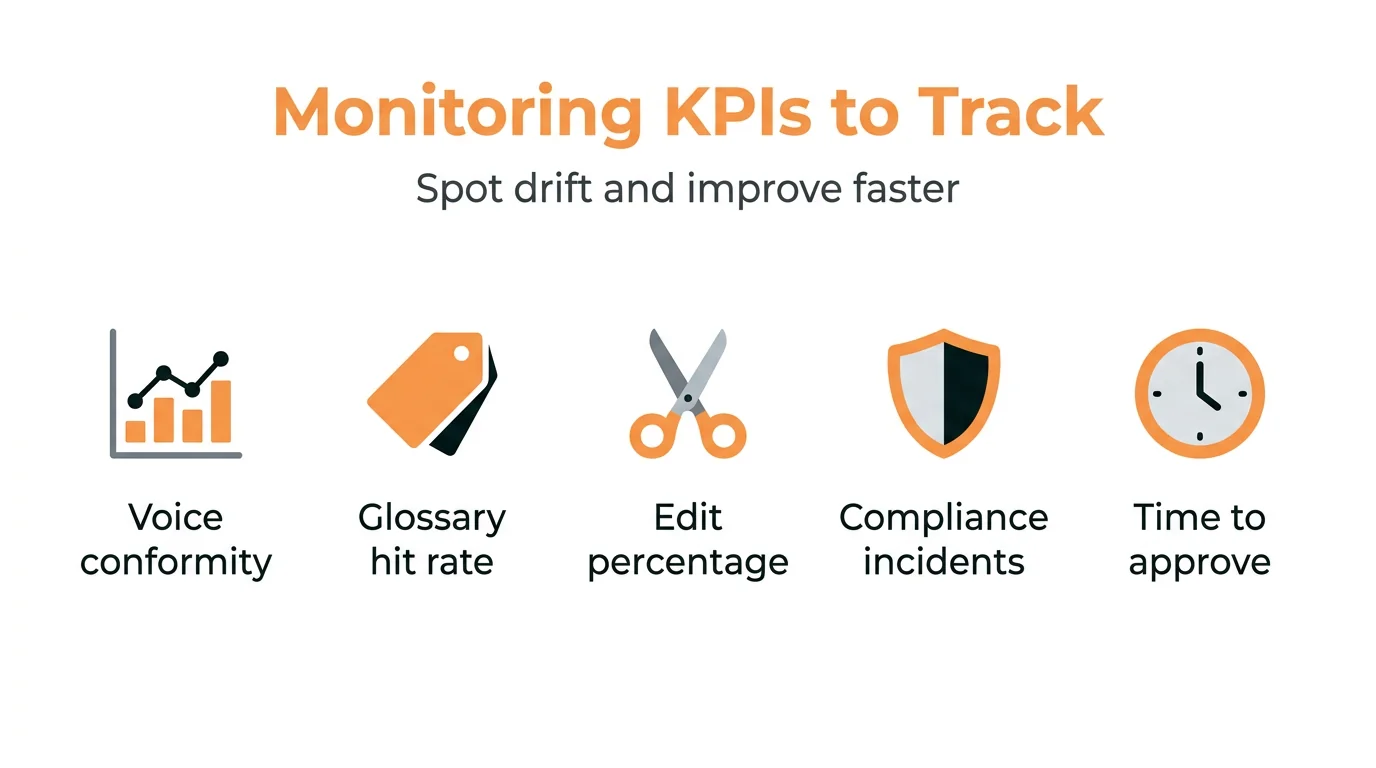
Review brand-voice conformity, glossary hit rates, and edit percentages. Sample ten to twenty pages per category. Investigate frequent red-flag triggers and expand prompt instructions where misses cluster.
What to check after 4-8 weeks
Assess term accuracy trends, compliance incidents, and time-to-approve. Compare conversion and engagement metrics to baselines. For outcome correlation, align with dashboards in Proving ROI: KPIs and Dashboards for AI Content in Pet eCommerce.
Signals to adjust glossary or style rules
Watch for recurring reviewer notes, synonym drift, and regional confusion. If conflicts rise, promote aliases to canonical or split by market. Sunset unused rules to reduce complexity and noise.
Evidence status: What we know and where it’s emerging
Evidence suggests structured glossaries reduce hallucinations
Research on computational style indicates defined vocabularies and labeled exemplars may stabilize model outputs and enhance interpretability in branding contexts.[2]
Observational data on review loops and brand consistency
Brand identity literature supports the impact of codified guidelines and cross-functional processes on consistency, especially during scale and change.[1]
Where more validation is needed
Multiview brand-signal modeling shows promise for objective alignment, yet broader tests in text-heavy contexts remain limited and evolving.[3][4]
Implementation walkthrough for pet categories
Dog chew pages: sample prompts and blocked terms
Prompt: “Write in confident, empathetic voice. Use canonical size terms and material taxonomy. Avoid cure language. Include safety disclaimer.” Block: “indestructible,” “guaranteed to last,” and medical verbs. Validate material-to-size fit before publish.
Cat nutrition posts: disclaimer templates and voice cues
Use a short medical disclaimer and conditional phrasing for benefits. Set POV from trusted advisor. For international variants, apply multilingual SEO localization to reflect regional labeling and ingredient names.
Retailer category pages: attribute mapping and internal links
Map product filters to glossary attributes. Prevent incompatible combinations through rules. For large catalogs, align with programmatic SEO templates for large pet catalogs to keep structure, metadata, and tone consistent.
Setup reference and next steps
How this connects to the parent strategy
Position governance as the operating layer beneath planning, production, and measurement. For context on portfolio-level priorities, see AI Content for Pet Brands: Strategy, Priorities, and Playbooks.
Versioning, ownership, and change control
Assign owners for style, glossary, and QA. Version rules quarterly. Use change logs, approval gates, and rollback paths. Announce updates via release notes and link to new examples.
Frequently Asked Questions
What should be in an AI style guide for pet brands?
Include tone rules, audience POV, formatting, claim boundaries, disclaimer templates, and a red-flag phrase list. Add examples of approved and rejected sentences to speed approvals.
How detailed should a pet glossary be for AI content?
Start with species and top 50 breeds, plus product attributes like size, life stage, and material. Map canonical names, aliases, and region-specific terms to reduce ambiguity.
When is human review required for AI content in pet niches?
Use mandatory review for medical, nutrition, behavioral, and safety topics. Lower-risk product copy may use spot checks if past quality metrics meet thresholds.
How do we measure if guardrails are working?
Track brand-voice conformity scores, term accuracy, edit rates, and compliance flags. Trends over 4-8 weeks may indicate whether rules or glossaries need updates.
Can guardrails slow content velocity too much?
A tiered QA model may preserve speed while protecting risk areas. Evidence suggests standard checklists reduce rework and keep throughput stable.
Strong guardrails do not limit creativity. They channel it. With a style spine, precise glossaries, and disciplined human-in-the-loop QA, teams may ship faster and safer. Start small, measure often, and evolve the kit as markets change.
References
- A Wheeler et al. (2024). Designing brand identity: A comprehensive guide to the world of brands and branding. 2024 - books.google.com. View article
- HH Wang et al. (2025). A data-driven approach to predicting and interpreting brand styles. Multimedia Tools and Applications. View article
- R Dew et al. (2022). Letting logos speak: Leveraging multiview representation learning for data-driven branding and logo design. Marketing Science. View article
- JT Yun et al. (2019). Are we who we follow? Computationally analyzing human personality and brand following on Twitter. International Journal of …. View article