AI vs Human Content for Pet Brands: What the Data Says


Table of Contents +
- What Does the Data Actually Say About AI Content Rankings?
- Why Does Pure AI Content Collapse After 3 Months?
- How Does the Hybrid Approach Actually Work?
- Why Is the Hybrid Model Not Optional for Pet Brands?
- What Does Google Actually Penalize - AI or Quality?
- How Do You Measure Whether Your AI Content Strategy Is Working?
- How Does AI Content Perform in AI Search and Voice Queries?
- What Content Types Work Best With AI for Pet Brands?
- Frequently Asked Questions
- References
AI and human content rank in Google's top 10 at nearly equal rates, but human content is 8x more likely to hold position 1. Data breakdown for pet brands.
The debate over AI-generated versus human-written content is loud, but the data is surprisingly clear. A Semrush analysis of 42,000 blog pages found that 57% of AI articles and 58% of human articles appear in Google's top 10[1]. On the surface, that looks like a tie. But dig deeper and the picture changes. Position 1 results are 8x more likely to be human-written - 80.5% human versus just 10% AI[2]. AI content can reach page one, but it rarely wins the top spot.
For pet brands, this distinction matters more than in most industries. Pet health content falls under Google's Your Money or Your Life (YMYL) guidelines, where E-E-A-T signals receive extra scrutiny. The wrong advice about medication dosing, toxic foods, or breed-specific health conditions can harm animals. Google evaluates pet content accordingly. The question is not whether to use AI - 74.2% of newly created web pages already contain some AI-generated material[3]. The question is how to use it without sacrificing the quality, accuracy, and authority that pet content demands.
TL;DR
AI content and human content rank in the top 10 at nearly identical rates (57% vs 58%), but human content is 8x more likely to hold position 1. Pure AI content on new domains collapses after 3 months. The winning approach is hybrid: AI-generated drafts refined with human expertise, which performs within 4% of fully human-written content. For pet brands, the hybrid model is not optional - it is the only way to meet YMYL quality standards at scale.
What Does the Data Actually Say About AI Content Rankings?
Three major studies published between 2025 and 2026 provide the most complete picture of how AI content performs in search:
Study 1: Semrush - 42,000 blog pages analyzed. Semrush collected 20,000 keywords, extracted the top 10 Google results for each (200,000 URLs), and filtered for blog pages. The finding: 57% of AI content and 58% of human content appeared in the top 10[1]. The gap is statistically insignificant for page-one presence. But at position 1, human content dominates with an 80.5% share[2].
Study 2: SE Ranking - 2,000 articles on 20 new domains. SE Ranking published 2,000 AI-generated articles across 20 brand-new domains. Initial results were promising: 70.95% of pages were indexed within 36 days. Eight websites ranked for more than 1,000 keywords each. Then, starting in February 2025, every single article dropped out of the top 100 results[4]. Complete traffic collapse within three months.
Study 3: Digital Applied - 16-month tracking of 4,200 articles. This study tracked AI-generated content versus human-written content targeting the same keywords over 16 months. Pure AI content consistently underperformed. But AI-drafted content with substantive human editing performed within 4% of fully human-written content on median ranking position[5]. The same study found that AI-only content acquired 61% fewer editorial backlinks than human-written articles[5].
The pattern across all three studies points to the same conclusion: AI content can rank, but it cannot sustain rankings without human involvement. And for pet brands operating in a YMYL space, the stakes are higher than for most industries.
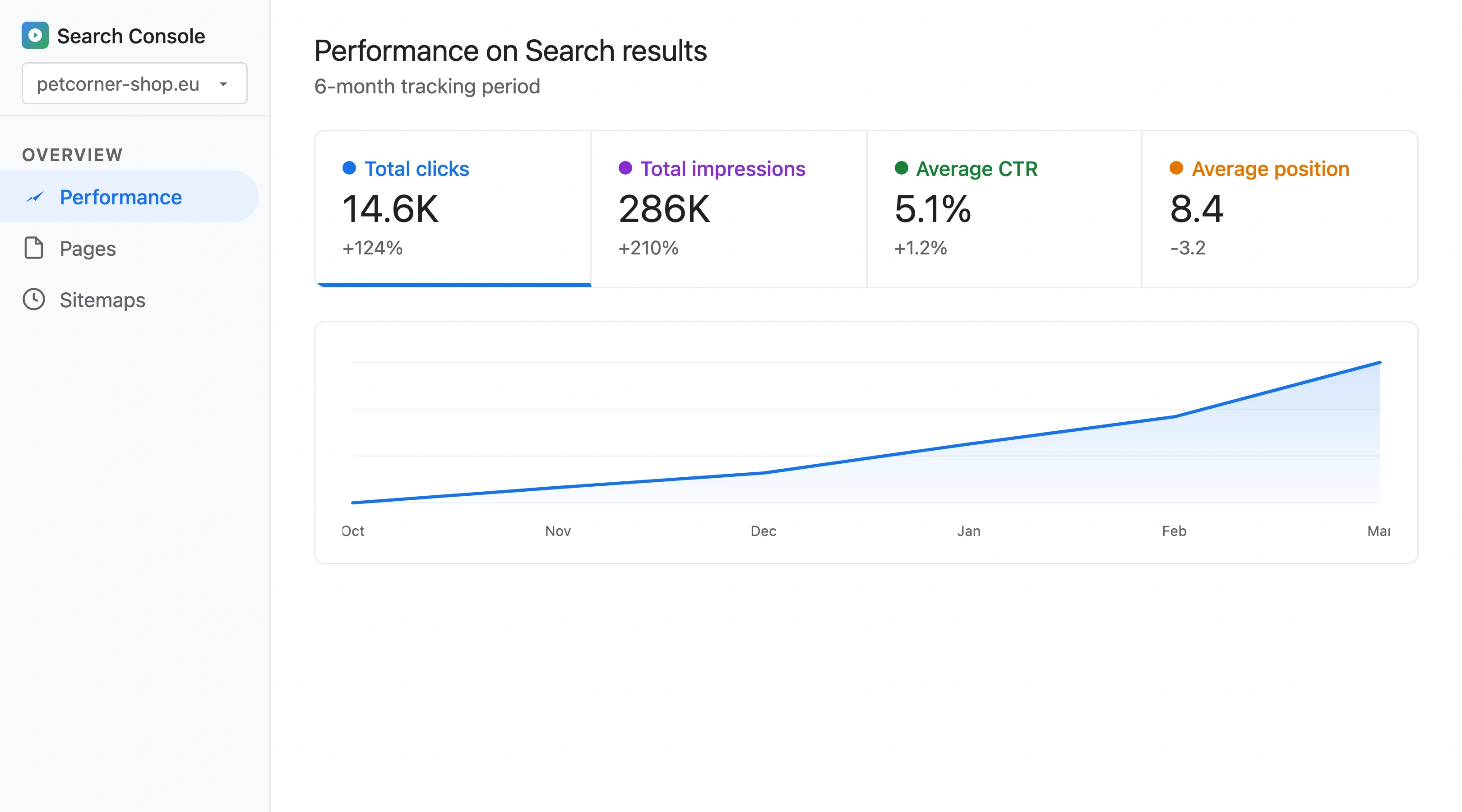
Petbase writes and publishes this kind of content automatically - 10 SEO articles per month for pet businesses - start your free trial.
Why Does Pure AI Content Collapse After 3 Months?
The SE Ranking experiment is the most instructive case study. All 2,000 articles were generated using AI with minimal human intervention, published on fresh domains with no backlink history. The collapse was not gradual - it was a cliff. One day the sites ranked for thousands of keywords. A few weeks later, they ranked for zero[4].
Several factors explain this pattern:
No domain authority. Fresh domains have no trust signals. AI content on established domains with existing backlinks and content history performs very differently than AI content on new domains. Google gives new domains a temporary visibility window (sometimes called the "honeymoon period"), then re-evaluates based on engagement signals, backlinks, and content quality.
No unique value. AI-generated content without human editing tends to be a synthesis of existing content - accurate but not original. Google's Helpful Content System explicitly targets content that does not add value beyond what already exists. If your AI article about cat nutrition says the same things as the top 10 existing results, Google has no reason to rank it.
No engagement signals. Human-written content generates 5.44x more traffic and 41% longer session durations than pure AI content[4]. These engagement metrics feed back into Google's ranking algorithm. Low engagement tells Google that users are not finding value, which accelerates the ranking decline.
No backlink acquisition. AI-only content acquires 61% fewer editorial backlinks[5]. Backlinks remain one of Google's strongest ranking signals. Content that other sites do not link to lacks the external validation Google uses to determine authority.
For pet brands, this collapse risk is amplified. Pet health content requires accuracy that generic AI cannot guarantee. A feeding guide that recommends incorrect portion sizes or a supplement article with wrong dosing information will not earn backlinks from veterinary sites - it will earn corrections and negative trust signals.
How Does the Hybrid Approach Actually Work?
The data points to a clear winner: AI-generated drafts refined by humans with domain expertise. This hybrid approach combines the speed and consistency of AI with the accuracy, originality, and authority signals that only human expertise provides. AI-drafted content with substantive editing performs within 4% of fully human-written content[5]. That 4% gap is the cost of efficiency - and for most pet brands, it is a worthwhile trade.
Here is what the hybrid workflow looks like in practice:
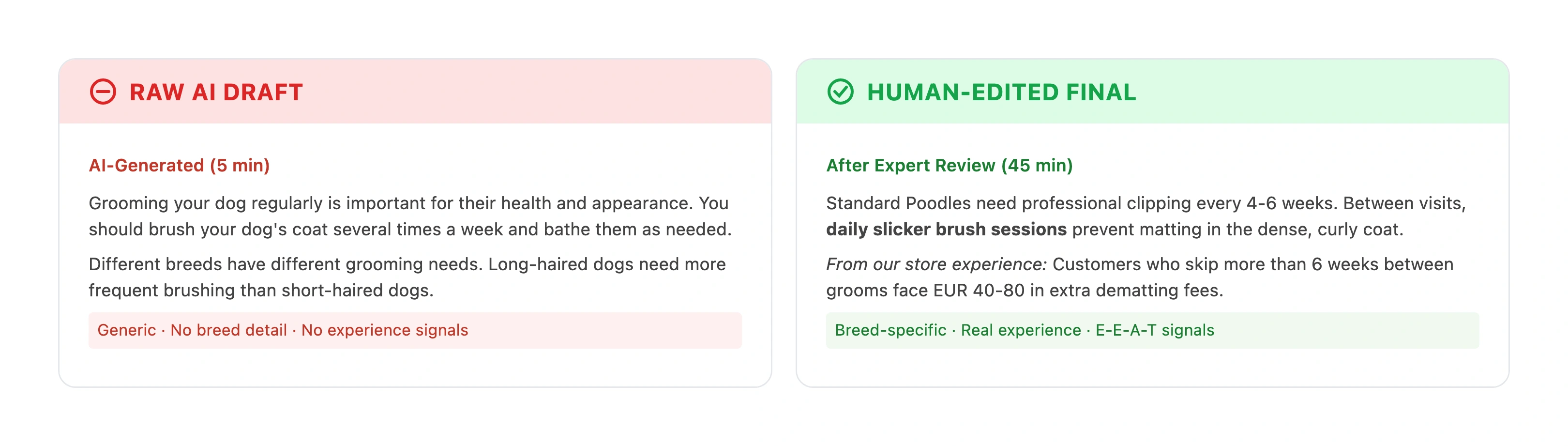
Phase 1: AI generates the draft. A pet-specific AI tool creates a comprehensive first draft based on keyword research, topical analysis, and content structure optimization. The AI handles the time-intensive work of research synthesis, outline creation, and initial writing. This phase takes minutes instead of the 3 hours 55 minutes an average blog post requires when written from scratch[6].
Phase 2: Human expert reviews and enhances. A person with pet industry knowledge reviews every factual claim, adds personal experience and unique insights, adjusts recommendations for specific audiences, and ensures the content reflects current veterinary consensus. This phase adds the E-E-A-T signals that pure AI cannot generate: real experience, genuine expertise, and trustworthy specificity.
Phase 3: SEO optimization and publishing. The enhanced content gets final SEO optimization - internal linking to related content, schema markup, meta descriptions, and proper heading structure. Then it publishes as part of a consistent content calendar.
| Approach | Top 10 Rate | Position 1 Rate | Backlink Acquisition | 3-Month Sustainability | Time per Article |
|---|---|---|---|---|---|
| Pure human | 58% | 80.5% | Baseline | High | 3h 55m |
| Hybrid (AI + human) | ~56% | Not isolated in studies | Near baseline | High | 45-60m |
| Pure AI (established domain) | 57% | 10% | -61% | Medium | 5-10m |
| Pure AI (new domain) | High initially | Rare | Minimal | Collapses | 5-10m |
The economics are straightforward. A freelance pet content writer charges USD 150-300 per article. An SEO agency charges USD 500-1,000+ per article. At 10 articles per month, that is USD 1,500-10,000. A hybrid approach using Petbase at USD 199/mo for 10 articles reduces the cost by 80-98% while maintaining ranking performance within 4% of fully human-written content. For a full cost breakdown, see our guide on AI content for pet businesses.
Why Is the Hybrid Model Not Optional for Pet Brands?
Pet content operates in a YMYL space where Google applies stricter quality evaluation. This makes the hybrid approach not just preferable but necessary for three reasons:
1. Health accuracy cannot be generated. A generic AI model does not know that grapes are toxic to dogs, that certain essential oils can kill cats, or that brachycephalic breeds need different exercise protocols than working breeds. These are not minor details - they are health and safety issues. Human review catches the errors that AI generates because it synthesizes from mixed-quality training data. Content that recommends the wrong flea treatment dosage or misidentifies a toxic plant does not just fail to rank - it puts animals at risk.
2. E-E-A-T requires human signals. Experience cannot be fabricated. When Google evaluates whether your pet nutrition guide demonstrates real experience, it looks for signals like specific brand evaluations based on actual use, breed-specific observations that come from working with those animals, and nuanced recommendations that reflect understanding of real-world trade-offs. AI can generate plausible-sounding experience. But Google's quality raters - and your readers - can tell the difference. For a deep look at how E-E-A-T applies to pet brands, read our guide on E-E-A-T in the pet business.
3. Breed specificity demands knowledge. "How to groom a Poodle" and "how to groom a Labrador" require completely different content because the coat types, tools, and techniques are different. A standard Poodle needs professional clipping every 4-6 weeks with specific scissor patterns for each clip style. A Labrador needs an undercoat rake during shedding season and a bristle brush weekly. Generic AI produces the same generic grooming advice for both breeds. Pet-specific AI combined with human review produces content that is actually useful to the reader.
In 25 years of SEO consulting, I have seen dozens of pet businesses experiment with pure AI content. The pattern is consistent: initial excitement as articles get indexed and start ranking, followed by gradual decline as engagement signals drop and competitors with more authoritative content outperform. The businesses that succeed with AI content are the ones that treat the AI output as a first draft, not a finished product.
What Does Google Actually Penalize - AI or Quality?
Google's official position is unambiguous: "Our focus on the quality of content, rather than how content is produced, is a useful guide." Google does not penalize content because AI wrote it. Google penalizes content because it is low quality, thin, manipulative, or unhelpful - regardless of whether a human or a machine produced it.
In practice, this means:
- AI content that is accurate, comprehensive, and useful will rank. The Semrush data proves this - 57% of AI content reaches the top 10[1].
- AI content that is generic, shallow, or factually wrong will not rank. The SE Ranking experiment proves this - pure AI content on new domains collapses within 3 months[4].
- Volume without quality is penalized. Google's SpamBrain system specifically targets "scaled content abuse" - using AI to mass-produce thin content designed to manipulate rankings. Publishing 100 AI articles per month without review is exactly this pattern.
- Quality with volume is rewarded. Companies publishing 16 or more blog posts per month get 3.5x more traffic[7]. The key is that each of those posts must meet quality thresholds.
The distinction that matters for pet brands: AI is the production method. Quality is the evaluation criterion. A pet nutrition guide written by AI but reviewed by a nutritionist, fact-checked against veterinary sources, and enhanced with breed-specific details will outrank a thin, surface-level guide written by a human who spent 30 minutes on it. The production method is irrelevant. The quality of the output is everything.
How Do You Measure Whether Your AI Content Strategy Is Working?
Track these metrics monthly to evaluate your hybrid content approach:
Ranking sustainability. Are your AI-assisted articles holding their positions after 3 months? After 6 months? The SE Ranking study showed pure AI content collapsing at the 3-month mark[4]. If your hybrid content holds rankings past 6 months, the human enhancement is working.
Backlink acquisition rate. Compare the number of backlinks your AI-assisted content earns versus your fully human-written content. The 61% backlink gap[5] seen in pure AI content should shrink significantly with hybrid content. If it does not, increase the level of human editing and original insight.
Engagement metrics. Monitor average session duration, scroll depth, and bounce rate. Human content sees 41% longer session durations[4]. Your hybrid content should approach those numbers. If session duration is significantly lower than your human-written posts, the AI draft needs more substantive editing.
Content ROI. Content marketing returns $7.65 for every $1 spent, compared to $1.80 for paid ads[8]. Calculate your per-article cost under the hybrid model versus the traffic and conversions each article generates. At USD 199/mo for 10 articles from Petbase, the break-even point is remarkably low.
E-E-A-T quality scores. Periodically audit your AI-assisted content against Google's quality rater guidelines. Check for: accurate health claims, cited sources, author attribution, breed-specific details, and appropriate disclaimers. Score each article on a 1-5 scale and track improvements over time. For practical E-E-A-T optimization, see our guide on pet health content Google trusts.
How Does AI Content Perform in AI Search and Voice Queries?
The shift toward AI-driven search adds another dimension to the AI vs human content debate. Pets and Animals queries trigger Google AI Overviews 36.8% of the time - the third highest category[9]. When Google generates an AI Overview, it selects citation sources based on content quality, structure, and authority. Content that lacks unique insights - a hallmark of unedited AI content - is less likely to be cited.
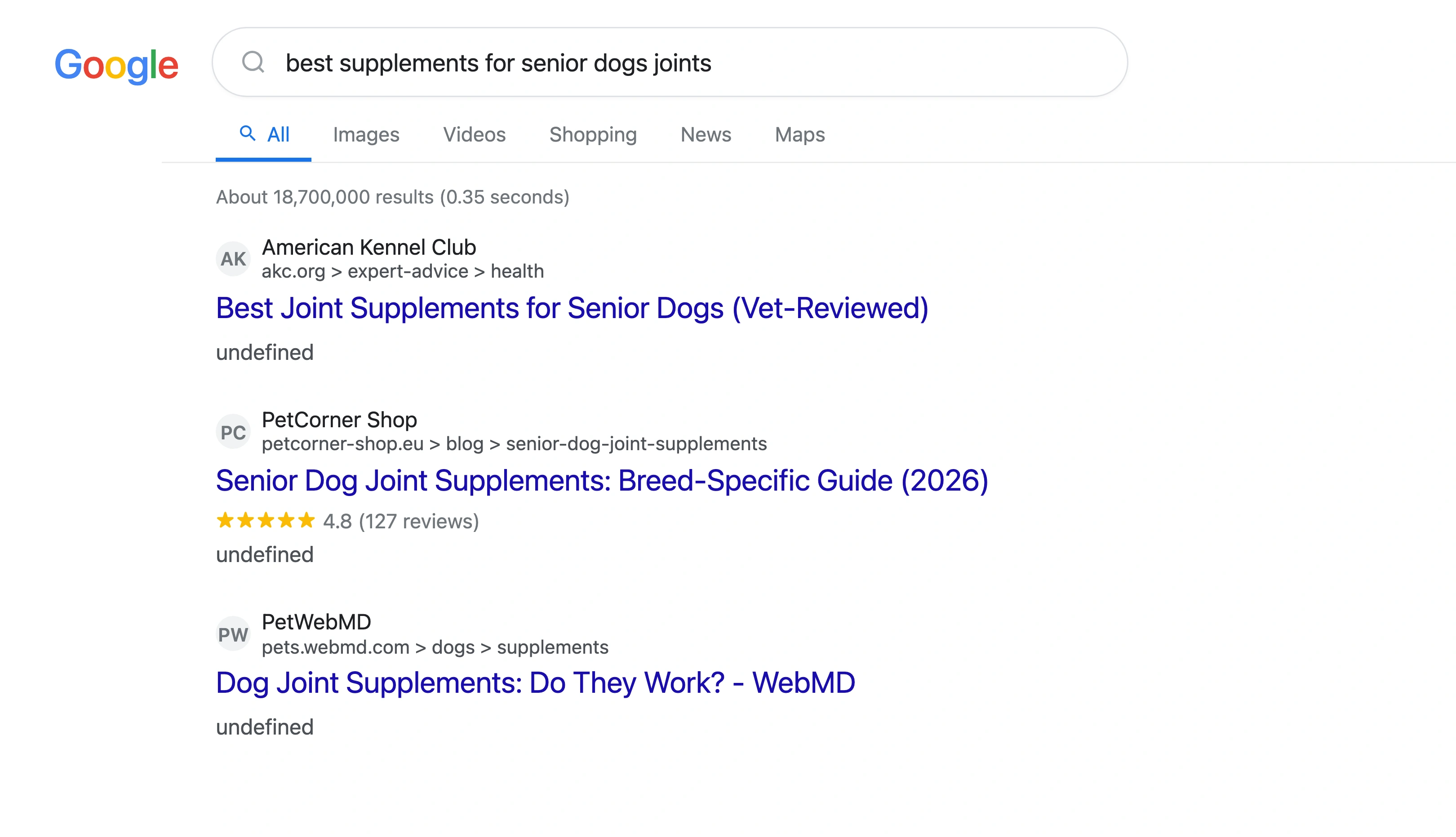
AI Overviews now appear on 48% of all tracked queries[10]. For pet brands, this means your content competes not just for organic rankings but for AI citation slots. The content characteristics that earn AI citations - clear structure, authoritative sourcing, and unique expert insights - are the same characteristics that differentiate hybrid content from pure AI output.
Pages with FAQPage schema are 3.2x more likely to appear in AI Overviews[11]. Human-edited content tends to include better FAQ sections because a human reviewer adds the specific questions their customers actually ask, not the generic questions an AI generates. A pet store owner knows that customers ask "can I mix wet and dry food for my kitten" rather than the generic "what should I feed my cat" that AI defaults to.
Only 38% of AI Overview citations come from pages ranking in the top 10 organic results[12]. This means well-structured content from smaller pet brands can earn AI citations even without top-10 rankings. The key is content quality and structure, not domain size - which plays directly to the strengths of the hybrid approach over both pure human (limited volume) and pure AI (limited quality).
What Content Types Work Best With AI for Pet Brands?
Not all pet content types benefit equally from AI assistance. Some types are natural fits for AI generation with light editing. Others require heavy human involvement regardless of the AI tool used.
Best for AI with light editing:
- Breed overview guides (temperament, size, exercise needs)
- Product comparison articles (food types, supplement categories)
- Seasonal care content (winter coat care, summer hydration tips)
- How-to guides for common tasks (nail trimming, crate training basics)
- Content calendar filler (weekly tips, monthly roundups)
Requires heavy human editing or fully human writing:
- Pet health condition guides (symptoms, treatments, veterinary recommendations)
- Medication and supplement dosing information
- Breed-specific health risk assessments
- Emergency care protocols (poisoning, injury first aid)
- Nutrition guides with specific calorie and macronutrient recommendations
The pattern: informational content with low risk of harm works well with AI. Content where incorrect information could harm an animal needs significant human oversight. A breed temperament overview with a minor inaccuracy is unlikely to cause harm. A medication dosing guide with a wrong number could be dangerous.
Or let Petbase handle this automatically. Petbase is built specifically for pet brands, with a knowledge model trained on pet industry data, veterinary information, and breed-specific content. Every article is designed for human review before publishing, combining AI efficiency with the accuracy standards pet content requires. Ten articles per month for USD 199/mo.
Frequently Asked Questions
Will Google eventually penalize all AI-generated content?
No. Google has repeatedly confirmed that AI content is not against its guidelines. What Google penalizes is low-quality content, regardless of production method. The trend is actually moving in the opposite direction - 74.2% of newly created web pages already contain some AI-generated material[3]. Google cannot penalize AI content without penalizing three-quarters of the web. The focus will continue to be on quality, accuracy, and helpfulness rather than production method.
How much human editing does AI pet content actually need?
The Digital Applied study found that substantive human editing closes the ranking gap to within 4% of fully human-written content[5]. "Substantive" means more than fixing typos. It means verifying health claims, adding breed-specific details from real experience, inserting original observations, and restructuring sections that read generically. Plan for 30-45 minutes of editing per AI-generated article for non-health content, and 60-90 minutes for health-related content where accuracy is critical.
Can AI content build topical authority for a pet store blog?
Yes, if it is part of a structured content cluster strategy. AI excels at producing the volume needed to cover a topic comprehensively - 20 to 30 articles about dog nutrition, each targeting a different long-tail keyword. The challenge is ensuring each article adds genuine value rather than repeating the same information in different words. Use AI for the initial draft, then ensure each article has at least 2-3 unique insights, specific examples, or data points that no other article in the cluster contains. Consistent publishing builds authority faster - companies publishing 16+ posts per month get 3.5x more traffic[7].
Is the 3-month collapse only for new domains or does it affect established sites too?
The SE Ranking study specifically tested new domains with no prior authority[4]. Established domains with existing backlinks, content history, and engagement signals do not experience the same cliff. However, established domains that suddenly shift to publishing high volumes of unedited AI content can see gradual ranking declines as engagement metrics drop and Google's quality systems detect the pattern change. The safest approach for any domain is hybrid: AI draft, human review, quality publishing.
References
- Semrush (2025). Does AI Content Rank Well in Search? Survey and Data Study. semrush.com
- Search Engine Land (2025). Human Content is 8x More Likely Than AI to Rank Number 1 on Google. searchengineland.com
- Axios (2025). AI-written web pages have not overwhelmed human-authored content, study finds. axios.com
- SE Ranking (2025). How AI-Generated Content Performs: Experiment Results. seranking.com
- Digital Applied (2026). AI vs Human Content: 16-Month Google Ranking Study. digitalapplied.com
- Orbit Media (2025). Blogging Statistics. orbitmedia.com
- HubSpot (2025). Marketing Statistics. hubspot.com
- Genesys Growth (2025). Content Marketing ROI Stats for Marketing Leaders. genesysgrowth.com
- Ahrefs (2025). What Triggers AI Overviews? 86 Factors and 146 Million SERPs Analyzed. ahrefs.com
- Stackmatix (2026). Google AI Overview SEO Impact: 2026 Data and Statistics. stackmatix.com
- Frase (2025). Are FAQ Schemas Important for AI Search, GEO and AEO? frase.io
- Ahrefs (2025). 38% of AI Overview Citations Pull From The Top 10. ahrefs.com