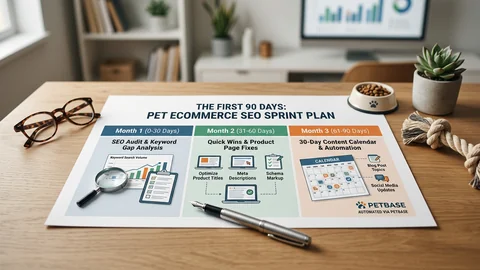
Your First 30 Days: An AI Blog Publishing Plan for Pet Brands


Table of Contents +
- Introduction
- Scope and success criteria for a 30-day AI publishing sprint
- Day-by-day schedule: research, drafting, review, and publishing
- Quick decision guide: if X, then Y
- Monitoring guidance: what to observe after 7-14 days and 4-8 weeks
- Practical safety boundaries for AI-assisted pet content
- Evidence status: what is known vs. emerging
- Appendix: 10 post briefs mapped to pet-owner intent
- Frequently Asked Questions
- Conclusion
- References
Day-by-day AI plan to research, draft, and publish 10 pet-owner posts in 30 days. Build E-E-A-T, align voice, and target pet-owner intent safely.
Introduction
Publishing consistent, trustworthy content is challenging. AI can help, but only with clear rules. You need speed without compromising safety or brand voice.
This guide matters because intent alignment and E-E-A-T determine discoverability and trust. You will learn a day-by-day plan, decision guardrails, monitoring milestones, and safety boundaries. For context, see AI Content for Pet Brands: Strategy, Priorities, and Playbooks.
Petbase handles this entire content workflow automatically - 10 SEO articles published to your blog every month - start your free trial.
Scope and success criteria for a 30-day AI publishing sprint
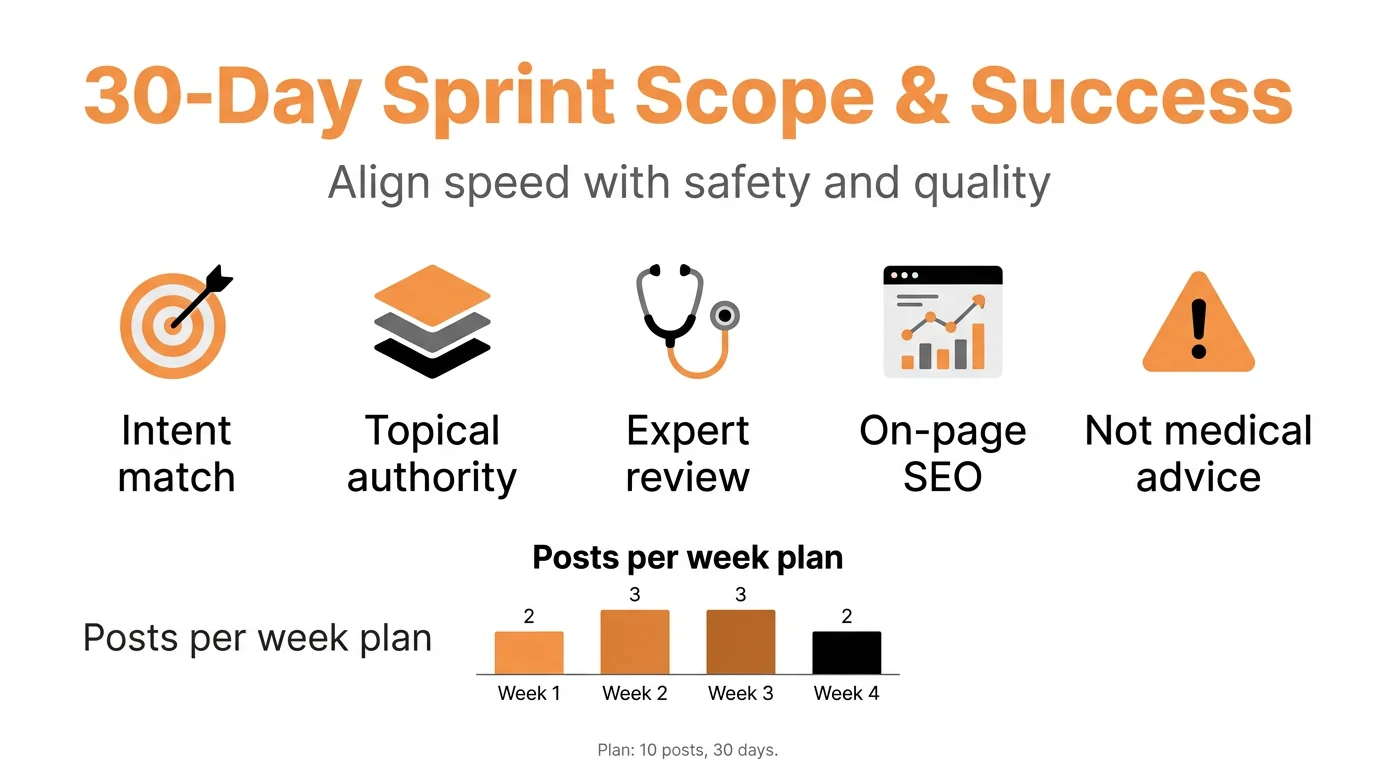
This sprint focuses on publishing 10 AI-assisted blog posts that match pet-owner intent, reinforce topical authority, and pass brand and review checks. It is designed for teams needing repeatable workflows powered by pet SEO automation.
What this 30-day plan does and does not cover
This plan covers pet keyword research, brief creation, AI drafting, expert review, on-page SEO, and release. It does not replace professional veterinary judgment, finalize legal advice, or automate product strategy beyond basic internal linking.
Definition of done: 10 posts, mapped to pet-owner intent and E-E-A-T signals
Each post meets these criteria: clear intent, authoritative sources, expert review where risky, structured data, optimized media, and internal links to relevant products or services. Published pages retain consistent brand voice and measurable engagement baselines.
Day-by-day schedule: research, drafting, review, and publishing
Use this timeline to keep quality, predictability, and velocity in balance as you produce AI content for pet brands.
Days 1-3: Intent mapping, seed keywords, and topical gaps
Interview customer support and sales for top questions. Build seed lists from pet keyword research and query patterns. Cluster by intent types: care, product comparison, how-to, and troubleshooting. Prioritize gaps that align with your categories.
Days 4-6: Outline templates, brand-voice guardrails, and evidence sources
Draft reusable outlines for each intent type. Create voice guardrails, glossary, and claim boundaries. Document trusted sources. For detailed guidance, see Guardrails for Brand Voice: Style, Glossary, and Review Loops for AI Content.
Days 7-12: Drafting with AI prompts and pet-specific language
Use structured prompts that specify audience, intent, and lexicon. Generate skimmable sections, safety notes, and product tie-ins. Deep learning’s success in complex pattern tasks suggests AI can support consistency when supervised carefully[3].
Days 13-16: Expert review and fact checks (safety, health claims, legal)
Route posts with health or training implications to qualified experts. Add disclosures and limits. Validate sources, dates, and dosage-style specifics. Remove absolutes. Ensure claims reflect prevailing consensus or label them as emerging evidence.
Days 17-22: On-page SEO, schema, images, and internal links to products
Add title tags, meta descriptions, and FAQ schema. Compress and tag images. AI image-captioning methods may enhance accessibility and relevance for SEO at scale[1]. Use product-aware anchors. Reference From Blog to Basket: Internal Linking Blueprints for Pet eCommerce.
Days 23-26: Publishing cadence, indexation checks, and multilingual options
Publish three to four posts weekly to stabilize crawling. Verify live status and structured data. Consider phased localization after early traction. For workflow efficiency, many teams use Petbase AI to coordinate scheduling and updates.
Days 27-30: Refreshes, cross-links, and backlog setup for month two
Update titles, headers, and FAQs based on early impressions. Add cross-links among related posts to strengthen topical authority in the pet industry. Build next-month briefs from uncovered questions and rising queries.
Quick decision guide: if X, then Y
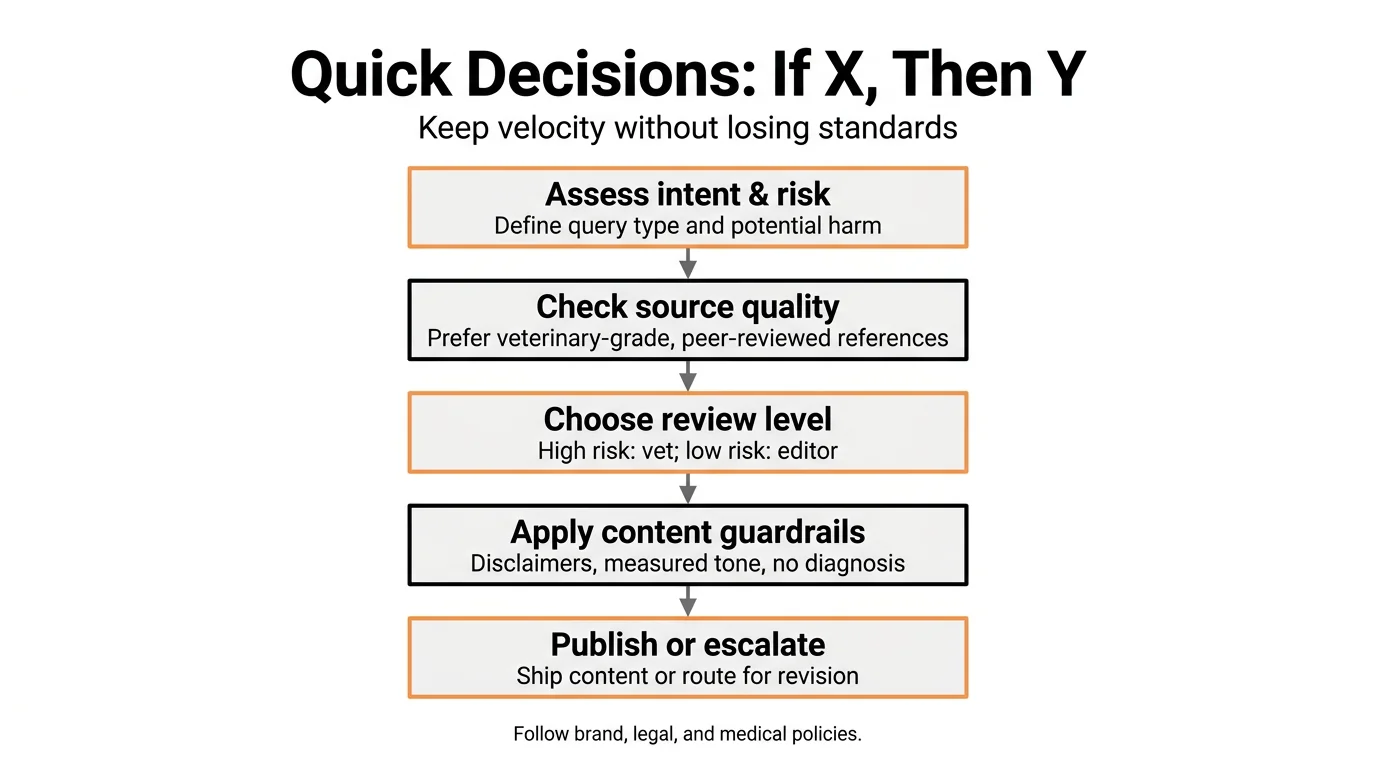
Use these pivots to keep velocity without compromising standards.
Topic selection pivots
- If a topic has high intent but shallow expertise, then recruit expert quotes before drafting.
- If keywords are competitive, then narrow to long-tail modifiers tied to size, life stage, or scenario.
- If search intent is mixed, then split into a how-to and a product-assisted comparison post.
Drafting and review time trade-offs
- If a post includes safety advice, then double review time and trim scope.
- If the draft exceeds 1,500 words, then prioritize sections with highest search demand first.
- If reviewers are backlogged, then publish lower-risk posts and queue updates.
When to localize or defer translation
- If early impressions are strong in one market, then localize the top two performers first.
- If voice consistency drops in translation, then standardize glossary before expanding.
- If indexation lags, then defer localization until crawl patterns stabilize.
Monitoring guidance: what to observe after 7-14 days and 4-8 weeks
Measure early technical health and medium-term business outcomes to validate your AI blog publishing plan for pet brands.
Early indicators (crawl, indexation, SERP features)
Within 7-14 days, review crawl stats, indexation, and rich results. Check FAQ and product schema visibility. For KPI structure, see Proving ROI: KPIs and Dashboards for AI Content in Pet eCommerce. Verify internal links distribute equity appropriately.
Medium-term signals (rank movement, engagement, assisted revenue)
By 4-8 weeks, watch rank deltas for target clusters, engagement time, and exits. Track assisted conversions via product links. Implement structured data carefully; safe templates may help consistency across catalogs[4]. Consider Programmatic SEO for Large Pet Catalogs: Safe Templates by Breed and Use-Case.
Practical safety boundaries for AI-assisted pet content
Prioritize user safety and regulatory alignment over volume. Use measured language and professional oversight where risks exist.
Medical, nutrition, and training advice constraints
Avoid diagnosing conditions or prescribing treatments. Frame guidance as educational. Require veterinarian review for medical content and clear disclaimers. State ranges rather than absolutes. Reference source dates and include context for variability among animals.
User-generated content, images, and sourcing
Obtain rights for images and testimonials. Label user stories as anecdotal. Use alt text and captions that match content. AI-assisted media descriptions may improve accessibility and consistency when reviewed carefully[1].
Evidence status: what is known vs. emerging
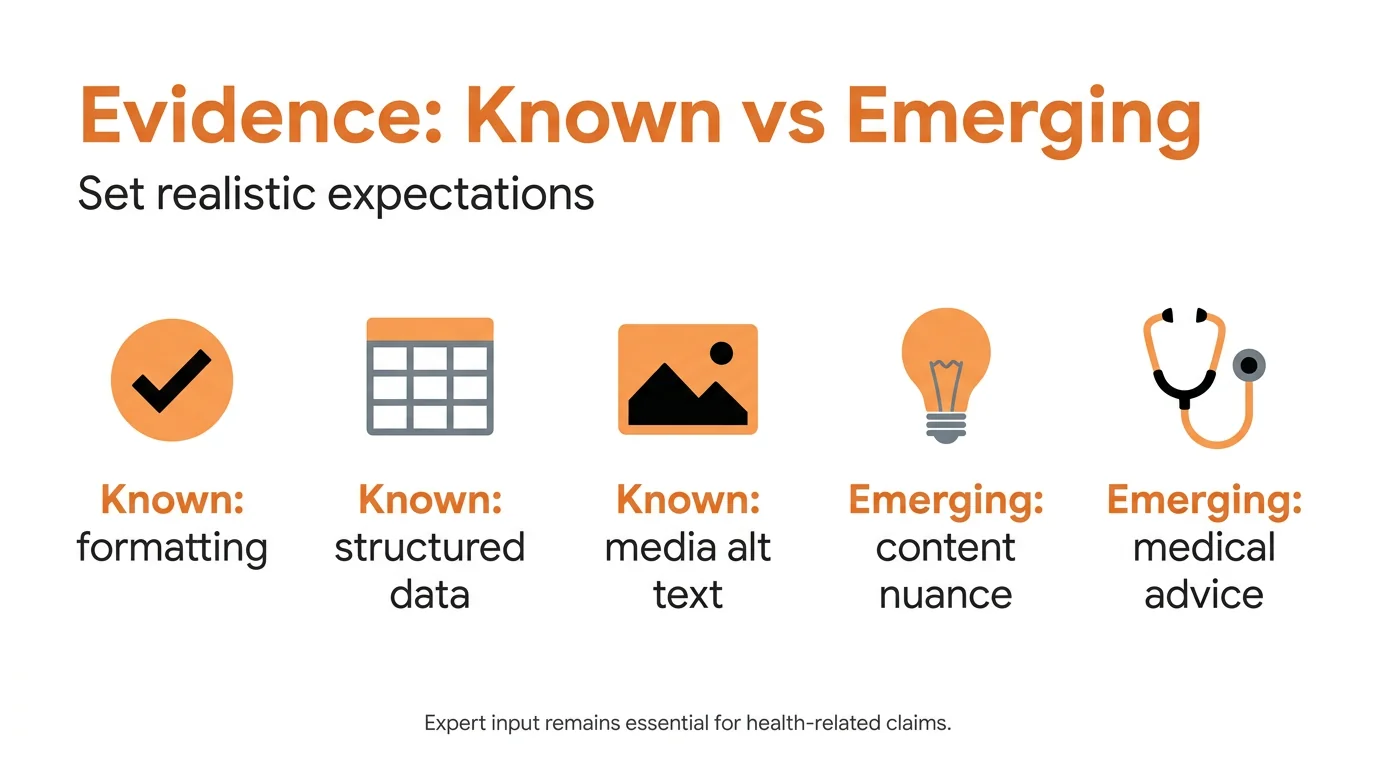
Set expectations for what AI may accelerate, and where expert input remains essential.
Signals that may support trust and rankings
Consistent formatting, accurate media descriptions, and structured data may support visibility. Evidence from adjacent fields shows AI can standardize complex tasks under supervision[2]. Treat these as operational advantages, not guarantees of ranking.
Areas where evidence is limited or context-dependent
Transferability across niches varies. Claims must reflect current consensus, local regulations, and product differences. Motion and context issues in other domains highlight why human validation remains critical for nuanced judgments[4].
Appendix: 10 post briefs mapped to pet-owner intent
Briefs with target query, outline, products to link, and review notes
-
Target query: “best grooming schedule by coat type” - Outline: overview, coat-type matrix, routines, safety tips. Link products: brushes, shampoos. Review: stylist checks terminology and tool recommendations.
-
Target query: “how to choose the right harness size” - Outline: measuring guide, fit checks, training steps. Link products: harness size chart, returns policy. Review: ensure no medical claims; add chafing prevention notes.
-
Target query: “safe treat portions by weight range” - Outline: calorie math, portion examples, training rewards. Link products: treats, feeders. Review: veterinarian confirms ranges; add disclaimer and monitoring advice.
-
Target query: “reduce shedding at home” - Outline: causes, tools, routines, when to escalate. Link products: deshedding tools, vacuums. Review: emphasize non-diagnostic guidance; avoid medical language.
-
Target query: “crate training at night” - Outline: setup, schedule, positive reinforcement. Link products: crates, bedding. Review: trainer validates steps; remove coercive phrasing; include pacing for sensitive learners.
-
Target query: “switching food gradually” - Outline: signs of readiness, seven-day transition, troubleshooting. Link products: food lines, digestive aids. Review: veterinarian checks timeframes; add red-flag symptoms and stop points.
-
Target query: “travel checklist for weekend trips” - Outline: packing list, safety, routines on-the-go. Link products: travel bowls, carriers. Review: legal checks for transport rules; add ID and microchip reminders.
-
Target query: “dental hygiene routine at home” - Outline: brushing steps, tools, treats, schedule. Link products: toothbrushes, dental chews. Review: veterinarian checks abrasion guidance; avoid curative claims.
-
Target query: “allergy season home strategies” - Outline: triggers, cleaning, bathing cadence, product choices. Link products: hypoallergenic supplies, air filters. Review: medical disclaimer; escalate persistent symptoms to professionals.
-
Target query: “introducing a new pet to the household” - Outline: prep, scent exchange, short sessions, progress milestones. Link products: gates, training treats. Review: trainer input; include contingency paths and stress-sign recognition.
Frequently Asked Questions
How many AI-assisted posts should a pet brand publish in the first month?
Many teams aim for 8-12 posts in 30 days. This plan outlines 10 posts, which may balance speed with quality controls, expert review, and brand-voice alignment.
How do I ensure E-E-A-T in pet content created with AI?
Cite credible sources, add expert review where advice could affect health or safety, include author bios with credentials, and show real-world experience through examples and images.
What metrics should I track in the first 4-8 weeks?
Monitor crawl and index status, impressions and clicks for target queries, engagement signals like time on page, and assisted conversions from internal links to product or service pages.
Can I localize pet content immediately for multiple regions?
You can, but evidence suggests starting with one primary market, validating traction, then localizing high performers to reduce translation overhead and maintain voice consistency.
Is it safe to publish AI-generated veterinary advice?
Use cautious language, avoid diagnoses, and require veterinarian review for medical guidance. Include disclaimers and encourage consultation for pet-specific conditions.
Conclusion
A disciplined 30-day workflow can produce 10 intent-aligned posts that respect E-E-A-T, protect readers, and strengthen internal paths to products. Pair structured briefs, expert reviews, and measured automation with ongoing monitoring. Iterate on what gains impressions, engagement, and assisted revenue. Expand carefully into localization once process reliability and topical authority improve. With this cadence, pet SEO automation becomes a reliable operating system rather than a gamble.
References
- Z Ayaz (2024). AI-driven automation in SEO: Enhancing image descriptions with BLIP-processor models. International Journal on Technical and Physical …. View article
- SK Kang et al. (2024). Accurate automated quantification of dopamine transporter PET without MRI using deep learning-based spatial normalization. Nuclear Medicine and …. View article
- … et al. (2023). Automatic Lung Cancer Segmentation in FDG PET/CT Using a Two-Stage Deep Learning Approach. Nuclear medicine and …. View article
- … et al. (2021). Data-driven respiratory phase-matched PET attenuation correction without CT. Physics in Medicine & …. View article