Local SEO for Pet Services: Automate GBP Posts, Services, and Reviews

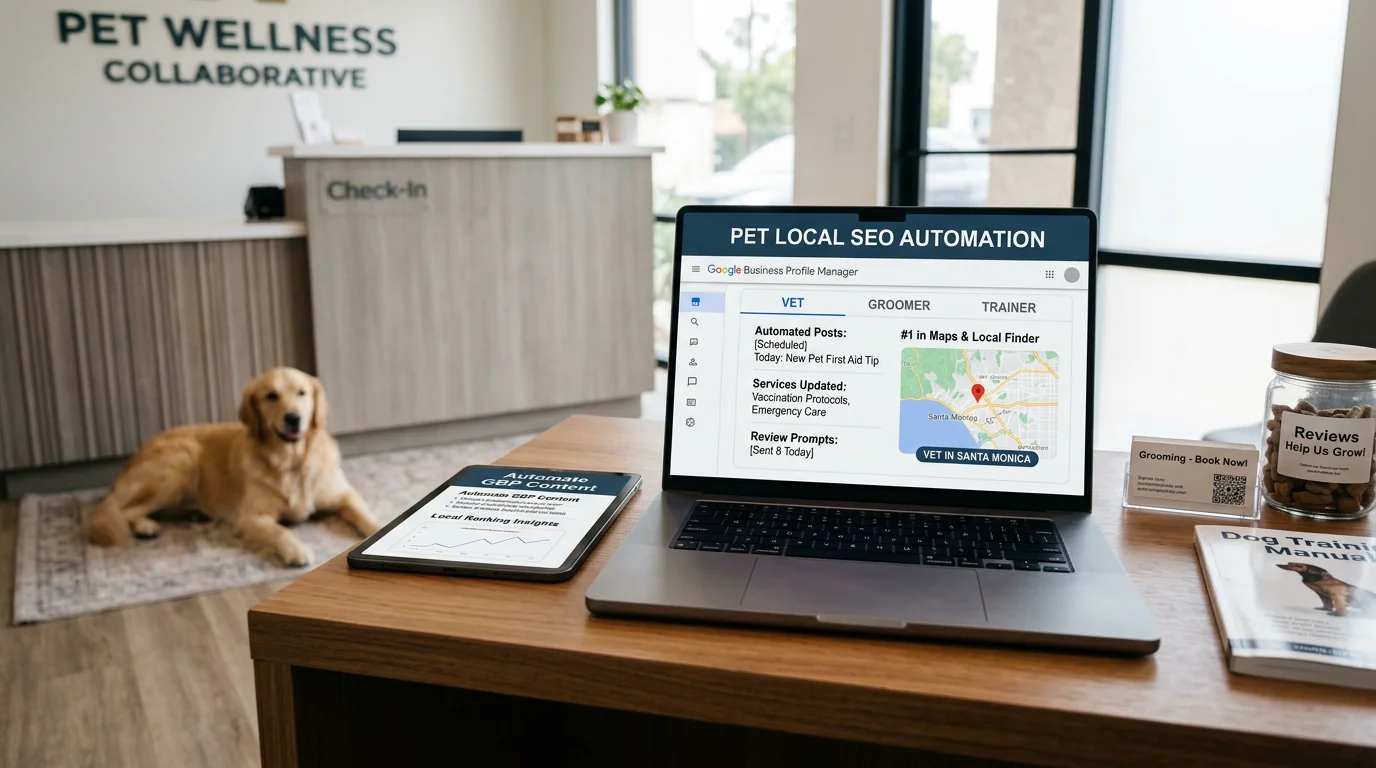
Table of Contents +
- Why automation matters for vets, groomers, and trainers
- Scope: one scenario to solve
- Quick decision guide
- Workflow: automate GBP posts without spam signals
- Workflow: standardize and sync GBP Services
- Workflow: compliant review prompts that customers welcome
- Monitoring: what to check after 7-14 days and 4-8 weeks
- Safety boundaries: stay within platform and legal guidelines
- Evidence status and known unknowns
- Implementation blueprint: 30-day automation plan
- Connect to the Strategic hub for AI visibility priorities
- Frequently Asked Questions
- Conclusion
- References
Automate Google Business Profile posts, services, and reviews for vets, groomers, and trainers. Practical workflows to rank in Maps and Local Finder.
Local search is crowded. Vets, groomers, and trainers compete for the same nearby customers. Automation narrows the gap by delivering consistent, on-brand activity without adding manual workload.
This matters because Maps ranking for pet services often responds to freshness, completeness, and trust signals. You will learn how to automate Google Business Profile content, services, and review prompts without spam signals or compliance risk.
Why automation matters for vets, groomers, and trainers
How GBP activity may influence Maps visibility
Regular GBP activity may signal relevance and reliability. Automated cadences help sustain posting, service updates, and review requests. Operations research shows coordinated scheduling can reduce bottlenecks under resource and handoff constraints.[4]
Single-location vs. multi-location nuances
Single locations should prioritize consistent GBP posts for vets and accurate Services. Multi-location groups gain from templatized posts, location tokens, and staggered calendars to avoid duplication, strengthen coverage, and balance pet groomer local SEO needs.
Petbase builds this SEO foundation automatically for pet businesses - 10 optimized articles published every month - start your free trial.
Scope: one scenario to solve
Automate weekly GBP posts, keep Services accurate, and trigger review prompts
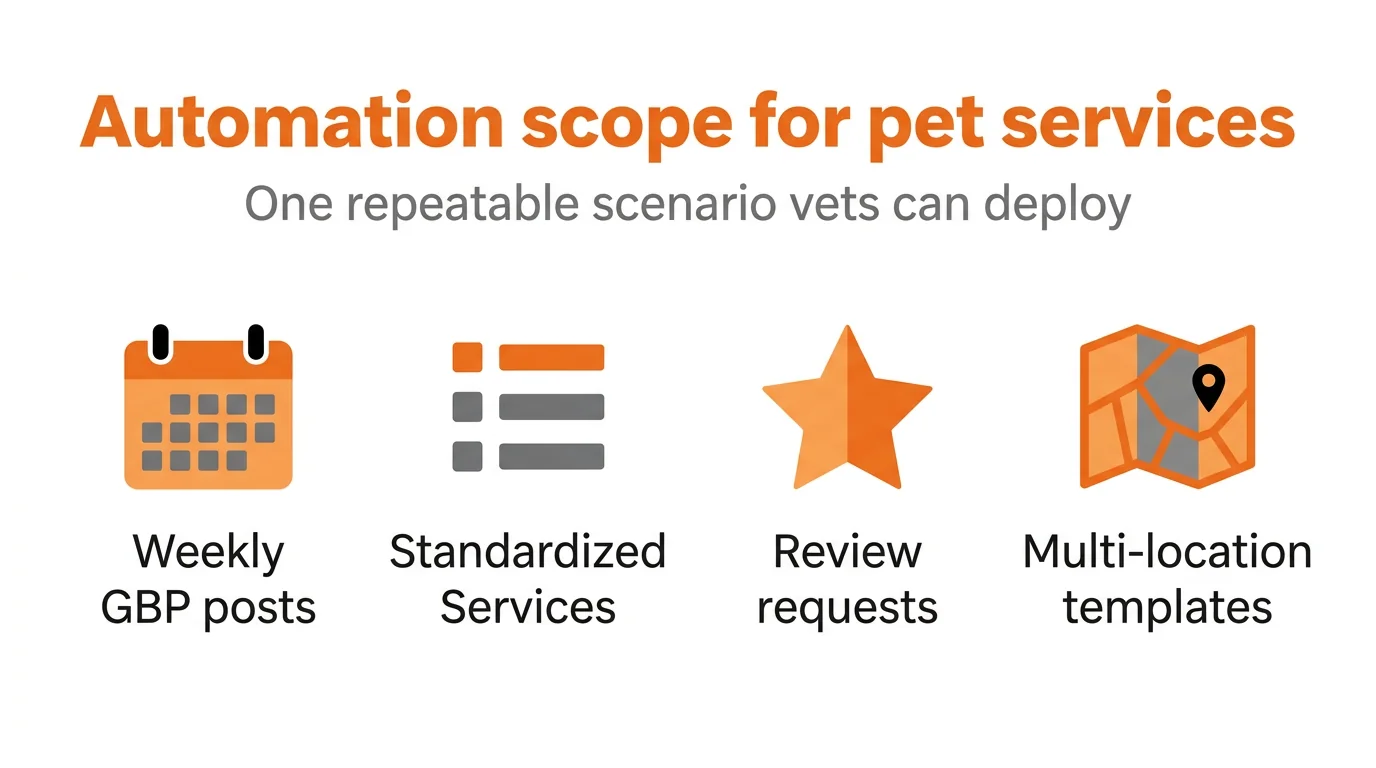
This guide focuses on Google Business Profile automation that publishes weekly posts, standardizes Services, and prompts reviews for vets, groomers, and trainers. The objective is practical uplift in Local Finder and Maps visibility with controlled, measurable workflows.
Quick decision guide
If you have <20 reviews and <4.6 avg rating, prioritize review prompts
Low volume or middling sentiment reduces trust. Deploy review requests immediately. Aim for two gentle prompts per appointment cycle to build momentum for dog trainer Google reviews.
If competitors post weekly, enable a 7-day GBP post cadence
Match or slightly exceed the competitive baseline. A weekly rhythm may sustain recency signals and engagement. Use diverse post types to avoid fatigue and encourage richer consumer actions.
If services are missing or outdated, sync Services before posting
Ensure core offerings exist and match terminology customers search. Align categories, descriptions, and price ranges first. Posting is more effective when Google understands your complete scope.
If you run promos/seasonal offers, schedule Offer posts, not Updates
Use Offer posts for time-bound deals. Include start, end, coupon codes, and terms. Updates serve evergreen guidance. Choose formats that mirror intent for stronger click and call-through rates.
If multi-location, template posts + location tokens; stagger schedules
Use tokens for city, neighborhood, and phone. Stagger publish times by location to reduce duplication signals. This approach aligns with coordinated scheduling principles for reliable throughput.[2]
If photo coverage is thin, auto-generate image posts with alt text
Publish fresh, non-stock visuals. Include descriptive alt text and captions that match services. Rotate staff, facility, and aftercare imagery to broaden relevance while protecting privacy policies.
If low post views after 4 weeks, test post types and first 120 chars
Iterate headline lines and preview text. Compare Updates versus Offers or Events. Experiment with different calls-to-action. Adjust cadence only after controlled tests for clarity and comparability.
Workflow: automate GBP posts without spam signals
Content sources: FAQs, seasonal care, procedure explainers
Start with customer-facing FAQs, season-specific care reminders, and clear procedure explainers. Convert top support queries into short posts linked to relevant pages. For best results, consider using Petbase AI which is designed for this purpose.
Cadence and structure: 1-2 posts/week, first 100-150 chars count
Publish 1-2 posts weekly. Front-load the first 100-150 characters with benefits, location cues, and a service keyword. Iterate with feedback loops to refine cadence and copy focus areas.[3]
Media guidelines: unique images, EXIF-safe, branded but not duplicate
Use unique images per post. Strip risky EXIF data if needed. Maintain brand overlays, but vary composition, background, and subject to avoid near-duplicate detection and engagement decline.
UTM tags and tracking: consistent campaign naming
Append UTM parameters to all links. Standardize source=google, medium=organic, campaign=gbp-posts, content=variant. Preserve consistency for clean analytics attribution and to measure post types against calls and bookings.
Workflow: standardize and sync GBP Services
Service taxonomy for vets, groomers, trainers
Create a master taxonomy mapped to GBP Services. Include core procedures, add-ons, and assessments. Mirror language used on-site and in booking tools. Align with product-aware linking so site context reinforces Services.
Descriptions, price ranges, and policy notes
Write concise descriptions with expected outcomes and inclusions. Add price ranges or “from” pricing where permitted. Include policy notes for cancellations, age limits, or proof-of-vaccination requirements to preempt friction.
Change management: updates, new services, seasonality
Schedule quarterly audits for additions and retirements. Batch updates by location to avoid inconsistencies. Structured change cycles reduce errors under resource constraints and handoffs.[1]
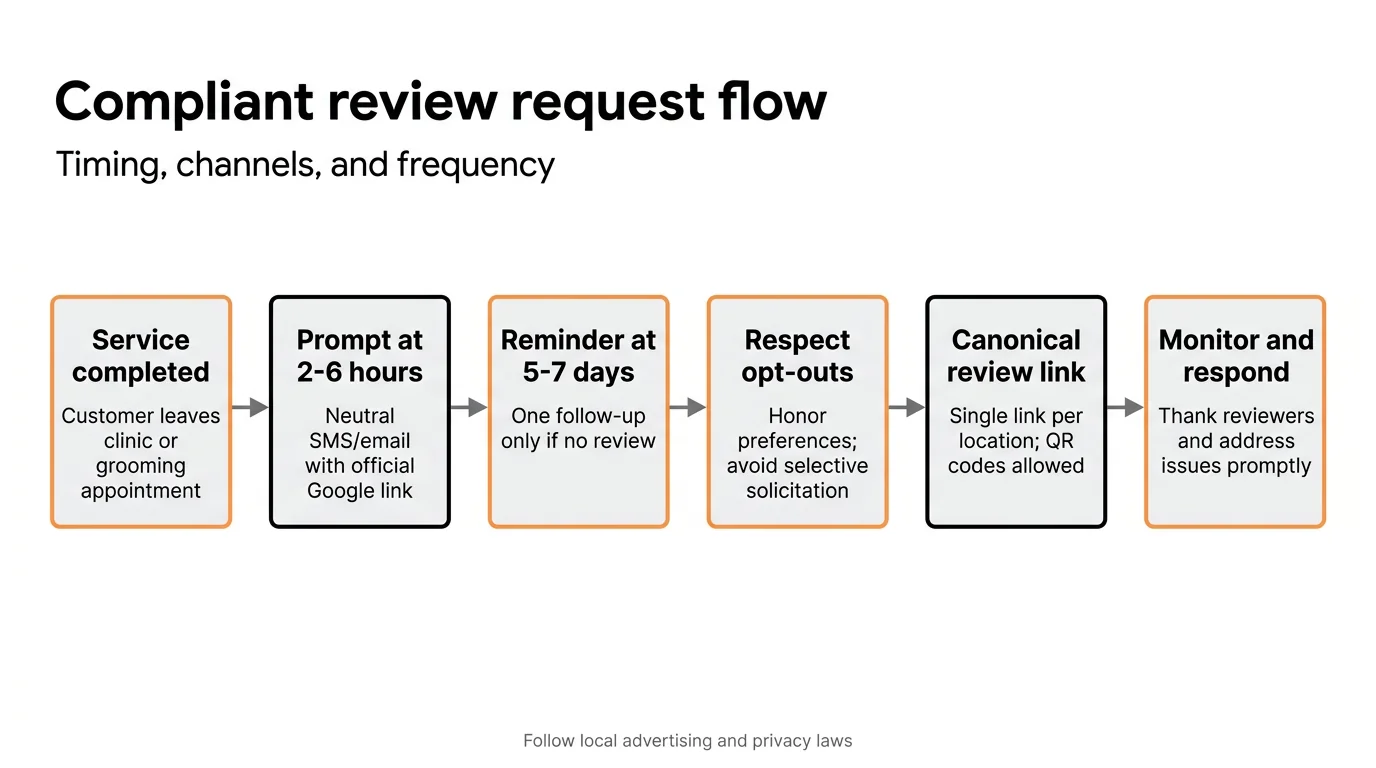
Workflow: compliant review prompts that customers welcome
Trigger points: post-appointment windows and reminders
Send the first prompt 2-6 hours after service while the experience is memorable. Follow with a gentle reminder at 5-7 days. Respect contact frequency caps to protect goodwill.
Link formatting, short URLs, and QR in-clinic assets
Use the official Google review link. Shorten for SMS and email. Add QR codes at checkout, care sheets, and signage. Keep one canonical link per location to simplify tracking.
Neutral language: avoid incentives; request specifics
Ask for honest feedback about the specific service received. Avoid discounts, contests, or gating. Request details on outcomes, care, or staff approach to enrich reviews and future relevance queries.
Monitoring: what to check after 7-14 days and 4-8 weeks
Early signals: post views, clicks, photo views, direction requests
Review post impressions, link clicks, and photo views after 7-14 days. Direction requests can indicate nearby demand. Adjust opening lines and images to improve skimmability and intent match.
Lagging signals: discovery impressions, calls, and query mix
At 4-8 weeks, assess discovery searches, calls, and top queries. Compare to promoted services. Iterative adjustments reflect a controlled optimization loop that responds to feedback frequencies.[2]
Service coverage vs. query match in Insights
Check if rising queries map to enabled Services. If languages vary, consider multi-language content creation for posts and Services to meet local audiences without fragmenting brand voice.
Safety boundaries: stay within platform and legal guidelines
No review gating or incentives
Do not request reviews only from satisfied customers or offer rewards. Use neutral prompts. Monitor opt-out preferences and comply with local advertising and healthcare communication standards.
Avoid duplicate or near-duplicate posts
Rotate topics, headlines, and images. Space similar content by at least four weeks per location. Stagger multi-location publishing to minimize duplication risk across your portfolio.
Accurate services and medical disclaimers for vets
Ensure Services reflect real capabilities and availability. Add medical disclaimers when discussing procedures. Avoid diagnostic claims in posts. Link to complete consent and policy pages on your site as needed.
Respect API limits and brand consistency
If using APIs, adhere to rate limits. Maintain consistent naming conventions, tone, and formatting across locations. Centralized templates reduce drift while accommodating location-specific details.
Evidence status and known unknowns
What data suggests about post frequency and visibility
A weekly cadence often sustains engagement, though causality with rankings is uncertain. Scheduling research supports systematic, repeatable cycles for stable operations under constraints.[4]
How reviews and Services completeness may support discovery
More high-quality reviews and complete Services may clarify relevance to Google. The pathway is indirect. Signals likely assist interpretation rather than acting as isolated ranking levers.
Limitations of GBP Insights and third-party rank tools
GBP metrics have sampling and attribution gaps. Rank trackers vary by location spoofing and personalization. Use them directionally. Validate with calls, bookings, and measured revenue contributions where possible.
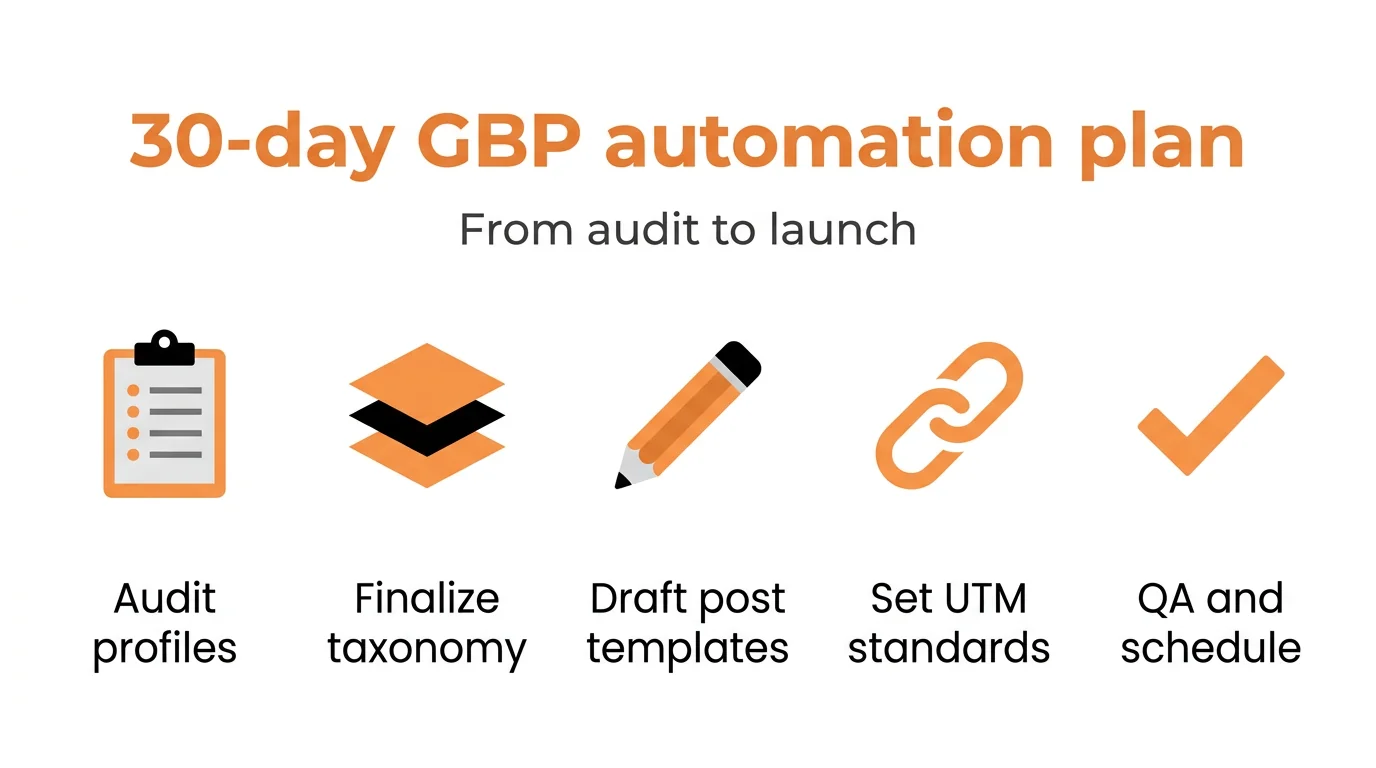
Implementation blueprint: 30-day automation plan
Week 1: audit, taxonomy, templates
Audit GBP profiles, Services accuracy, and image quality. Finalize a service taxonomy for vets, groomers, and trainers. Create post templates with tokens for location, service, and CTA, referencing automated editorial calendars for consistency.
Week 2: post queue, media, UTM setup
Draft 4-6 posts per location from FAQs and seasonal care. Produce unique images and captions. Implement UTM standards. QA for duplication, EXIF safety, and local keywords in the first sentence.
Week 3: review triggers live, signage, training
Activate SMS/email prompts and reminders. Print QR codes for checkout areas and care sheets. Train staff on neutral language and escalation paths for complex feedback.
Week 4: evaluate KPIs and iterate
Review post views, clicks, calls, and discovery impressions. Compare query mix to Services coverage. Adjust opening lines, Offer vs. Update balance, and imagery. Document learnings and refresh the next month’s queue.
Connect to the Strategic hub for AI visibility priorities
Local tactics perform best when aligned with a broader AI visibility roadmap. Position GBP automation alongside on-site schema, content, and conversion flow improvements by reviewing our Strategic hub for AI visibility priorities.
Use this perspective to connect Maps visibility with downstream outcomes, including structured data improvements, collection pages, and content assets that influence assisted conversions across channels.
Frequently Asked Questions
How often should pet service businesses post on Google Business Profile?
Evidence suggests a steady weekly cadence may support visibility and engagement. Many teams see useful signals with 1-2 posts per week paired with fresh photos.
Do GBP Services descriptions affect ranking in Maps?
Completeness and relevance may help Google understand offerings. Clear service names and concise descriptions can align with user queries and improve discovery.
What is a compliant way to request Google reviews?
Use neutral, non-incentivized prompts after service is delivered. Provide the direct review link, ask for honest feedback, and avoid gating based on sentiment.
Which KPIs should I track first for GBP automation?
Monitor post views, link clicks, calls, direction requests, and photo views. Over 4-8 weeks, assess discovery impressions and query types to validate alignment.
Can duplicate GBP posts hurt performance?
Repetitive or near-duplicate posts may reduce engagement and could be filtered. Vary topics, images, and opening lines to keep content useful and unique.
Conclusion
Automation turns good intentions into reliable execution for Local SEO for pet services. By standardizing GBP posts, Services, and review prompts, you may compound relevance and trust signals. Keep cadences steady, measure outcomes, and refine through small, documented iterations. Respect platform boundaries and patient safeguards for veterinary contexts. Use consistent UTM tracking, staggered multi-location schedules, and neutral review language. Anchor all work to customer value and measurable actions. With disciplined operations and careful monitoring, vets, groomers, and trainers can win more nearby demand from Maps and Local Finder with confidence.
References
- Y Zhou et al. (2024). Machine-fixture-pallet resources constrained flexible job shop scheduling considering loading and unloading times under pallet automation system. Journal of Manufacturing Systems. View article
- H Wang et al. (2025). Planning of heuristics: Strategic planning on large language models with monte carlo tree search for automating heuristic optimization. arXiv preprint arXiv:2502.11422. View article
- J Zhang (2026). Control-Theoretic Optimization: An Automation Engineer Inspired Heuristic Method. researchgate.net. View article
- B Xin et al. (2023). Simultaneous scheduling of processing machines and automated guided vehicles via a multi-view modeling-based hybrid algorithm. … on Automation …. View article