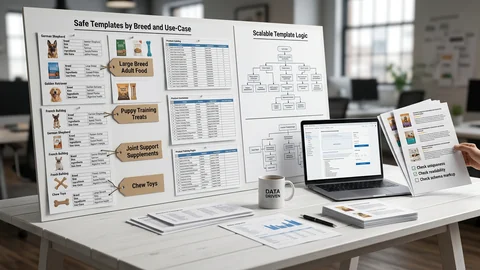
Programmatic SEO for Pet Catalogs: Safe Templates by Breed, Size, and Life Stage


Table of Contents +
- Why one safe template matters for breed, size, and life stage
- Template architecture: fields that reduce duplication risk
- Quick Decision Guide
- Practical safety boundaries for programmatic pages
- Evidence status: what current data suggests
- Monitoring and iteration plan
- Implementation example with Petbase fields
- Common pitfalls and recovery playbook
- Next steps and resources
- Frequently Asked Questions
- References
Build scalable, compliant pet catalog templates by breed, size, and life stage. Reduce thin content risk and duplication while improving relevance.
Scaling pet catalog pages is tempting, but duplication and thin content risks are real. One safe, structured template may prevent cannibalization while improving user trust.
This matters because breed, size, and life stage queries carry intent and compliance considerations. You will learn a template architecture that stays unique, indexable, and useful. You will also gain thresholds, quick decisions, and monitoring steps to stay safe at scale.
Why one safe template matters for breed, size, and life stage
The specific problem: scale without thin or duplicate content
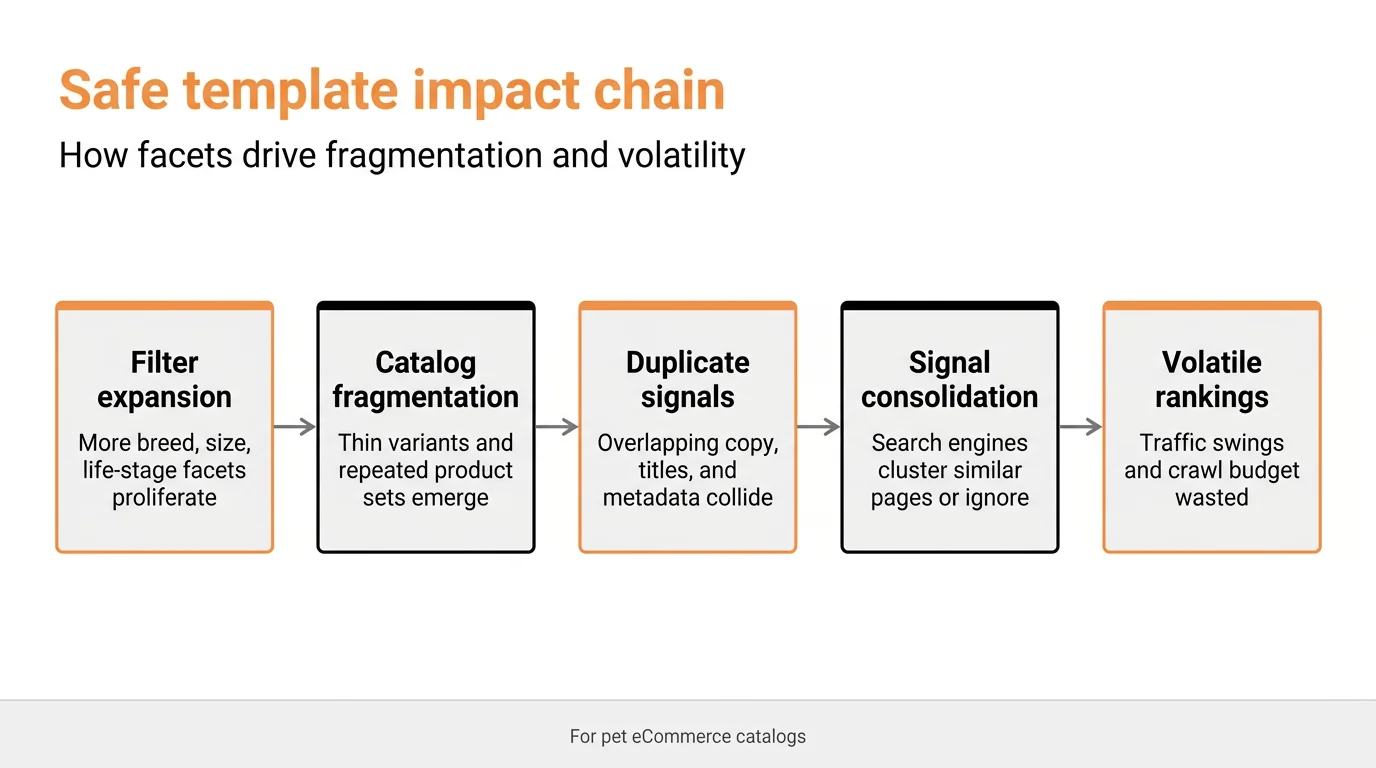
Catalogs fragment as filters multiply. Copy overlaps and product sets repeat. Search engines may consolidate signals, creating rank volatility and crawl waste. A single, flexible template can map shared logic while enforcing variant-level distinctiveness.
Constraints: compliance, E-E-A-T, and catalog volatility
Pet eCommerce SEO requires careful claims hygiene and transparent data sources. Inventory turns fast, creating mismatches between copy and availability. E-E-A-T increases the need for authoritative patterns and consistent product evidence across life stage product pages.
Petbase automates SEO content for pet stores - publishing 10 optimized articles monthly so you can focus on running your shop - start your free trial.
Template architecture: fields that reduce duplication risk
Required unique fields per variant (breed/size/life stage)
Set mandatory fields that trigger publication only when populated. Include need-state summary, sizing guidance, material or nutrient emphasis, fit considerations, and three to five curated product sets. Require unique FAQs and media alt text per variant.
Reusable blocks with guardrails (copy, media, and data)
Centralize reusable components such as delivery info, returns, trust badges, and brand values. Gate variable text behind conditional rules to avoid repeated phrasing. Evidence suggests template-driven authoring can reduce production variance at scale[1][2].
Structured data and filters that keep pages indexable
Implement Product, ItemList, and FAQ schema across the template. Expose breed, size, and life stage as product features. Use canonicalization for overlapping combinations. Crawler-oriented configuration may improve discoverability of structured templates[3]. See the overall AI visibility roadmap for complementary governance.
Quick Decision Guide
If X situation, then Y action (5-7 decisive patterns)
- If search demand exists for an exact combination, publish a canonical variant page with unique sets and need-state copy.
- If demand is ambiguous and inventory fluctuates, keep combinations as filters with noindex to protect crawl budget.
- If curated products overlap more than 60% across variants, merge into a single page and expose filters client-side.
- If unique needs differ materially, split pages and enforce 30-50% unique text plus distinct media and FAQs.
- If compliance-sensitive claims appear, add a disclosure block and citations, or remove the claim until verified.
- If analytics show pogo-sticking, prioritize sizing guidance and fit visuals, then re-run internal link optimization.
- If seasonality spikes demand, pre-generate variants with stock-aware logic and hold until thresholds are met.
Practical safety boundaries for programmatic pages
Content uniqueness thresholds
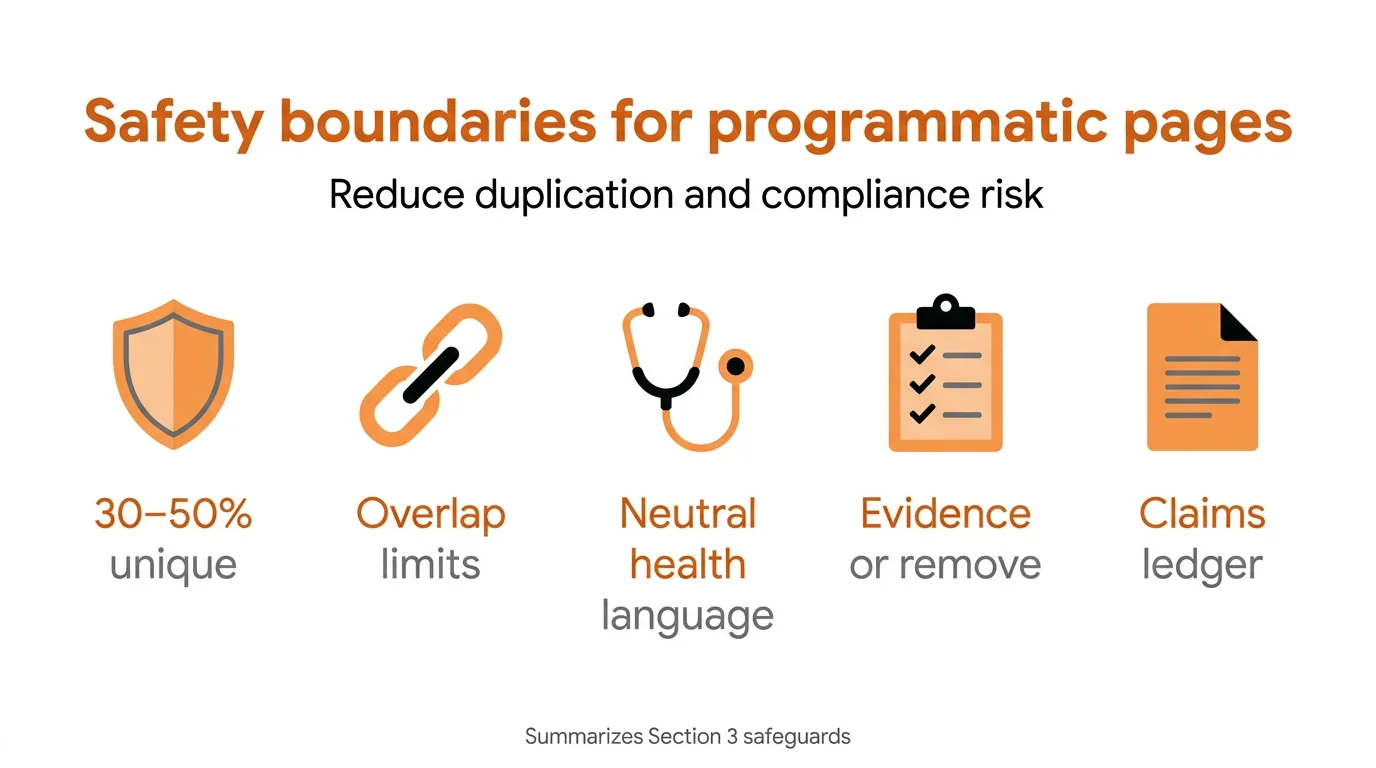
Target 30-50% page-unique copy by variant. This includes need-state overview, fit guidance, curated sets, and FAQs. Enforce product overlap rules, such as a maximum 40-60% shared SKUs across adjacent variants.
Compliance and claims hygiene
Use neutral, non-diagnostic language for health-adjacent copy. Add evidence or remove the claim. Maintain a claims ledger with approval status and versioning. Structured workflows may reduce errors in templated outputs[1].
Crawl/index controls for facets
For faceted SEO for pets, keep low-demand combinations noindexed and disallowed from parameter sprawl. Use canonical tags for near-duplicates. Consider static landing pages for high-demand terms and filter-enabled browsing for breadth.
Evidence status: what current data suggests
Signals that may support these patterns
Template-driven generation can reduce production cycles and bolster consistency while preserving variant-level elements via structured fields. Studies of AI-supported content pipelines show improved speed and governance at scale[1][2].
Where evidence is weaker or context-dependent
Rigid templates can underperform when user preferences shift. Adaptive layouts may help, but performance varies by segment and content depth. Research on template-adaptive organization suggests benefits are situational rather than universal[4].
Monitoring and iteration plan
Checks after 7-14 days
Review log files for crawl patterns and parameter bloat. Confirm that canonicals resolve correctly. Track impressions and CTR for variant pages. Benchmark internal link flows and exits to product categories. See programmatic SEO results for pet catalogs for evaluating visibility signals beyond ranks.
Checks after 4-8 weeks
Assess index coverage, duplication clusters, and Product/FAQ rich result rates. Compare assisted conversions by variant. Evidence suggests AI-supported workflows shorten iteration cycles for templated content governance[1].
Implementation example with Petbase fields
Field map: breed → needs → benefits → products
Data model: breed-specific templates feed a “needs” table. Each need maps to tangible benefits, then to SKU clusters. Example: “sizing guidance” → “secure fit” → curated sets. This supports pet SEO automation and consistent inventory-aware curation.
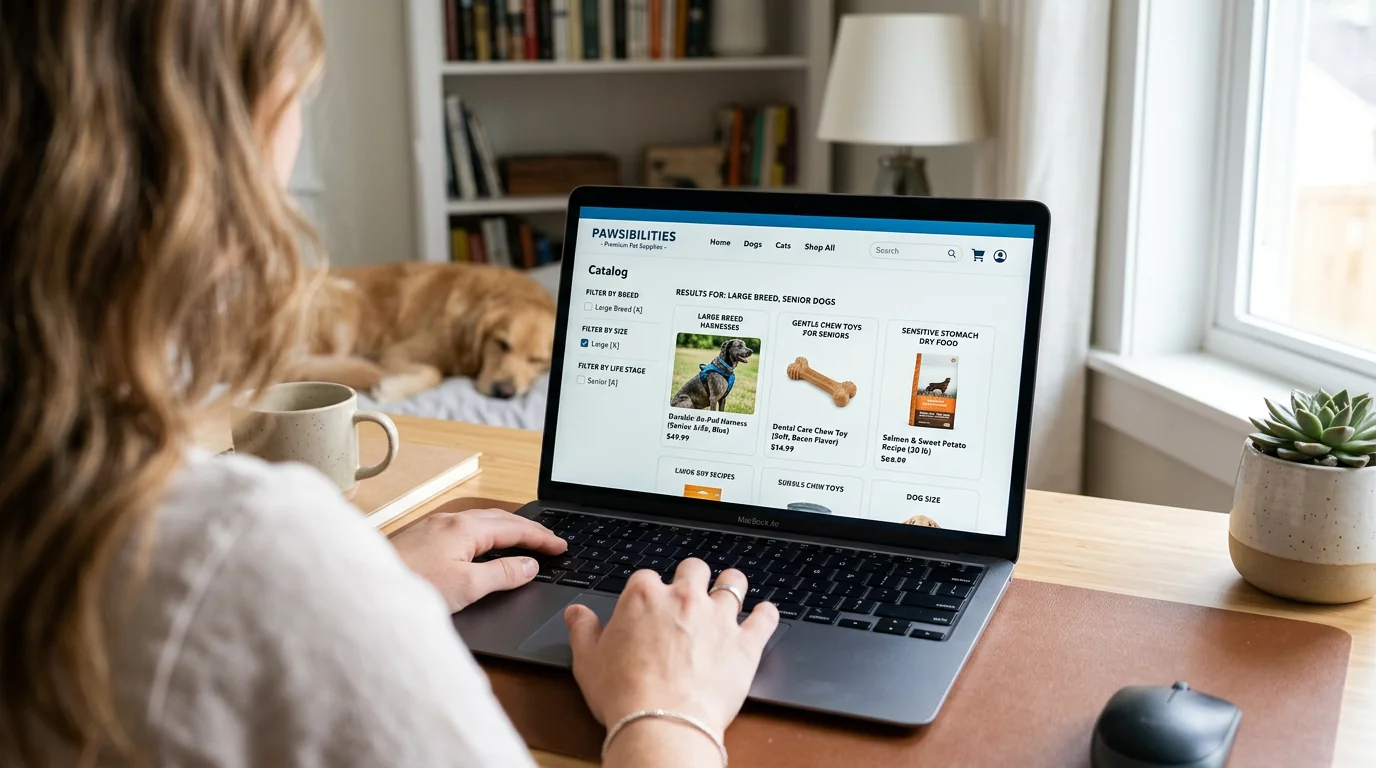
Present example anchors for shopper flow: Large Breed Harnesses, Gentle Chew Toys for Seniors, Sensitive Stomach Dry Food. Keep each set constrained to five to nine items with rotation rules and availability checks.
Internal linking rules that guide users to products
Place two to three contextual links from need-state paragraphs to relevant category pages using exact-match anchors. Position one link above the fold and one near FAQs. For workflow efficiency, consider Petbase AI during generation to pre-fill variant fields while preserving editorial review.
For deeper merchandising rigor, align with pet-specific content automation practices that standardize briefs, thresholds, and approval gates.
Common pitfalls and recovery playbook
When duplication creeps in
Run similarity scoring on titles, H1s, and need-state paragraphs. Merge or canonicalize overlapping pages. Refresh unique media, alt text, and FAQs. Rebuild curated sets to reduce SKU overlap across adjacent variants.
When crawl budget is wasted
Audit parameterized URLs and duplicate facet paths. Consolidate filters and standardize canonical rules. Move low-value views behind client-side filters. For governance tactics, review faceted navigation SEO for pet stores.
When product coverage is uneven
Detect gaps where variants lack sufficient SKUs. Expand eligibility rules or pause publication for underfilled pages. Rebalance internal links from high-coverage variants to adjacent low-coverage pages to stabilize discovery and conversions.
Next steps and resources
Rollout order and QA checklist
Start with top-demand combinations. Launch a limited set with strict thresholds. Verify structured data, canonical tags, and unique copy percentages. Monitor indexation and adjust filters. Expand once duplication and availability stabilize.
See the overall AI visibility roadmap
Align template launches with measurement frameworks, editorial calendars, and conversion instrumentation. Coordinate cross-functional reviews to maintain E-E-A-T and compliance. This keeps programmatic SEO for pet catalogs both sustainable and accountable.
Frequently Asked Questions
How do I avoid thin content when creating breed pages at scale?
Ensure each page has unique need-state content (care, fit, sizing) tied to that breed, distinct product recommendations, and at least 30-40% page-unique copy. Evidence suggests unique data fields and media variations reduce duplication risk.
Should size and life stage be separate URLs or filters?
If search demand exists for the exact combination (e.g., large breed senior dog food), a canonical URL may help. If demand is low and facets explode the index, keep as filters with noindex to preserve crawl budget.
What structured data helps pet product templates?
Product, ItemList, and FAQ schema may support richer results. Include breed/size/life stage attributes in product features and ensure price, availability, and reviews are accurate.
How much copy should be unique per template variant?
Many teams target 30-50% unique content, but thresholds vary. Focus on specific care needs, sizing guidance, and curated product sets to differentiate meaningfully.
When should I use canonical tags on programmatic pages?
Use canonical tags when multiple URLs serve near-identical intent, such as overlapping facet combinations. If each page addresses discrete demand with unique value, self-canonicalize.
Conclusion
A single, safe template can unlock scale for breed, size, and life stage product discovery without inviting duplication issues. Use mandatory unique fields, controlled reusable blocks, and rigorous compliance workflows.
Monitor indexation, overlap, and conversions in staged rollouts. Evidence suggests template discipline, supported by automation, may improve consistency and speed. With clear guardrails, pet eCommerce SEO becomes scalable, resilient, and useful for shoppers.
References
- S ABEDI (2026). Optimizing Content Production Cycles with AI Technology. thesis.unipd.it. View article
- MJ Kim et al. (2025). From Menus to the Interactive Food-Ordering Systems. Proceedings of the 34th …. View article
- Z Cui (2024). A Visual Crawler Based on Collection Template Configuration. 2024 10th International Conference on Computer and …. View article
- CH Lam et al. (2025). Template-Adaptive Content Organization: AI-Driven Personalization for E-Commerce Email Marketing. 2025 6th International Conference on …. View article