Measure AI Visibility Beyond Rankings: AOV Boxes, Snippets, and Assisted Revenue

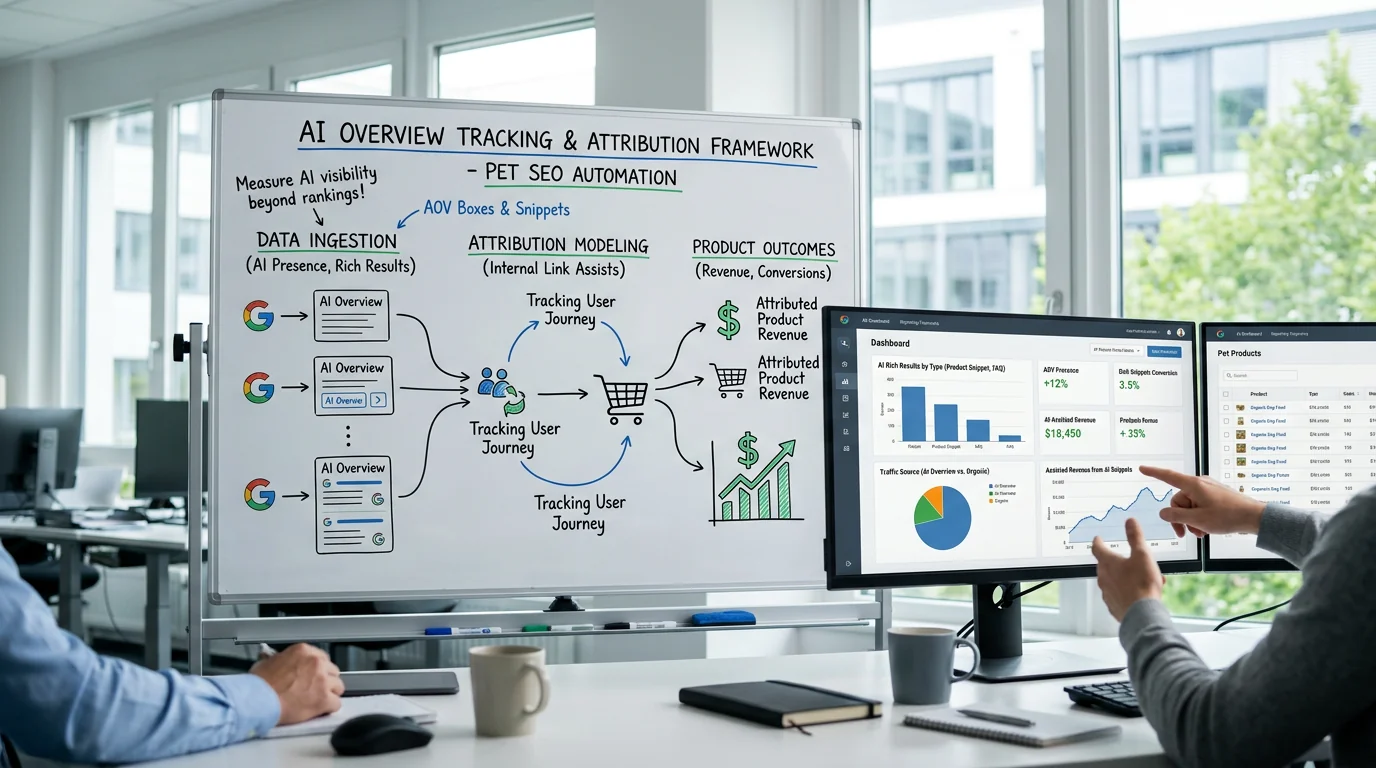
Table of Contents +
- Context: One scenario this framework solves
- Framework architecture: From SERP features to assisted revenue
- Instrumentation: How to capture AI Overviews, AOV boxes, and snippets
- Quick decision guide
- KPIs and diagnostics for pet brands
- Monitoring guidance: 7-14 days and 4-8 weeks
- Practical safety boundaries
- Evidence status and uncertainties
- Implementation steps for pet catalogs
- How this ties to your AI Visibility strategy hub
- Frequently Asked Questions
- References
Build a reporting framework to track AI Overviews, rich results, internal link assists, and product revenue. See what truly drives pet brand outcomes.
Your rankings can rise while revenue stalls. AI Overviews and rich results may be capturing intent before clicks. Traditional rank reports miss this shift.
This matters because your product pages must win attention across more surfaces. You will learn a focused reporting framework that tracks AI Overview presence, snippet wins, internal link assists, and product outcomes. You will also see practical safeguards and monitoring timelines, so your pet eCommerce SEO metrics reflect real commercial impact.
Context: One scenario this framework solves
Problem definition: Rankings up, revenue flat
Teams report higher average positions and more impressions, yet revenue remains unchanged. AI Overview answers and snippets may intercept demand. Organic clicks redistribute across SERP features, dulling traditional SEO success signals.
Scope: Pet product pages influenced by AI Overviews and snippets
We focus on product pages and their supporting content. The framework tracks AI Overviews tracking, “AOV boxes,” and snippet eligibility. It then connects assisted revenue attribution from internal links to observable product outcomes.
Petbase writes and publishes this kind of content automatically - 10 SEO articles per month for pet businesses - start your free trial.
Framework architecture: From SERP features to assisted revenue
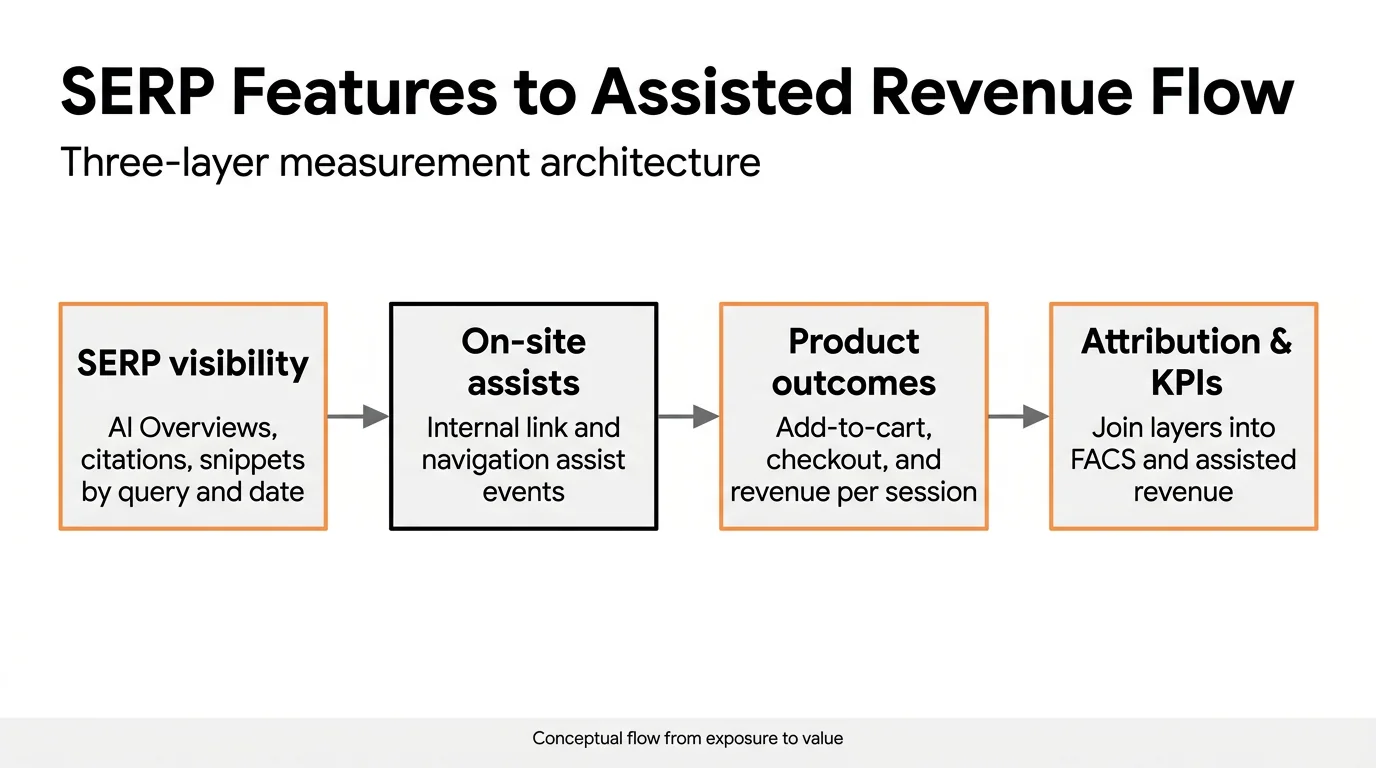
Data layers: SERP feature presence, on-site assists, product outcomes
Use three layers. First, SERP feature visibility for each query and URL. Second, on-site assists from internal links and navigation. Third, product outcomes: add-to-cart, checkout starts, and orders. This layered view supports balanced evaluation practices[2].
Entities and joins: Query → Page → Feature → Session → Order
Join entities with persistent keys. Query to landing page. Page to observed feature by date and device. Feature to session via timestamp and country. Session to order through client ID. This chain supports measuring search-to-purchase interactions[1].
Instrumentation: How to capture AI Overviews, AOV boxes, and snippets
Detecting AI Overview presence and ‘AOV boxes’
Record daily AI Overview presence by query, device, and country. Flag whether your domain appears as a cited source within the AI answer cards (“AOV boxes”). Track position above or below the AI Overview and log any carousel expansions.
Rich results and snippet flags via schema and GSC
Enable Product, Offer, Rating, FAQ, and Breadcrumb markup. Monitor Search Console for rich results reporting and eligible impressions. Validate pages with a schema testing tool and log “snippetEligible = true/false.” For automation, see automatic schema for products.
Session tagging for internal link assists
Tag internal link clicks with session-scoped events: assist_source, assist_type, and assist_position. Define a lookback window and touch cap. For deployment patterns, review internal link assists for pet SKUs.
Quick decision guide
If X situation, then Y action (5-7 practical routes)
- If AI Overview appears and your domain is uncited, prioritize a concise explainer page and add structured data that supports factual snippets.
- If AI Overview appears and your domain is cited, add intent-matched CTAs and FAQs to capture post-AOV clicks.
- If snippet eligibility drops, validate schema and reduce duplicative content that may confuse extractive systems.
- If internal assists rise but orders do not, review landing speed, PDP trust elements, and price competitiveness before scaling traffic.
- If product discovery shifts to informational pages, embed comparison tables and soft CTAs targeting add-to-cart micro-conversions.
- If click share fragments across features, diversify assets: short answers, images, and FAQs to expand “shelf space.”
KPIs and diagnostics for pet brands
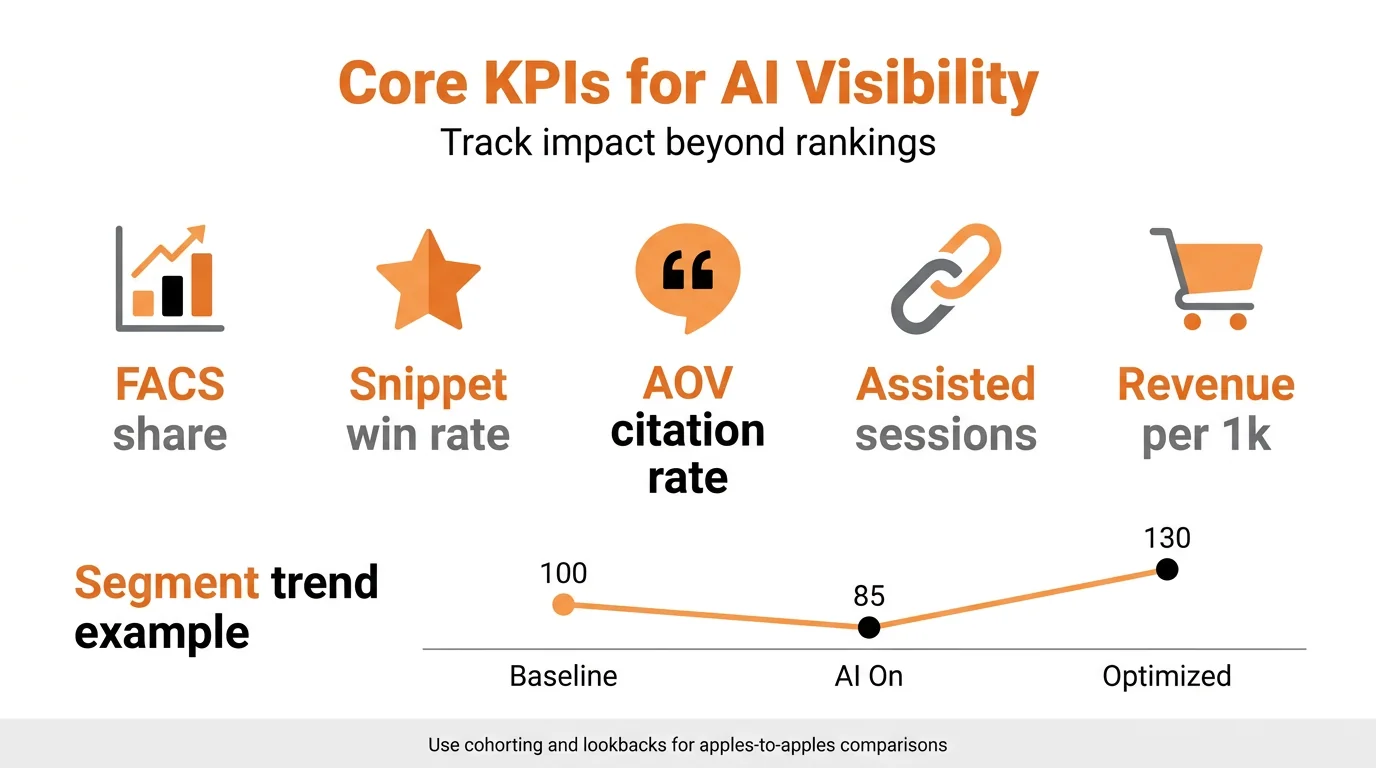
Feature-Adjusted Click Share (FACS)
Estimate share of potential organic clicks after controlling for AI Overviews and rich results. FACS compares your clicks to modeled available clicks given observed features. It aligns with SERP real estate dynamics discussed in SEO literature[4].
Assisted Add-to-Cart Rate and Assisted Revenue
Measure sessions with an internal link assist that produce add-to-cart or revenue within the lookback window. Attribute fractional value to assists. This ties upper-SERP exposure to transaction propensity in product search contexts[1].
Snippet Win Rate and Shelf Space Index
Snippet Win Rate is the percent of impressions where your URL wins a rich result or featured snippet. Shelf Space Index counts distinct SERP placements your brand occupies per query. These metrics contextualize SERP feature visibility within competitive SEO/SEM strategy[3].
Monitoring guidance: 7-14 days and 4-8 weeks
Early signal checks (7-14 days)
Validate detection coverage, event firing, and schema eligibility. Check FACS directionality on target queries. Review assisted add-to-cart movement across top product pages. Ensure seasonality or promotions are annotated for attribution clarity[2].
Stability and lift analysis (4-8 weeks)
Assess sustained changes in FACS, Snippet Win Rate, and Assisted Revenue per 1,000 impressions. Segment by category, device, and country. Use pre/post baselines with confidence bands. Reconcile with paid and CRM signals to reduce attribution bias[2].
Practical safety boundaries
Attribution guardrails
Use a 24-72 hour lookback for content assists to limit long-tail inflation. Cap at two assists per order. Apply fractional credit by proximity. Keep a “direct-only” view to validate blended findings.
Sampling and bot-filtering safeguards
Exclude known bots and suspicious IPs. Suppress sessions with zero scroll and sub-two-second dwell when bounce is immediate. Sample SERPs by device and geography to prevent overfitting to one environment.
Schema and content boundaries
Maintain truthful, supportable claims in structured data. Avoid over-markup that implies guarantees. Keep FAQs concise and factually grounded. Periodically test removals to ensure features are earned, not forced.
Evidence status and uncertainties
What current evidence suggests
Research emphasizes connecting search exposure to purchasing behavior and optimizing revenue, not clicks alone[1]. Performance evaluation frameworks recommend multi-metric monitoring and prudent attribution practices across channels[2]. Literature also highlights the commercial relevance of SERP features in SEO/SEM strategy[3].
Assumptions to document and revisit
Record assumptions about AI Overview volatility, snippet extraction rules, and shopper behavior. Document lookback choices and assist caps. Revisit quarterly as SERP layouts, models, and user patterns evolve[4].
Implementation steps for pet catalogs
Priority categories and seasonal lines
Start with top-revenue categories and seasonal lines with volatile demand. Map head and mid-tail queries to SERP features. Assign A/B cohorts where feasible. Apply AI Overviews tracking in markets with sufficient search volume.
Schema and internal linking checklist
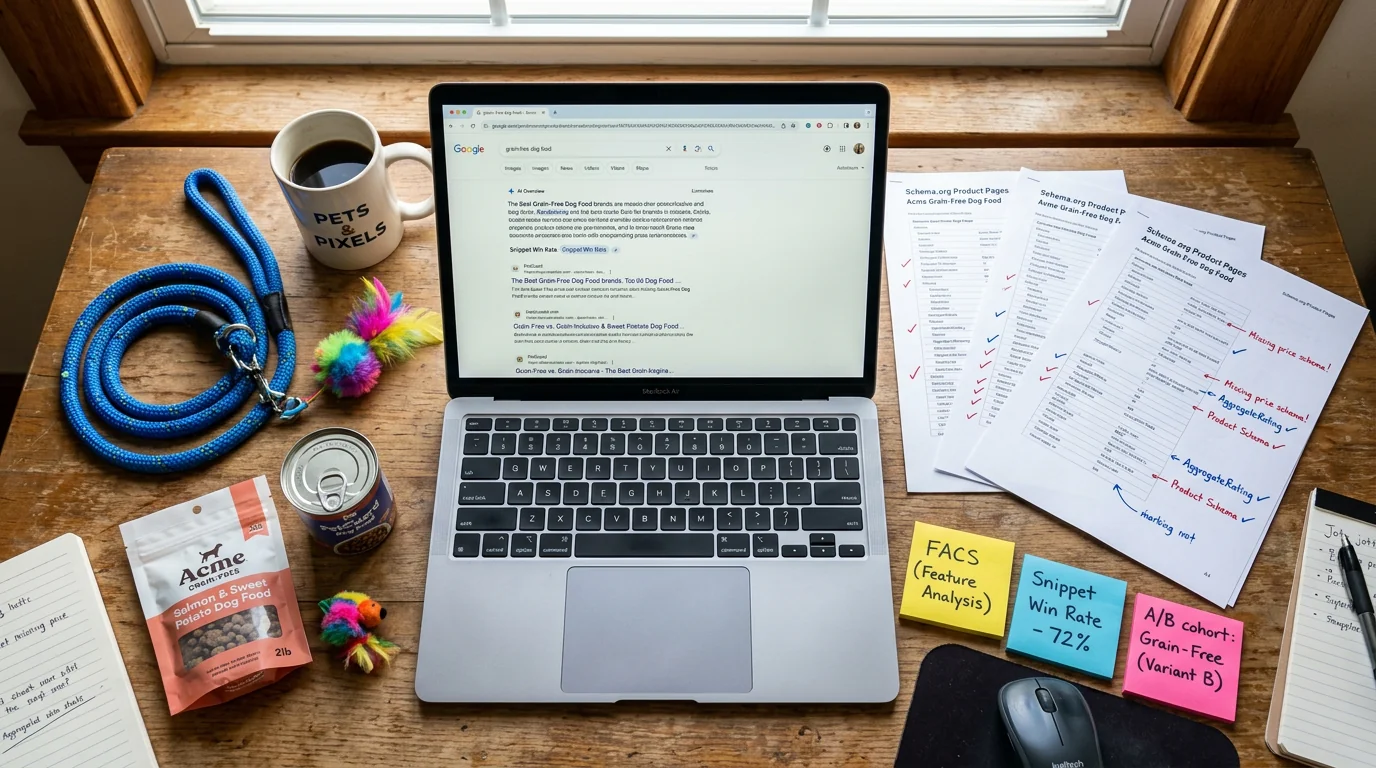
Confirm product schema completeness, ratings integrity, and availability signals. Build internal link hubs with clear anchor taxonomy and assist tagging. Use FAQ and comparison sections to target snippet surfaces. Validate rich results reporting weekly.
How this ties to your AI Visibility strategy hub
Orienting metrics to strategic bets
Translate FACS, Snippet Win Rate, and Assisted Revenue into portfolio-level bets. Reallocate content and schema efforts toward features with measurable lift. For strategic orientation, see the AI Visibility strategy hub.
Frequently Asked Questions
How do I know if AI Overviews are impacting my pet product queries?
Evidence suggests monitoring AI Overview presence alongside changes in click-through and branded discovery can help. Track query-level AI Overview flags and compare to shifts in assisted revenue on related product pages.
What counts as an internal link assist for attribution?
An assist may be any internal link click from a blog or guide that precedes add-to-cart or checkout within a defined lookback window. Using UTM-like parameters or session-scoped events can reduce ambiguity.
Can rich results materially change conversions for pet SKUs?
Rich results may increase visibility and trust, which can correlate with higher click-through and on-site engagement. Results vary by category; test product schema completeness and monitor assisted metrics.
Which KPIs should I report beyond rankings?
Consider Feature-Adjusted Click Share, Snippet Win Rate, Internal Link Assist Rate, Assisted Add-to-Cart Rate, and Assisted Revenue per 1,000 impressions. These may provide a fuller view of impact.
How long should I run the test before judging impact?
Many teams observe directional signals in 7-14 days and assess stability over 4-8 weeks. Seasonality and campaign noise can extend the window needed for confident interpretation.
Conclusion
Ranking alone no longer predicts commercial outcomes. This framework connects AI Overviews, snippets, and internal assists to real product results. Implement conservative attribution, validate schema, and monitor FACS and assisted revenue. Use disciplined observation windows and revisit assumptions as SERPs evolve. With structured AI visibility reporting, Petbase helps you prioritize the surfaces that matter, and grow organic revenue with confidence.
References
- L Wu et al. (2018). Turning clicks into purchases: Revenue optimization for product search in e-commerce. … ACM SIGIR Conference on Research & …. View article
- E Gaitniece (2018). Digital marketing performance evaluation methods. CBU International Conference Proceedings. View article
- S Das (2021). Search engine optimization and marketing: A recipe for success in digital marketing. 2021 - api.taylorfrancis.com. View article
- M Iqbal et al. (2022). Search engine optimization (seo): A study of important key factors in achieving a better search engine result page (serp) position. Sukkur IBA Journal …. View article