AI Keyword Research for Pet Stores


Table of Contents +
- Why Does Traditional Keyword Research Fail Pet Stores?
- What Are the Four Keyword Categories Every Pet Store Should Target?
- How Do AI Tools Change the Keyword Research Process?
- Which Traditional Tools Still Matter for Pet Store Keyword Research?
- How Should You Evaluate Keyword Difficulty for a Pet Store?
- How Do You Build a Keyword Target List Step by Step?
- How Does AI Search Change Which Keywords Are Worth Targeting?
- What Mistakes Do Pet Stores Make With Keyword Research?
- Frequently Asked Questions
- References
AI keyword research for pet stores: 4 keyword categories to target, AI-assisted research methods, difficulty evaluation, and a step-by-step target list builder.
Most pet stores approach keyword research the same way: open a tool, type "dog food," stare at 10,000 results, pick the ones with high volume, and hope for the best. The result is a content calendar full of generic terms dominated by Amazon, Chewy, and PetSmart. Organic search drives 46.98% of all web traffic[1], but only if you target the right keywords. For independent pet stores, "right" does not mean highest volume. It means specific enough to rank and commercial enough to convert.
AI tools have changed this process fundamentally. Instead of sorting spreadsheets by search volume, you can now map customer intent, discover semantic clusters, and find competitor gaps in a fraction of the time. But AI keyword research only works when you know which keyword categories matter for pet stores and how to evaluate them. This guide covers the complete process.
TL;DR: AI keyword research helps pet stores find specific, lower-competition terms that drive actual sales. Focus on four categories: breed-specific, health condition, product comparison, and local queries. AI tools cut research time by 60% and surface long-tail opportunities traditional tools miss. Target difficulty 20-45 for the best ROI.
Why Does Traditional Keyword Research Fail Pet Stores?
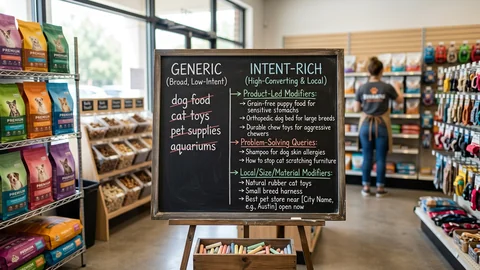
Traditional keyword research ranks keywords by monthly search volume. The logic seems sound: more searches means more potential traffic. But for pet stores, high-volume keywords are a trap. Terms like "dog food" or "cat toys" attract millions of searches, yet the top 10 results are occupied by sites with domain authorities above 80 and marketing budgets in the millions. SEO delivers a 748% return on investment when done correctly[2], but only when you target winnable terms.
The real problem is specificity. A search for "dog food" reveals nothing about the searcher. Are they looking for puppy food? Senior dog food? Grain-free options for a dog with allergies? A pet store that targets "dog food" competes with everyone. A pet store that targets "best grain-free food for French Bulldog puppies with sensitive stomachs" competes with almost no one - and reaches a buyer ready to purchase. Long-tail keywords account for 70% of all search traffic[3], and this is where pet stores win.
AI Overviews now appear in 48% of Google queries[4]. This makes generic keywords even less valuable because Google answers simple questions directly. The queries that still send clicks to websites are specific, nuanced, and product-oriented - exactly the kind pet stores should target.
Petbase automates SEO content for pet stores - publishing 10 optimized articles monthly so you can focus on running your shop - start your free trial.
What Are the Four Keyword Categories Every Pet Store Should Target?
Every pet store keyword strategy should cover four distinct categories. Each serves a different purpose in the buyer journey, and together they build the topical authority that earns both Google rankings and AI citations. Sites with 5 or more connected pages on a topic earn 86% of all AI citations[5].
Category 1: Breed-specific queries
Breed-specific searches identify pet owners with a known animal and predictable product needs. A person searching "best food for a French Bulldog puppy" has a specific dog, a specific life stage, and buying intent. These queries convert at higher rates because the searcher already knows what they need - they just need a trusted recommendation.
Target patterns include "best [food/treat/supplement] for [breed]," "[breed] health problems," "how to groom a [breed]," and "[breed] puppy care guide." The competition is typically low because large generic sites do not build breed-specific content libraries. A pet store that ranks for 50 breed-specific feeding guides has built a defensible position that national chains are not structured to compete with.
Category 2: Health condition queries
Pet owners dealing with a health condition - pancreatitis, allergies, arthritis, dental disease - search with urgency and high purchase intent. They need specific foods, supplements, or care products. Target patterns include "dog food for [condition]," "best supplements for [condition]," and "[condition] diet for dogs/cats."
These keywords require accurate, well-sourced content because they fall under Google's YMYL (Your Money or Your Life) evaluation. The trade-off is worth it: accurate health content earns strong E-E-A-T signals and AI search citations. Content with statistics earns 28-40% higher AI visibility[6]. See the AI content quality guide for accuracy requirements.
Category 3: Product comparison queries
Queries containing "best," "vs," "comparison," and "review" reach buyers at the decision point. These are among the highest-converting content types because the searcher is actively evaluating options. Target patterns include "best [product] for [breed/condition]," "[Product A] vs [Product B]," and "[product] alternatives."
Comparison content must be genuinely balanced to rank. Google evaluates whether comparisons serve the reader or just promote the author's products. An honest comparison that acknowledges competitor strengths - while explaining why your recommendation fits a specific use case - outperforms promotional content. Companies using AI for content production create 42% more content per month[7], making it feasible to cover comparison topics at scale.
Category 4: Local pet queries
For pet stores with physical locations, local keywords drive foot traffic. These combine pet topics with geographic modifiers: "pet store near me," "dog grooming [city]," "organic pet food [region]." Local SEO is a separate discipline covered in the local SEO guide for pet businesses, but local keywords belong in every keyword research session.
How Do AI Tools Change the Keyword Research Process?
AI tools transform keyword research from a data-extraction task into a strategic exercise. The average blog post takes 3 hours 55 minutes to write manually[8]. AI reduces research time proportionally, but the real value is in the approaches that were previously impossible.
Customer question mapping
Instead of starting with seed keywords, start with customer questions. Prompt an AI tool with: "List the 50 most common questions a new French Bulldog owner would have in the first year." Sort the results by topic cluster and check search volume for the most specific queries. This surfaces long-tail keywords that keyword planners miss because individual volumes are low - but collectively they drive significant traffic when you rank for 20-30 of them.
Competitor content gap analysis
Feed an AI tool the blog URLs of your top 5 competitors. Ask it to identify topic clusters they have built, topics they cover partially, and topics they have ignored. This reveals content gaps where a new article from your pet store could rank without competing against an established cluster. Topic clusters generate approximately 30% more organic traffic than isolated articles[9].
Semantic cluster mapping
Traditional research groups keywords by volume. AI groups them by semantic relationship - which queries represent the same underlying need. "Dog food for upset stomach," "best food for dogs with diarrhea," and "gentle dog food for sensitive digestive system" all represent one content need. Ranking with one comprehensive article covering the full semantic cluster beats publishing three thin articles each targeting one phrasing. Internal linking within clusters boosts rankings by up to 40%[10].
Mapping customer questions to keyword clusters takes hours. Petbase builds your topic map and generates 10 optimized articles per month from it. See how it works.
Which Traditional Tools Still Matter for Pet Store Keyword Research?
AI tools supplement but do not replace traditional keyword research platforms. You still need volume data, difficulty scores, and competitor metrics. Businesses that prioritize blog SEO are 13x more likely to see positive ROI[11]. Here are the tools most useful for pet stores, with a realistic assessment of when each one matters.
| Tool | Best for | Cost | When to use |
|---|---|---|---|
| Google Keyword Planner | Volume estimates, seasonal trends | Free (Google Ads account) | Every research session |
| Google Search Console | Queries your site already receives | Free | Monthly review |
| Ahrefs | Competitor gaps, keyword difficulty | USD 99-199/month | After 50+ articles published |
| SEMrush | Full competitor suite, local tracking | USD 120-450/month | After 50+ articles published |
| AnswerThePublic | Question-based keyword discovery | Free tier available | Topic brainstorming phase |
| AI chat tools (ChatGPT/Claude) | Customer question mapping, gap analysis | USD 20/month | Every research session |
| Reddit/pet forums | Actual language pet owners use | Free | Validating keyword phrasing |
For pet stores with fewer than 50 published articles, Google Keyword Planner and Search Console provide enough data for a sound strategy. The paid tools become valuable at scale - when you need to identify which existing content to optimize versus which new topics to pursue. ChatGPT now has 900 million weekly users[12], making AI-assisted research a mainstream approach.
How Should You Evaluate Keyword Difficulty for a Pet Store?
Keyword difficulty scores range from 0 to 100 and indicate how competitive a term is to rank for. For pet stores, these scores need context. A difficulty of 40 means something very different for a new blog than for a site with 100 published articles and established topical authority. Topic clusters help rankings last 2.5x longer[9].
- Difficulty 0-30: Achievable for new pet store blogs within 3-6 months with one high-quality article
- Difficulty 31-50: Achievable within 6-12 months if your site has topical authority in the related cluster
- Difficulty 51-70: Competitive. Requires strong domain authority, multiple supporting articles, and quality backlinks
- Difficulty 71+: Dominated by national brands and pet media sites. Not worth targeting with standard blog content
The sweet spot for most independent pet stores is difficulty 20-45. These keywords are specific enough to have real commercial value but not so competitive that ranking requires years of authority building. One pattern I have seen across pet store content programs: stores that focus on this difficulty range for their first 30 articles build enough cluster authority to then compete on difficulty 50-60 terms without additional backlink investment.
An important caveat: difficulty scores measure competition in traditional Google results. AI search citation follows different patterns. A keyword with difficulty 60 in traditional search may have far less competition in AI search if existing content is not structured for AI extraction. AI tools improve rankings by 49.2% when used strategically[13]. For more on this, read AI search ranking factors for pet brands.
How Do You Build a Keyword Target List Step by Step?
A practical keyword target list turns research into a publishing plan. Pet stores that publish 16 or more posts per month generate 4.5x more leads than those publishing fewer[14]. Follow these steps to build a target list for your first 4-5 months of content.
- Start with your products. List your top 20 products or product categories. For each, identify the primary question a pet owner has before purchasing. That question is your first content target.
- Add 10 breed or species topics. Choose the breeds most relevant to your customers. For each, find the single most searched question owners ask. These become breadth content targets.
- Add 5 health condition topics. Select conditions most commonly associated with your product categories. These become authority targets because health content earns the strongest E-E-A-T signals.
- Add 5 comparison topics. Identify the most common purchase decisions your customers face. "Best [product] for [breed]" and "[brand A] vs [brand B]" patterns work well here.
- Add local variants if applicable. For physical stores, add geographic modifiers to your top 5 topics.
- Check AI search gaps. Test 10 of your target queries in ChatGPT and Perplexity. Note which queries return weak or generic answers - these are AI citation opportunities.
This gives you 40-45 initial targets - enough for 4-5 months at 10 articles per month. Once articles are published, Google Search Console data reveals additional keywords you rank for partially, and these often become the best next opportunities. The full content planning workflow is in AI content strategy for pet brands.
Building a 45-keyword target list takes a full day of research. Petbase maps your topic clusters automatically and turns them into publish-ready articles. Start your free trial.
How Does AI Search Change Which Keywords Are Worth Targeting?
AI search has fundamentally shifted keyword value. AI tools now handle 56% of search sessions[15], which means more than half of potential customers may never see a traditional search results page. This changes which keywords deserve your investment.
Queries with 8 or more words in AI Overviews grew 7x since May 2024[16]. Long, specific questions - exactly the kind pet owners ask - are now more valuable than ever. "What is the best hypoallergenic dry food for a miniature Schnauzer with skin allergies" is the type of query AI search handles and where pet stores can earn citations.
But 93% of AI search sessions end without a click to any website[17]. This makes some keyword categories less valuable for driving traffic. Pure informational queries ("what temperature is too cold for dogs") may get fully answered by AI without sending visitors to your site. The keywords that retain full value are transactional ("buy grain-free puppy food online"), comparative ("Orijen vs Acana for large breeds"), and local ("organic pet store Berlin").
The strategy shift: target keywords where your content provides value beyond what an AI summary delivers. Product-specific details, real customer experience insights, current pricing, and local availability are elements AI cannot fully replicate. Sites with high topical authority gain traffic 57% faster[9]. For the complete picture on zero-click search, see zero-click search and pet store SEO.
What Mistakes Do Pet Stores Make With Keyword Research?
After working with dozens of pet stores on content strategy, I have seen the same research mistakes repeatedly. Avoiding them saves months of wasted effort.
Chasing volume over intent. A keyword with 10,000 monthly searches and difficulty 75 will bring zero traffic to a new pet store blog. A keyword with 200 monthly searches and difficulty 25 will bring consistent, converting visitors within 3 months. Blog posts gain 60% more traffic after 12 months of being published[11], so low-volume keywords compound over time.
Ignoring search intent. "Dog food" could mean a buyer, a researcher, or someone looking for a recipe. Before targeting any keyword, search it yourself and examine the top 10 results. If the results are all e-commerce product pages and you are writing a blog post, there is an intent mismatch. Match your content format to what Google already rewards for that query.
Skipping the cluster. Targeting 30 random keywords builds no authority. Targeting 30 keywords organized into 4-5 topic clusters builds compounding topical authority. Topic clusters generate 3.2x more AI citations[5]. Every keyword should belong to a cluster before you write a single article. The clustering approach is detailed in content clustering for pet websites.
Not using Search Console data. After 3 months of publishing, your Google Search Console contains the best keyword intelligence available - real queries where your site already appears. Keywords where you rank at positions 8-20 are the fastest wins because a small content improvement can push them to page one. Active blogs generate 97% more inbound links[11].
Stop guessing which keywords to target. Petbase analyzes your niche and generates a data-backed content plan every month. See the plan.
Frequently Asked Questions
How often should a pet store update its keyword research?
Review your keyword target list quarterly. Pet industry trends shift seasonally, and Google Search Console reveals new queries your published content is attracting. The global pet care market reached USD 273.42 billion in 2025[18], so new product categories and search terms appear regularly.
Should pet stores target keywords competitors already rank for?
Yes, but selectively. If a competitor ranks with thin, 500-word content that does not fully answer the query, you can outrank it with a comprehensive article. If they rank with a 3,000-word authority piece, find an adjacent sub-topic first. Content in the 2,100-2,800 word range ranks highest when created with AI assistance[7].
Can a new pet store blog compete with established sites on any keywords?
Yes. New blogs can rank for difficulty 0-30 keywords within 3-6 months. Complete topic clusters see ranking improvements in 60-90 days[19]. Focus on breed-specific and condition-specific long-tail terms where large sites have thin or no coverage. Build clusters of 5-8 related articles to establish topical authority quickly.
References
- DemandSage (2025). SEO Statistics. demandsage.com
- SEOProfy (2025). SEO ROI Statistics. seoprofy.com
- Semrush (2025). Long-Tail Keyword Research. semrush.com
- Position Digital (2026). AI SEO Statistics. position.digital
- Yext (2025). AI Citations and Topic Clusters. yext.com
- Averi AI (2025). AI Visibility and Content Statistics. averi.ai
- Typeface (2025). Content Marketing Statistics. typeface.ai
- Orbit Media (2024). Annual Blogging Survey. orbitmedia.com
- HireGrowth (2025). Topical Authority and Content Clusters. hiregrowth.com
- Authority Hacker (2025). Internal Linking Study. authorityhacker.com
- Shno (2025). Blogging and Content ROI Statistics. shno.co
- Business of Apps (2025). ChatGPT Statistics. businessofapps.com
- ZoomYourTraffic (2025). AI SEO Impact Study. zoomyourtraffic.com
- HubSpot (2025). Marketing Statistics. hubspot.com
- Exposure Ninja (2025). AI Search Statistics. exposureninja.com
- BrightEdge (2025). Long-Tail Keyword Optimization in AI. brightedge.com
- Superlines (2025). AI Search Statistics. superlines.io
- Fortune Business Insights (2025). Pet Care Market Report. fortunebusinessinsights.com
- Knapsack Creative (2025). Topic Cluster Ranking Timelines. knapsackcreative.com