Zero-Click Search: What Pet Stores Need to Know in 2026

Table of Contents +
- What Exactly Is a Zero-Click Search?
- How Are AI Overviews Changing the Search Landscape?
- Which Pet Store Searches Are Most Affected?
- What Happened to Featured Snippets?
- How Should Pet Stores Adapt Their SEO Strategy?
- How Do You Track Success in a Zero-Click World?
- What Does the Future of Pet Store SEO Look Like?
- Frequently Asked Questions
- References
Zero-click searches hit 69% in 2025 and AI Overviews cut clicks by 58%. Learn how pet stores can adapt SEO strategy for brand visibility and local dominance.
Between May 2024 and May 2025, zero-click searches increased from 56% to 69%[1]. That means roughly 7 out of 10 Google searches now end without the user clicking on any result. For pet store owners who have invested in SEO, this raises an urgent question: if Google answers the question directly on the search page, why would anyone visit your website?
The answer is more nuanced than the headline statistic suggests. Zero-click search is real, it is accelerating, and it will change how you think about SEO. But it does not make SEO irrelevant - it makes a different kind of SEO essential.
TL;DR
Zero-click searches now account for 65-69% of all Google queries. AI Overviews reduce clicks by 58% on queries where they appear. Pet stores are partially insulated by local and transactional intent, but informational queries are heavily impacted. Adapt by building brand visibility, earning featured snippets, and creating content so comprehensive that Google cites you as the source.
What Exactly Is a Zero-Click Search?
A zero-click search is any Google search where the user gets the answer they need without clicking through to a website. Google provides the answer directly on the search results page through features like:
- AI Overviews: Google's AI-generated summary that synthesizes information from multiple sources and displays it at the top of the results page
- Featured snippets: A highlighted answer box pulled from a single website, displayed above the organic results
- Knowledge panels: Information boxes that appear for entities (businesses, products, breeds) with key facts and images
- People Also Ask: Expandable question-and-answer boxes that pull answers from various websites
- Local packs: The map and three business listings that appear for local searches
Semrush's research found that 58.5% of US searches and 59.7% of EU searches conclude entirely within Google's search results page[2]. For every 1,000 Google searches in Europe, only 374 clicks go to the open web[2].
The trend is accelerating. Mobile users are 66% more likely to experience zero-click searches than desktop users[1], and mobile now accounts for the majority of all searches. As Google continues to expand its SERP features, the share of searches that result in a click will continue to decline.
Petbase automates SEO content for pet stores - publishing 10 optimized articles monthly so you can focus on running your shop - start your free trial.
How Are AI Overviews Changing the Search Landscape?
AI Overviews (formerly known as Search Generative Experience) represent the biggest shift in how Google delivers search results since the introduction of featured snippets. By February 2026, AI Overviews appeared on approximately 48% of all tracked queries - up 58% year over year[3].
The impact on click-through rates is severe. Ahrefs found that AI Overviews reduce clicks by 58% for the top-ranking page on queries where they appear[4]. A separate study from Seer Interactive showed that organic click-through rates on queries with AI Overviews fell 61%, dropping from 1.76% to 0.61%[5]. Paid advertising CTRs were hit even harder, plunging 68%[5].
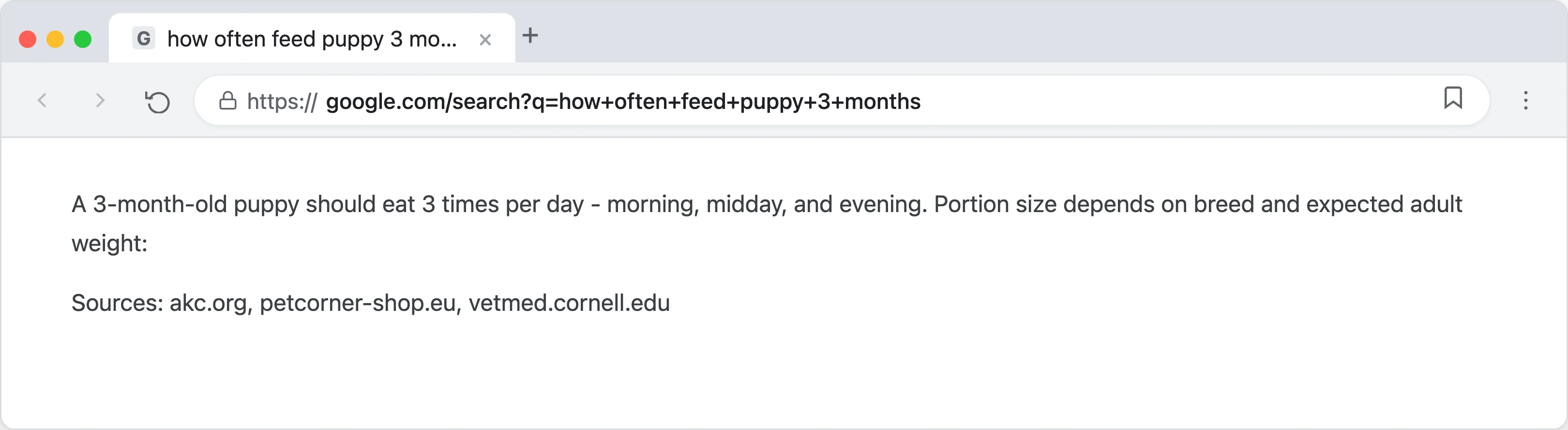
For pet stores, consider what happens when someone searches "how often should I feed my puppy." Previously, they would click on a pet store's blog post to find the answer. Now, Google's AI Overview synthesizes information from multiple veterinary and pet care sources, displays a complete feeding schedule directly on the results page, and the searcher never visits your website. Only 1% of AI Overviews lead to a click on a cited source[5].
However, there is an important counterpoint. Brands cited in AI Overviews earn 35% more organic clicks than those not cited[5]. Being the source Google references does not eliminate the click loss, but it significantly reduces it compared to brands that are not referenced at all.
Which Pet Store Searches Are Most Affected?
Not all searches are equally affected by the zero-click trend. Understanding which search types are most impacted - and which are partially protected - helps you allocate your SEO efforts effectively.
Most affected: informational queries. Questions like "what is the best diet for a senior cat," "how to groom a Poodle," or "symptoms of hip dysplasia in dogs" are prime targets for AI Overviews. These are the queries where Google can synthesize a complete answer from existing content. Informational queries make up the largest share of pet-related searches, and they are where zero-click rates are highest.
Moderately affected: comparison queries. Searches like "Royal Canin vs Hills Science Diet" or "raw food vs kibble for dogs" still generate clicks because users want to read detailed analysis and real experiences before forming an opinion. AI Overviews provide summaries, but comparison queries drive deeper engagement.
Least affected: local and transactional queries. "Pet store near me," "buy dog food online," and "pet grooming [city name]" still generate clicks because the user needs to visit a website or physical location to complete their goal. 46% of Google searches have local intent[6], and 76% of "near me" searches result in a same-day store visit[7]. Google cannot fulfill the intent of these searches without sending the user somewhere.
This means pet stores with physical locations have a built-in advantage. Your local search visibility - Google Business Profile, reviews, local content - remains valuable even as informational queries lose clicks. The challenge is that many pet stores have invested heavily in informational blog content that is now more vulnerable to zero-click erosion.
What Happened to Featured Snippets?
Featured snippets were once the most coveted SERP position. A featured snippet sits above the traditional #1 result and absorbs approximately 42.9% of total clicks when present[8]. For pet stores, earning a featured snippet for "how to choose the right dog food" or "best supplements for senior dogs" drove significant traffic.
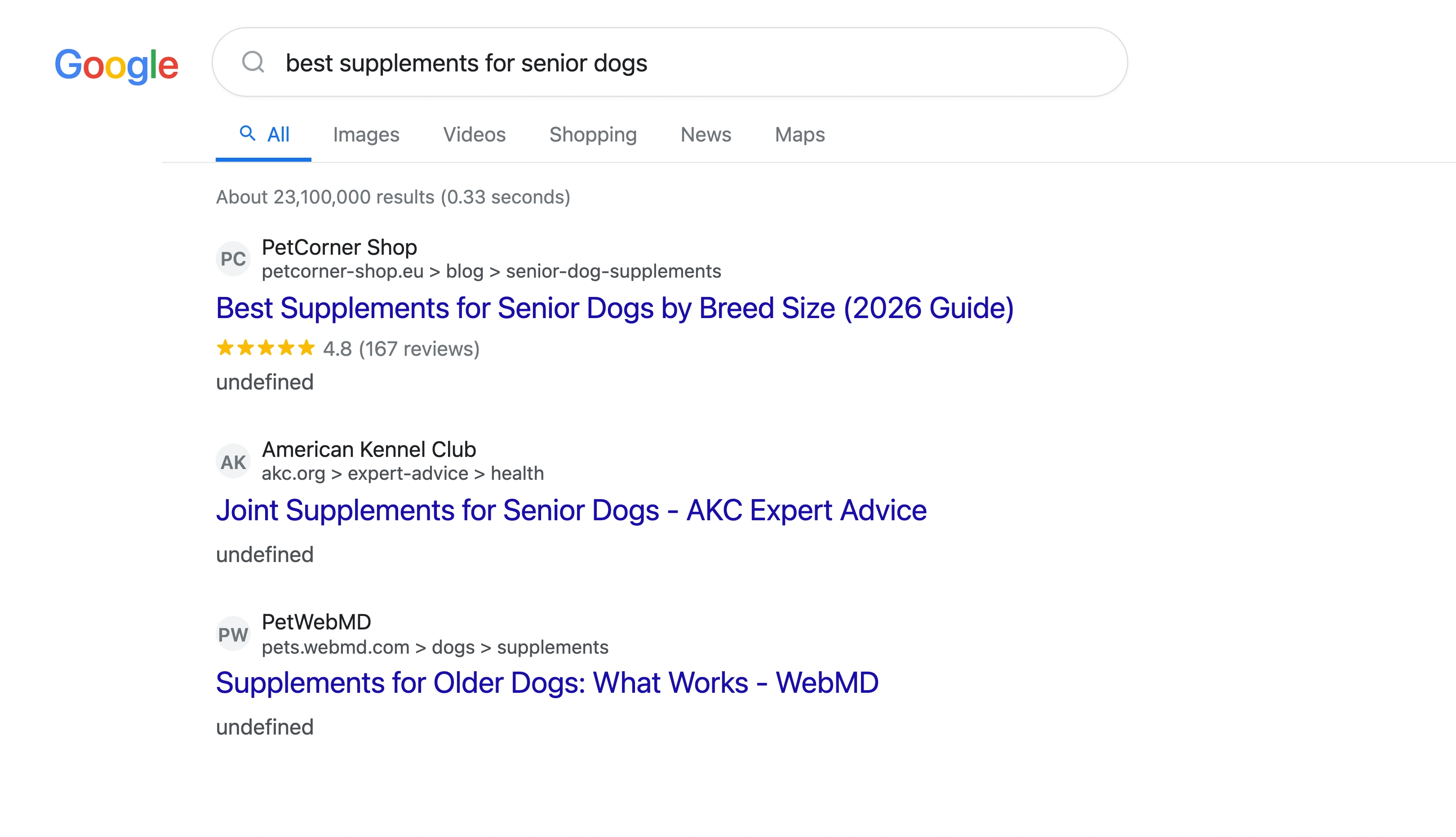
AI Overviews are displacing featured snippets. Ahrefs recorded a 64% drop in featured snippet visibility between January and June 2025[9]. When an AI Overview appears, it typically replaces or pushes down the featured snippet, absorbing the traffic that the snippet previously captured.
This does not mean featured snippets are irrelevant. On queries where AI Overviews do not appear - and there are still many - featured snippets remain the highest-traffic SERP position. The strategy should be to optimize for both: structure your content to earn featured snippets while also creating the depth and authority that gets you cited in AI Overviews.
In my experience working with pet stores across Europe, the businesses that perform best in the current search environment are those that do both. They produce comprehensive, well-structured content that earns featured snippets on standard queries, and they build enough topical authority that Google references them in AI Overviews on broader queries.
How Should Pet Stores Adapt Their SEO Strategy?
The zero-click trend does not make SEO irrelevant. It makes SEO different. Here are the specific adaptations pet stores should make:
1. Prioritize brand-building content over pure information. If Google can answer "how often to feed a puppy" without sending traffic to your site, then the value of ranking for that query has decreased. Instead, create content that builds brand awareness and preference. Content like "Our veterinary nutritionist explains why we formulated our puppy food differently" establishes your brand as an authority, even when displayed in a zero-click result.
2. Double down on transactional and commercial keywords. Keywords with purchase intent - "buy organic dog food online," "best pet supplement subscription" - still drive clicks because the user needs to visit your site to complete the purchase. For pet store SEO strategy and keyword prioritization, see our SEO strategy roadmap.
3. Optimize for AI Overview citations. Being cited in an AI Overview earns 35% more clicks[5]. To get cited, your content must be comprehensive, well-sourced, and clearly structured. Use clear question-and-answer formatting. Provide specific data points ("feed puppies 3 times daily until 6 months, then twice daily") rather than vague advice ("feed your puppy an appropriate amount").
4. Build topical authority through content clusters. AI Overviews pull from sources that demonstrate broad expertise on a topic. A single blog post about dog nutrition is less likely to be cited than a pet store with 20 interconnected articles covering breed-specific nutrition, life stage feeding, common allergies, ingredient analysis, and supplement guides. This cluster approach signals to Google that your site is a comprehensive authority on the topic.
5. Invest in local SEO. Local searches are the most resistant to zero-click erosion. Ensure your Google Business Profile is complete with current hours, photos, and regular posts. Encourage customer reviews - 90% of consumers say reviews helped them discover local businesses[6]. Create location-specific content ("Best Dog Parks Near [Your City]" or "Pet Emergency Vets in [Your Area]") that serves local searchers.
6. Measure brand metrics, not just traffic. Traditional SEO success metrics (organic traffic, clicks) will decline even with perfect execution because of the zero-click trend. Start tracking brand search volume (how many people search for your store name), impression share (how often you appear in results, even without clicks), and direct traffic (visitors who type your URL directly). These metrics better reflect your true search visibility in a zero-click world.
Or let Petbase handle the content strategy automatically. Petbase builds topical authority clusters designed for the zero-click era - content that is structured for featured snippet capture and comprehensive enough to be cited in AI Overviews.
How Do You Track Success in a Zero-Click World?
If clicks are declining industry-wide, how do you know if your SEO is working? The answer is to expand your measurement beyond clicks.
Traditional metrics that are losing reliability:
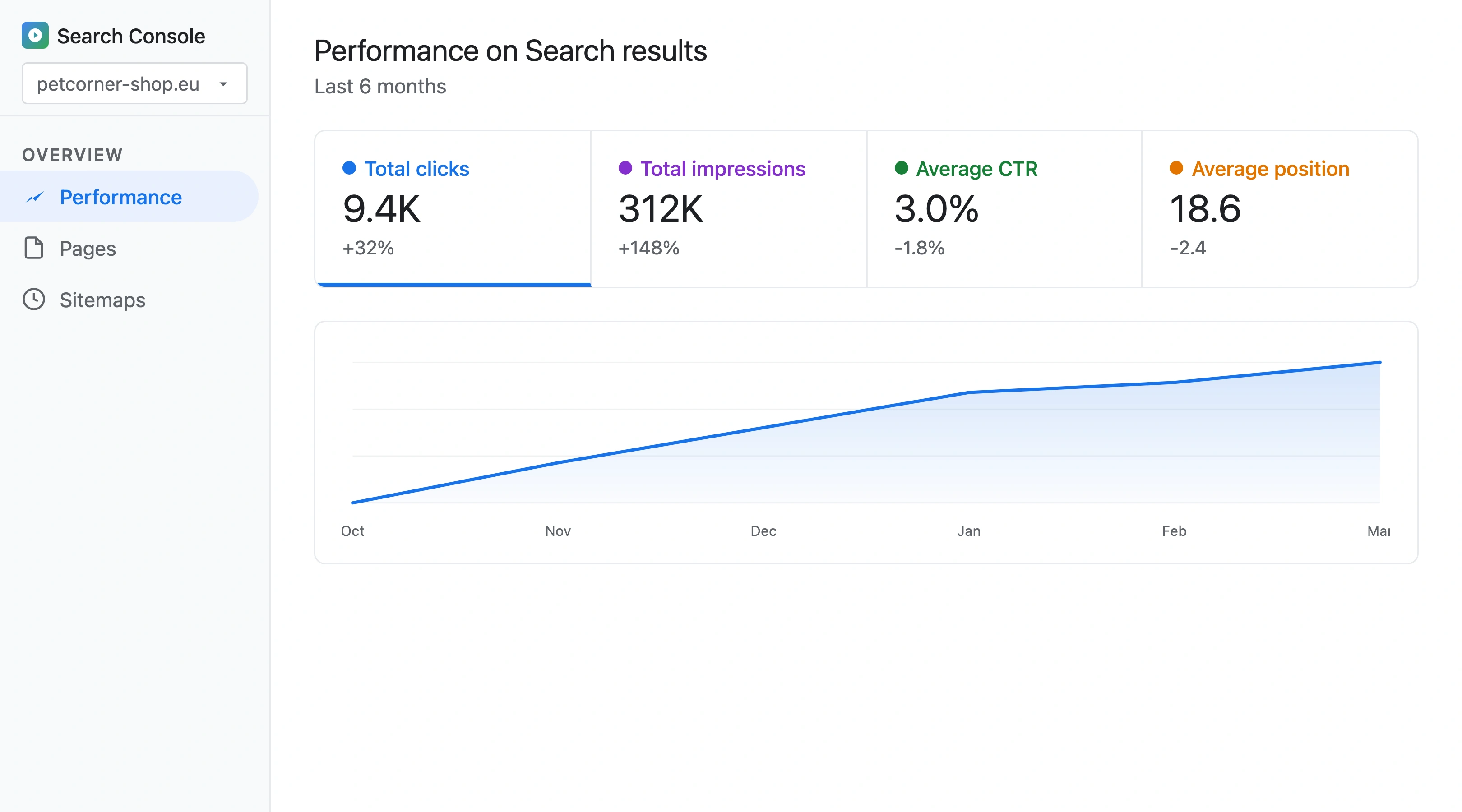
- Organic clicks: Will decline even if your rankings improve, because zero-click rates are rising across all queries
- Click-through rate: Drops when AI Overviews appear, regardless of your content quality
- Sessions from organic search: Will flatten or decline as zero-click searches increase
New metrics that matter more:
- Brand search volume: Are more people searching for your store name? This indicates that your content is building brand awareness, even when users do not click through. Use Google Search Console to track branded query impressions over time.
- Impression share: How often does your site appear in search results across your target keywords? Even without clicks, appearing consistently builds brand recognition.
- SERP feature ownership: How many featured snippets, People Also Ask appearances, and AI Overview citations does your site hold? Track these using tools like Semrush or Ahrefs.
- Direct traffic growth: Users who see your brand in search results repeatedly often return later by typing your URL directly. A growing direct traffic trend indicates successful brand-building through search.
- Conversion rate on remaining traffic: If total organic clicks decrease but conversion rate increases, your SEO is attracting more qualified visitors - a sign that you are ranking for the right queries.
For detailed guidance on tracking your pet store's rankings and measuring progress, read our guide to tracking Google rankings for pet stores.
What Does the Future of Pet Store SEO Look Like?
The zero-click trend is not a temporary fluctuation. It is the direction search is heading permanently. Analysts project that zero-click searches will reach 75% of all informational queries by late 2026[10]. Google is becoming an answer engine, not just a search engine.
For pet stores, this means three things:
First, your website becomes a conversion tool, not a discovery tool. In the past, blog content attracted new visitors who then explored your store. In the zero-click future, brand awareness happens on Google's results page. Your website's job shifts from "attract visitors" to "convert visitors who already know your brand." Product pages, conversion paths, and user experience become more important relative to blog traffic.
Second, content quality beats content quantity. Google's AI Overviews cite the most authoritative, comprehensive sources. Publishing 30 thin articles will not earn AI Overview citations. Publishing 10 deeply researched, expert-level articles will. Content marketing still generates $3 for every $1 invested[11], but only if the content is genuinely valuable.
Third, multi-channel presence becomes essential. If Google sends less traffic, you need other channels working. Email lists, social media, review platforms, and community presence all contribute to a brand that does not depend entirely on Google clicks. The pet stores that thrive in 2026 and beyond will be the ones with diversified customer acquisition - not single-channel dependence on organic search.
One pattern I have seen repeatedly with the pet stores I advise is this: the ones who started building topical authority early - 12 to 18 months ago - are now the sources Google cites in AI Overviews. They invested in comprehensive, expert content when clicks were still plentiful, and that investment is now paying dividends in brand visibility even as clicks decline. The stores that waited are finding it much harder to break into AI Overview citations without an established content foundation.
For a complete timeline of how Google rankings develop for pet stores, see our rankings timeline guide.
Frequently Asked Questions
Should pet stores stop investing in SEO because of zero-click search?
No. SEO remains the highest-ROI digital marketing channel, delivering an average 748% return on investment[12]. What changes is the type of SEO that works. Focus less on chasing informational traffic and more on building brand authority, earning AI Overview citations, and dominating local search results. The stores that stop investing in SEO will lose visibility entirely - not just clicks, but the brand impressions that drive future direct traffic and word-of-mouth.
Are local pet stores less affected by zero-click search than online-only stores?
Yes, significantly. Local searches ("pet store near me," "pet grooming [city]") are the most resistant to zero-click erosion because the user needs to visit a physical location. 76% of local searches result in a same-day store visit[7]. Local pet stores should invest heavily in their Google Business Profile, customer reviews, and local content to capitalize on this advantage.
How can a pet store get cited in Google AI Overviews?
AI Overviews pull from content that demonstrates comprehensive expertise on a topic. Publish detailed, well-structured content that directly answers common questions. Use specific data points, clear formatting (lists, tables, headers), and cite authoritative sources. Build topical authority by publishing clusters of interconnected content on your core topics (nutrition, breed care, health conditions). There is no shortcut - AI Overview citations reward the same content quality signals that have always driven SEO success, just at a higher threshold.
References
- SparkToro/Datos (2024). 2024 Zero-Click Search Study. sparktoro.com
- Semrush (2025). Zero-Click Searches Study. semrush.com
- Advanced Web Ranking (2026). AI Overviews Tracking Data. advancedwebranking.com
- Ahrefs (2025). AI Overviews Reduce Clicks by 58%. ahrefs.com
- Seer Interactive (2025). AIO Impact on Google CTR: September 2025 Update. seerinteractive.com
- BrightLocal (2025). Local Consumer Review Survey. brightlocal.com
- Google/Think with Google (2025). Consumer Trends. thinkwithgoogle.com
- First Page Sage (2025). Google Click-Through Rates by Ranking Position. firstpagesage.com
- Ahrefs (2025). Featured Snippets Study. ahrefs.com
- Click Vision (2026). Zero Click Search Statistics. click-vision.com
- Content Marketing Institute (2025). Content Marketing Statistics. contentmarketinginstitute.com
- First Page Sage (2026). E-Commerce SEO ROI Report. firstpagesage.com