How Pet Stores Appear in AI Search Results


Table of Contents +
- Why Are AI Search Results Changing Everything for Pet Stores?
- How Does Google AI Overviews Select Pet Store Content?
- How Does ChatGPT Find and Cite Pet Store Content?
- How Does Perplexity Evaluate Pet Content?
- What Signals Matter Most Across All AI Platforms?
- How Does AI Search Impact Click-Through Rates for Pet Stores?
- What Can a Pet Store Do Today to Appear in AI Search?
- How Will AI Search Continue to Evolve for Pet Queries?
- Frequently Asked Questions
- References
Pet stores appear in AI search results 36.8% of the time. Learn how Google AI Overviews, ChatGPT, and Perplexity select and cite pet store content in 2026.
TL;DR: AI search engines like Google AI Overviews, ChatGPT, and Perplexity now answer pet-related queries directly. Pets and Animals queries trigger AI Overviews 36.8% of the time - the third highest category. Pet stores that structure their content for AI citation earn more visibility. This guide explains how each platform selects sources and what your store can do about it.
Why Are AI Search Results Changing Everything for Pet Stores?
Search is splitting in two. Traditional search results show ten blue links. AI search results show a direct answer - often with no need to click. In 2025, 60% of Google searches ended without any click to a website[1]. That number is growing.
For pet stores, this shift matters more than for most industries. The Pets and Animals category triggers Google AI Overviews 36.8% of the time - the third highest rate of any category, behind only Science (43.6%) and Health (43.0%)[2]. When a pet owner searches "best food for a senior Labrador," Google increasingly shows an AI-generated answer at the top of the page instead of linking to your blog post.
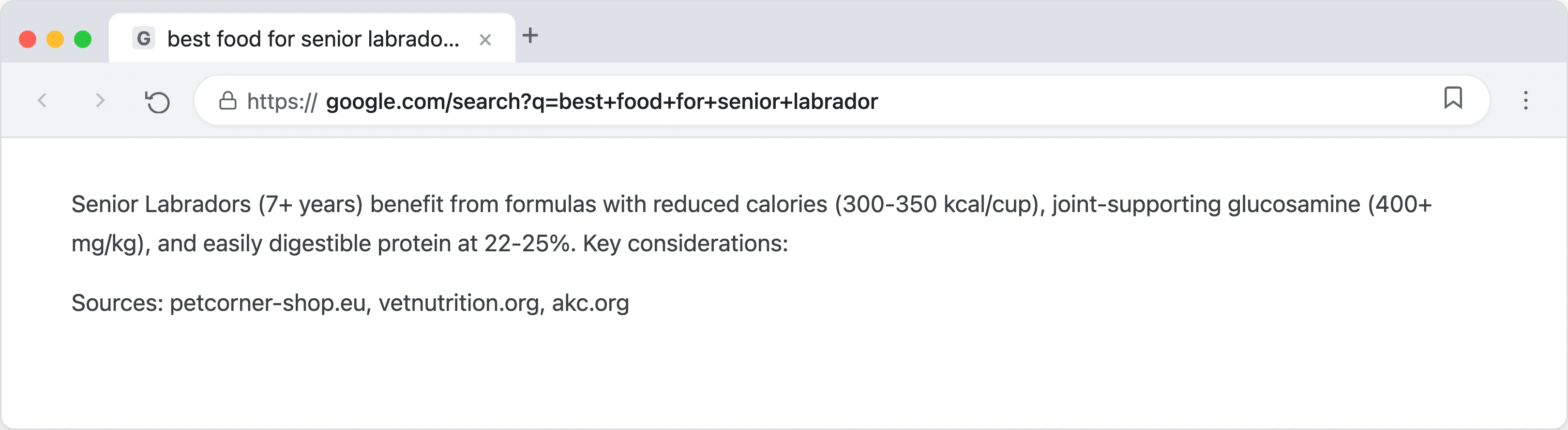
This is a problem if your content is not being cited. It is an opportunity if it is. Brands cited in AI Overviews earn 35% more organic clicks than those not cited[3]. The question for pet store owners is not whether AI search matters - it clearly does. The question is how to get your store's content into those AI answers.
Petbase automates SEO content for pet stores - publishing 10 optimized articles monthly so you can focus on running your shop - start your free trial.
How Does Google AI Overviews Select Pet Store Content?
Google AI Overviews (previously called Search Generative Experience, or SGE) synthesize answers from multiple web pages and display them at the top of search results. For pet-related queries, the system evaluates content based on several signals.
Topical depth. AI Overviews favor content that covers a topic comprehensively. A 300-word blog post about dog nutrition is unlikely to be cited. A 3,000-word guide covering specific breeds, life stages, ingredient analysis, and feeding schedules has a much higher chance. Over 70% of high-ranking pages belong to websites with strong internal linking and topic-based content architecture[4].
Content structure. Sites with clear H2, H3, and bullet point structures are 40% more likely to be cited in AI responses[5]. AI systems parse structured content more easily than dense paragraphs. For pet stores, this means organizing articles with descriptive headings, comparison tables, and scannable lists.
Freshness. Content updated within 30 days gets 3.2x more AI citations than older content[6]. Pet content has natural freshness hooks: seasonal care changes, new product releases, updated veterinary guidelines. Stores that update existing content regularly have a structural advantage.
E-E-A-T signals. Google AI Overviews inherit the same quality standards as regular search. Experience, Expertise, Authoritativeness, and Trustworthiness signals matter enormously for pet content, especially health-related topics. For a deeper explanation of how E-E-A-T applies to pet stores, see our guide on why E-E-A-T is crucial for pet businesses.
Schema markup. Proper Article and FAQ schema increases AI citations by 28%[6]. Schema helps AI systems understand what your page is about, who wrote it, and how the information is structured.
How Does ChatGPT Find and Cite Pet Store Content?
ChatGPT operates differently from Google AI Overviews. When users search with ChatGPT, the system draws from two sources: its pre-trained knowledge (everything it learned during training) and live web browsing (when the search feature is active).
For pet stores, this distinction matters. ChatGPT's pre-trained knowledge includes general pet information but not your specific product catalog, your latest blog posts, or your local store details. When ChatGPT searches the web in real time, it selects sources based on authority, relevance, and content quality - similar to Google but with different preferences.
Wikipedia is ChatGPT's most-cited source at 7.8% of total citations[5]. This tells you something important about what ChatGPT values: factual, well-structured, encyclopedic content with clear references. Pet stores that publish content with this level of depth and citation quality are more likely to be selected.
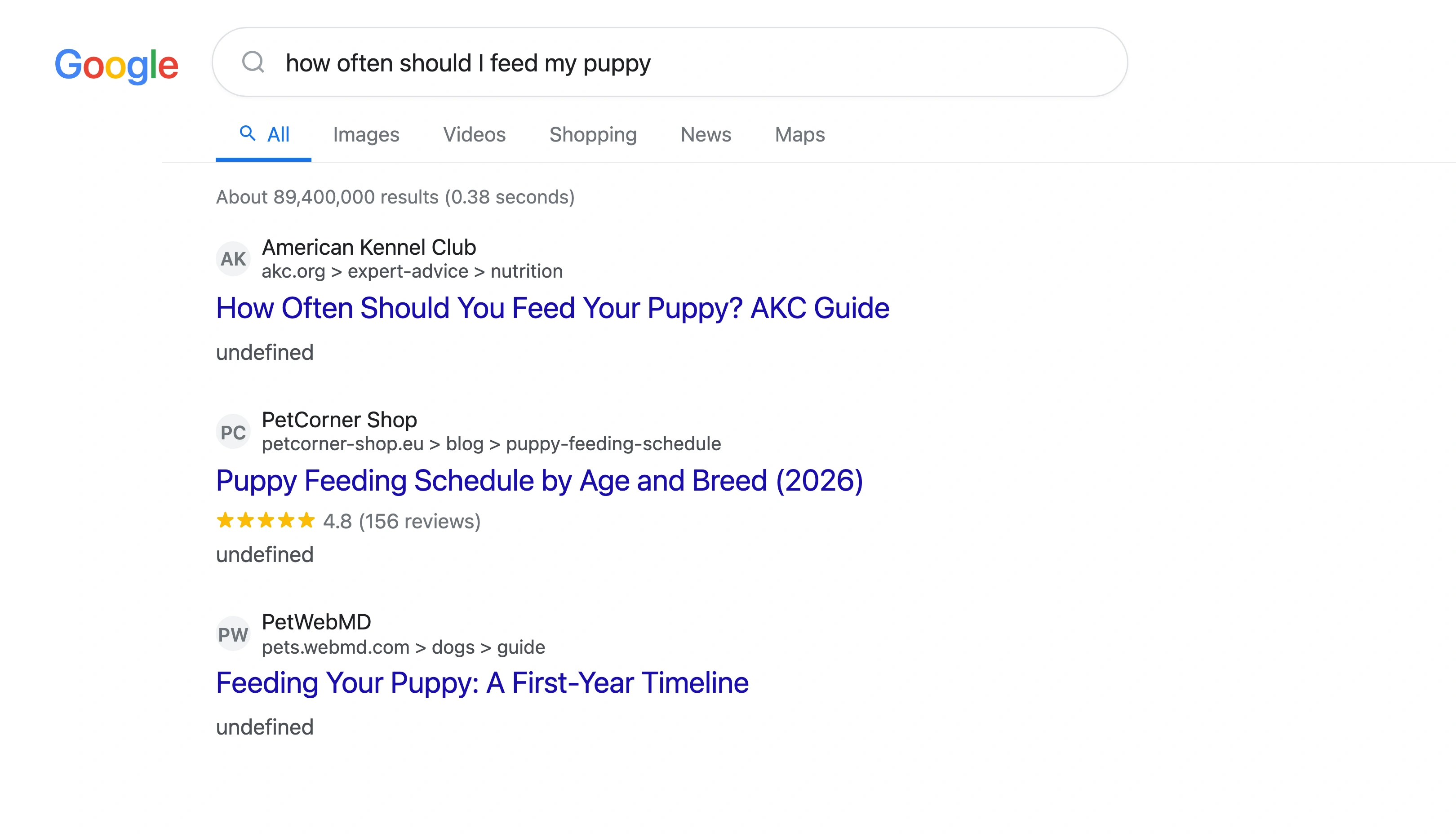
In my experience working with pet stores across Europe, the ones that get cited by ChatGPT share three characteristics: they publish comprehensive breed-specific guides (not generic "dog care" articles), they include original data or unique observations, and they update content regularly. A German aquarium store I worked with started appearing in ChatGPT results within four months of publishing a 40-article topic cluster on freshwater fish species. The content was structured, specific, and updated monthly.
How Does Perplexity Evaluate Pet Content?
Perplexity is a conversational search engine that always cites its sources. Unlike ChatGPT, Perplexity performs live web retrieval for every query - it does not rely on pre-trained knowledge for factual answers. This makes it particularly interesting for pet stores because fresh content has a direct advantage.
Perplexity's citation patterns differ from both Google and ChatGPT. Reddit is Perplexity's leading source at 6.6% of citations[5]. This reflects Perplexity's preference for authentic, experience-based content. Pet store owners who share genuine expertise - real-world product comparisons, breed-specific care observations, customer feedback patterns - align with the type of content Perplexity favors.
Perplexity cites nearly 2x more real-time sources than ChatGPT[5]. This means recently published content has a better chance of appearing in Perplexity results than in ChatGPT results. For pet stores, the implication is clear: a consistent publishing schedule (10 articles per month, published throughout the month) gives you more chances to be cited than publishing everything at once.
Pages with original data get 4.1x more AI citations across all platforms[6]. For a pet store, "original data" does not mean conducting academic research. It means sharing specific information only you have: customer purchasing patterns, product performance observations, breed popularity trends in your region, seasonal demand shifts. This type of proprietary data is exactly what AI systems look for because it cannot be found anywhere else.
What Signals Matter Most Across All AI Platforms?
Despite their differences, Google AI Overviews, ChatGPT, and Perplexity share several common preferences. Optimizing for these shared signals gives your pet store the broadest AI visibility.
| Signal | Google AI Overviews | ChatGPT | Perplexity | Action for Pet Stores |
|---|---|---|---|---|
| Topical depth | High priority | High priority | High priority | Build topic clusters with 10+ posts per niche |
| Content structure | H2/H3/lists increase citation 40% | Prefers encyclopedic format | Parses structured content well | Use clear headings, tables, and bullet points |
| Freshness | 3.2x more citations for content under 30 days old | Moderate preference | Strong preference (live retrieval) | Update existing posts monthly, publish new content weekly |
| Original data | Moderate preference | Strong preference | 4.1x more citations | Include unique product data, regional trends, customer insights |
| Schema markup | 28% more citations | Indirect benefit (helps indexing) | Indirect benefit | Add Article, FAQ, and Product schema to all pages |
| E-E-A-T signals | Critical for pet/health content | Values authoritative sources | Prefers expert content | Author bios, citations, veterinary disclaimers |
| Internal linking | Strong ranking signal | Helps topic association | Follows link structures | Link related articles within topic clusters |
How Does AI Search Impact Click-Through Rates for Pet Stores?
The impact of AI search on organic traffic is significant and well-documented. When an AI Overview appears for a query, the top-ranking organic result sees a 58% drop in click-through rate[7]. Some studies report drops as high as 61% for organic CTR and 68% for paid CTR[3].
For pet stores, the 36.8% AI Overview trigger rate means roughly one in three pet-related searches now shows an AI answer before any organic results[2]. This does not mean those clicks disappear entirely. It means they redistribute. The sites that get cited in the AI Overview capture a disproportionate share of remaining clicks - 35% more than non-cited sites[3].
AI referral traffic to websites surged 527% in 2025[6]. This new traffic source is growing fast, even as traditional organic click-through rates decline. Pet stores that position their content for AI citation are tapping into this new traffic channel while competitors focus exclusively on traditional rankings.
The practical takeaway: traditional SEO and AI visibility are not separate strategies. The same content qualities that earn AI citations - topical depth, clear structure, original data, E-E-A-T signals - also improve traditional rankings. Optimizing for one improves the other.
What Can a Pet Store Do Today to Appear in AI Search?
Here are seven concrete steps a pet store can take to improve AI search visibility, ordered from highest to lowest impact.
Step 1: Build topic clusters, not random blog posts. Choose 3-5 core topics for your store (for example: dog nutrition, cat health, aquarium care, grooming, seasonal pet care). Create 10 or more interconnected articles per topic. Content grouped into clusters drives 30% more organic traffic and holds rankings 2.5x longer than standalone pieces[8]. For a practical guide on planning this structure, see our article on content clustering for pet websites.
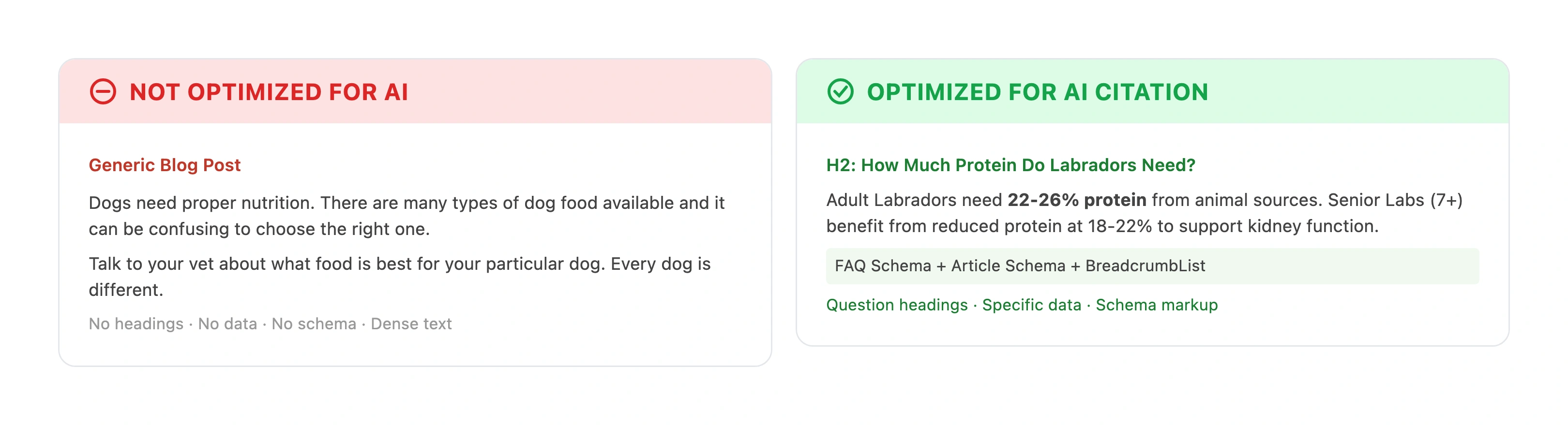
Step 2: Structure every article for AI parsing. Use descriptive H2 and H3 headings that match common questions ("What is the best food for a senior Labrador?" not "Food Options"). Include comparison tables, numbered lists, and bullet points. Put the direct answer to the search query in the first 100 words of the article. Opening paragraphs that directly answer queries get cited 67% more often[6].
Step 3: Add schema markup to every page. Article schema, FAQ schema, Product schema, and HowTo schema all help AI systems understand your content. Schema markup increases AI citations by 28%[6]. Most CMS platforms support schema plugins that make this straightforward.
Step 4: Include original data in your content. Share what you know that nobody else does. Which breeds are most popular in your region? What products do customers ask about most? What seasonal patterns do you observe in your store? This proprietary information earns 4.1x more AI citations[6] because AI systems cannot find it anywhere else.
Step 5: Update existing content regularly. Set a monthly schedule to review and update your top-performing articles. Add new product information, update statistics, and refresh seasonal recommendations. Fresh content gets 3.2x more AI citations[6].
Step 6: Strengthen E-E-A-T signals. Add author bios with real credentials to every article. Include proper citations for health claims. Add veterinary consultation disclaimers where appropriate. Link to authoritative sources. These trust signals help AI systems identify your content as reliable.
Step 7: Publish consistently. AI platforms favor active sites. A pet store publishing 10 articles per month, spread across the month, appears in AI crawl indexes more frequently than one publishing sporadically. Consistency builds both traditional and AI visibility simultaneously.
Or let Petbase handle this automatically. The platform builds topic clusters, structures content for AI parsing, and publishes on a consistent schedule - all optimized for pet industry visibility.
How Will AI Search Continue to Evolve for Pet Queries?
AI search is not static. Here are three trends pet store owners should watch.
More transactional AI answers. At the start of 2025, transactional queries accounted for only 2% of AI Overview triggers. By late 2025, that number rose to 14%[2]. This means AI Overviews are increasingly appearing for product searches, not just informational queries. Pet stores with well-structured product pages will benefit.
Multi-platform visibility. Google is no longer the only search engine that matters. ChatGPT, Perplexity, Claude, and Gemini all serve search functions. AI traffic surged 527% in 2025[6], and this growth will continue. Pet stores that optimize for AI citation patterns (not just Google rankings) will capture traffic from multiple platforms.
Higher quality thresholds. As AI systems improve, they become better at distinguishing genuinely helpful content from thin, keyword-stuffed pages. The bar for being cited will rise. Pet stores investing in deep, accurate, well-structured content now are building a moat that shallow content producers cannot cross.
One pattern I have seen repeatedly: pet store owners who wait for AI search to "settle down" before acting lose months of indexing and authority building. The stores that start now - even imperfectly - are the ones that will be cited when AI search fully matures.
Frequently Asked Questions
Does my pet store need to optimize for AI search separately from regular SEO?
No. The signals that earn AI citations overlap heavily with traditional SEO best practices: topical depth, content structure, freshness, E-E-A-T signals, and schema markup. Optimizing for AI search improves your traditional rankings at the same time. The main addition is thinking about content structure specifically for AI parsing - using clear headings that match questions, providing direct answers early in the article, and including comparison tables that AI can reference. For a comprehensive SEO foundation, start with our pet store SEO guide.
How long does it take for a pet store to appear in AI search results?
It depends on your current authority and content depth. A pet store with an established domain and existing content can start appearing in AI Overviews within 2-3 months of publishing well-structured topic clusters. A new site typically needs 4-6 months of consistent publishing to build enough topical authority. Perplexity tends to pick up fresh content fastest due to its live retrieval system. Google AI Overviews take longer because they factor in overall domain authority.
Will AI search completely replace traditional search results for pet queries?
Not completely, but the balance is shifting. With 36.8% of pet queries already triggering AI Overviews and transactional AI answers growing rapidly, AI will handle an increasing share of pet-related searches. Traditional organic results will still exist, but they will appear below AI answers for many queries. The pet stores that thrive will be the ones cited in both AI answers and traditional results - which, given the overlapping optimization signals, is a single strategy rather than two separate ones.
References
- The Digital Bloom (2025). 2025 Organic Traffic Crisis: Zero-Click and AI Impact Report. thedigitalbloom.com
- Semrush (2025). AI Overviews Study: What 2025 SEO Data Tells Us About Google's Search Shift. semrush.com
- Seer Interactive (2025). AIO Impact on Google CTR: September 2025 Update. seerinteractive.com
- Velir (2025). How Topical Authority Is Driving Smarter SEO Strategies in 2025. velir.com
- Profound (2025). AI Platform Citation Patterns: How ChatGPT, Google AI Overviews, and Perplexity Source Information. tryprofound.com
- Superprompt (2025). AI Traffic Surges 527%: How to Get Your Site Cited by ChatGPT, Claude, and Perplexity. superprompt.com
- Ahrefs (2025). Update: AI Overviews Reduce Clicks by 58%. ahrefs.com
- Path Digital Services (2025). Content Clusters: The Secret to Topical Authority. pathdigitalservices.com