AI SEO Tools for Pet Stores: A Comparison Guide for 2026


Table of Contents +
- Why Do Pet Stores Need Specialized AI SEO Tools?
- What Should a Pet Store Look for in an AI SEO Tool?
- How Do the Major AI Tools Compare for Pet Store Content?
- What Does the Pricing Really Mean for a Pet Store?
- How Does E-E-A-T Compliance Differ Between Tools?
- What About Combining Multiple Tools?
- How Do You Evaluate Output Quality From Any AI Tool?
- What Results Can a Pet Store Expect From AI SEO?
- What About Using an SEO Agency Instead?
- How Do You Make the Final Decision?
- Frequently Asked Questions
- References
Compare AI SEO tools for pet stores: ChatGPT, Jasper, Surfer SEO, and Petbase. Honest pricing, output quality, and E-E-A-T compliance comparison for 2026.
TL;DR: Most AI SEO tools are built for general marketing teams, not pet stores. This guide compares ChatGPT, Jasper, Surfer SEO, and Petbase on price, output quality, pet industry accuracy, and E-E-A-T compliance. The right choice depends on whether you need a general writing assistant or a purpose-built SEO engine for your pet store.
Why Do Pet Stores Need Specialized AI SEO Tools?
The AI content marketing industry has grown to a $57.99 billion market in 2026[1]. Within this market, 85% of marketers now use AI for content creation[2]. Pet stores are no exception. The global pet care e-commerce market reached $94.89 billion in 2024 and is projected to hit $147.59 billion by 2030[3]. Competition for online visibility in this space is fierce.
But here is the problem. Most AI tools on the market are designed for general marketing. They write about any topic, target any keyword, and produce content that sounds polished but lacks the depth that Google demands for pet-related queries. A generic AI tool does not know the difference between grain-free and limited-ingredient dog food. It does not understand that recommending essential oils around cats can be dangerous. And it certainly does not build the topical authority structure that Google rewards in 2026.
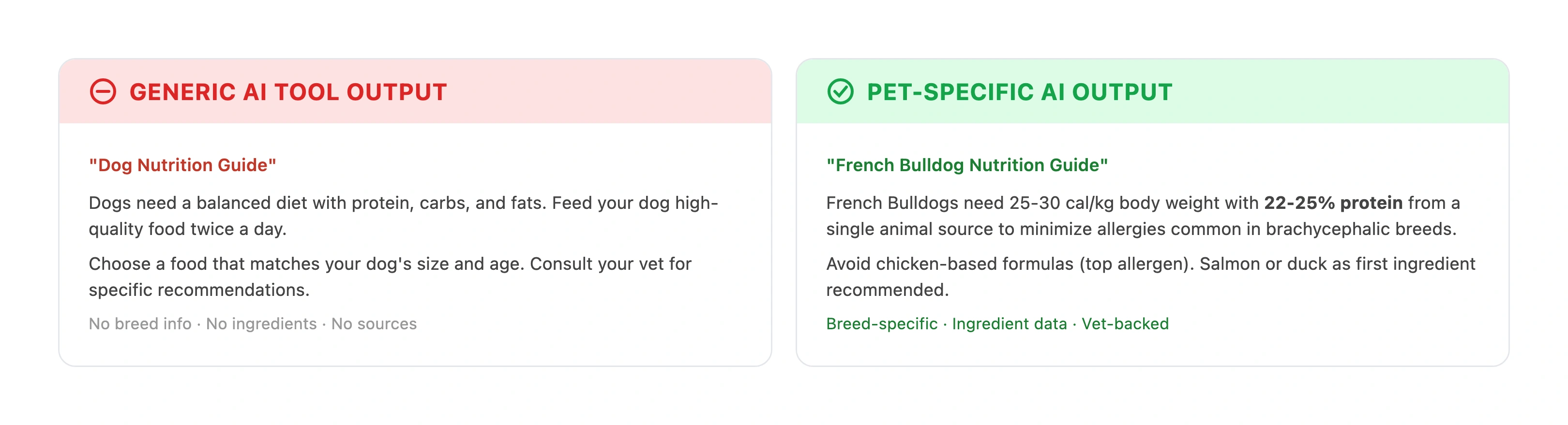
In my experience working with pet stores across Europe, the ones that struggle most with content marketing are not the ones who write too little. They are the ones using generic tools that produce high volumes of shallow content that never ranks. The math is simple: 10 strategically planned articles outperform 50 random ones every time.
Petbase automates SEO content for pet stores - publishing 10 optimized articles monthly so you can focus on running your shop - start your free trial.
What Should a Pet Store Look for in an AI SEO Tool?
Before comparing specific tools, you need a clear framework for evaluation. The AI-based SEO tools market is valued at $19.35 billion in 2025 and is projected to reach $38.61 billion by 2030[4]. That growth means more options every month. Not all of them are worth your money.
Here are the seven criteria that matter most for pet stores:
- Pet industry knowledge. Does the tool understand breeds, health conditions, nutrition, and seasonal care? Generic tools hallucinate product names and mix up breed-specific advice.
- E-E-A-T compliance. Google evaluates pet health content under strict quality guidelines. Experience, Expertise, Authoritativeness, and Trustworthiness (E-E-A-T) signals are not optional in this niche.
- Topical authority building. Websites using structured content clusters generate up to 55% more organic traffic[5]. Does the tool plan topic clusters or just write isolated articles?
- Keyword research. Does it identify pet-specific search opportunities, or does it rely on you to provide keywords?
- Content quality. Long-form content of 3,000 or more words generates 3x more traffic and 4x more shares than shorter posts[6]. Does the tool produce comprehensive content or thin 500-word posts?
- Publishing workflow. Does it connect to your Content Management System (CMS) and publish automatically, or does it just generate text you need to copy and paste?
- Pricing versus value. Content marketing returns $7.65 for every $1 spent[7]. But only if the content ranks. A cheap tool that produces content nobody reads is not a bargain.
How Do the Major AI Tools Compare for Pet Store Content?
Let us break down the four most common options pet store owners consider: ChatGPT, Jasper, Surfer SEO, and Petbase. Each serves a different purpose and sits at a different point on the price-to-value spectrum.
ChatGPT (OpenAI)
ChatGPT is a general-purpose language model. It generates text on any topic based on your prompts. For pet stores, this means you are the expert. You provide the topic, the keyword, the structure, and the fact-checking. ChatGPT writes words - you supply everything else.
Strengths: Low cost (free tier available, Plus at $20/month). Flexible for brainstorming, drafting, and research. Can handle many content formats.
Weaknesses for pet stores: No built-in pet industry knowledge. No SEO optimization. No content planning. No topical authority building. No CMS integration. You need to verify every health claim, breed detail, and product mention manually. Companies publishing 11 or more blog posts per month gain 4x more leads[8], but producing that volume with ChatGPT requires significant manual effort.
Jasper AI
Jasper is an AI writing platform designed for marketing teams. It offers templates for blog posts, social media, email, and ad copy. The Creator plan starts at $49 per month, and the Pro plan at $69 per month[9].
Strengths: Better writing templates than raw ChatGPT. Brand voice customization. Team collaboration features on higher plans.
Weaknesses for pet stores: No pet industry specialization. The brand voice feature helps maintain tone but does not add pet expertise. No keyword research. No topical authority planning. No auto-publishing. You still need to provide all pet-specific knowledge and SEO strategy yourself.
Surfer SEO
Surfer SEO is a content optimization tool, not a content generator. It analyzes what is ranking for your target keyword and provides recommendations for word count, headings, keyword density, and related terms. The Essential plan starts at $89 per month, and the Scale plan at $129 per month[10].
Strengths: Strong on-page SEO analysis. Data-driven content optimization. Shows what competitors are doing for any keyword.
Weaknesses for pet stores: Does not write content - only optimizes it. You still need a writer (human or AI). No pet industry knowledge. No content calendar or topical authority planning. No publishing workflow. You can pair it with ChatGPT or Jasper, but that means managing and paying for multiple tools.
Petbase
Petbase is an AI SEO platform built exclusively for pet stores. It combines content generation, keyword research, topical authority building, and auto-publishing in a single platform at USD 199 per month for 10 articles[11].
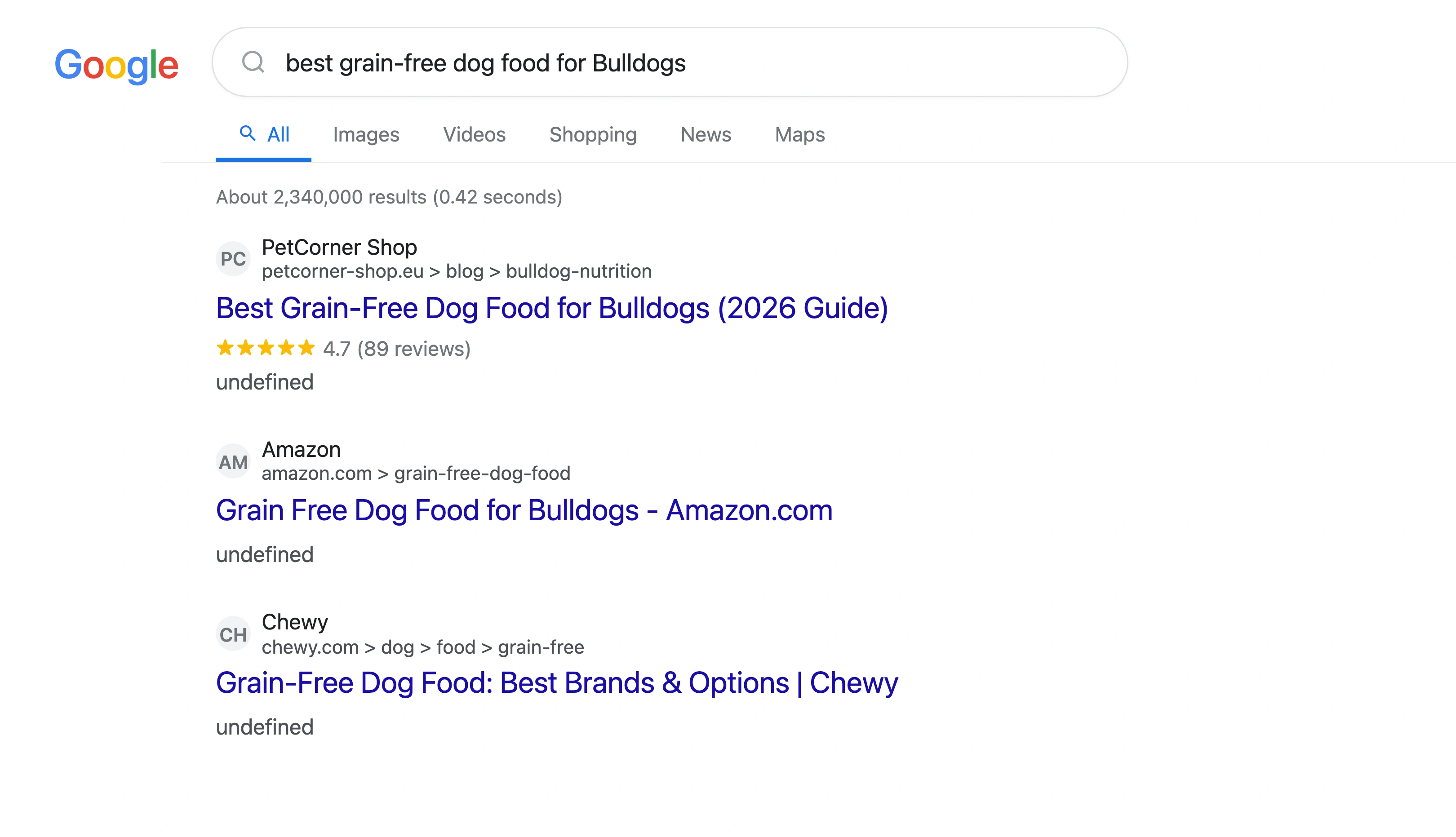
Strengths: Built-in pet industry knowledge model covering breeds, health, nutrition, and seasonal care. Automatic keyword research and content planning. Topical authority builder that creates interconnected content clusters. Auto-publishing to your CMS. E-E-A-T compliance built into the content generation process.
Weaknesses: Limited to 10 articles per month on the standard plan. Only serves pet stores - not useful if you also need content for non-pet topics. Higher monthly cost than individual generic tools.
What Does the Pricing Really Mean for a Pet Store?
Raw pricing tells only part of the story. The real question is: what does each euro you spend produce in terms of published, ranking content? Here is the full cost picture when you include the hidden costs of time, expertise, and additional tools.
| Factor | ChatGPT | Jasper | Surfer SEO | Petbase |
|---|---|---|---|---|
| Monthly tool cost | $20 | $49-$69 | $89-$129 | USD 199 |
| Articles per month | Unlimited (you write) | Unlimited (you write) | 0 (optimization only) | 10 (done for you) |
| Keyword research included | No | No | Partial | Yes |
| Pet industry knowledge | None | None | None | Built-in |
| Content calendar | No | No | No | Yes |
| Topical authority planning | No | No | No | Yes |
| Auto-publishing | No | No | No | Yes |
| Time per article (your hours) | 3-4 hours | 2-3 hours | 3-4 hours (writing + optimization) | 15-30 minutes (review only) |
| Effective monthly time cost | 30-40 hours | 20-30 hours | 30-40 hours | 2.5-5 hours |
| Additional tools needed | Keyword tool + SEO tool | Keyword tool + SEO tool | AI writer | None |
When you factor in the time cost, the comparison shifts dramatically. An average blog post takes 3 hours and 55 minutes to write[12]. If you value your time at USD 50 per hour (a modest estimate for a business owner), producing 10 articles with ChatGPT costs roughly USD 1,975 per month in time alone - plus the $20 tool cost. The same 10 articles with Petbase cost USD 199 plus 2.5 to 5 hours of review time (USD 125-250).
One pattern I have seen repeatedly across pet stores in Germany, Austria, and the Netherlands: owners start with ChatGPT because it is cheap, spend weeks producing content, then realize none of it ranks because it lacks topical structure and pet-specific depth. The tool savings get eaten by the time investment and the opportunity cost of content that does not perform.
How Does E-E-A-T Compliance Differ Between Tools?
E-E-A-T is not a ranking factor you can ignore in the pet industry. Google evaluates pet health content under stricter quality guidelines because incorrect advice can harm animals. Here is how each tool handles E-E-A-T requirements.
Experience signals. Google wants to see that content comes from real experience with the topic. Generic tools produce text with no experiential markers. Petbase incorporates operational knowledge from pet store workflows, customer interaction patterns, and real-world product usage. For a deeper understanding of why this matters, see our guide on E-E-A-T in the pet business.
Expertise signals. Pet content requires accurate breed information, correct nutritional data, proper health guidance, and evidence-based claims. Generic AI tools mix accurate veterinary information with outdated forum posts. A tool built for pet stores draws from verified pet industry data, reducing the risk of health misinformation.
Authority signals. Authority comes from comprehensive topic coverage with strong internal linking. Individual tools do not plan content architectures. Petbase builds topic clusters that signal authority to Google - a strategy that delivers up to 55% more organic traffic[5].
Trust signals. Trustworthiness means citing sources, acknowledging limits ("consult your veterinarian"), and never making unsupported health claims. Generic AI outputs lack citations entirely. Petbase generates content with source references and appropriate health disclaimers built in.
What About Combining Multiple Tools?
Some pet store owners consider combining tools: ChatGPT for writing, Surfer SEO for optimization, and a keyword tool like Semrush or Ahrefs for research. This approach can work, but it has significant trade-offs.
The cost adds up quickly. ChatGPT Plus ($20) + Surfer SEO Essential ($89) + Semrush ($139.95) = $248.95 per month. That is more than Petbase, and you still do all the work yourself.
No tool talks to the other. You export keywords from Semrush, paste them into Surfer, write in ChatGPT, check the optimization score, revise, and then manually publish. Each handoff introduces friction and errors.
No pet industry knowledge anywhere in the stack. None of these tools understand pet content specifically. You remain the sole source of pet expertise, which means every article depends entirely on your knowledge and available time.
No topical authority planning. Individual tools optimize individual articles. Nobody plans the overall content architecture that builds authority across your pet niche. 68% of businesses report improved ROI after integrating AI into content workflows[13], but integration means the tools work together, not in isolated silos.
The multi-tool approach works best for pet store owners who already have SEO expertise and want fine-grained control over every step. For most pet store owners, a single platform that handles the entire workflow is more practical and often more cost-effective.
How Do You Evaluate Output Quality From Any AI Tool?
Regardless of which tool you choose, you need a quality checklist. Not all AI output is equal, and publishing low-quality content damages your site's authority. Here is what to check before publishing any AI-generated article for your pet store.
Accuracy audit (5 minutes):
- Are breed names spelled correctly and breed-specific details accurate?
- Are health claims medically sound? Would a veterinarian agree?
- Are product names, ingredients, and dosing information real and correct?
- Are statistics cited with source, date, and context?
SEO audit (3 minutes):
- Does the article target a specific primary keyword?
- Are H2 and H3 headings descriptive and keyword-relevant?
- Does the content include internal links to related pages on your site?
- Is the meta description unique and under 160 characters?
E-E-A-T audit (3 minutes):
- Does the content demonstrate real experience with the topic?
- Is the expertise level appropriate for the target audience?
- Are there proper citations and source references?
- Does it include veterinary consultation disclaimers where relevant?
Pet-specific audit (3 minutes):
- Is breed information specific, not generic "for all dogs" advice?
- Are seasonal and regional details accurate for your market?
- Does the content address the actual question a pet owner would ask?
- Would you confidently share this with a customer in your store?
This 14-minute review process catches the most common AI content failures before they reach your blog. The difference between a pet store that ranks and one that does not often comes down to this review step.
What Results Can a Pet Store Expect From AI SEO?
Setting realistic expectations matters. AI SEO tools accelerate content production, but they do not produce instant rankings. Here is a realistic timeline based on what I have observed across dozens of pet store clients.
Month 1-2: Content foundation. The tool produces your first 10-20 articles covering core pet topics. Google indexes the pages but rankings are minimal. This is normal.
Month 3-4: Early signals. Google begins recognizing your topical coverage. Some long-tail keywords start ranking on page 2-3. Organic traffic shows first increases. Content clusters start linking to each other internally.
Month 5-8: Momentum builds. Topical authority accumulates. More articles reach page 1 for specific queries. Traffic grows consistently month over month. Internal linking strengthens the entire site.
Month 9-12: Compound growth. Your site ranks for hundreds of pet-related keywords. Organic traffic has typically tripled compared to month 1. The content library works as a system, not just individual articles.
This timeline assumes consistent publishing of 10 quality articles per month with proper topical planning. For a more detailed look at ranking timelines, see our guide on pet store SEO fundamentals. Skipping months or publishing low-quality content resets the clock.
What About Using an SEO Agency Instead?
SEO agencies are the traditional alternative to AI tools. They offer human expertise, strategy, and execution. But the cost and output differences are substantial.
A typical SEO agency charges USD 5,000 or more per month for pet store clients. For that investment, you typically get 4 to 10 articles per month, keyword research, technical SEO audits, and link building. The content quality is usually high, but the volume is limited by human production capacity.
Petbase delivers 10 articles per month for USD 199. The articles are optimized for pet-specific keywords, structured into topic clusters, and published automatically. You do not get the broader strategic consulting an agency provides, but for content production specifically, the value comparison is clear. For a full breakdown of when an agency makes sense versus an AI tool, see our detailed comparison of SEO agencies versus AI tools for pet stores.
The hybrid approach also works well: use Petbase for consistent content production and an SEO consultant for quarterly strategy reviews, technical audits, and link building. This gives you the volume of AI with the strategic guidance of a human expert at a combined cost still well below a full-service agency.
How Do You Make the Final Decision?
The right tool depends on your situation. Here is a simple decision framework:
Choose ChatGPT if: You have strong SEO knowledge, deep pet industry expertise, and 30-40 hours per month available for content production. You want full control and low tool cost. You are comfortable with slower output and manual optimization.
Choose Jasper if: You have a marketing team that needs writing assistance across multiple channels (not just blog content). You already have SEO tools and pet expertise in-house. You need brand voice consistency across team members.
Choose Surfer SEO if: You already write content (or have a writer) and need optimization guidance. You want data-driven recommendations for keyword usage, content length, and structure. You pair it with another writing tool.
Choose Petbase if: You want done-for-you pet store content that ranks. You do not have 30-40 hours per month for content production. You need pet industry accuracy without being a pet content expert yourself. You want topical authority building and auto-publishing included.
Or let Petbase handle this automatically. Start with a 7-day trial and compare the output quality to whatever you are producing now. The difference in pet-specific depth and SEO optimization is visible in the first article.
Frequently Asked Questions
Can I use ChatGPT for pet store SEO and get the same results as Petbase?
Technically, ChatGPT can generate text about any pet topic. But the output lacks pet industry specialization, SEO optimization, topical authority planning, and content calendar management. You would need to add all of that yourself. If you have deep SEO knowledge and 30-40 hours per month, ChatGPT can work. For most pet store owners, the time investment makes it impractical. The content also requires extensive fact-checking because generic AI models regularly produce inaccurate pet health information.
Is USD 199 per month worth it for a small pet store?
Consider the alternative costs. A single freelance article costs USD 200-500. An SEO agency charges USD 5,000 or more per month. Your own time at 30-40 hours per month has a real cost, even if you do not pay yourself hourly. Petbase delivers 10 optimized, pet-specific articles per month for USD 199 - effectively USD 19.90 per article. Content marketing returns $7.65 for every $1 spent[7]. If even two of those articles bring in regular organic traffic, the investment pays for itself within months.
Do I still need to review and edit AI-generated content?
Yes. No AI tool should publish without human review, regardless of how specialized it is. The review process for Petbase takes 15-30 minutes per article rather than the 3-4 hours needed with generic tools. You check for accuracy, add personal observations from your store, and approve for publishing. This human review step is what keeps your content quality high and your E-E-A-T signals strong. For more on how AI content fits into your overall strategy, see our guide on AI content for pet businesses.
References
- Typeface (2026). 50+ Content Marketing Statistics to Watch. typeface.ai
- Arvow (2026). AI Content Marketing Statistics: 50+ Data Points on Adoption, ROI, and Trends. arvow.com
- Grand View Research (2024). Pet Care E-commerce Market Size and Share Report. grandviewresearch.com
- Research and Markets (2025). AI-Based SEO Tools Market Global Forecast 2025-2030. researchandmarkets.com
- Path Digital Services (2025). Content Clusters: The Secret to Topical Authority. pathdigitalservices.com
- Ranktracker (2025). Content Marketing ROI Statistics: What Actually Works. ranktracker.com
- Genesys Growth (2024). Content Marketing ROI Stats for Marketing Leaders. genesysgrowth.com
- HubSpot (2024). Marketing Statistics. hubspot.com
- Jasper (2026). Jasper AI Pricing. jasper.ai
- Surfer SEO (2026). Surfer SEO Pricing. surferseo.com
- Petbase (2026). Petbase Pricing. petbase.ai
- Orbit Media (2024). Blogging Statistics. orbitmedia.com
- Loopex Digital (2026). AI Marketing Statistics: The Complete Performance Report. loopexdigital.com