Shopify SEO for Pet Stores: Complete Guide


Table of Contents +
- Why Does Shopify SEO Matter for Pet Stores?
- What Are Shopify's SEO Limitations?
- How Do You Structure Collections for Pet SEO?
- How Do You Optimize Shopify Product Pages for Pet SEO?
- How Do You Fix Shopify Speed Issues?
- How Do You Handle Internal Linking on Shopify?
- Which Shopify Apps Help Pet Store SEO?
- What Content Strategy Works for Shopify Pet Stores?
- What Is the 90-Day Shopify SEO Sprint?
- How Does Petbase Help Shopify Pet Stores Scale Content?
- Frequently Asked Questions
- References
Platform-specific Shopify SEO guide for pet stores. Fix URL duplicates, optimize product schema, speed up your theme, and build the content strategy that ranks.
Shopify powers 54.4% of all online pet stores[1], with 16,882 active stores selling pet products on the platform. It holds 10.32% of the global e-commerce market[2] and is the default choice for most new DTC pet brands. But Shopify's convenience comes with SEO trade-offs that most store owners never address - rigid URL structures, limited robots.txt control, theme bloat, and app-driven performance problems.
This guide covers exactly how pet store owners optimize Shopify for search - from platform-specific settings that most generic SEO guides miss to pet-category content strategies that drive organic traffic and sales.
TL;DR
Shopify powers over half of online pet stores but has SEO quirks that hurt rankings if left unaddressed. Duplicate URLs from collection paths, theme speed issues, and limited technical control are the main problems. This guide covers the exact Shopify settings, collection structure, product schema, and content strategy that pet stores need to rank.
Why Does Shopify SEO Matter for Pet Stores?
43% of all e-commerce traffic comes from organic Google search, making it the single largest traffic source[3]. For pet stores with 200 to 2,000 SKUs, organic search is the difference between slow growth and compounding revenue.
Shopify handles hosting, security, and basic on-page meta fields well. Where it falls short is the structural SEO layer: URL architecture, crawl control, page speed, and internal linking. These are the areas where pet store owners lose ranking potential without realizing it.
For broader e-commerce SEO fundamentals, see our pet store e-commerce SEO guide.
Petbase automates SEO content for pet stores - publishing 10 optimized articles monthly so you can focus on running your shop - start your free trial.
What Are Shopify's SEO Limitations?
Every platform has SEO trade-offs. Shopify's matter because they affect how Google crawls and indexes your product catalog:
1. Forced URL Prefixes
Shopify forces /collections/ and /products/ into every URL. You cannot change this. A dog food product page is always /products/premium-chicken-kibble, never /dog-food/premium-chicken-kibble. This means you lose keyword-rich URL hierarchy. The workaround: use collection pages as your category-level ranking targets and optimize product page titles and H1s to compensate for the flat URL structure.
2. Duplicate URL Paths
Shopify creates a canonical product URL at /products/item-name AND an additional URL at /collections/collection-name/products/item-name for every collection the product belongs to. A product in three collections has four URLs pointing to the same content. Shopify adds canonical tags to handle this, but crawl budget is still wasted on the duplicate paths. For stores with 500+ products across multiple collections, this adds thousands of unnecessary URLs to Google's crawl queue.
3. Limited robots.txt Control
Shopify auto-generates robots.txt and restricts direct editing. You cannot block specific collection filter combinations or non-essential paths the way you can on WooCommerce or custom platforms. Use the Shopify theme.liquid meta robots approach to noindex pages you do not want ranked.
4. Theme Speed and App Bloat
Every Shopify app injects JavaScript. Five apps can add 300ms to 800ms of load time. For pet stores, common culprits are review apps, upsell popups, loyalty programs, and chatbots. Audit your apps quarterly. Remove any that are not directly driving revenue. Use Shopify's built-in speed report and test with PageSpeed Insights after each app install.
How Do You Structure Collections for Pet SEO?
Collections are Shopify's primary category mechanism and your main ranking targets for category-level keywords. Structure them to match how pet owners search:
By Animal Type
- Dog Food, Dog Treats, Dog Supplements, Dog Accessories
- Cat Food, Cat Treats, Cat Supplements, Cat Accessories
- Small Animal, Bird, Fish, Reptile (if you carry them)
By Need or Condition
- Sensitive Stomach, Weight Management, Joint Support, Dental Health
- Puppy, Senior, Indoor Cat, Large Breed
By Ingredient or Diet Type
- Grain-Free, Raw Food, Fresh Food, Limited Ingredient, Organic
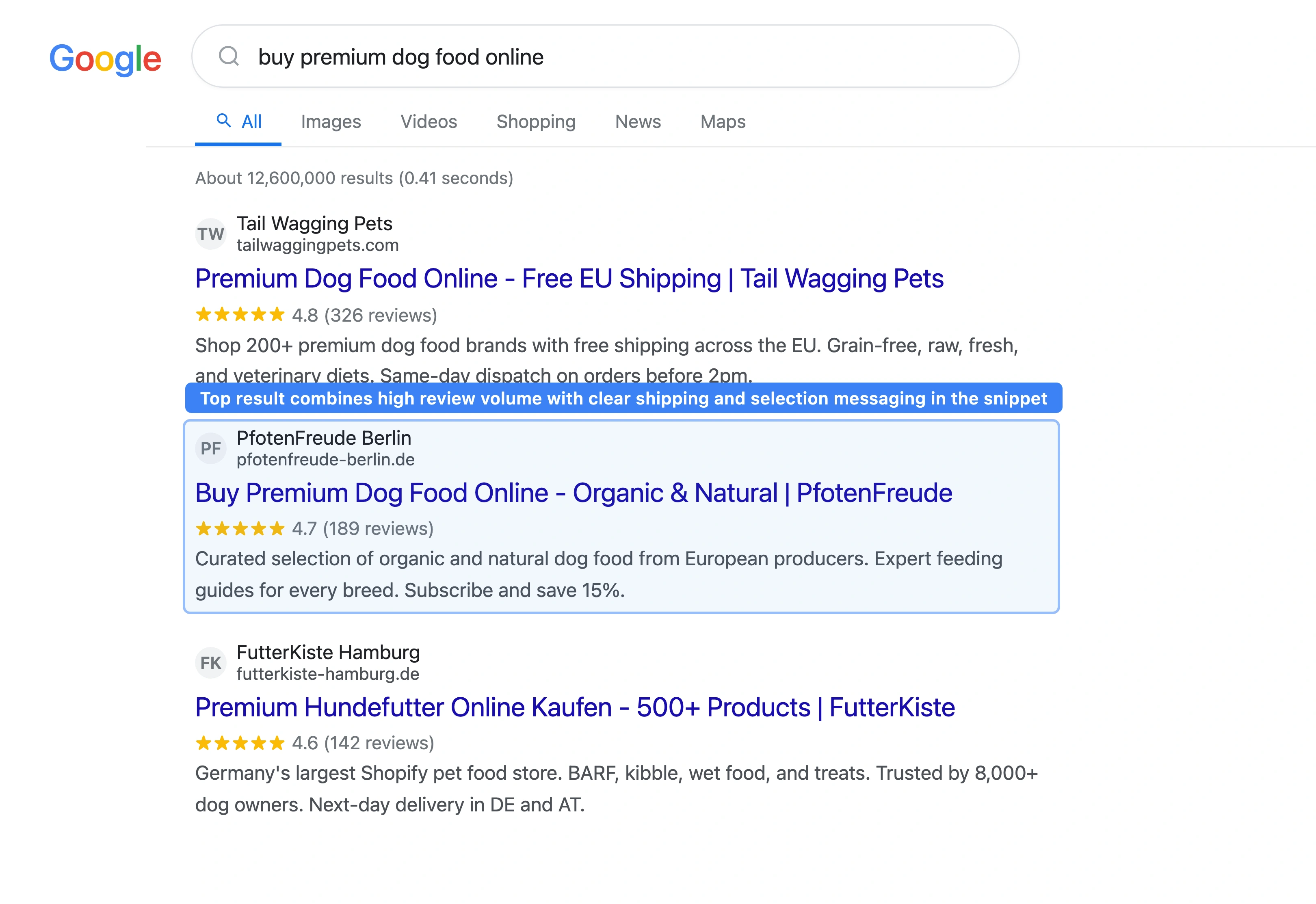
Each collection page needs a unique title tag, meta description, and 150 to 300 words of unique body text above or below the product grid. 87% of consumers say product content is the most important factor when deciding to purchase online[4], and that applies to collection pages as much as product pages.
For detailed collection page optimization, see our category page optimization guide.
How Do You Optimize Shopify Product Pages for Pet SEO?
Product pages are where conversions happen. Each page needs:
Unique Product Descriptions
Never use manufacturer copy. Google devalues duplicate content, and your competitors are using the same descriptions. Write unique, benefit-led descriptions for every SKU. For a 500-SKU catalog, this is the single largest SEO investment you will make - and the one with the highest return.
Product Schema Markup
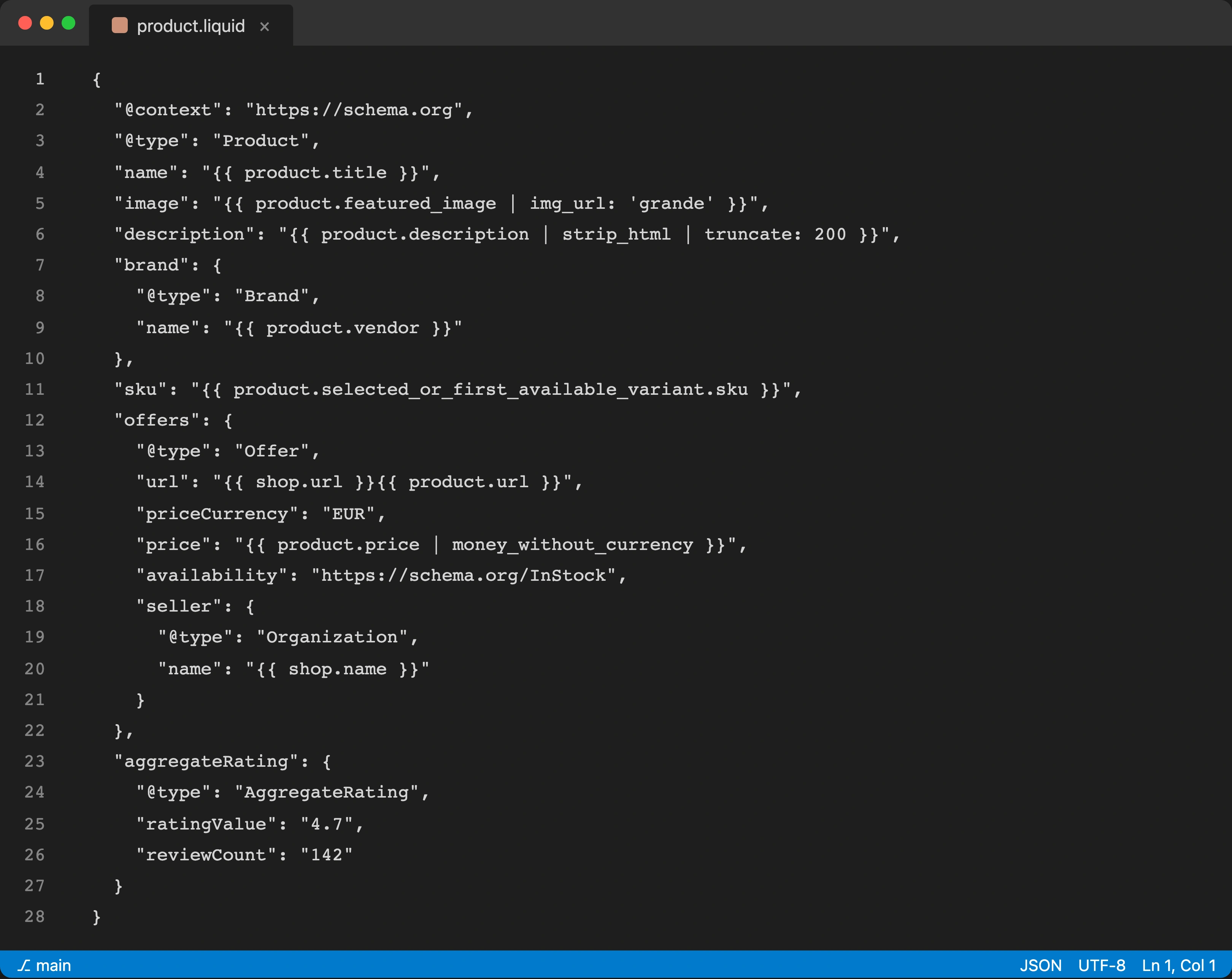
Product schema delivers 4.2x higher Google Shopping visibility and 20 to 40% higher CTR[5]. Shopify themes vary in schema support. Check your theme's product.liquid template for schema.org/Product JSON-LD. If it is missing or incomplete, add it manually or use an app like JSON-LD for SEO. Ensure your schema includes: name, image, description, brand, SKU, offers (price + availability), and aggregateRating.
Review Integration
Consumer reviews drive a 120.3% lift in conversion[6]. Use a reviews app that outputs valid AggregateRating schema (Judge.me, Loox, Yotpo). Verify the schema renders correctly in Google's Rich Results Test after installation.
Image Optimization
Pet product images are large (often 2000px+). Shopify auto-serves WebP on supporting browsers but does not auto-compress. Use descriptive filenames before upload (premium-chicken-dog-food-2kg.jpg, not IMG_4821.jpg). Add keyword-rich alt text to every image. Lazy-load below-fold images via the theme's loading attribute.
How Do You Fix Shopify Speed Issues?
Page speed directly affects rankings and conversions. Shopify stores commonly score 40 to 60 on mobile PageSpeed. Here is how to reach 80+:
- Audit and remove unused apps. Each app injects JS. Uninstall apps you no longer use and check for leftover code from previously uninstalled apps (common problem).
- Use a lightweight theme. Dawn (Shopify's default) is fast. Premium themes with heavy animations, video backgrounds, and mega-menus add weight. Test your theme's empty-state speed before customizing.
- Defer non-critical JavaScript. Move review widgets, chat widgets, and loyalty popups below the fold or load them on user interaction rather than page load.
- Optimize hero images. Compress to under 150KB. Use the theme's
loading="eager"andfetchpriority="high"for above-fold images,loading="lazy"for everything else. - Minimize Liquid template complexity. Nested loops and excessive
{% for %}blocks in product templates slow server response. Simplify where possible.
How Do You Handle Internal Linking on Shopify?
86% of e-commerce brands lack optimized internal links[3]. On Shopify, internal linking is particularly important because the flat URL structure means Google cannot infer category relationships from paths alone.
Tactics that work:
- add "Related Products" and "Customers Also Bought" sections to every product page
- link from collection descriptions to relevant blog posts and buying guides
- link from blog posts to specific product and collection pages (not just the homepage)
- add breadcrumb navigation with BreadcrumbList schema
- use Shopify's navigation menus to create a logical category hierarchy (even though URLs are flat)
One pattern I have seen repeatedly with pet stores on Shopify: the stores that link blog posts to specific product pages see 2x to 3x more organic product page traffic than stores that only link blog posts to the homepage.
Which Shopify Apps Help Pet Store SEO?
Keep your app stack lean. These categories matter most for SEO:
| Category | Purpose | Install If... |
|---|---|---|
| JSON-LD Schema | Product, Collection, Article, BreadcrumbList schema | Your theme's built-in schema is incomplete or missing AggregateRating |
| Image Optimizer | Auto-compress, add alt text suggestions | You have 200+ product images without alt text |
| Reviews (Judge.me, Loox) | UGC reviews with valid schema output | Always - reviews drive 120% conversion lift |
| Redirect Manager | 301 redirects for discontinued products | You retire or rename products regularly |
| Blog / SEO (SEOAnt, Plug in SEO) | Meta tag templates, bulk editing, broken link detection | You have 100+ products and limited time for manual SEO |
Avoid: apps that inject heavy JavaScript for minor features (countdown timers, animated badges, floating bars). Each one costs PageSpeed points.
What Content Strategy Works for Shopify Pet Stores?
Shopify's built-in blog is functional for SEO. Use it to build topical authority around your product categories:
- breed-specific feeding guides (link to relevant food collections)
- ingredient explainers (link to products containing that ingredient)
- seasonal care guides (link to seasonal product collections)
- product comparison guides (link to both products)
- condition-specific care (joint health, dental, weight - link to supplement collections)
Each post should target a specific long-tail keyword and link to at least one product or collection page. For content structure guidance, see our content clustering guide.
What Is the 90-Day Shopify SEO Sprint?
Here is a practical 90-day sprint for pet stores on Shopify:
| Week | Action | Impact |
|---|---|---|
| 1-2 | Audit current schema, fix or install JSON-LD app, verify Product schema on all product pages | Very High (4.2x Shopping visibility) |
| 2-3 | Restructure collections by animal, condition, ingredient - add 150-300 words unique text to each | High |
| 3-5 | Rewrite top 50 product descriptions with unique, benefit-led copy and keyword-rich alt text | Very High |
| 4-6 | App audit: remove unused apps, check for leftover scripts, test PageSpeed before and after | High |
| 5-7 | Install reviews app with schema, send review requests to last 90 days of customers | Very High (120% conversion lift) |
| 6-9 | Publish 6 blog posts targeting breed and condition keywords, link to product and collection pages | High |
| 8-10 | Build internal linking: add related products, blog-to-product links, breadcrumb schema | High |
| 9-12 | Set up 301 redirects for discontinued products, audit broken links | Medium |
| Ongoing | Monthly blog content, quarterly app audit, weekly review requests | Compounds over time |
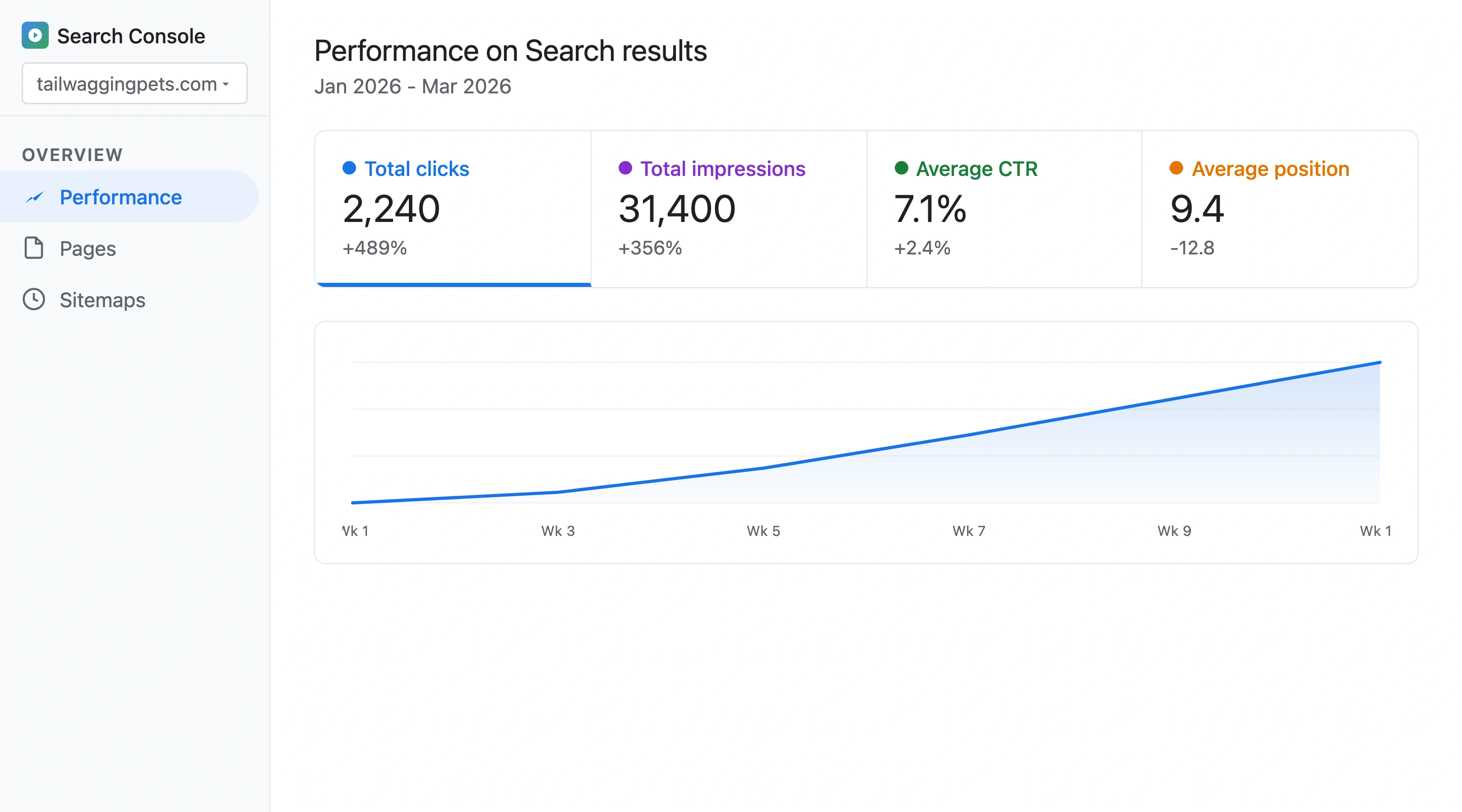
This sprint roughly maps to the cadence we cover in our how long pet store SEO takes guide - real ranking gains within 8 to 12 weeks.
How Does Petbase Help Shopify Pet Stores Scale Content?
Most Shopify pet store owners do not have time to rewrite 500 product descriptions, write weekly blog posts, and optimize collection page copy. Your day is fulfillment, customer service, and inventory management.
That is exactly the gap Petbase fills. Petbase generates optimized product descriptions, breed feeding guides, condition-specific content, and educational articles tailored to the pet care industry. 10 articles per month, published directly to your website, for USD 199/month.
43% of e-commerce traffic comes from organic search[3]. On Shopify, the stores that invest in unique content and proper schema consistently outrank the stores relying on manufacturer defaults. The question is whether your product pages appear when a pet parent searches for "best grain-free dog food" - or whether the competitor who wrote the guide gets the click.
Start your 7-day free trial and see what consistent, research-backed content does for your Shopify store traffic.
Frequently Asked Questions
Is Shopify good for pet store SEO?
Shopify is a solid foundation but has SEO limitations: forced URL prefixes, duplicate collection paths, limited robots.txt control, and speed issues from app bloat. These are all fixable with the right approach. The platform handles hosting, security certificates, and basic meta fields well. For most pet stores under 2,000 SKUs, Shopify's convenience outweighs its SEO trade-offs as long as you address the structural issues covered in this guide.
How do you fix duplicate URLs on Shopify?
Shopify automatically adds canonical tags pointing to the /products/ URL, which prevents duplicate content penalties. The remaining issue is crawl budget waste. Minimize it by limiting the number of collections each product appears in (aim for 2 to 3 maximum), and use the Shopify Search and Discovery app to control which collection paths Google discovers. For stores with 500+ products, this can reduce crawlable URL count by 40% to 60%.
Which Shopify theme is best for pet store SEO?
Dawn and similar minimal themes score highest on PageSpeed. Premium themes with heavy animations, mega-menus, and video backgrounds look good but add 500ms to 1,500ms of load time. Choose a theme that scores 75+ on mobile PageSpeed in its demo state. Customize conservatively. Test PageSpeed after every significant theme change.
How much does Shopify SEO cost for a pet store?
Most Shopify pet stores spend USD 200 to USD 1,000 per month on SEO. Essential apps (schema, reviews, image optimization) cost USD 30 to USD 80 per month combined. Content tools like Petbase (USD 199/month) handle ongoing blog and product description generation. Given that a 10% increase in organic traffic for a store doing USD 10,000/month in revenue translates to USD 1,000 in additional monthly revenue, the ROI is typically positive within the first quarter.
References
- EachSpy (2026). Pet Stores on Shopify. eachspy.com
- eDesk (2025). Shopify Statistics: Market Share, Revenue, Users. edesk.com
- Charle Agency (2026). E-commerce SEO Statistics. charleagency.com
- 1WorldSync / Salsify (2024). Product Content and Consumer Behavior. convertcart.com
- Taylor Scher SEO (2025). E-commerce SEO Statistics. taylorscherseo.com
- CXL / PowerReviews (2024). User-Generated Reviews and Conversion. cxl.com