AI for Pet Product Descriptions: How to Write Copy That Ranks and Sells


Table of Contents +
- Why Do Product Descriptions Matter So Much for Pet Stores?
- What Is the AIDA Framework and Why Does It Work for Pet Products?
- How Does AI Change the Product Description Writing Process?
- How Do Manual, Template, and AI Approaches Compare?
- What Makes Pet Product Descriptions Different From General Ecommerce?
- How Do You Optimize Pet Product Descriptions for SEO?
- How Do You Scale AI Descriptions Across Hundreds of Pet SKUs?
- What Does a Great AI-Generated Pet Product Description Look Like?
- How Do You Handle Breed-Specific Content at Scale?
- Frequently Asked Questions
- References
AI pet product descriptions cut writing time by 88% and boost conversions by 23.7%. Learn the AIDA framework for breed-specific copy that ranks and sells.
A pet store with 500 products needs roughly 150,000 words of product content[1]. At a manual writing pace of 4-6 descriptions per day, that is 4-6 months of full-time work - just for the initial catalog. Meanwhile, 87% of online shoppers say product content is the most important factor in their purchase decision[2]. You cannot afford to skip product descriptions. You also cannot afford to spend half a year writing them.
AI product description tools promise to solve this problem. But for pet stores, generic AI creates a new problem: inaccurate breed information, fabricated health claims, and copy that sounds like every other online retailer. The solution is AI built specifically for pet products.
TL;DR
AI product description tools can cut writing time by 88% and improve conversions by up to 23.7%. But generic AI fails on pet-specific content - breed details, health claims, and life stage nutrition. Use the AIDA framework with a pet-specific AI tool to produce descriptions that rank in search and convert browsers into buyers.
Why Do Product Descriptions Matter So Much for Pet Stores?
Product descriptions are not filler text below your product images. They are the primary conversion driver on your product pages. Research from Baymard Institute found that 20% of all online purchase failures are directly caused by missing or unclear product descriptions[3]. That is one in five potential customers who wanted to buy but could not find the information they needed to complete the purchase.
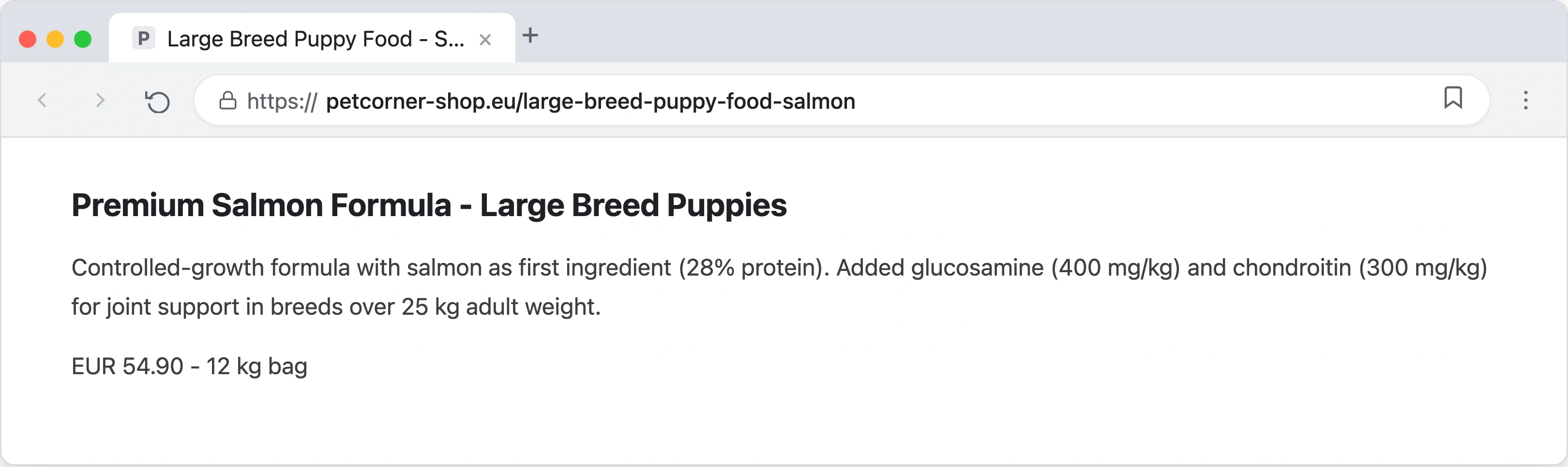
For pet stores specifically, the stakes are higher than for general retail. Pet owners are researching ingredients, breed suitability, age appropriateness, and potential allergens. A dog food description that says "premium quality nutrition for all dogs" tells the customer nothing. A description that says "grain-free formula with salmon as the first ingredient, formulated for large-breed adult dogs over 25 kg with joint support from added glucosamine" answers the exact questions the customer typed into Google.
The pet ecommerce market is expected to reach USD 102.3 billion in 2025, growing at 7.8% annually[4]. Competition is intense. Product descriptions are one of the few areas where independent pet stores can differentiate from Amazon and large chains - by providing the kind of expert, breed-specific detail that generalist retailers do not offer.
Well-written product descriptions also serve a dual purpose. They convert visitors who land on the page, and they attract new visitors through search. Every product page is a potential Google ranking page. Accurate, detailed descriptions help those pages rank for long-tail keywords like "hypoallergenic cat food for sensitive stomachs" or "durable chew toy for aggressive chewers."
Petbase automates SEO content for pet stores - publishing 10 optimized articles monthly so you can focus on running your shop - start your free trial.
What Is the AIDA Framework and Why Does It Work for Pet Products?
AIDA stands for Attention, Interest, Desire, Action. It is a copywriting framework that has been used in marketing for over a century, and it works because it mirrors how customers naturally make purchase decisions[5].
Here is how AIDA applies to a pet product description:
- Attention: Open with the specific problem the product solves. "Your Golden Retriever's joints take a beating on every walk" immediately speaks to a specific customer with a specific concern.
- Interest: Present the product's key features using specific, factual detail. Ingredient lists, weight recommendations, breed suitability, and certifications all build credibility.
- Desire: Connect features to outcomes the pet owner cares about. "Glucosamine and chondroitin support joint health, so your dog stays active and comfortable into their senior years" transforms a feature into an emotional benefit.
- Action: End with a clear call to action. "Add to cart" is the minimum - but adding urgency or reassurance ("Free shipping on orders over EUR 50" or "30-day satisfaction guarantee") increases completion rates.
Research shows that translating technical specifications into real-world benefits boosts conversions by up to 40%[6]. The AIDA framework forces this translation at every step. Instead of listing "contains 30% crude protein," you write "30% protein from real chicken supports lean muscle development in active breeds."
For a deeper look at how AIDA applies across your entire pet store marketing funnel, see our guide to writing pet product descriptions that rank and sell.
How Does AI Change the Product Description Writing Process?
The traditional process of writing product descriptions for a pet store looks like this: research the product, identify key features, write the description, optimize for SEO, format for the website, and publish. For a single product, this takes 20-40 minutes. For a catalog of 500 products, you are looking at 170-330 hours of work.
AI compresses this timeline dramatically. One ecommerce brand generated 78 product descriptions in 2 hours - work that previously required two weeks, representing 88% time savings[7]. At the extreme end, 703 product descriptions were created in just 2 hours, a process that would have manually taken 13-14 weeks[7].
But speed without accuracy is dangerous - especially for pet products. In my experience working with pet stores across Europe, the biggest risk with AI product descriptions is not that they sound bad. It is that they sound plausible while containing incorrect information. A generic AI tool might confidently state that a particular dog food is "grain-free" when it contains rice, or recommend a supplement for puppies when it is formulated for adult dogs only.
This is why 47% of marketers encounter factual errors in AI-generated content on a weekly basis[8]. For pet stores, factual errors in product descriptions are not just embarrassing - they can lead to returns, negative reviews, and in the worst case, harm to an animal.
The solution is not to avoid AI entirely. It is to use AI that understands pet products. AI content creation is 430% faster than manual writing[9], and when AI-generated descriptions are edited by humans, costs drop by 54% while conversion improves by 21% compared to purely human-created text[10].
How Do Manual, Template, and AI Approaches Compare?
Pet store owners typically choose between three approaches for product descriptions. Each has clear trade-offs:
| Factor | Manual Writing | Template-Based | Pet-Specific AI |
|---|---|---|---|
| Time per description | 20-40 minutes | 5-10 minutes | 1-2 minutes |
| Cost per 100 descriptions | EUR 2,000-4,000 (freelancer) | EUR 500-1,000 (your time) | Included in EUR 199/month plan |
| SEO optimization | Requires SEO knowledge | Basic keyword insertion | Automatic keyword targeting |
| Breed-specific accuracy | Depends on writer expertise | Limited by template scope | Built-in breed knowledge |
| Consistency across catalog | Varies with writer fatigue | High (same template) | High (same model) |
| Scalability (500+ SKUs) | 4-6 months full-time | 2-3 months | 1-2 weeks |
| AIDA framework compliance | Requires training | Partially built in | Fully automated |
| Unique content per product | Yes | No - repetitive phrasing | Yes - unique per product |
The template approach deserves special attention because many pet stores default to it. Templates work like this: you create a master format ("[Product Name] is a [category] designed for [target pet]. Key features include [feature 1], [feature 2], [feature 3].") and fill in the blanks for each product.
Templates are faster than manual writing, but they create a critical SEO problem: duplicate content patterns. Google's algorithms recognize templated content and may rank it lower than unique descriptions[11]. When 200 of your product pages share the same sentence structure with only the product name swapped out, Google sees thin content rather than unique value.
For a detailed breakdown of how these three approaches perform across different store sizes, read our comparison of AI, templates, and manual product descriptions.
What Makes Pet Product Descriptions Different From General Ecommerce?
Pet product descriptions face challenges that most ecommerce categories do not. Understanding these challenges explains why generic AI tools fall short:
Breed specificity. There are over 400 recognized dog breeds and 70+ cat breeds, each with distinct dietary needs, size ranges, activity levels, and health predispositions. A product description for joint supplements must differentiate between a Great Dane (prone to hip dysplasia from age 2) and a Chihuahua (different joint concerns entirely). Generic AI tools treat "dogs" as a single category.
Life stage accuracy. Puppy, junior, adult, senior, and geriatric pets have fundamentally different nutritional requirements. A product description that says "suitable for dogs of all ages" is technically inaccurate for most specialized foods and supplements. FEDIAF (the European Pet Food Industry Federation) guidelines specify different nutrient levels for each life stage[12]. Your product descriptions should reflect this precision.
Health claim regulations. In the European Union, pet food health claims are regulated. You cannot claim a food "prevents" disease, but you can say it "supports" specific health functions when backed by ingredient evidence. Generic AI does not understand this distinction and frequently generates claims that could create regulatory problems.
Ingredient transparency. Pet owners are increasingly ingredient-conscious. 85% of pet owners do thorough online research before making purchases[13]. Your product descriptions need to address common questions: Is this grain-free? What is the protein source? Are there artificial preservatives? Is it single-protein for dogs with allergies?
Seasonal relevance. Pet products have seasonal demand patterns - flea and tick prevention peaks in spring, coat supplements in autumn, travel crates before holiday seasons. Product descriptions that reference seasonal context ("Prepare your dog for tick season with this veterinary-recommended prevention") perform better than static descriptions year-round.
How Do You Optimize Pet Product Descriptions for SEO?
A well-written product description that nobody finds in search is a missed opportunity. Every product page should target at least one specific keyword. For pet stores, the most valuable keywords are long-tail and breed-specific:
- "grain-free senior cat food" (high purchase intent)
- "large breed puppy food with glucosamine" (specific need)
- "hypoallergenic dog treats for sensitive stomachs" (problem-solution)
- "natural flea collar for small dogs" (product + size specificity)
Organic search generates 53% of all website traffic[14], and for ecommerce specifically, SEO delivers an average 748% ROI over time[15]. Each optimized product description contributes to this compounding return.
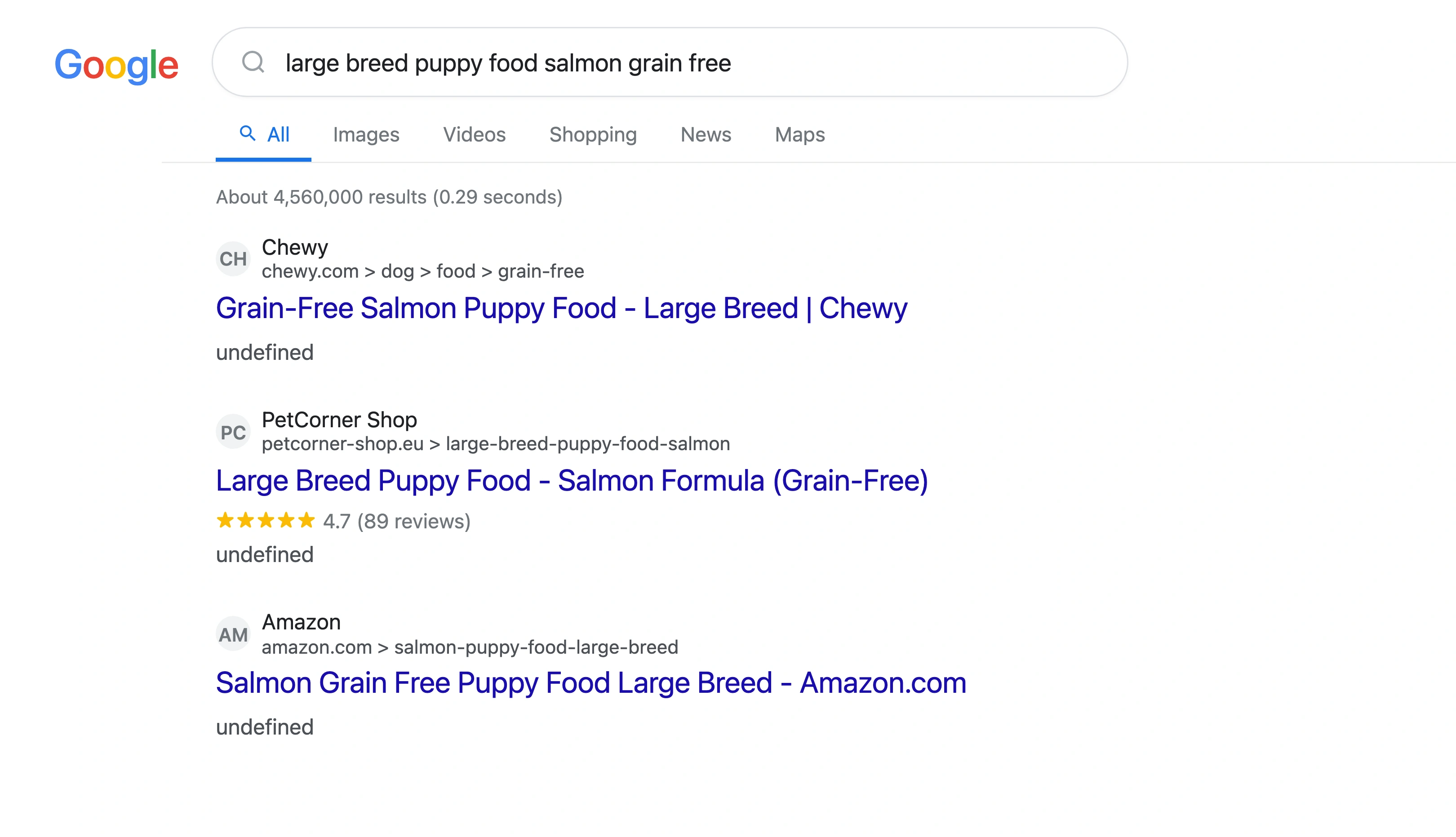
Here are the SEO elements every pet product description should include:
1. Primary keyword in the first 100 words. Google gives extra weight to keywords that appear early. If your product targets "salmon dog food for allergies," work that phrase naturally into the opening sentence.
2. Structured content with headers. Use H2 and H3 tags to organize the description into scannable sections: Overview, Key Ingredients, Breed Suitability, Feeding Guide. This structure helps Google understand the page and improves chances of appearing in featured snippets.
3. Unique meta description. Each product page needs a unique meta description (150-160 characters) that includes the primary keyword and a benefit statement. "Grain-free salmon formula for dogs with food sensitivities. Rich in Omega-3 for healthy skin and coat. Suitable for medium and large breeds."
4. Schema markup. Product schema (price, availability, reviews) helps Google display rich results. Products with rich snippets get higher click-through rates in search results.
5. Internal links. Link related products to each other and to relevant blog content. A salmon dog food product page should link to your blog post about dog food allergies. This builds topical relevance and keeps visitors on your site longer.
For more on optimizing your product pages for maximum search visibility, see our product page optimization guide.
How Do You Scale AI Descriptions Across Hundreds of Pet SKUs?
Scaling is where AI provides the most dramatic advantage over manual approaches. A mid-sized pet store with 500 SKUs needs roughly 150,000 words of product content[1]. At a manual writing pace, populating this catalog takes 83-125 working days[1].
With a pet-specific AI tool, the same catalog can be completed in 1-2 weeks. But scaling is not just about speed - it is about maintaining quality and uniqueness across every description. Here is a practical workflow:
Step 1: Categorize your catalog. Group products by type (food, supplements, toys, accessories, grooming) and by pet (dog, cat, small animal, bird, fish). Each category has different description requirements and keyword targets.
Step 2: Define AIDA templates per category. The Attention hook for dog food ("Your active Border Collie needs fuel that matches their energy") differs from the hook for cat toys ("Indoor cats need mental stimulation to prevent behavioral problems"). Set up category-specific AIDA structures.
Step 3: Feed product data into AI. Provide the AI with accurate product data: ingredient lists, weight ranges, breed recommendations, life stage suitability, and any certifications. The quality of AI output depends directly on the quality of input data.
Step 4: Review and refine. Even with pet-specific AI, human review is essential. Focus your review time on accuracy (correct breed recommendations, valid health claims) rather than style (the AI handles tone and structure). This targeted review takes 2-3 minutes per description versus the 20-40 minutes of writing from scratch.
Or let Petbase handle this automatically. Petbase uses the AIDA framework with built-in pet industry knowledge to generate product descriptions that are breed-specific, life-stage-appropriate, and SEO-optimized from the start.
Nearly 47% of online sellers already use AI to create product content[9]. The question is not whether to use AI for product descriptions - it is whether to use generic AI that requires extensive correction or pet-specific AI that gets it right the first time.
What Does a Great AI-Generated Pet Product Description Look Like?
Theory is useful, but examples make the difference concrete. Here is the AIDA framework applied to a real pet product category - a premium dog food for large breeds:
Generic AI output:
"Premium dog food made with high-quality ingredients. This nutritious formula provides balanced nutrition for your dog. Contains real meat as the first ingredient. Suitable for all breeds and life stages. Give your dog the nutrition they deserve."
This description could apply to any dog food on the market. It contains no specific claims, no breed detail, and no SEO-targeted keywords. It would not rank for any meaningful search query.
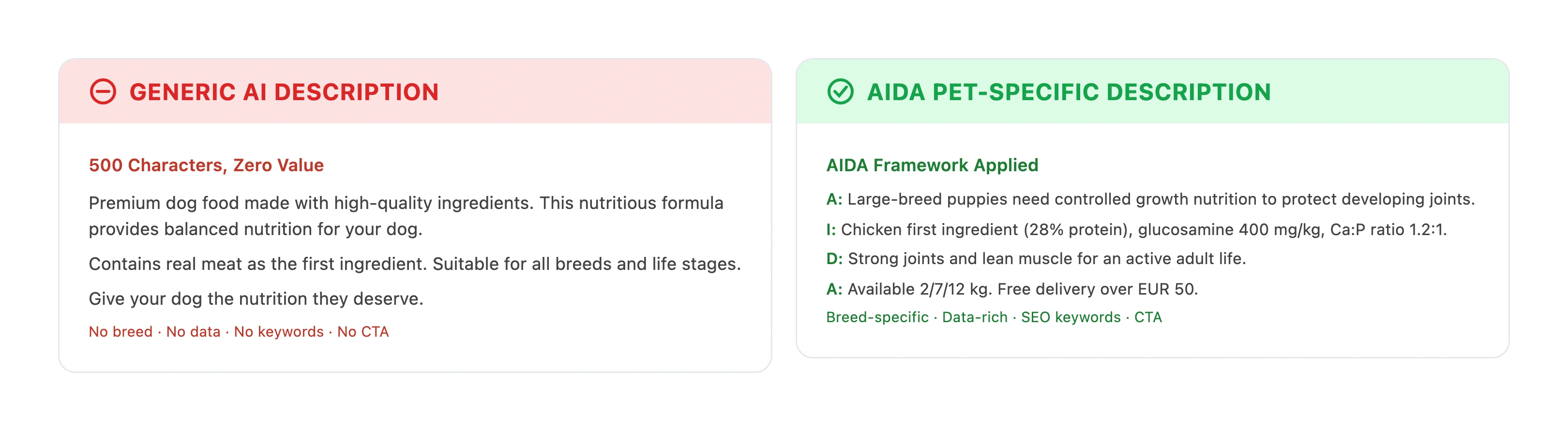
AIDA-structured, pet-specific AI output:
Attention: "Large-breed dogs like German Shepherds, Labradors, and Golden Retrievers need controlled growth nutrition to protect their developing joints. Standard puppy food can cause rapid weight gain that stresses growing bones."
Interest: "This large-breed puppy formula uses chicken as the first ingredient (28% crude protein) with added glucosamine (400 mg/kg) and chondroitin (300 mg/kg) for joint support. The controlled calcium-to-phosphorus ratio (1.2:1) supports healthy bone development without accelerating growth. Grain-free with sweet potato and peas as carbohydrate sources."
Desire: "Veterinarians recommend controlled-growth formulas for breeds over 25 kg adult weight. This formula helps your large-breed puppy develop strong joints and lean muscle, setting the foundation for an active, comfortable adult life."
Action: "Available in 2 kg, 7 kg, and 12 kg bags. Free delivery on orders over EUR 50. 30-day satisfaction guarantee."
The difference is measurable. The AIDA version targets specific keywords ("large-breed puppy formula," "glucosamine for dogs," "grain-free puppy food"), provides concrete nutritional data, and addresses the specific concerns of large-breed puppy owners. AI product descriptions like this improve conversion rates by up to 23.7%[16].
How Do You Handle Breed-Specific Content at Scale?
One pattern I have seen repeatedly across pet stores is the temptation to write one generic description and reuse it across breed-specific products. "Great for all dogs" feels efficient, but it fails both the customer and search engines.
Breed-specific content matters because:
- Search intent is breed-specific. Pet owners search for "best food for French Bulldogs" not "best dog food." Products with breed-specific descriptions rank for these long-tail queries.
- Conversion depends on relevance. A French Bulldog owner who sees "formulated for brachycephalic breeds with smaller kibble size for flat-faced dogs" knows this product was made for their dog. Personalized descriptions deliver 4.5x higher conversion rates than generic ones[6].
- Trust requires specificity. Pet owners trust stores that demonstrate breed knowledge. A description that mentions "the Labrador Retriever's tendency toward weight gain" signals expertise that generic retailers cannot match.
AI makes breed-specific scaling practical. Instead of writing one description per product, you can generate variations for different breed groups (small, medium, large, giant) or specific popular breeds (Labrador, German Shepherd, French Bulldog, Golden Retriever). Each variation targets different search queries while remaining accurate to the product.
A pet store with 200 food products and 5 breed-group variations would need 1,000 unique descriptions. Manually, that is 6-12 months of work. With pet-specific AI, it is 2-4 weeks including human review.
Frequently Asked Questions
Will AI product descriptions hurt my Google rankings?
No. Google evaluates content quality, not production method[11]. AI-generated product descriptions that are unique, accurate, and useful rank just as well as human-written ones. What hurts rankings is thin, duplicated, or templated content - regardless of whether a human or AI produced it. The key is ensuring each description is unique and provides genuine value to the searcher.
How long should a pet product description be for SEO?
Research shows that product descriptions between 200 and 400 words perform best for standard pet products. Simple accessories (leashes, bowls) can work with 150-200 words. Complex products (specialized diets, supplements, medical devices) benefit from 400-600 words that cover ingredients, usage instructions, and breed suitability. The principle is: write exactly enough to answer every question the customer might have, but do not pad with filler content.
Can I use the same AI description for the same product in different languages?
Translation is not the same as localization. A product description written in English and machine-translated to German will sound unnatural and may miss regional differences in how pet owners search. German pet owners search for "Hundefutter fuer grosse Rassen" (dog food for large breeds), not a literal translation of the English keyword. Effective multilingual product content requires separate keyword research and native-language generation for each market, not translation of a single source description.
How do I maintain accuracy in AI-generated pet health claims?
Always review AI-generated health claims against the product manufacturer's official documentation and FEDIAF guidelines[12]. Use "supports" language rather than "prevents" or "cures" language. Verify specific nutrient levels, ingredient percentages, and breed recommendations against the product label. A pet-specific AI tool reduces the review burden because it is trained on accurate pet industry data, but human verification remains essential for health-related content.
References
- Ecommerce Fastlane (2025). AI Product Descriptions At Scale. ecommercefastlane.com
- 1WorldSync (2024). Product Content Benchmark Report. 1worldsync.com
- Baymard Institute (2024). Product Page Information. baymard.com
- Grand View Research (2025). Pet Care E-commerce Market Report. grandviewresearch.com
- Siege Media (2025). What Is the AIDA Model? siegemedia.com
- Envive (2025). Product Description Optimization Statistics. envive.ai
- Describely (2025). AI-Generated Product Descriptions for Ecommerce. describely.ai
- NP Digital (2024). AI Hallucination Data Study. neilpatel.com
- Semrush (2025). AI Content Statistics. semrush.com
- XICTRON (2025). AI-Generated Product Descriptions in E-Commerce. xictron.com
- Google (2023). Google Search Spam Policies. developers.google.com
- FEDIAF (2024). Nutrition Guidelines. fediaf.org
- eTailPet (2025). Local SEO for Pet Stores. etailpet.io
- BrightEdge (2025). Research Reports. brightedge.com
- First Page Sage (2026). E-Commerce SEO ROI Report. firstpagesage.com
- Linearloop (2025). AI vs Human Product Descriptions Conversion. linearloop.io