Your First 90 Days with AI Content: A Pet Store Timeline


Table of Contents +
- What Happens in the First 30 Days?
- What Changes Between Days 30 and 60?
- What Happens at the 8-12 Week Mark?
- What Does Month 3 to Month 6 Look Like?
- What Does the 6-12 Month Picture Look Like?
- What Can Go Wrong - and How Do You Avoid It?
- How Do You Calculate ROI on AI Content for a Pet Store?
- Frequently Asked Questions
- References
Month-by-month timeline for AI content results at your pet store. Expect page 1 rankings in 8-12 weeks, compounding traffic by month 6, and 748% SEO ROI.
The most common question pet store owners ask before investing in AI content is: "How long until I see results?" It is a fair question. You are considering spending USD 199 per month on a tool that produces blog content, and you want to know when that investment starts paying back.
The honest answer is that SEO is not instant. But it is predictable. Decades of search data show clear patterns in how content gets indexed, starts ranking, and begins driving traffic. This article gives you a realistic, month-by-month timeline based on actual data - not marketing promises.
TL;DR
Expect 8-12 weeks before your first AI-generated articles reach page 1 of Google. By month 3, early posts are ranking while newer posts climb. By month 6, compounding returns kick in as topical authority builds. After 12 months, your content library becomes a durable traffic asset with declining cost per visitor.
What Happens in the First 30 Days?
The first month is about laying foundations. Google needs to discover, crawl, and index your new content before it can rank for anything. Here is what to expect:
Week 1-2: Publishing and indexing. Your first batch of AI-generated articles goes live. Google typically discovers and indexes new pages within one week - research shows that 83% of pages are indexed within the first seven days of publication[1]. You can verify indexing by searching "site:yourdomain.com/blog/article-slug" in Google. If the page appears, it is indexed.
Week 2-4: The sandbox period. Your content is indexed but not ranking yet. Google places new content through an evaluation period where it tests the page against various queries, measures user signals, and assesses content quality. During this period, your articles might appear on page 5-10 of results for target keywords. This is normal. Do not panic and do not make drastic changes to content that is only two weeks old.
What you should be doing: Publishing consistently. If your plan includes 10 articles per month, aim to spread them across the month (2-3 per week) rather than publishing all 10 at once. Consistent publishing signals to Google that your site is actively maintained. Companies publishing 16 or more posts per month get 3.5x more traffic than those publishing four or fewer[2].
Realistic expectations: Zero organic traffic from new content in month 1. Your existing pages continue performing as before. New content is being evaluated. This is the month that tests your patience - and where most pet store owners who try DIY content give up. With AI content, the difference is that you are still publishing consistently because the tool handles the writing.
Petbase automates SEO content for pet stores - publishing 10 optimized articles monthly so you can focus on running your shop - start your free trial.
What Changes Between Days 30 and 60?
Month 2 is where the first signals of progress appear. Google has had time to evaluate your content and is starting to position it in search results.
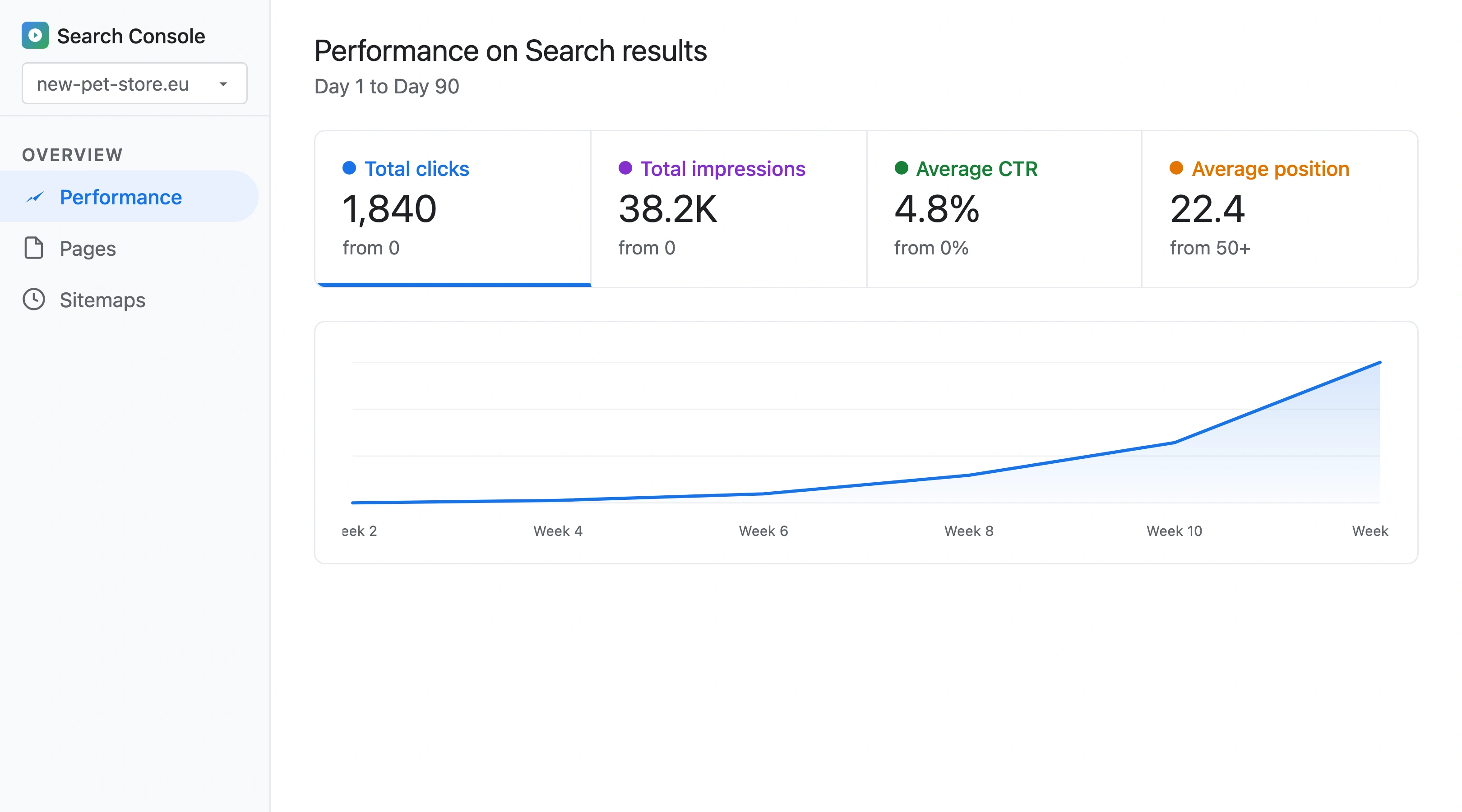
Week 4-6: Initial ranking signals. Check Google Search Console. You should see your new articles appearing in the "Performance" report with impressions - meaning Google is showing your pages in search results, even if users are not clicking yet. Impressions without clicks at this stage are a positive sign. They mean Google considers your content relevant enough to display.
Week 6-8: Position movement. Articles targeting lower-competition, long-tail keywords start moving from page 5+ toward page 2-3. A blog post targeting "best dog food for French Bulldogs with allergies" (low competition, high specificity) will show ranking movement before a post targeting "dog food" (extremely competitive). This is why content strategy matters - targeting the right keywords with the right difficulty determines how quickly you see results.
Internal linking takes effect. By month 2, you have 20 articles live (10 from month 1, 10 from month 2). Internal links between related articles start building what SEO professionals call topical relevance. Your article about Golden Retriever nutrition links to your article about joint supplements for large breeds, which links to your article about senior dog care. Google interprets these connections as evidence that your site covers this topic comprehensively.
Websites using AI content grow organic traffic 5% faster than those that do not[3]. The advantage is not that AI content ranks faster - it ranks on the same timeline as human content. The advantage is volume. While a pet store owner manually writing 2-3 posts per month has 5-6 articles in the pipeline, AI-assisted publishing puts 20 articles into the ranking pipeline in the same period.
Realistic expectations: Low single-digit organic clicks per day from new content. Most of your content is still on page 2-5. You will see impressions growing in Search Console. This is the month where data starts confirming that your strategy is working, even though revenue impact is not visible yet.
What Happens at the 8-12 Week Mark?
This is the critical inflection point. In my experience working with pet stores, the 8-12 week window is where the first tangible results appear - and where the difference between a strategic content approach and random article publishing becomes obvious.
Week 8-10: First page 1 rankings. Your earliest published articles - now 8-10 weeks old - start reaching page 1 for their target keywords. This happens first for long-tail, lower-competition keywords. Articles targeting specific breed combinations, local modifiers, or niche product categories break through before broader terms.
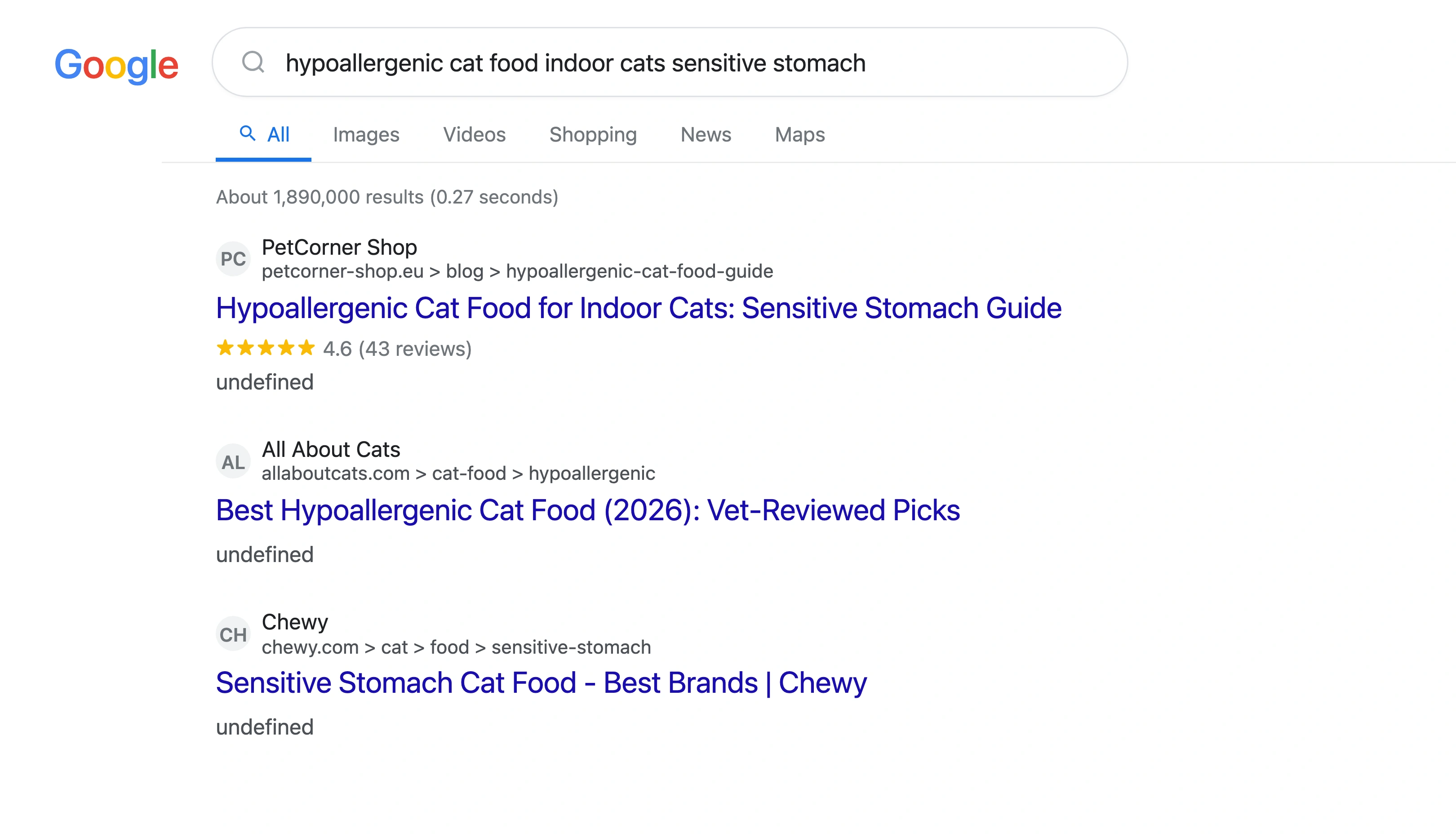
Most new content takes 3-6 months to reach page 1 on competitive keywords[4]. But lower-competition long-tail keywords that pet stores target ("hypoallergenic cat food for indoor cats," "best harness for Dachshunds") often rank faster because fewer websites are competing for those specific terms.
Week 10-12: Topical authority signals. With 30 articles live across interconnected topics, Google begins recognizing your site as an authority in your content clusters. Research shows that topical authority results become visible in 8-12 weeks after publishing a well-linked content cluster[5]. This means your newer articles (month 2-3) start ranking faster than your earliest articles did, because they benefit from the authority your site has already begun building.
This is the compounding effect in action. Article 1 took 10 weeks to reach page 1. Article 15, published 6 weeks later on a related topic, might reach page 1 in 6-7 weeks because it launches from a stronger domain position. By article 30, you may see page 1 rankings in 4-5 weeks for lower-competition terms.
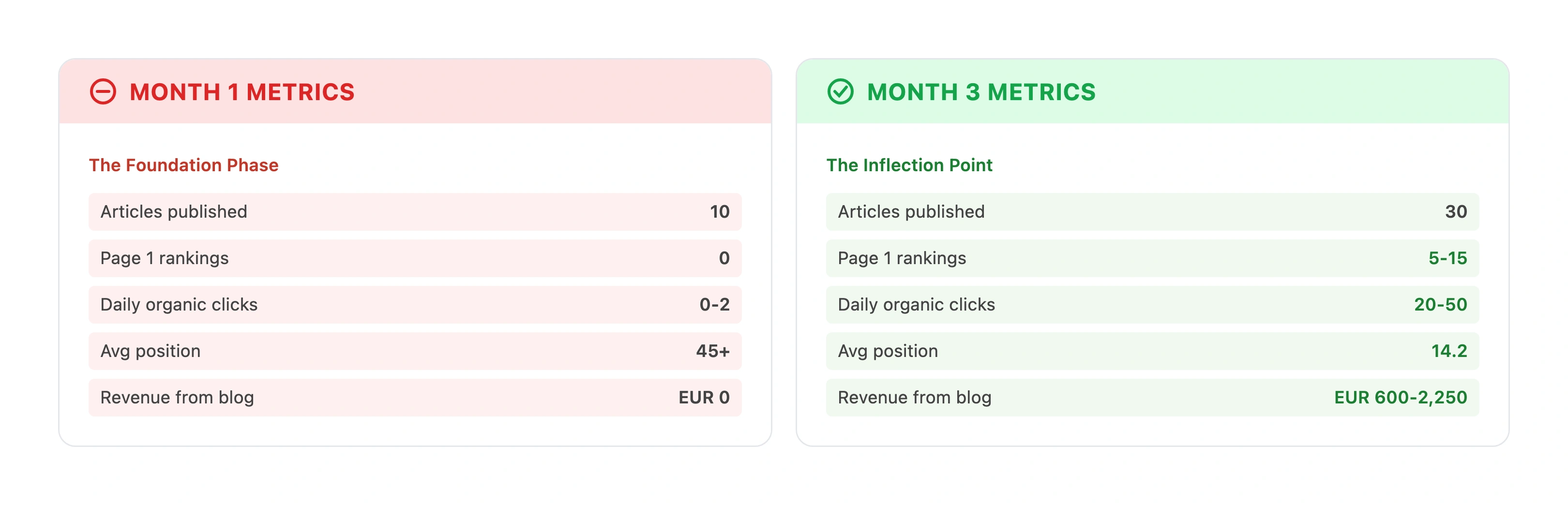
Realistic expectations: 5-15 page 1 rankings across your content. Daily organic traffic from blog content reaching 20-50 visits. First measurable leads or inquiries from blog visitors. This is the month you can point to specific articles driving specific traffic and start calculating early ROI.
What Does Month 3 to Month 6 Look Like?
Months 3-6 are where consistent publishing transforms from an expense into an asset. The content you published in month 1 is now mature. New content ranks faster. And the cumulative effect of 30-60 articles starts compounding.
Month 3-4: The ranking pipeline fills up. You now have content at every stage of the ranking journey. Month 1 articles are on page 1. Month 2 articles are climbing to page 1. Month 3 articles are being indexed and evaluated. This is the "pipeline" effect that makes consistent publishing so powerful - you always have content at every stage, which means you see steady weekly improvements rather than waiting months between results.
The average top-ranking page is 5 years old, but that does not mean new content cannot rank[6]. Among pages that do achieve top 10 rankings, 40.82% do so within the first month of reaching page 1[6]. The key differentiator is topical authority - and that is exactly what consistent, clustered content builds.
Month 4-5: Traffic compounds. Organic search generates 53% of all website traffic[7], and your share of that organic traffic is growing. Each new article that reaches page 1 adds a permanent traffic stream. Unlike paid advertising, which stops producing traffic the moment you stop paying, content that ranks continues driving visitors month after month.
Content marketing generates $3 for every $1 invested[8]. At USD 199 per month for AI content, your break-even point is modest. A pet store with an average order value of USD 50 needs just 12 additional orders per month from organic traffic to exceed a 3x return on the content investment.
Month 5-6: Competitive keywords start ranking. Your more competitive target keywords - "best dog food for allergies," "pet store online," "premium cat food" - are now beginning to rank on page 1. These broader keywords were too competitive for a new site to rank for immediately, but 5-6 months of consistent, expert content has built enough domain authority and topical relevance to compete.
One pattern I have seen repeatedly is that pet stores experience a noticeable jump in traffic around month 5-6 that exceeds the sum of individual article contributions. This is the topical authority multiplier - Google starts ranking your pages higher across the board because it trusts your site on the topic as a whole, not just on individual keywords.
Realistic expectations: 30-60 page 1 rankings. Daily organic blog traffic of 100-300 visits. Measurable revenue attribution from content. Your cost per visitor from organic content is already lower than paid advertising and declining with each month.
What Does the 6-12 Month Picture Look Like?
Months 6-12 are where the economics of content marketing become compelling. SEO customer acquisition cost decreases 60% over 2 years[9] because the content you paid for in month 1 continues driving traffic in month 12, month 24, and beyond - at no additional cost.
Month 6-8: Full topical authority. With 60-80 articles published across interconnected content clusters, your site has established topical authority in your core areas. Research indicates that full topical authority typically develops in 6-12 months of consistent publishing[5]. At this stage, new articles rank significantly faster because they inherit the authority of the entire cluster.
For pet stores, this means a new article about "grain-free food for Labrador puppies" can reach page 1 within 2-3 weeks if your site already has established authority on dog nutrition, breed-specific content, and puppy care. Without that authority, the same article would take 3-6 months.
Month 8-10: Compounding traffic growth. SEO delivers an average 748% ROI[9]. By month 8-10, you are likely seeing this return materialize. Your monthly content investment remains USD 199, but your monthly organic traffic is growing at an increasing rate because:
- Old content continues ranking and driving traffic
- New content ranks faster due to established authority
- Internal linking creates pathways between articles that increase pageviews per session
- Google surfaces your content in more featured snippets and AI Overviews as your authority grows
Month 10-12: The durable asset. After 12 months, you have 120 articles live. Ahrefs found that only 1.74% of newly published pages rank in the top 10 within a year[6] - but that statistic includes all websites, most of which publish sporadically without a content strategy. Pet stores with consistent, clustered, expert content dramatically outperform this average.
At the 12-month mark, your content library is a durable business asset. It drives traffic 24 hours a day, 7 days a week. It generates leads while you sleep. And every month of additional content makes the entire library more valuable because topical authority strengthens the whole, not just the newest articles.
What Can Go Wrong - and How Do You Avoid It?
Not every pet store sees these results on this timeline. Here are the most common reasons for slower progress and how to avoid them:
Problem: Publishing without a content strategy. Random articles on disconnected topics do not build topical authority. A post about hamster cage sizes, followed by dog grooming tips, followed by fish tank maintenance, signals no clear expertise to Google. For your SEO strategy and content planning, see our SEO strategy roadmap for pet stores.
Solution: Focus on 2-3 content clusters in the first 90 days. Dog nutrition, cat care, and pet health are natural starting clusters for most pet stores. Build depth within each cluster before expanding to new topics.
Problem: No internal linking. Articles that do not link to each other are isolated pages, not a connected content library. Google uses internal links to understand topic relationships and distribute authority across your site.
Solution: Every new article should link to 2-3 existing related articles. Go back to older articles and add links to newer related content. This is one area where AI content tools with built-in linking logic outperform manual writing - they automatically suggest and implement cross-references.
Problem: Thin content without expertise signals. Pure AI content without human expertise collapses in rankings after approximately 3 months[10]. Google's E-E-A-T framework specifically rewards content that demonstrates experience and expertise.
Solution: Use AI as the production engine, not the expertise source. Add your product knowledge, customer questions you hear daily, and real observations about pet care trends. A pet store owner who adds "We have seen a 40% increase in grain-free food inquiries this year" to an AI-generated nutrition article transforms it from generic to expert-level.
Problem: Unrealistic timeline expectations. Some pet store owners expect page 1 rankings in 2 weeks and cancel when it does not happen. 85% of newly published website content does not break into the top 50 SERP positions within the first 6 months[6] - but that average includes websites with no content strategy. Strategic, consistent, expert content beats this average dramatically.
Solution: Use this article as your benchmark. Check progress against the timeline at each milestone. If your articles are not indexed within 1 week, something technical is wrong. If you are not seeing impressions by week 4, check your keyword targeting. If page 1 rankings have not appeared by week 12, evaluate content quality and competition level.
Or let Petbase handle the strategy, production, and optimization together. Petbase builds content clusters with internal linking, breed-specific expertise, and SEO optimization built in - so you can focus on the human expertise that makes the content rank.
How Do You Calculate ROI on AI Content for a Pet Store?
Here is a realistic ROI calculation for a pet store using AI content at USD 199 per month:
| Metric | Month 3 | Month 6 | Month 12 |
|---|---|---|---|
| Articles published (cumulative) | 30 | 60 | 120 |
| Page 1 rankings | 5-15 | 30-60 | 80-120 |
| Daily organic blog visits | 20-50 | 100-300 | 300-800 |
| Monthly blog visits | 600-1,500 | 3,000-9,000 | 9,000-24,000 |
| Conversion rate (industry avg) | 2-3% | 2-3% | 2-3% |
| Monthly conversions from blog | 12-45 | 60-270 | 180-720 |
| Content investment (cumulative) | USD 597 | USD 1,194 | USD 2,388 |
| Revenue at USD 50 avg order | USD 600-2,250 | USD 3,000-13,500 | USD 9,000-36,000 |
Even at the conservative end of these estimates, AI content reaches positive ROI within the first 3 months and compounds from there. By month 12, the annual content investment of USD 2,388 has generated USD 9,000-36,000 in attributed revenue - a 3.8x to 15x return.
Compare this to the alternative: hiring a freelance writer at USD 200-400 per article produces 12 articles per year for the same budget. That is 12 articles versus 120 articles - a 10x difference in content volume that translates directly into ranking opportunities and traffic potential.
For a complete analysis of how long Google rankings take to develop for pet stores specifically, read our pet store rankings timeline guide.
Frequently Asked Questions
What if my pet store website is brand new with no existing authority?
Brand new websites take longer to rank because they have no established domain authority. Expect the timeline to shift by approximately 4-6 weeks. Your first page 1 rankings might appear at week 14-16 instead of week 8-12. The strategy remains the same: consistent publishing, content clusters, and internal linking. The compounding effect still works - it just starts from a slightly later point. Many of the pet stores we work with are in this situation, and they consistently see meaningful traffic by month 5-6.
Can I speed up results by publishing more than 10 articles per month?
Publishing more content can accelerate results, but only if quality remains high. Research shows that businesses publishing 16 or more posts per month get 3.5x more traffic than those publishing four or fewer[2]. However, 20 thin, generic articles will underperform 10 well-researched, expert-level articles. The optimal approach for most pet stores is 10 high-quality articles per month for the first 6 months, then evaluate whether to increase volume based on results.
How do I know if my AI content is working before I see page 1 rankings?
Track leading indicators in Google Search Console: impressions (your content is being shown), average position (your content is climbing), and indexed pages (Google has accepted your content). If impressions are growing week over week and average position is improving (moving from 40 to 25 to 15), your content is working even before it reaches page 1. Also track the number of keywords each article ranks for - a single article targeting "senior dog supplements" might also rank for 20-30 related long-tail keywords.
What happens if I stop publishing after 90 days?
Existing content continues ranking and driving traffic for months or even years - that is the compounding advantage of content over paid ads. However, your competitors continue publishing. Without new content, your topical authority stops growing, and competitors gradually overtake your rankings. The ideal approach is ongoing publication, but even a 90-day burst of 30 articles creates a content asset that delivers value long after you stop publishing. It simply will not compound the way continuous publishing does.
References
- Search Engine Journal (2025). How Long Before Google Indexes My New Page? searchenginejournal.com
- HubSpot (2025). Marketing Statistics. hubspot.com
- Ahrefs (2025). Websites Using AI Content Grow Faster. ahrefs.com
- Crowdo (2025). How Long to Rank in Google 2025. crowdo.net
- Keyword Insights (2025). How to Build Topical Authority in SEO. keywordinsights.ai
- Ahrefs (2024). How Long Does It Take to Rank in Google? ahrefs.com
- BrightEdge (2025). Research Reports. brightedge.com
- Content Marketing Institute (2025). Content Marketing Statistics. contentmarketinginstitute.com
- First Page Sage (2026). E-Commerce SEO ROI Report. firstpagesage.com
- SE Ranking/Search Engine Land (2024). AI-Generated Content Google Search Experiment. searchengineland.com