How to Optimize Pet Store Content for Google AI Overviews

Table of Contents +
- Why Does Pet Content Trigger AI Overviews So Often?
- What Content Format Does Google's AI Overview Prefer to Cite?
- How Does Schema Markup Increase Your Chances of Being Cited?
- How Should You Structure Pet Blog Posts for AI Overview Citation?
- What Authority Signals Make Google's AI Trust Your Pet Content?
- What Are the Most Common AI Overview Formats for Pet Queries?
- How Do You Track Whether Your Pet Content Appears in AI Overviews?
- What Should You Do If AI Overviews Are Reducing Your Traffic?
- How Do You Optimize Existing Pet Content for AI Overviews?
- Frequently Asked Questions
- References
Pet queries trigger AI Overviews 36.8% of the time. Learn how to structure pet store content with schema, answer blocks, and FAQ formatting to get cited.
Google AI Overviews now appear on 48% of all tracked search queries - a 58% increase year over year[1]. For pet store owners, that number matters even more. The Pets and Animals category triggers AI Overviews 36.8% of the time, making it the third-highest category after Science (43.6%) and Health (43.0%)[2]. That means more than one in three pet-related searches now displays an AI-generated summary above all organic results.
The problem: organic click-through rates drop 61% on queries where AI Overviews appear[3]. If your content is not cited inside that overview, you lose visibility to a box that answers the question before the searcher ever scrolls down. But sites that earn citations inside AI Overviews see click-through rate increases of up to 35%[4]. The gap between being cited and being invisible is wider than ever.
TL;DR
Pet store content triggers AI Overviews at the 3rd highest rate of any category (36.8%). To get cited, structure content with direct answer blocks, FAQ schema, comparison tables, and clear authority signals. Pages with FAQPage markup are 3.2x more likely to appear. This guide covers the exact formatting, schema, and content patterns Google's AI prefers to cite for pet-related queries.
Why Does Pet Content Trigger AI Overviews So Often?
Google's AI Overviews are designed to synthesize answers for queries where users need comprehensive, factual information. Pet-related searches fit that pattern perfectly. A pet owner searching "how much should I feed my French Bulldog puppy" wants a specific, authoritative answer - not a list of ten links to browse. Ahrefs analyzed 146 million search results and found that question-based queries trigger AI Overviews 99.2% of the time[5]. Pet queries are overwhelmingly question-based.
Three characteristics make pet content particularly susceptible to AI Overview triggers:
1. Health and safety overlap. Pet nutrition, medication dosing, and symptom identification fall under Google's Your Money or Your Life (YMYL) guidelines. Google treats these queries with extra care it reserves for topics where wrong answers cause harm. AI Overviews provide a controlled, synthesized answer rather than relying on the user to evaluate ten different sources.
2. Breed specificity creates long-tail queries. Queries with eight or more words are 7x more likely to trigger AI Overviews compared to shorter queries[5]. "Best grain-free food for senior Golden Retriever with allergies" is a typical pet search query - long, specific, and exactly the type AI Overviews target.
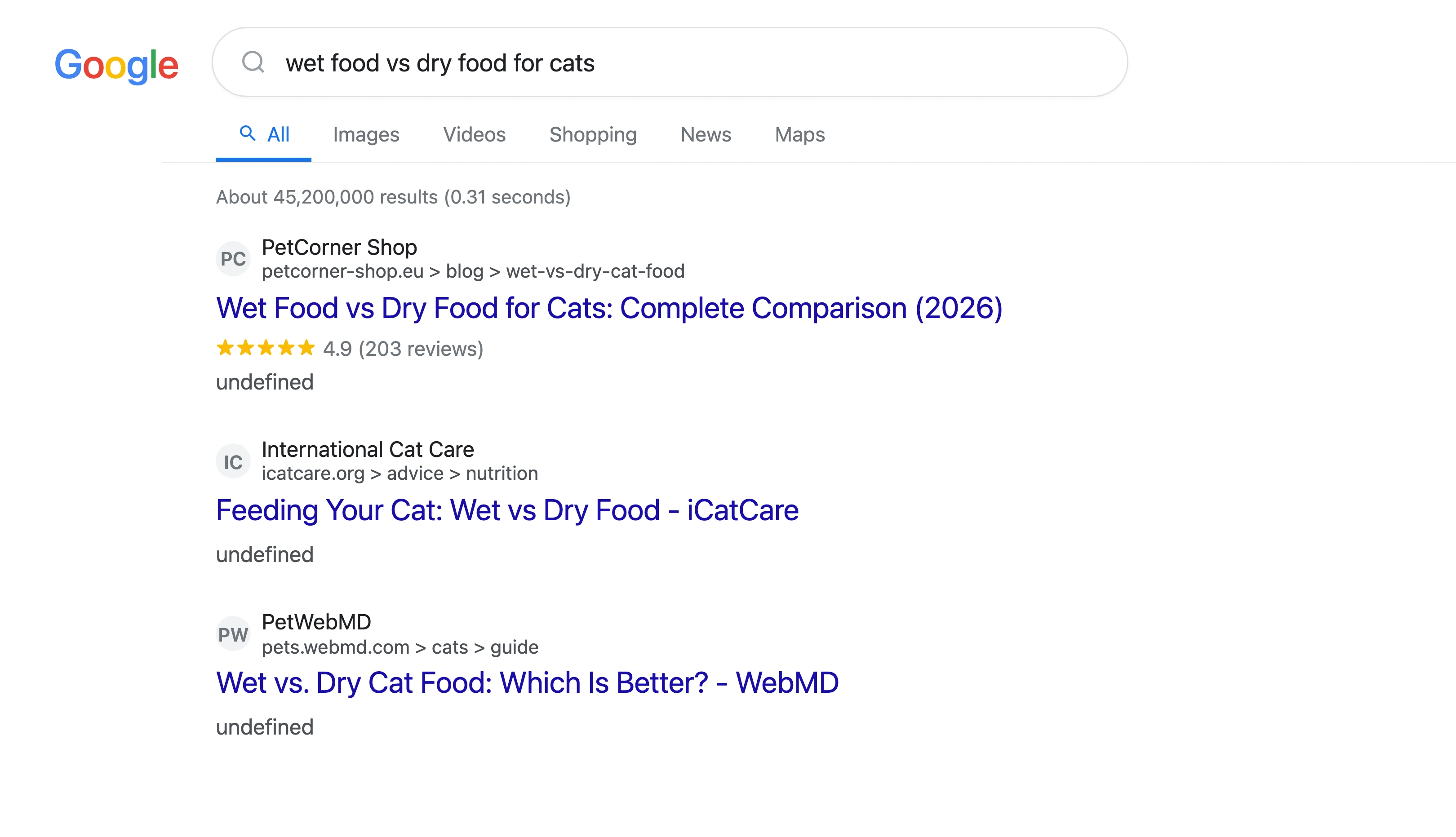
3. Comparison and recommendation intent. Pet owners frequently compare products, breeds, foods, and treatments. These comparison queries generate AI Overviews because the AI can structure a useful side-by-side summary. A search for "wet food vs dry food for cats" triggers an overview that synthesizes nutritional differences, convenience factors, and veterinary recommendations.
In my experience working with pet stores across Europe, the shift toward AI Overviews has been dramatic since mid-2025. Stores that previously relied on ranking in positions 3-5 for informational queries have seen traffic drop significantly - while those whose content gets cited in the overview have maintained or increased their click-through rates. For the full picture of how to build a solid SEO foundation for your pet store, start with our pet store SEO checklist.
Petbase automates SEO content for pet stores - publishing 10 optimized articles monthly so you can focus on running your shop - start your free trial.
What Content Format Does Google's AI Overview Prefer to Cite?
Google's AI does not cite random pages. It selects sources based on structure, authority, and how cleanly the content answers the query. Only 38% of AI Overview citations come from pages ranking in the top 10 organic results[6]. That means 62% of citations come from pages that are not even on page one. Structure matters more than rank position for AI citation.
The formats Google's AI prefers to cite follow clear patterns:
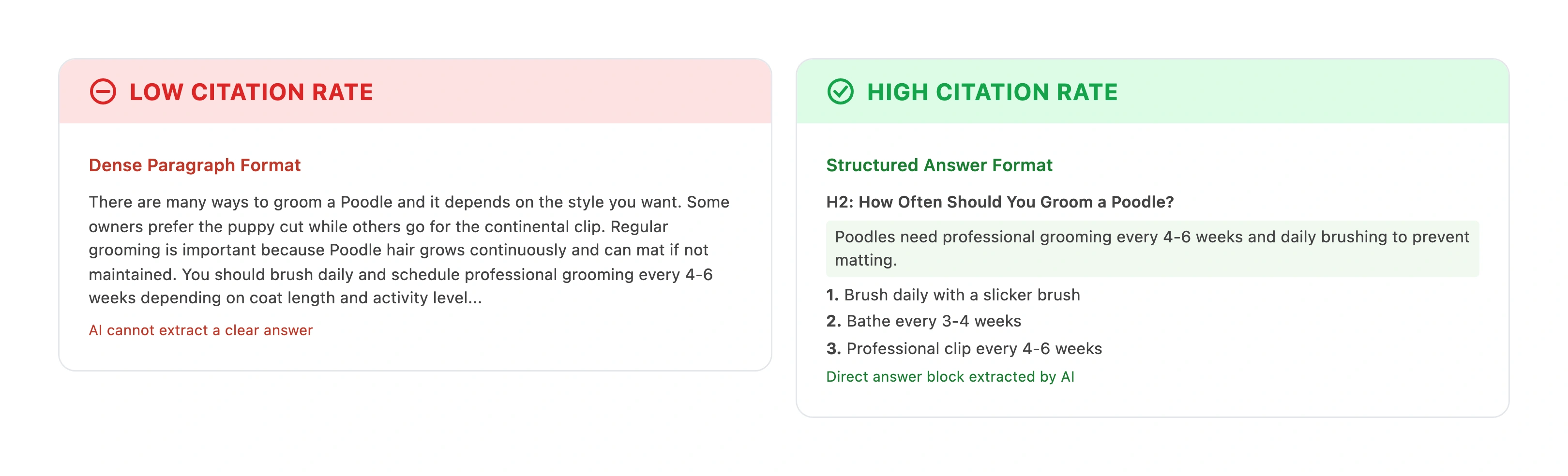
Direct answer blocks. Lead each section with a concise 40-70 word summary that directly answers the question posed in the heading. Google's AI extracts these summary blocks as citation material. A section headed "How often should you bathe a Labrador?" should begin with "Labradors should be bathed every 4-6 weeks under normal conditions, or more frequently if they swim regularly or develop skin issues." That direct answer is what the AI pulls into the overview.
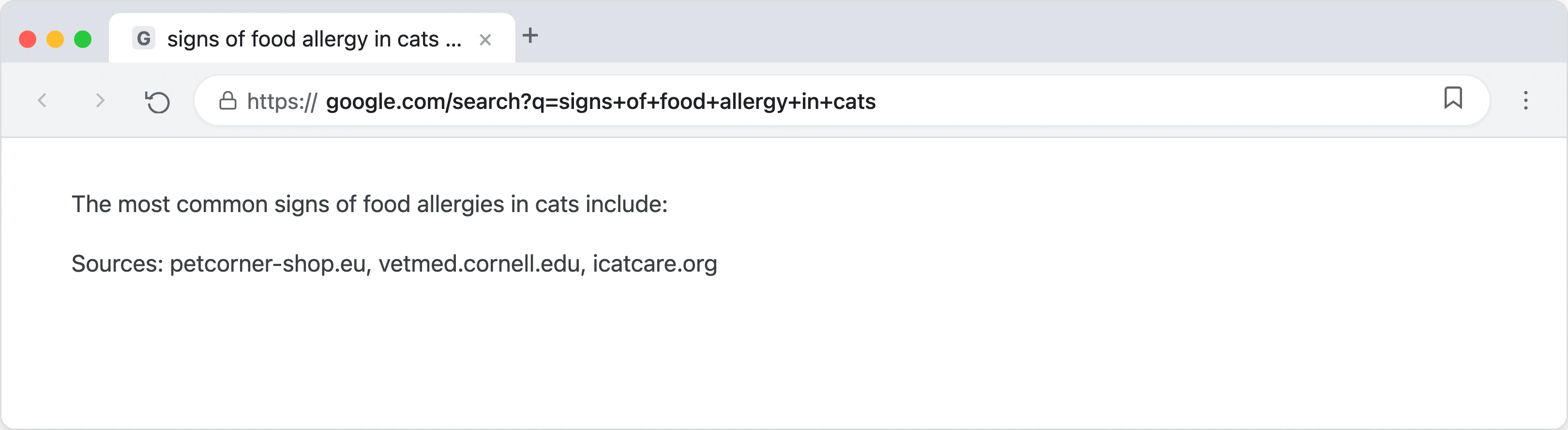
List and step formats. AI Overviews frequently display content in numbered lists or bullet points. When your content is already formatted as a numbered list, the AI can extract and display it without reformatting. A "5 signs your cat has a food allergy" article formatted as a clear numbered list is more citable than the same information buried in paragraph form.
Comparison tables. Structured data in table format is easy for AI to parse and display. A table comparing wet food versus dry food across nutritional value, cost per serving, hydration benefit, and shelf life gives the AI exactly what it needs to generate a comparison overview.
| Content Format | AI Overview Citation Rate | Best Use for Pet Content |
|---|---|---|
| Direct answer block (40-70 words) | High | Breed-specific questions, feeding guides, health symptoms |
| Numbered list / steps | High | How-to guides, grooming routines, training protocols |
| Comparison table | Medium-High | Product comparisons, food types, supplement options |
| FAQ with concise answers | High | Common pet care questions, product FAQs |
| Long paragraph prose | Low | Avoid for key information - use for context only |
The pattern is clear: AI Overviews cite structured, scannable content. Dense paragraphs get skipped even when the information they contain is accurate and comprehensive.
How Does Schema Markup Increase Your Chances of Being Cited?
Schema markup gives Google machine-readable context about your content. For AI Overviews, this context determines whether your page is even considered as a citation source. Pages with FAQPage schema are 3.2x more likely to appear in Google AI Overviews[7]. That is not a marginal improvement - it is a multiplier.
Pages with three to four complementary schema types (such as Article + FAQPage + BreadcrumbList) get cited 2x more often than pages with just one schema type[8]. For pet store blog posts, the ideal schema stack looks like this:
- Article schema: Tells Google this is an informational blog post with a specific author, publication date, and topic.
- FAQPage schema: Marks your FAQ section as structured question-answer pairs that AI can extract directly.
- BreadcrumbList schema: Shows the content hierarchy (Home > Blog > Dog Nutrition > Best Food for Labrador Puppies).
- HowTo schema (when applicable): For step-by-step guides like grooming routines, training protocols, or supplement dosing instructions.
Only 30% of websites currently use any structured data at all[9]. In the pet retail space, the percentage is even lower among independent stores. Adding proper schema markup to your blog posts gives you a structural advantage over 70% of competing sites before you write a single additional word. For a complete implementation guide with copy-paste code examples, see our schema markup guide for pet stores.
How Should You Structure Pet Blog Posts for AI Overview Citation?
The structure of your blog post determines whether Google's AI can extract useful citation material. Here is the specific framework that works for pet content:
Step 1: Open with a direct answer. The first 100 words of your post should contain a clear, factual answer to the primary query. If your post targets "how much exercise does a Border Collie need," start with "Adult Border Collies need 90 to 120 minutes of exercise daily, split into two or more sessions that include both physical activity and mental stimulation." Do not start with a story, a question, or background context. Answer first, then expand.
Step 2: Use question-phrased H2 headings. Each section heading should be a question that a pet owner would actually type into Google. "What is the best diet for a senior Dachshund?" is more citable than "Senior Dachshund Nutrition Overview." Question headings align your content with the question-based queries that trigger AI Overviews 99.2% of the time[5].
Step 3: Include a self-contained answer block under each H2. The first paragraph under each heading should be a complete, standalone answer in 100-150 words. If Google's AI only extracts that one paragraph, the reader should still get a useful answer. Then expand with supporting details, examples, and data in subsequent paragraphs.
Step 4: Add structured elements within each section. Include at least one of: a numbered list, a comparison table, a definition block, or a set of bullet points. These structured elements are the specific content pieces AI Overviews extract and display.
Step 5: Close with an FAQ section. Add three to five frequently asked questions with concise answers (50-100 words each). Back each FAQ with FAQPage schema. These question-answer pairs are among the most commonly cited content formats in AI Overviews.
Or let Petbase handle this automatically. Petbase generates blog posts that follow this exact structure - question-based headings, direct answer blocks, comparison tables, and FAQ sections with proper schema - for USD 199/mo (10 articles per month).
What Authority Signals Make Google's AI Trust Your Pet Content?
AI Overviews do not just cite well-formatted content. They cite well-formatted content from authoritative sources. Google evaluates authority through several signals that matter specifically for pet content:
Topical authority through content clusters. Google's 2025 ranking factors weight niche expertise at 13% and consistent publication of satisfying content at 23%[10]. A pet store with 30 interlinked articles about dog nutrition signals more authority on that topic than a general blog with one article about dog food. Content clusters tell Google your site is a specialist, not a generalist. For a detailed guide on building these clusters, see our post on content clustering for pet websites.
E-E-A-T signals in pet health content. Pet health topics fall under YMYL guidelines. Google evaluates Experience, Expertise, Authoritativeness, and Trustworthiness more strictly for content that could affect animal welfare. Practical signals include: named author bios with verifiable credentials, citations to veterinary or academic sources, disclaimers recommending veterinary consultation for medical decisions, and consistent factual accuracy across your content library.
Freshness and update frequency. AI Overviews favor recent content. A feeding guide updated in 2026 with current nutritional research is more citable than the same guide from 2022 with outdated recommendations. Regular publishing signals to Google that your site is actively maintained. Companies publishing 16 or more blog posts per month get 3.5x more traffic than those publishing four or fewer[11].
Backlink profile and domain trust. While only 38% of AI Overview citations come from top-10 organic results[6], domain authority still plays a role. Sites with strong backlink profiles from veterinary associations, pet industry publications, and .edu domains earn more AI citations. Long-form content (3,000+ words) receives an average of 3,000 more backlinks than shorter posts[12], making comprehensive breed guides and health articles natural link magnets.
What Are the Most Common AI Overview Formats for Pet Queries?
Understanding how AI Overviews display pet content helps you format your content to match. Pet queries generate several distinct AI Overview formats:
Definition overviews. Queries like "what is pancreatitis in dogs" trigger a definition-style overview. The AI pulls a concise, medically accurate definition from the most authoritative source. To get cited, include a clear one-to-two sentence definition at the top of your content, followed by symptoms, causes, and treatment options in separate structured sections.
Step-by-step overviews. Queries like "how to trim a cat's nails" trigger a numbered step format. The AI extracts steps from HowTo schema or well-formatted numbered lists. Each step should be one clear sentence with an optional brief explanation.
Comparison overviews. Queries like "wet food vs dry food for puppies" trigger a two-column comparison. Format your content as a structured comparison table with clear categories (nutrition, cost, convenience, hydration) and the AI can extract it directly.
List overviews. Queries like "best supplements for senior dogs" trigger a bulleted or numbered list. Each list item should have a bold name followed by a one-sentence description. Keep the list to 5-8 items - AI Overviews rarely display more than that.
Multi-source synthesis. Complex queries like "should I give my dog probiotics after antibiotics" trigger an overview that synthesizes information from multiple sources. Getting cited here requires your content to cover one specific angle with clear expertise - the dosing timeline, the probiotic strains, or the veterinary recommendation - rather than trying to cover everything superficially.
One pattern I have seen repeatedly across pet store clients is that the sites getting cited are not always the ones with the highest domain authority. They are the ones with the most clearly structured content that directly answers the specific question being asked. A small pet store with a well-formatted breed feeding guide can get cited over a major retailer with a poorly structured category page.
How Do You Track Whether Your Pet Content Appears in AI Overviews?
You cannot optimize what you do not measure. Tracking AI Overview citations requires specific tools and approaches:
Google Search Console. While Search Console does not yet have a dedicated AI Overview report, you can monitor impression and click data for queries that likely trigger overviews. A sudden drop in CTR for a query where your ranking position stayed the same often indicates an AI Overview appeared and captured clicks.
Manual spot-checking. Search for your target keywords in an incognito browser and note which queries display AI Overviews. Document which sources are cited and compare your content structure to theirs. Do this monthly for your top 20 keywords.
Third-party tracking tools. Ahrefs, Semrush, and SE Ranking now offer AI Overview tracking features that monitor which queries trigger overviews, which sources are cited, and whether your domain appears[13]. These tools automate the monitoring that would take hours to do manually.
Metrics to track:
- Number of queries where your domain is cited in AI Overviews
- CTR changes for keywords where AI Overviews appear
- Citation position (first cited source vs. supplementary source)
- Content format of your cited pages vs. non-cited pages
- Schema types present on cited vs. non-cited pages
Track these metrics monthly and compare against your optimization changes. The feedback loop between tracking and optimization is what separates sites that improve their AI visibility from those that decline.
What Should You Do If AI Overviews Are Reducing Your Traffic?
If AI Overviews are capturing clicks that used to go to your pet store content, there are two strategic responses:
Strategy 1: Get cited. Restructure your existing content to match the formats AI Overviews prefer. Add direct answer blocks, comparison tables, FAQ sections with schema, and clear heading structures. This guide provides the exact framework. The goal is to become the source the AI cites, which delivers a 35% CTR increase[4] rather than the 61% CTR loss that non-cited pages experience[3].
Strategy 2: Target queries that do not trigger AI Overviews. Not all pet queries generate overviews. Transactional queries ("buy grain-free dog food online"), local queries ("pet store near me open now"), and highly specific product queries ("Orijen Senior Dog Food 11.4kg price") are less likely to trigger AI Overviews. Shifting some of your content strategy toward these query types protects your traffic from AI disruption. E-commerce queries trigger AI Overviews only 4% of the time[1].
Strategy 3: Build authority on multiple AI platforms. Google AI Overviews are just one AI search surface. ChatGPT, Perplexity, and Claude also generate answers from web sources. Content optimized for one AI platform tends to perform well across all of them because the underlying quality signals - structure, authority, accuracy - are universal. A pet store that gets cited in Google AI Overviews, ChatGPT, and Perplexity captures visibility across the entire AI search ecosystem. An estimated 31.3% of the US population will use generative AI search in 2026[14].
Or let Petbase handle this automatically. Petbase generates pet store content pre-optimized for AI citation - with question headings, direct answer blocks, FAQ schema, and comparison tables built in. Ten articles per month, each structured for AI visibility, for USD 199/mo.
How Do You Optimize Existing Pet Content for AI Overviews?
You do not need to rewrite your entire blog. Focus optimization on your highest-traffic and highest-potential posts first. Here is a practical prioritization framework:
Priority 1: Posts already ranking on page 1. These posts have demonstrated authority. Adding AI-friendly formatting (direct answer blocks, FAQ schema, structured data) gives them the structural edge needed to get cited. Since only 38% of AI citations come from top-10 results[6], even page-1 content needs formatting optimization.
Priority 2: Posts targeting question-based keywords. If a post targets a question like "how to transition a puppy to adult food," it is a high-probability AI Overview candidate. Restructure these posts with a direct answer in the first paragraph and FAQ schema at the bottom.
Priority 3: Posts with comparison content. Any post that compares products, ingredients, breeds, or approaches can be restructured with comparison tables that AI Overviews extract and display.
The optimization checklist for each post:
- Add a 40-70 word direct answer in the first paragraph
- Convert section headings to question format
- Add a self-contained answer block (100-150 words) under each H2
- Insert at least one comparison table or structured list
- Add 3-5 FAQ items with FAQPage schema
- Add HowTo schema if the post contains sequential steps
- Update the publication date and ensure all data is current
- Add or update author bio with verifiable credentials
Organic search still drives 53% of all website traffic[15]. AI Overviews are changing how that traffic flows, but the opportunity has not disappeared. It has shifted to sites that structure their content for AI extraction. For a comprehensive on-page optimization approach, see our on-page SEO guide for pet stores.
Frequently Asked Questions
Do AI Overviews replace organic search results for pet queries?
No. AI Overviews appear above organic results, but the organic listings still display below. The challenge is that users who get a satisfactory answer from the overview may not scroll down to click organic results. That is why organic CTR drops 61% on queries with AI Overviews[3]. However, sites cited within the AI Overview see CTR increases of up to 35%[4]. The traffic is not gone - it is redistributed to the sources the AI cites.
Does schema markup directly improve rankings in AI Overviews?
Schema markup does not directly improve organic rankings, but it dramatically improves your chances of being cited in AI Overviews. Pages with FAQPage schema are 3.2x more likely to appear in AI Overviews[7], and pages with three to four complementary schema types get cited 2x more often[8]. Schema helps Google's AI understand your content structure, making it easier to extract and cite.
How long does it take for optimized content to appear in AI Overviews?
There is no fixed timeline because AI Overview citations depend on Google recrawling your page and re-evaluating it against competing sources. In practice, most pet store clients see changes within 2-4 weeks after restructuring content and adding schema markup. Requesting indexing through Google Search Console can accelerate the process. Consistent publishing also helps - sites that publish regularly get crawled more frequently, which means format changes are picked up faster.
Can small pet stores compete with major retailers in AI Overviews?
Yes. Only 38% of AI Overview citations come from top-10 organic results[6], which means Google's AI actively looks beyond the biggest sites when selecting citation sources. A small pet store with a well-structured, accurate breed feeding guide can get cited over a major retailer with a poorly formatted category page. Content structure and topical authority matter more than raw domain authority for AI citations.
References
- Stackmatix (2026). Google AI Overview SEO Impact: 2026 Data and Statistics. stackmatix.com
- Ahrefs (2025). What Triggers AI Overviews? 86 Factors and 146 Million SERPs Analyzed. ahrefs.com
- Seer Interactive (2025). AIO Impact on Google CTR: September 2025 Update. seerinteractive.com
- Dataslayer (2025). Google AI Overviews: The End of Traditional CTR. dataslayer.ai
- WordStream (2025). 34 AI Overviews Stats and Facts. wordstream.com
- Ahrefs (2025). 38% of AI Overview Citations Pull From The Top 10. ahrefs.com
- Frase (2025). Are FAQ Schemas Important for AI Search, GEO and AEO? frase.io
- Stackmatix (2026). Structured Data AI Search: Schema Markup Guide. stackmatix.com
- Amra and Elma (2025). Top Schema Markup Statistics. amraandelma.com
- First Page Sage (2025). The Google Algorithm Ranking Factors. firstpagesage.com
- HubSpot (2025). Marketing Statistics. hubspot.com
- BuzzStream (2025). Link Building Statistics. buzzstream.com
- Ahrefs (2025). How to Track AI Overviews: Mentions, Citations, Click Loss. ahrefs.com
- eMarketer (2026). FAQ on GEO and AEO: Where AI Search and SEO Overlap. emarketer.com
- BrightEdge (2025). How Much Traffic Comes From Organic Search. seoinc.com