How Pet Stores Get to Page 1 of Google: A Realistic Guide

Table of Contents +
- What Does It Actually Take to Rank on Page 1?
- Which Keywords Should Pet Stores Target First?
- How Long Does It Really Take a Pet Store to Rank?
- What Is the Role of Content Volume in Ranking?
- Why Does Topical Authority Matter More Than Individual Keywords?
- What Technical Factors Make or Break Pet Store Rankings?
- How Do Pet Stores Compete With Major Retailers?
- What Is a Realistic Action Plan for the First 90 Days?
- Frequently Asked Questions
- References
Only 5.7% of pages reach Google's top 10 within a year, but pet stores targeting niche keywords rank faster. Timelines, keyword types, and a 90-day plan.
Only 5.7% of newly published pages reach Google's top 10 within one year[1]. That statistic stops most pet store owners before they start. But it tells only half the story. The 5.7% figure includes every page on the internet - from a local pet store targeting "best dog food in Munich" to a new website trying to outrank Amazon for "buy dog food online."
For pet stores targeting niche, long-tail keywords with lower competition, the success rate is significantly higher. The question is not whether a pet store can reach page 1 - it is understanding which keywords to target, which ranking factors to prioritize, and how long the process realistically takes.
TL;DR
Only 5.7% of pages reach Google's top 10 within a year. But for pet stores targeting niche keywords, the timeline is shorter and the success rate is higher. This guide covers the specific ranking factors, keyword types, and realistic timeline for pet stores going from invisible to page 1.
What Does It Actually Take to Rank on Page 1?
Google uses over 200 ranking factors, but they are not all equal. Research from First Page Sage analyzed the relative weight of key factors[2]:
- Content quality and relevance: 25-30% of ranking weight. Google evaluates whether your content genuinely answers the searcher's question better than competing pages.
- Backlinks: 15-20%. The number and quality of other websites linking to your page. The #1 result on Google has an average of 3.8x more backlinks than results in positions 2-10[8].
- Technical SEO: 10-15%. Site speed, mobile-friendliness, crawlability, schema markup, and Core Web Vitals.
- User experience signals: 10-15%. Click-through rate, time on page, and bounce rate tell Google whether searchers found what they were looking for.
- Topical authority: 10-15%. Sites that publish comprehensive content on a topic are rewarded over sites with a single post on that topic.
For pet stores, the practical implication is clear: content quality and topical authority together account for 35-45% of your ranking ability. That is the largest single lever you can pull - and it is entirely within your control, regardless of budget.
Organic search drives 53% of all website traffic[3]. The top 3 results on Google capture 68.7% of all clicks[4]. Being on page 1 is not just better than page 2 - it is the difference between being found and being invisible.
Petbase automates SEO content for pet stores - publishing 10 optimized articles monthly so you can focus on running your shop - start your free trial.
Which Keywords Should Pet Stores Target First?
Not all keywords are created equal. The type of keyword you target determines your competition level, timeline to rank, and the value of the traffic you receive.
| Keyword Type | Example | Competition | Search Volume | Conversion Rate | Time to Rank |
|---|---|---|---|---|---|
| Head terms | "dog food" | Extreme | Very high | Low (1-2%) | 12-24+ months |
| Product keywords | "grain-free senior dog food" | High | Medium | Medium (3-5%) | 6-12 months |
| Local keywords | "pet store Munich" | Low-medium | Low-medium | Very high (8-12%) | 4-8 weeks |
| Breed-specific | "best food for French Bulldogs" | Low-medium | Low | High (5-8%) | 8-12 weeks |
| Informational long-tail | "how much should a Labrador puppy eat" | Low | Low | Medium (2-4%) | 8-12 weeks |
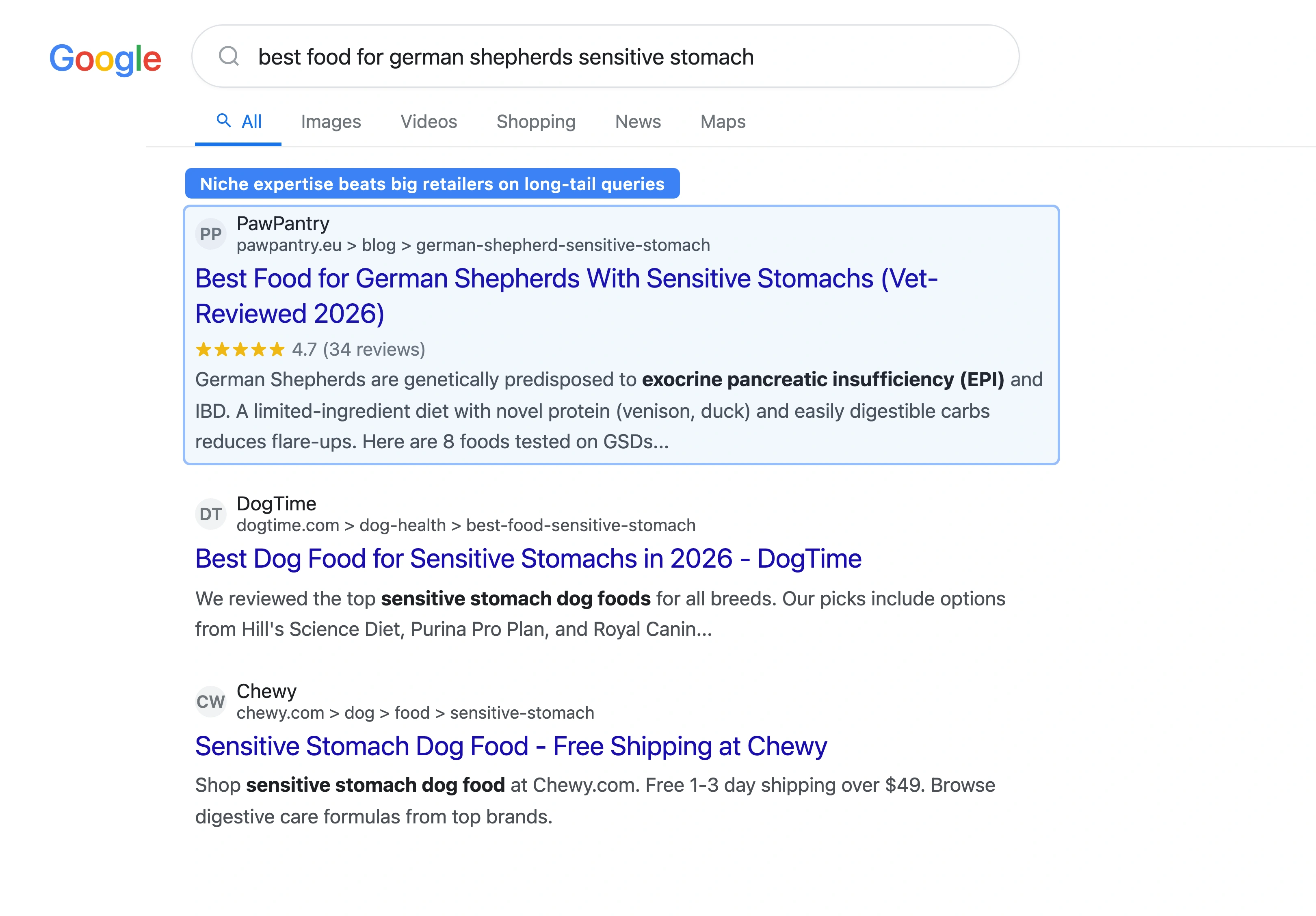
Long-tail keywords convert at 2.5x the rate of head terms[5]. A pet store ranking #1 for "best hypoallergenic food for miniature Schnauzers" gets less traffic than ranking #1 for "dog food" - but the visitors who arrive are far more likely to buy. They have a specific need and they are looking for a specific solution.
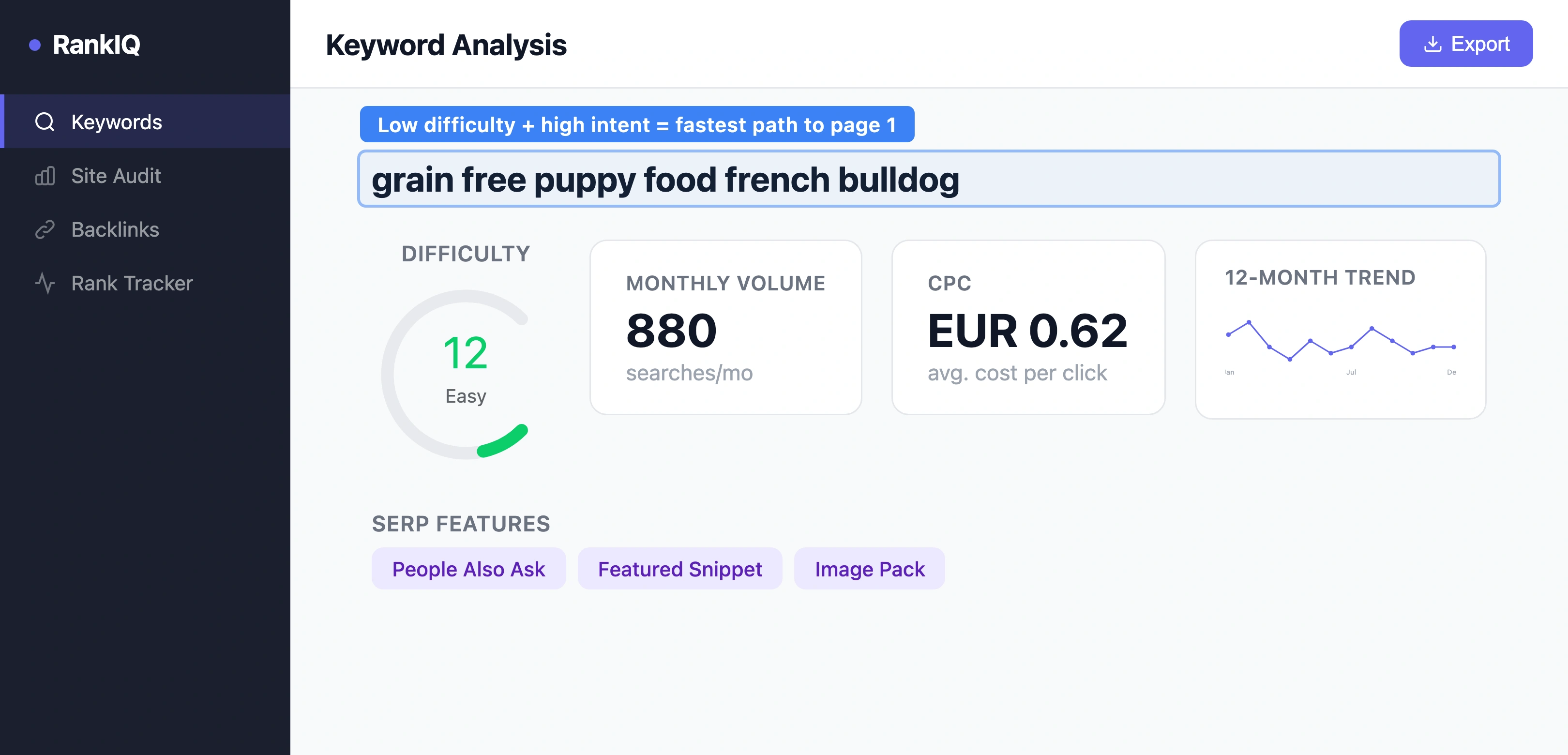
The strategy that works for pet stores: start with local keywords and breed-specific long-tail keywords (lowest competition, fastest results), then build toward product keywords and eventually head terms as your site's authority grows.
For detailed guidance on finding the right keywords, read our keyword research guide for pet businesses.
How Long Does It Really Take a Pet Store to Rank?
The honest answer: it depends on the keyword, your site's current authority, and your content strategy. But here are realistic timelines based on the data:
Local keywords ("pet store [city]"): 4-8 weeks. If you have a Google Business Profile and a website with basic local SEO, you can appear in the Local Pack within weeks. 46% of all Google searches have local intent[6], making this the fastest win for stores with a physical location. See our Google Business Profile guide for the setup process.
Long-tail informational keywords: 8-12 weeks. A well-written, comprehensive article targeting "how to transition a puppy to adult dog food" can reach page 1 within 3 months if your site has basic authority and the article is properly optimized. The key factors: content length (1,500-2,500 words for informational posts), heading structure, and internal links from related pages.
Product and category keywords: 3-6 months. More competitive keywords require more authority signals. This means more content (to build topical authority), more backlinks, and stronger technical SEO. Content clusters accelerate this timeline by building concentrated authority in specific topic areas.
Head terms: 12-24+ months. Broad, high-volume keywords like "dog food" or "pet supplies" are dominated by major retailers with massive domain authority and thousands of backlinks. Most independent pet stores should not target these directly. Instead, rank for dozens of specific long-tail variations that collectively generate more relevant traffic.
For a detailed timeline analysis with real examples, read our guide on how long it takes pet stores to rank on Google.
What Is the Role of Content Volume in Ranking?
Google does not rank websites. It ranks individual pages. But the authority of your domain affects how quickly and easily each individual page can rank. Domain authority comes from two sources: backlinks from other websites, and topical depth on your own site.
Businesses publishing 16 or more blog posts per month get 3.5x more traffic than those publishing four or fewer[7]. This is not because Google rewards publishing frequency - it is because more content creates more ranking opportunities, more internal links, and stronger topical authority signals.
For a pet store starting from zero blog content, the path to page 1 looks like this:
- Months 1-2: Publish 10 articles per month in your first content cluster (e.g., dog nutrition). Target long-tail keywords. Build internal links between all articles.
- Month 3: First articles start reaching page 2-3 of Google. Continue publishing. Start second content cluster.
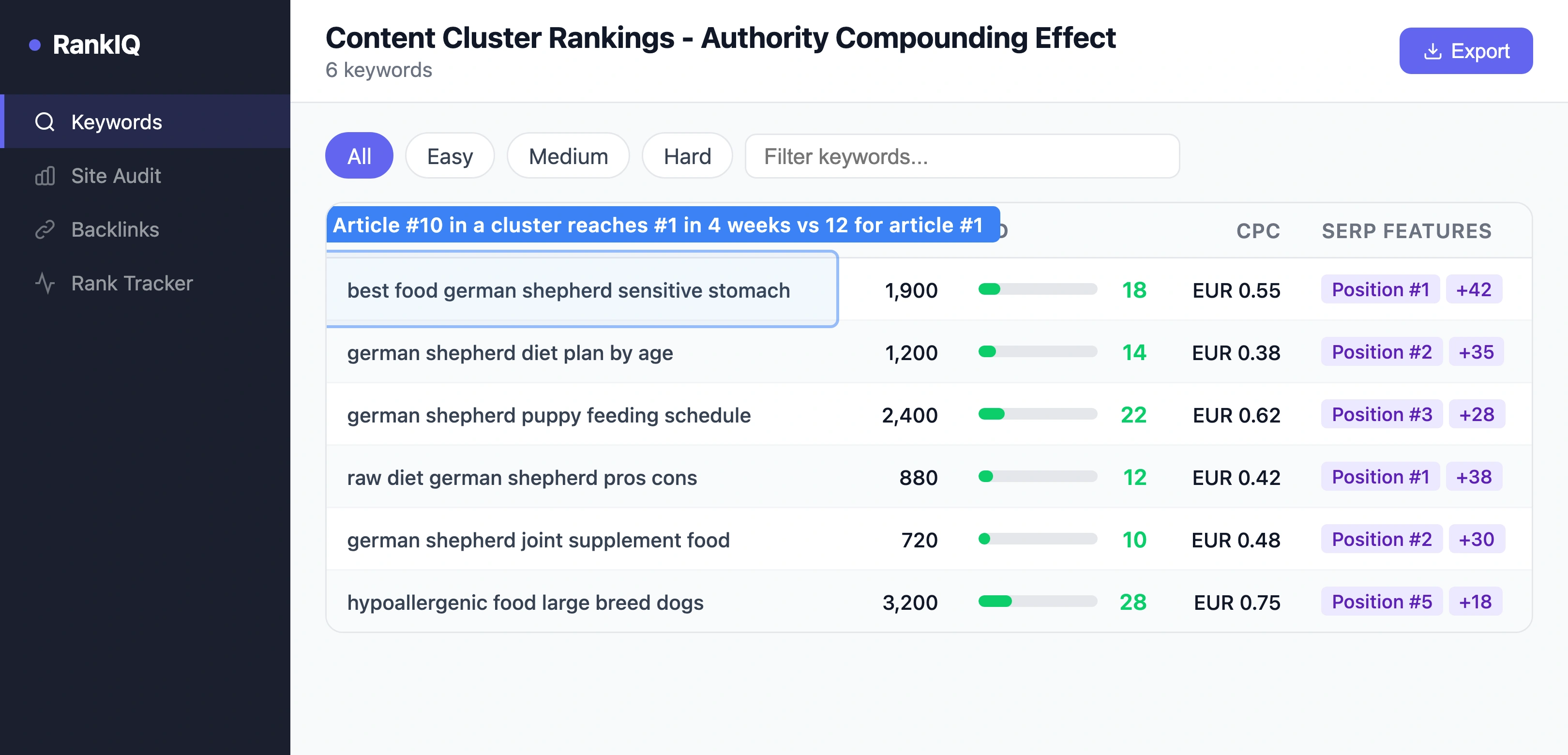
- Months 4-6: Early articles move to page 1 for long-tail keywords. Newer articles rank faster because the cluster has established authority. Total: 40-60 published articles across 2-3 clusters.
- Months 6-12: Established clusters are generating consistent traffic. Begin targeting more competitive product keywords. Update and expand best-performing content.
The key principle: each new article in a cluster ranks faster than the previous one because it inherits authority from the connected articles. Article #1 might take 12 weeks. Article #10 might take 4 weeks.
Why Does Topical Authority Matter More Than Individual Keywords?
Google's algorithms have evolved beyond matching keywords to pages. Modern Google evaluates whether your site demonstrates genuine expertise on a topic. This is the foundation of E-E-A-T (Experience, Expertise, Authoritativeness, Trustworthiness).
A pet store with one article about "senior dog nutrition" is competing against websites with 50 articles about dog nutrition. Even if that single article is excellent, Google has limited evidence that the site is a dog nutrition authority. The site with 50 connected articles on the topic has overwhelming evidence.
This is why topical authority through content clusters is the most effective SEO strategy for pet stores. Instead of targeting 50 random keywords, you target 10-15 keywords within one topic area. The interconnected content builds authority faster and ranks more pages in less time than a scattered approach.
Content that demonstrates E-E-A-T outperforms generic content by 40% in search rankings[9]. For pet stores, E-E-A-T means content that includes breed-specific knowledge, accurate health information, product experience, and the practical insights that only come from working with pets and pet owners daily.
What Technical Factors Make or Break Pet Store Rankings?
Content gets you to page 1. Technical SEO keeps you there. These are the technical factors that matter most for pet store websites:
Site speed. Google has confirmed that page speed is a ranking factor. For pet stores, the biggest speed killers are unoptimized product images and heavy homepage sliders. Compress all images to WebP format and aim for a mobile PageSpeed score above 80.
Mobile-friendliness. Google uses mobile-first indexing - it evaluates the mobile version of your site, not desktop. If your product pages are hard to navigate on a phone, your rankings suffer regardless of how good the content is.
Schema markup. Structured data helps Google understand your content. Product schema, LocalBusiness schema, FAQ schema, and Article schema can increase click-through rates by up to 30%[10]. Our pet store SEO checklist includes the specific schema types to implement.
Internal linking. Every page on your site should be reachable within 3 clicks from the homepage. Blog articles should link to related articles, product pages, and category pages. Product pages should link to relevant blog content. This structure distributes authority and helps Google discover new content.
HTTPS and security. Non-negotiable. If your site is still on HTTP, migrate to HTTPS immediately. Google has used HTTPS as a ranking signal since 2014.
How Do Pet Stores Compete With Major Retailers?
Amazon, Chewy, and large chain retailers dominate head terms. An independent pet store cannot outrank Amazon for "buy dog food online." But you can outrank them for hundreds of specific, high-intent keywords they do not target.
Major retailers optimize for product and transactional keywords. They rarely publish educational content, breed-specific guides, or local content. This leaves a massive gap that independent pet stores can fill:
- Breed-specific content: "Best food for Cavalier King Charles Spaniels with heart conditions" - too specific for Amazon, perfect for a pet store that knows the breed.
- Local content: "Dog-friendly hiking trails near Munich" or "best pet store in [your city]" - major retailers cannot compete on local relevance.
- Expert advice content: "How to switch a cat from wet food to dry food" or "supplements for senior Golden Retrievers" - content that requires genuine pet knowledge, not just product listings.
- Comparison and review content: Honest comparisons of products you carry, with breed-specific recommendations based on your experience serving customers.
The strategy is not to compete directly with major retailers. It is to own the long-tail, educational, and local keywords they ignore. Over 12-24 months, hundreds of ranked pages targeting specific, high-intent keywords can generate more qualified traffic than a single page ranking for a broad term.
What Is a Realistic Action Plan for the First 90 Days?
Days 1-7: Foundation. Claim and optimize your Google Business Profile. Fix any critical technical issues (site speed, mobile-friendliness, HTTPS). Choose your first content cluster topic based on your strongest product category.
Days 8-30: First content cluster. Publish 8-10 articles in your first cluster, each targeting a specific long-tail keyword. Link every article to 2-3 related articles within the cluster. Check our SEO strategy roadmap for detailed planning templates.
Days 31-60: Expand and optimize. Start your second content cluster. Update and expand any articles from the first cluster that are gaining impressions in Search Console. Begin basic link building through local directories and pet industry partnerships.
Days 61-90: Measure and adjust. Evaluate which keywords and articles are showing the strongest momentum. Double down on what is working. Identify content gaps in your clusters and fill them. By day 90, you should have 20-30 published articles and see your first long-tail keywords reaching page 1.
The key mindset: SEO is not a one-time project. It is an ongoing process where results compound over time. Every month of consistent publishing makes the next month more productive. Pet stores that commit to 12 months of structured content creation build a traffic asset that generates customers for years.
Frequently Asked Questions
How long does it take to reach page 1 of Google?
For local keywords with a Google Business Profile: 4-8 weeks. For long-tail informational keywords: 8-12 weeks. For competitive product keywords: 3-6 months. For broad head terms: 12-24+ months. The timeline depends on keyword competition, your site's existing authority, and the quality of your content. Pet stores starting from zero should expect their first page 1 rankings within 3 months by targeting specific, low-competition long-tail keywords.
Do I need backlinks to rank on page 1?
For low-competition long-tail keywords: not necessarily. Good content with proper on-page SEO can rank without backlinks for specific, niche queries. For more competitive keywords: yes, backlinks significantly impact rankings. The #1 result has 3.8x more backlinks than positions 2-10[8]. Start with content and on-page SEO, then build backlinks through local partnerships, pet industry directories, and high-quality content that earns links naturally.
Should I focus on a few head keywords or many long-tail keywords?
Many long-tail keywords. Long-tail keywords convert at 2.5x the rate of head terms[5], face less competition, and rank faster. Fifty pages ranking for specific long-tail keywords will generate more qualified traffic and more sales than one page stuck on page 3 for a head term. As your site authority grows from long-tail success, broader keywords become achievable.
Can a small pet store website compete with large sites?
Yes, but not on the same keywords. Large retailers dominate broad product keywords. Small pet stores dominate breed-specific, local, and educational keywords that large sites do not target. The total traffic potential from hundreds of niche keywords exceeds what most small stores need to grow. Focus on depth in your niche rather than breadth across all pet topics.
References
- Ahrefs (2024). How Long Does It Take to Rank in Google. ahrefs.com
- First Page Sage (2024). Google Ranking Factors. firstpagesage.com
- BrightEdge (2024). Organic Search Channel Share. brightedge.com
- GrowthSrc (2024). Google Search Statistics. growthsrc.com
- Embryo (2024). 30 Statistics About Long-Tail Keywords. embryo.com
- BrightLocal (2024). Local Consumer Review Survey. brightlocal.com
- HubSpot (2024). Marketing Statistics. hubspot.com
- BuzzStream (2024). Link Building Statistics. buzzstream.com
- Semrush (2024). E-E-A-T and Google Rankings. semrush.com
- Search Engine Journal (2024). Schema Markup for SEO. searchenginejournal.com