Pet Supplement Brand SEO: How to Grow Visibility, Trust and Sales Through Content

Table of Contents +
- Why Is SEO Different for Pet Supplement Brands?
- What Does the Pet Supplement Market Look Like?
- How Should Supplement Brands Build E-E-A-T?
- What Content Strategy Works for Supplement Brands?
- How Do You Handle FTC Compliance in SEO Content?
- How Can Supplement Brands Win in AI Search?
- What Does a DTC Supplement SEO Funnel Look Like?
- Scaling Supplement SEO With Petbase
- Frequently Asked Questions
- References
Pet supplement SEO guide: $2.76B market, YMYL compliance, E-E-A-T strategy, and FTC-safe content that ranks. Data-backed framework for supplement brands.
The pet supplement market is projected to reach $2.76 billion, growing at 6.9% annually.[1] That growth attracts new brands every month - all competing for the same Google searches. But supplement brands face a unique challenge: Google treats pet health content as YMYL (Your Money or Your Life), applying stricter quality standards than for typical ecommerce products.
If your supplement brand does not demonstrate genuine expertise, Google will not rank your content. Paid ads will keep getting more expensive. And competitors with stronger E-E-A-T signals will take the organic traffic you need to grow.
TL;DR
The pet supplement market is $2.76 billion growing at 6.9% annually. Supplement brands face unique YMYL scrutiny and FTC compliance requirements that make generic content strategies fail. E-E-A-T (Experience, Expertise, Authority, Trust) content strategy is the only sustainable path to organic visibility. This guide covers the full framework - from compliance to content clusters to conversion.
Why Is SEO Different for Pet Supplement Brands?
Pet supplements sit at the intersection of ecommerce and health content. Google evaluates health-related content through its YMYL framework, which means your pages need stronger trust signals than a typical pet store product page.
Three factors make supplement SEO uniquely challenging:
- FTC compliance. The Federal Trade Commission requires that health claims about supplements be backed by scientific evidence.[2] Claims like "cures joint pain" or "eliminates allergies" without clinical backing can result in enforcement action - and Google increasingly demotes content with unsupported health claims.
- YMYL scrutiny. Google Quality Raters evaluate pet health content against E-E-A-T criteria: Experience, Expertise, Authority, and Trust. Pages that lack author credentials, citations, or clear sourcing rank lower.
- AI Overview exposure. 36.8% of pet-related queries now trigger AI Overviews in Google search results.[3] For supplement brands, this means your content must be authoritative enough for Google to cite - otherwise AI-generated summaries replace your organic traffic entirely.
Brands that treat supplement SEO like regular product marketing will struggle. The brands that invest in E-E-A-T content strategy will dominate. For a deep dive into E-E-A-T for pet businesses, see our E-E-A-T guide.
Petbase builds this SEO foundation automatically for pet businesses - 10 optimized articles published every month - start your free trial.
What Does the Pet Supplement Market Look Like?
Understanding market dynamics helps you target the right content opportunities.
Key market data:
- Global pet supplement market: $2.76 billion, growing at 6.9% CAGR[1]
- 73% of EU pet owners treat their pet's nutrition as they would a family member's[4]
- DTC (direct-to-consumer) pet brands are scaling rapidly - the broader DTC market grew from $3.1 billion to $19.5 billion in recent years[5]
- The Farmer's Dog, a DTC pet nutrition brand, attracts 1.3 million monthly organic visitors[6] - proof that content-driven SEO works at scale for pet nutrition brands
The competitive landscape is shifting. Large retailers dominate generic supplement searches, but niche-specific content (breed-specific supplements, age-specific formulas, condition-specific solutions) remains wide open for specialized brands.
How Should Supplement Brands Build E-E-A-T?
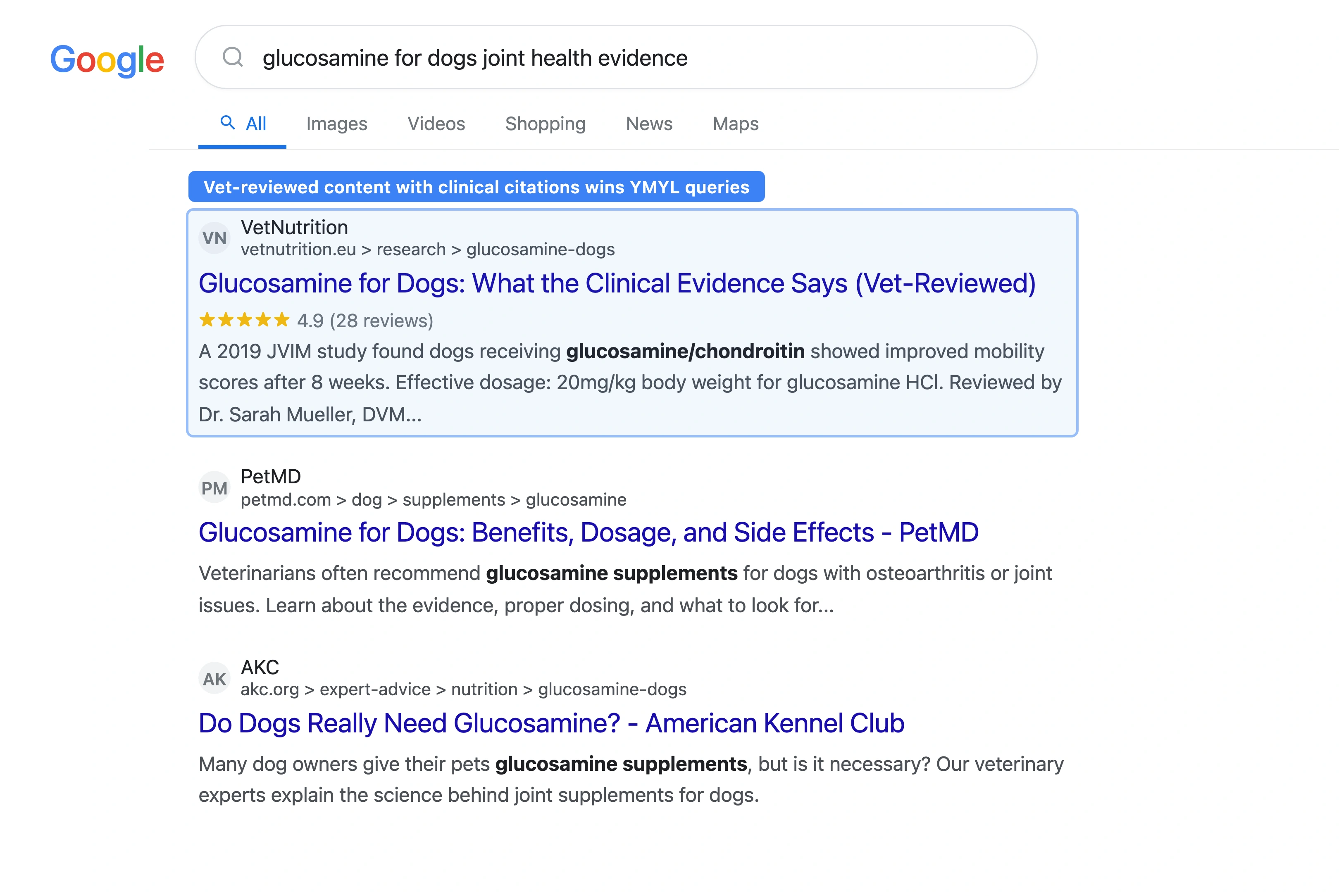
E-E-A-T is not a ranking factor you can toggle on. It is a pattern of trust signals that Google evaluates across your entire site. Brands with strong E-E-A-T signals see up to 40% more organic visibility compared to competitors without them.[7]
Experience
Show that real people with real experience are behind your content:
- Include author bios with veterinary or animal nutrition credentials
- Share product development stories and sourcing transparency
- Feature customer testimonials with specific health outcomes (within FTC guidelines)
- Document your testing and quality assurance processes
Expertise
Demonstrate deep knowledge of pet nutrition and supplementation:
- Publish detailed ingredient guides explaining what each compound does and why it is included
- Create condition-specific content (joint health, skin and coat, digestive support, anxiety)
- Reference peer-reviewed research and veterinary studies
- Address common misconceptions about pet supplements with factual corrections
Veterinary AI accuracy remains a concern - a study in Frontiers in Veterinary Science found that AI-generated pet health content contains significant accuracy gaps.[8] This means human-reviewed, expert-vetted content has a clear competitive advantage over AI-only content.
Authority
Build authority through external signals:
- Earn backlinks from veterinary publications and pet health websites
- Get cited in industry reports and market analyses
- Partner with veterinary professionals for content review and endorsement
- Maintain consistent brand presence across industry directories and platforms
Trust
Trust is the foundation. For supplement brands, trust means:
- Transparent ingredient sourcing and manufacturing processes
- Third-party testing certifications displayed prominently
- Clear dosage guidelines and safety warnings
- FTC-compliant claims - no exaggeration, no unsupported promises
- Accessible customer service and clear return policies
For a broader perspective on health content that Google trusts, see our pet health content guide.
What Content Strategy Works for Supplement Brands?
The most effective content strategy for pet supplement brands follows a topic cluster model built around conditions and life stages.
Core Topic Clusters
| Cluster Topic | Example Articles | Search Intent | Conversion Path |
|---|---|---|---|
| Joint Health | "Signs of joint pain in dogs," "Glucosamine for dogs - what the research says" | Informational to commercial | Joint supplement product page |
| Skin and Coat | "Why is my dog itching," "Omega-3 for dogs - dosage and benefits" | Problem-aware to solution-aware | Skin and coat supplement page |
| Digestive Health | "Probiotics for dogs - do they work," "Dog food sensitivities guide" | Research to purchase | Digestive supplement page |
| Senior Pet Care | "Best supplements for aging dogs," "Cognitive support for senior cats" | Life-stage specific | Senior wellness bundle page |
| Anxiety and Calming | "Natural calming supplements for dogs," "CBD vs. melatonin for pet anxiety" | Comparison and evaluation | Calming supplement page |
Each cluster should contain 5-10 articles that link to each other and to the relevant product page. This internal linking structure passes topical authority from informational content to commercial pages.
Content Formats That Perform
- Ingredient deep dives. "What is glucosamine and how does it help dogs?" - these rank for high-volume informational queries and position your brand as an authority.
- Condition guides. "Complete guide to managing arthritis in senior dogs" - comprehensive content that earns backlinks and featured snippets.
- Comparison content. "Fish oil vs. krill oil for dogs" - captures evaluation-stage searches where buyers are close to a purchase decision.
- Veterinary Q&A. Interview format with a vet reviewing your products or discussing supplement science - strong E-E-A-T signal.
How Do You Handle FTC Compliance in SEO Content?
FTC compliance is not optional for supplement brands - and it directly affects SEO. Google increasingly demotes content with unsubstantiated health claims.
Rules to follow:
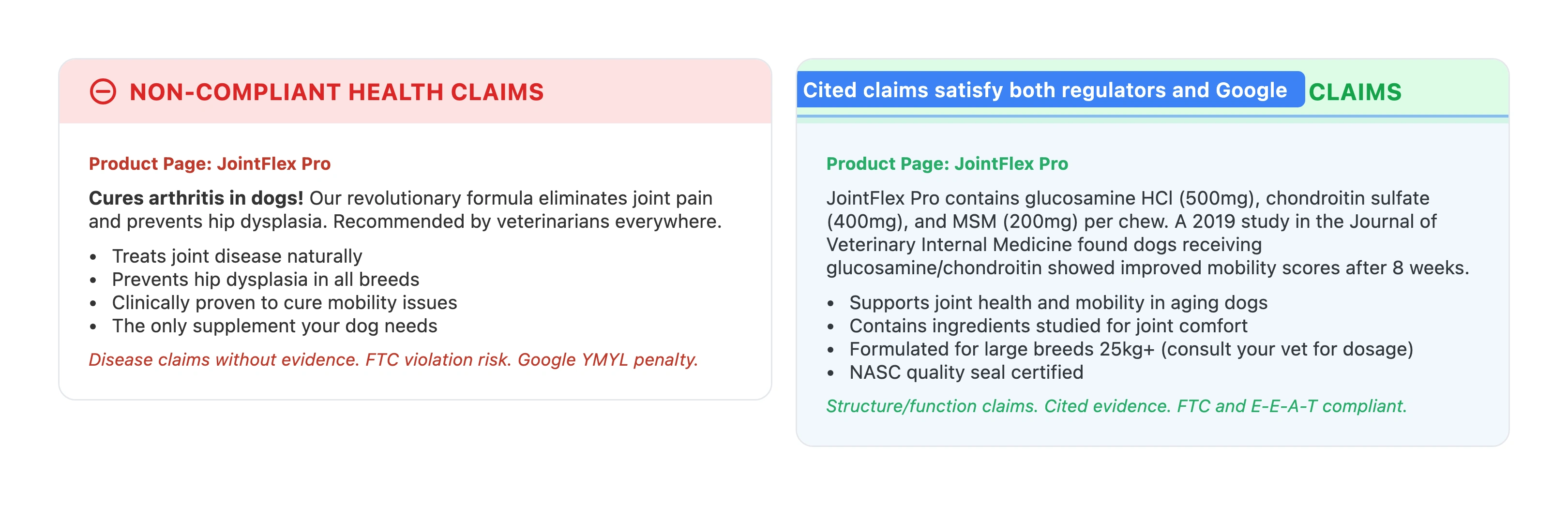
- No disease claims. "Treats," "cures," "prevents," and "diagnoses" are reserved for FDA-approved drugs, not supplements.
- Structure-function claims only. "Supports joint health" is acceptable. "Cures arthritis" is not.
- Substantiation required. Every claim must be backed by competent and reliable scientific evidence.[2]
- Disclaimers where needed. "These statements have not been evaluated by the FDA" should appear where applicable.
- Testimonial guidelines. Customer results must represent typical outcomes, not exceptional cases.
Compliant content actually performs better in search because it aligns with what Google considers trustworthy. Non-compliant content triggers quality rater downgrades and risks manual actions.
How Can Supplement Brands Win in AI Search?
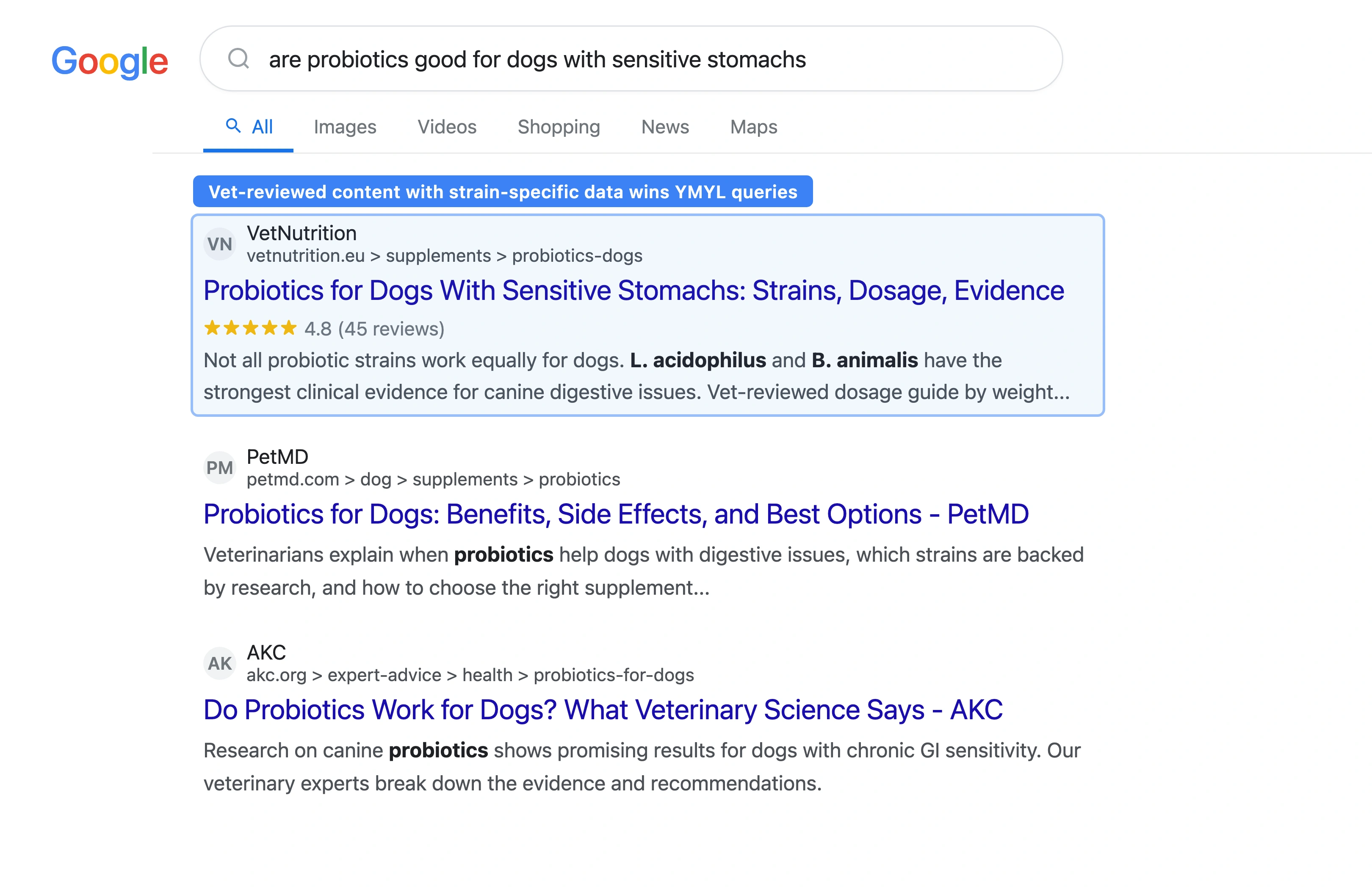
With 36.8% of pet queries triggering AI Overviews[3], supplement brands need content that AI systems cite rather than replace.
Strategies for AI search visibility:
- Structured data. Implement Product, Review, and FAQ schema on every product and content page.
- Clear, factual statements. AI systems prefer concise, citation-backed claims over marketing fluff.
- Unique research. Original data, proprietary studies, and expert interviews give AI systems reasons to cite your content.
- Comprehensive coverage. Articles that fully answer a question are more likely to be featured than thin pages.
The brands that produce the most authoritative, well-structured, and factually grounded content will be the ones AI systems reference. For more on this trend, see our pet product brand SEO guide.
What Does a DTC Supplement SEO Funnel Look Like?
DTC supplement brands need content at every stage of the buying journey:
- Awareness. Blog posts about pet health conditions - "Signs your dog has joint pain." These capture top-of-funnel searches and introduce your brand.
- Consideration. Comparison and ingredient content - "Glucosamine vs. chondroitin for dogs." These help buyers evaluate options.
- Decision. Product pages with schema markup, reviews, and clear pricing. Internal links from consideration content drive qualified traffic here.
- Retention. Dosage guides, administration tips, and progress tracking content. These reduce churn and build long-term customer value.
This funnel mirrors the AIDA framework (Attention, Interest, Desire, Action) applied specifically to supplement sales through organic search.
Scaling Supplement SEO With Petbase
Pet supplement brands need consistent, expert-quality content that meets YMYL standards - published regularly and optimized for both traditional and AI search. That is a significant content operation to build and maintain.
Petbase generates 10 expert articles per month for EUR 199/mo, tailored to the pet supplement industry. Every article is built around your target keywords, links to your product pages, and follows E-E-A-T best practices that pet health content requires.
With the DTC pet market scaling rapidly[5] and AI search reshaping how pet owners discover supplements, the brands that build content authority now will own the organic channel for years to come.
Start your free trial and build supplement content that Google trusts.
Frequently Asked Questions
Do pet supplement brands need different SEO than regular pet stores?
Yes. Pet supplement content falls under Google's YMYL (Your Money or Your Life) classification, which means stricter quality evaluation. Every health claim needs scientific backing, author credentials matter more, and E-E-A-T signals carry more weight. Brands with strong E-E-A-T see up to 40% more visibility.[7] Regular pet store SEO focuses on product and local optimization; supplement SEO requires a layer of medical-grade content trust on top of that foundation.
Can supplement brands make health claims in SEO content?
Only structure-function claims are permitted for supplements. You can say "supports joint health" but not "cures arthritis." The FTC requires competent and reliable scientific evidence for any benefit claim.[2] Compliant content actually ranks better because it aligns with Google's trustworthiness criteria. Non-compliant claims risk both FTC enforcement and Google ranking penalties.
How important is veterinary endorsement for supplement SEO?
Veterinary involvement is one of the strongest E-E-A-T signals for pet supplement content. Having a veterinarian review and co-author content, provide dosage guidance, and contribute to product development stories sends clear expertise signals to both Google and potential customers. AI accuracy concerns in veterinary content[8] make human veterinary oversight a competitive advantage that AI-only brands cannot replicate.
How long does it take for supplement brand content to rank?
YMYL content typically takes longer to establish rankings than non-YMYL content - expect 4-8 months for informational articles and 6-12 months for competitive commercial keywords. The key accelerator is E-E-A-T signal strength: brands with veterinary authors, cited research, and strong backlink profiles rank faster. Consistent publishing of 8-10 articles per month builds the topical authority that Google requires before elevating supplement content to page one. AI content tools can help scale your supplement brand's publishing - see our AI content guide for pet businesses.
References
- Grand View Research (2024). Pet Supplement Market Size, Share & Trends Analysis Report. grandviewresearch.com
- Federal Trade Commission (2024). Dietary Supplements: An Advertising Guide for Industry. ftc.gov
- BrightEdge (2025). Generative AI in Search Research Report. brightedge.com
- FEDIAF (2024). European Pet Statistics. fediaf.org
- Statista (2025). DTC E-commerce Sales in the United States. statista.com
- Semrush (2025). The Farmer's Dog Domain Overview. semrush.com
- Semrush (2025). E-E-A-T and Google Rankings. semrush.com
- Frontiers in Veterinary Science (2024). AI Accuracy in Veterinary Health Information. frontiersin.org