How to Repurpose Pet Store Blog Content Across 7 Channels


Table of Contents +
- Why Does Creating Content Once and Posting Once Waste Your Effort?
- What Is the Real Cost of Not Repurposing Pet Store Content?
- Which Blog Posts Should You Repurpose First?
- Channel 1: How Do You Turn Blog Posts Into Social Media Content?
- Channel 2: How Can Email Newsletters Multiply Your Blog Reach?
- Channel 3: Why Is Short-Form Video a High-ROI Repurposing Channel?
- Channel 4: How Does Pinterest Extend the Life of Your Content?
- Channel 5: How Do Google Business Profile Posts Boost Local Visibility?
- Channel 6: How Can Community Forums and Q&A Sites Drive Targeted Traffic?
- Channel 7: How Do You Convert Blog Content Into Podcast or Audio Material?
- What Does a Full Repurposing Workflow Look Like?
- How Do You Measure Which Channels Perform Best?
- What Are the Most Common Repurposing Mistakes Pet Stores Make?
- Frequently Asked Questions
- References
Learn how to repurpose pet store blog content across 7 channels. Save 60-80% of creation time and increase reach by 300% with this step-by-step guide.
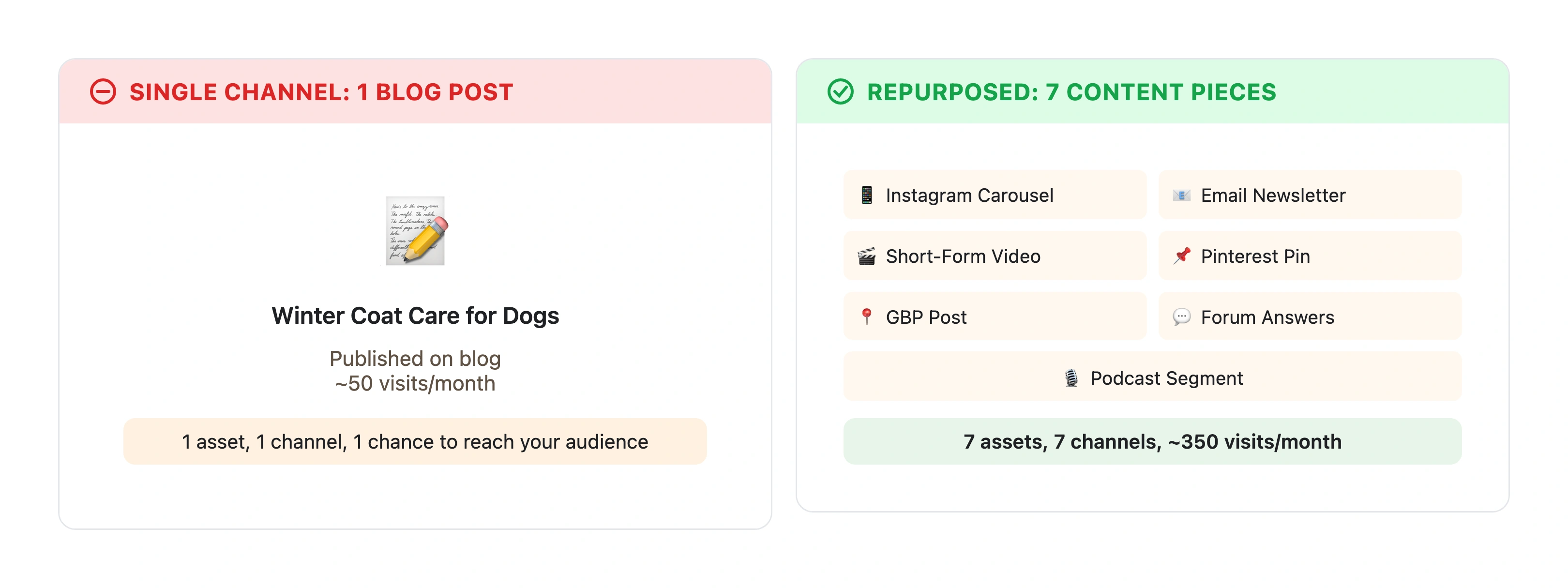
You spend four hours writing a blog post about winter coat care for dogs. You publish it. It gets some traffic from Google. And then it sits there - one article, one channel, one chance to reach your audience. Meanwhile, a competing pet store took the same topic and turned it into an Instagram carousel, a short video, a newsletter, a Pinterest pin, a Google Business Profile update, and a podcast segment. Same effort at the source. Seven times the reach.
This is the gap most pet store owners do not see. 94% of marketers already repurpose their content[1], yet many pet stores still treat each blog post as a one-and-done effort. The result is wasted hours and missed opportunities to connect with pet owners where they actually spend time online.
TL;DR
One blog post can fuel seven channels: social media, email, video, Pinterest, Google Business Profile, community forums, and podcast content. Content repurposing saves 60-80% of creation time while increasing reach by up to 300%. This guide shows exactly how to adapt pet store content for each channel with real examples.
Why Does Creating Content Once and Posting Once Waste Your Effort?
The average blog post takes 3 to 5 hours to write[2]. For a pet store owner already working long days, that is a significant investment. And when you only use that content on your blog, you are leaving most of its value untapped.
Consider the numbers. Companies with active blogs generate 55% more website traffic[3]. But blogs receive 70% of their traffic from organic search[2] - which means they miss the other 30% of potential readers who find content through social media, email, or other platforms. Multi-channel content strategies generate 287% higher engagement compared to single-channel approaches[4].
Resource constraints are the number one content marketing challenge, with 39% of businesses citing them as their top barrier[5]. Repurposing solves this by getting more output from the same input. Instead of creating seven separate pieces of content, you create one strong blog post and adapt it to seven formats. Content repurposing saves 60-80% of creation time while increasing reach by up to 300%[6].
For a deeper look at why consistent blogging matters for pet stores, read our guide on how blog posts drive sales for pet stores.
Petbase automates SEO content for pet stores - publishing 10 optimized articles monthly so you can focus on running your shop - start your free trial.
What Is the Real Cost of Not Repurposing Pet Store Content?
Think about the content you have already published. If your pet store blog has 30 articles, and each took 4 hours to write, that is 120 hours of work. If each article only lives on your blog, you have 30 assets working in one channel. Repurpose those same 30 articles across 7 channels, and you have 210 content touchpoints - without writing a single new word from scratch.
The financial impact is real. Content marketing returns an average of $7.65 for every dollar spent, compared to $1.80 for paid advertising[7]. Content repurposing strategies improve that ROI by an additional 32%[1]. Your competitors who repurpose are extracting more value from the same time investment. Your competitors who do not repurpose are leaving money on the table - just like you.
In my experience working with pet stores across Europe, the ones that repurpose consistently see their content efforts compound. A breed guide that gets turned into social posts, email segments, and Google Business Profile updates generates three to four times more total engagement than the blog post alone. The effort to repurpose is 30 minutes per channel. The effort to create original content for each channel is 20 or more hours.
Which Blog Posts Should You Repurpose First?
Not every blog post is equally suited for repurposing. Start with your best-performing content and your most evergreen topics. 76% of blog traffic comes from older posts published months or years ago[3], and only 10% of posts become compounding - yet those generate 38% of total blog traffic[3].
For pet stores, the best candidates for repurposing fall into five categories:
- Breed guides: Articles about specific breeds (nutrition, grooming, exercise) have long-lasting relevance and lend themselves to visual formats like Instagram carousels and Pinterest pins.
- Seasonal care content: Winter coat care, summer heat safety, tick prevention guides - these can be repurposed annually with minor updates.
- Product education: Posts comparing food types, explaining supplement ingredients, or reviewing grooming tools are ideal for short-form video demonstrations.
- How-to tutorials: Step-by-step grooming tips, feeding guides, or training basics translate directly to video and infographic formats.
- Local guides: "Best dog parks in [city]" or seasonal event round-ups work well across Google Business Profile posts and social media.
If you need help building a content library worth repurposing, see our guide to building an SEO content calendar for your pet business.
Channel 1: How Do You Turn Blog Posts Into Social Media Content?
Social media is the most straightforward repurposing channel. A single 2,000-word blog post about puppy nutrition can become 5 to 8 separate social media posts across Instagram, Facebook, and LinkedIn.
Here is how to break it down for pet store content:
- Instagram carousel: Pull the 5 key takeaways from your blog post. Each slide covers one point with a bold headline and one supporting sentence. Example: A blog post about "Best food for senior dogs" becomes a 5-slide carousel - one slide per life-stage-specific nutrient (joint support, digestible proteins, omega fatty acids, fibre, reduced calories).
- Facebook post: Take the opening paragraph of your blog post, add a question at the end to prompt engagement, and link back to the full article. Pet content generates strong engagement on Facebook because pet owners love sharing advice.
- LinkedIn update: If your pet store targets B2B clients (breeders, groomers, doggy daycares), adapt the blog content into a professional insight post. LinkedIn articles repurposed from blog posts see a 45% increase in shares[8].
The key is adaptation, not duplication. Do not simply copy-paste your blog text into a social post. Reformat it for the platform: shorter sentences for Instagram, more context for LinkedIn, and a conversational tone for Facebook.
Channel 2: How Can Email Newsletters Multiply Your Blog Reach?
Email is one of the highest-ROI marketing channels available to small businesses. Email marketing achieves $42 in return for every dollar spent[9]. And 64% of small businesses already use email marketing to reach customers[10].
For pet stores, blog-to-email repurposing works like this:
- Weekly digest: Summarize your latest 2-3 blog posts in a short email with one-paragraph summaries and links to the full articles. This drives traffic back to your blog and keeps your store top-of-mind.
- Segmented content: If your blog post covers "Top 5 supplements for large breed dogs," send it specifically to customers who have purchased large breed food. Personalized emails have 29% higher open rates and 41% more unique click rates[9].
- Seasonal tip series: Turn a comprehensive blog post about summer pet safety into a 4-email drip series, releasing one tip per week throughout June. This transforms one blog post into a month of email content.
81% of small businesses rely on email as their primary customer acquisition channel[10]. Every blog post you publish is a potential email. If you are not sending it, you are ignoring the channel where your customers are most likely to buy.
Channel 3: Why Is Short-Form Video a High-ROI Repurposing Channel?
Short-form video delivers 890% ROI - the highest of any content format[11]. And 45% of marketers report video as their top-performing content in 2025[11]. For pet stores, the visual nature of your products and customers (pets) gives you a natural advantage that most B2B companies do not have.
Here is how to repurpose blog content into video:
- Talking head + key points: Stand in your store, summarize the 3 main takeaways from your blog post in 60 seconds, and post to Instagram Reels, TikTok, and YouTube Shorts simultaneously. A blog post about "How to choose the right dog harness" becomes a quick comparison video showing different harness types on a dog mannequin or a willing store visitor.
- Product demonstration: If your blog post reviews or compares products, film a 30-second demonstration. Show the supplement, the grooming tool, or the toy in action. This is content your blog cannot deliver because text does not show motion.
- Before/after: Blog posts about grooming, nutrition improvements, or training results translate well into before/after video clips. These generate high engagement because the transformation is visually compelling.
You do not need professional equipment. A smartphone and natural light from your shop window produce good enough quality. The content expertise in your blog post is what matters - the video format simply makes it more accessible. For more on this topic, keep an eye out for our upcoming guide to video SEO for pet stores.
Channel 4: How Does Pinterest Extend the Life of Your Content?
Most social media posts have a lifespan measured in hours. Pinterest is different. Pinterest content stays relevant for approximately 3.76 months[12] - nearly four months of visibility from a single pin. Pinterest users are also 7 times more likely to say Pinterest is the most influential platform for purchasing decisions[12].
For pet stores, Pinterest is particularly effective because pet content is one of the most-pinned categories on the platform. Here is how to repurpose:
- Infographic pins: Condense your blog post into a vertical infographic. A 2,500-word article about "Feeding schedule for puppies by age" becomes a single, pin-friendly visual with age ranges, portion sizes, and meal frequency. Tools like Canva have pet-themed templates ready to use.
- Product round-up pins: If your blog post compares five dog food brands, create a pin for each brand with a brief verdict and a link to the full comparison on your blog.
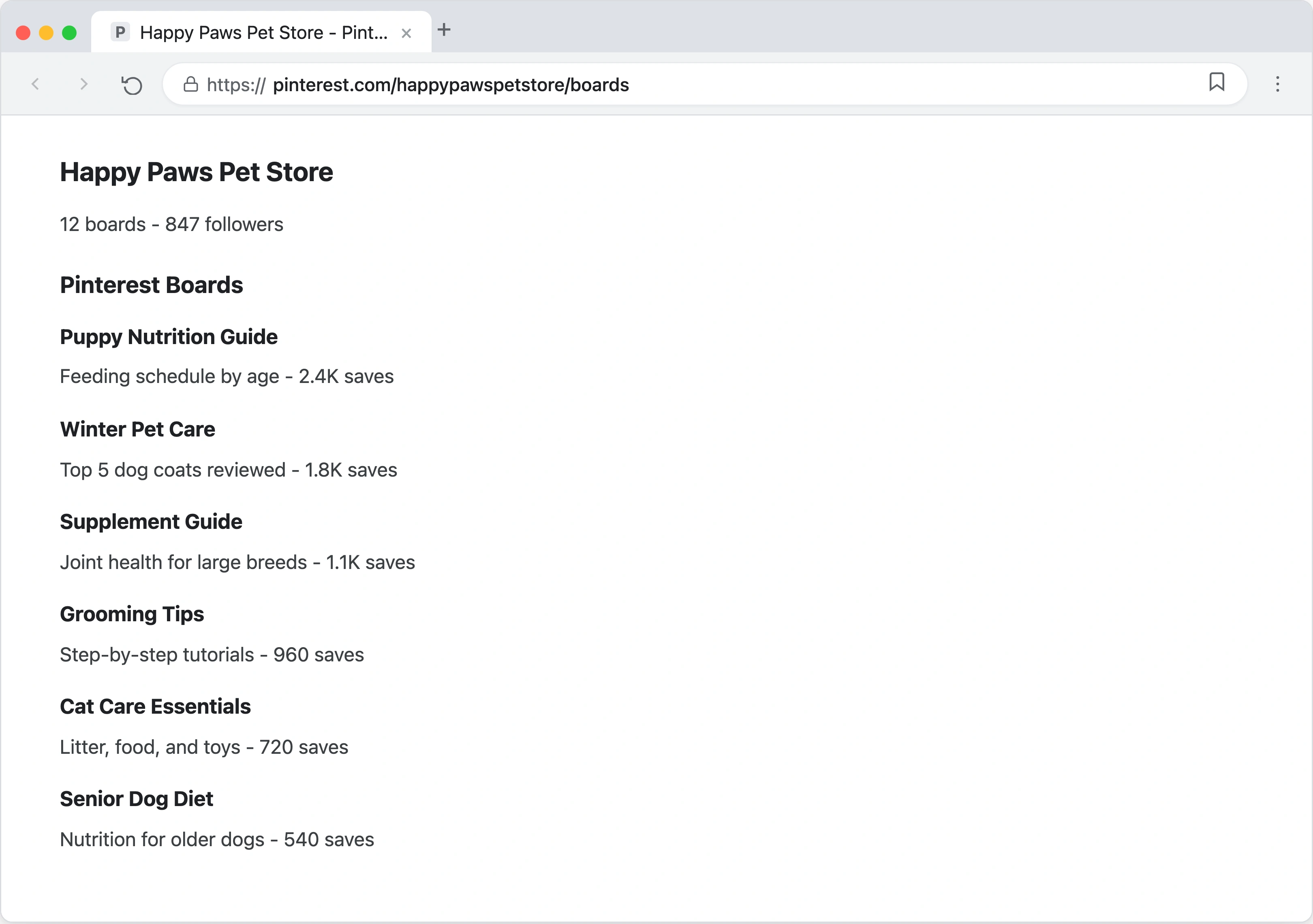
- Seasonal boards: Organize your repurposed pins into themed boards - "Winter Pet Care," "Puppy First Year," "Natural Pet Supplements" - that pet owners can follow for ongoing inspiration.
Pinterest drives purchasing behaviour more directly than Instagram or Facebook. A pin showing your recommended winter coat for small dogs, linked to your blog review, creates a path from discovery to your online store.
Channel 5: How Do Google Business Profile Posts Boost Local Visibility?
If you have a physical pet store, Google Business Profile (GBP) is one of the most underused repurposing channels. GBP listings with recent posts receive 21% more user interactions than inactive listings[13]. Profiles with regular post updates appear 2.8 times more frequently in the top 3 map results[13].
Repurposing blog content to GBP takes less than 10 minutes per post:
- What's New posts: Write a 2-3 sentence summary of your latest blog post, add a photo from your store, and link to the full article. "Just published: our complete guide to choosing the right cat litter. 5 types compared with pros and cons for each."
- Offer posts: If your blog post mentions a specific product category, pair the GBP post with a store promotion. "Read our guide to winter dog coats - and get 15% off all outerwear this week in-store."
- Event posts: Seasonal blog content pairs well with in-store events. A blog post about puppy socialisation can promote your store's weekend puppy meetup.
This is where blog content and local SEO intersect. Every GBP post signals to Google that your business is active, relevant, and regularly updated. Combined with a strong Google Business Profile setup, repurposed blog content directly improves your local search rankings.
Channel 6: How Can Community Forums and Q&A Sites Drive Targeted Traffic?
Pet owners ask questions on Reddit, Quora, breed-specific forums, and Facebook groups every day. Your blog posts already contain the answers. Repurposing blog content for community engagement does not mean copying your article into a forum post. It means using your blog's expertise to answer specific questions with a link back to the full resource.
Here is the approach:
- Monitor pet forums and subreddits: Subreddits like r/dogs, r/cats, r/pets, and breed-specific communities regularly have questions that your blog content addresses. When someone asks "What should I feed my senior Golden Retriever?" and you have a blog post on senior dog nutrition, write a concise 3-4 sentence answer and reference your full guide.
- Quora answers: Search Quora for questions matching your blog topics. Write a helpful answer (not a sales pitch) and include a link to your blog post for readers who want more detail.
- Facebook Groups: Many cities have local pet owner groups. Share relevant blog content when it genuinely answers a question. A post about tick prevention shared in a local dog walkers group during spring is helpful, not promotional.
One pattern I have seen repeatedly is pet store owners who answer 5 forum questions per week, each linked to a blog post, generating 200-400 additional monthly visits from these referral sources. This is targeted traffic from people actively seeking the exact information your blog provides.
Channel 7: How Do You Convert Blog Content Into Podcast or Audio Material?
Podcasting and audio content are growing rapidly among pet enthusiasts. You do not need to launch a full podcast to use this channel. Repurposing blog content into audio can be as simple as recording yourself reading and commenting on your blog post, then uploading it to Spotify or Apple Podcasts.
For pet stores, practical approaches include:
- Mini-episodes (5-10 minutes): Take your blog post's main points and discuss them in a conversational format. Add personal anecdotes from your store - a customer's experience, a product you recently tested, a seasonal trend you are noticing. This adds the E-E-A-T (Experience, Expertise, Authoritativeness, Trustworthiness) signal that search engines value.
- Interview format: Invite a local veterinarian, dog trainer, or groomer to discuss the topic of your blog post. Record the conversation. Now you have original audio content grounded in your written research.
- Audio snippets for social: Extract a 60-second clip from your audio recording and post it as an Instagram Story or LinkedIn audio clip. This creates yet another content touchpoint from the same original blog post.
Repurposing blog content into podcast episodes can increase your reach by 30%[8]. For a pet store, audio content is especially effective during commute times when pet owners are driving to work and planning their weekend shopping.
What Does a Full Repurposing Workflow Look Like?
Here is a concrete example using a single blog post - "Complete Guide to Puppy Nutrition in the First Year" - repurposed across all 7 channels in one week:
| Day | Channel | Format | Time Needed |
|---|---|---|---|
| Monday | Blog | Full article published (2,500 words) | 4 hours (or automated) |
| Monday | Email newsletter | Summary + link to full post | 20 minutes |
| Tuesday | 5-slide carousel: one nutrient per slide | 30 minutes | |
| Tuesday | Google Business Profile | "What's New" post with store photo | 10 minutes |
| Wednesday | Short-form video | 60-second talking head: top 3 puppy feeding mistakes | 30 minutes |
| Thursday | Infographic pin: feeding schedule by age | 25 minutes | |
| Friday | Forum/Q&A | 3 answers on Reddit/Quora linking to blog | 20 minutes |
| Weekend | Audio/Podcast | 8-minute discussion of the blog topic | 30 minutes |
Total additional time: approximately 2 hours and 45 minutes. That is less time than writing a second blog post, but it creates 7 additional content touchpoints reaching different audience segments on different platforms. Companies that publish 16 or more posts per month get 3.5 times more traffic[3], and repurposing is how small teams reach that volume without burning out.
For a complete blog strategy framework, start with a solid content plan before adding repurposing to your workflow.
How Do You Measure Which Channels Perform Best?
Not all 7 channels will deliver equal results for every pet store. Track these metrics per channel to focus your repurposing effort where it matters most:
| Channel | Primary Metric | Secondary Metric | Expected Timeline |
|---|---|---|---|
| Blog (SEO) | Organic traffic | Keyword rankings | 8-12 weeks |
| Social media | Engagement rate | Referral traffic to blog | Immediate |
| Click-through rate | Revenue per email | Immediate | |
| Video | View count + watch time | Profile follows | 1-4 weeks |
| Pin saves + clicks | Referral traffic | 1-4 months | |
| Google Business Profile | Post views + actions | Direction requests | 1-2 weeks |
| Forums/Q&A | Referral traffic | Answer upvotes | 1-4 weeks |
| Podcast/Audio | Downloads + listens | Subscriber growth | 2-6 months |
The blog itself remains the foundation. 70% of blog traffic comes from organic search[2], and that traffic compounds over time. The other 6 channels amplify the blog's reach and drive additional traffic, engagement, and sales that the blog alone would not capture. For a broader perspective on SEO foundations, see our complete pet store SEO guide.
What Are the Most Common Repurposing Mistakes Pet Stores Make?
After working with dozens of pet stores on their content strategies, here are the mistakes I see most often:
- Copy-pasting instead of adapting. Posting the exact same text on Instagram, Facebook, LinkedIn, and your newsletter is not repurposing - it is duplication. Each platform has a different audience expectation and format. Adapt the message, do not clone it.
- Ignoring evergreen content. Pet stores often focus only on repurposing their newest posts. But 76% of blog traffic comes from older content[3]. Your breed guides and nutrition articles from last year are still valuable. Repurpose them seasonally.
- Skipping Google Business Profile. This is free local visibility that directly impacts foot traffic. 21% more interactions for active profiles[13] and you are already writing the content. Posting it takes 10 minutes.
- No link back to the blog. Every repurposed piece should drive traffic back to the original blog post. That blog post is what ranks on Google and builds your site's content marketing authority. Social posts and emails are distribution channels, not destinations.
- Trying all 7 channels at once. Start with 2-3 channels, build a routine, and add more when the workflow feels sustainable. Consistency on 3 channels outperforms sporadic effort on 7.
Frequently Asked Questions
How often should I repurpose the same blog post?
Evergreen blog posts can be repurposed multiple times per year. A comprehensive guide to flea and tick prevention, for example, can be shared as a social carousel in spring, a newsletter in early summer, and a Pinterest infographic year-round. The content stays the same, but the format and timing change. Seasonal content should be repurposed annually with updated statistics or product recommendations. Avoid posting the exact same repurposed piece within a 3-month window on the same channel to prevent audience fatigue.
Do I need special tools for content repurposing?
No expensive tools are required. Canva (free tier) handles social graphics and infographics. Your smartphone records video. Your email marketing platform (Mailchimp, Brevo, or similar) handles newsletters. Google Business Profile is free. The only investment is time - approximately 2-3 hours per week to repurpose your weekly blog post across all 7 channels. If you want to reduce even the blog writing time, a tool like Petbase can generate your source articles automatically, letting you focus entirely on repurposing.
Which channel should a pet store start with for repurposing?
Start with email and Google Business Profile. Email delivers the highest ROI at $42 per dollar spent[9] and reaches customers who already know your store. Google Business Profile takes the least time (10 minutes per post) and directly improves local search visibility[13]. Once those two are part of your routine, add social media as a third channel. Video and Pinterest can follow once you have capacity.
Will repurposed content hurt my SEO through duplicate content?
No. Duplicate content penalties apply when the same text appears on multiple pages of your own website. Repurposing across different platforms (Instagram, email, Pinterest, GBP) is not duplicate content because these are different platforms with different formats. Google does not penalize you for sharing a blog summary in your newsletter or posting a key statistic from your article on Instagram. The blog post remains the canonical source, and repurposed content on other platforms drives traffic back to it.
References
- ReferralRock / CloudPresent (2025). The Complete Guide to Repurposing Content. cloudpresent.co
- Orbit Media (2025). Blogging Statistics. orbitmedia.com
- HubSpot (2025). Marketing Statistics. hubspot.com
- Mediainsight (2025). Complete Guide to Multi-Channel Content Distribution. mediainsight.ai
- Content Marketing Institute (2026). B2B Content Marketing Trends Research. contentmarketinginstitute.com
- Siege Media (2025). Content Repurposing: 16 Ways to Boost Reach and ROI. siegemedia.com
- Genesys Growth (2025). Content Marketing ROI Stats. genesysgrowth.com
- Scopic Studios (2026). B2B Content Repurposing Statistics. scopicstudios.com
- Oberlo (2025). Email Marketing Statistics. oberlo.com
- Porch Group Media (2025). Email Marketing Statistics. porchgroupmedia.com
- Penfriend (2025). Top 7 Content Types Getting the Most ROI. penfriend.ai
- Marketing LTB (2025). Pinterest Statistics. marketingltb.com
- Birdeye (2025). State of Google Business Profiles. birdeye.com