SEO for Pet Stores on a Small Budget


Table of Contents +
- What Can a Pet Store Achieve With 2-3 Hours Per Week?
- Week 1: Set Up Your Google Business Profile (2 Hours)
- Weeks 2-3: Fix Your On-Page SEO Basics (2 Hours Each Week)
- Week 4+: Publish Your First Blog Posts (2-3 Hours Per Week)
- Month 2+: Build Momentum With Content Clusters and Local SEO
- How Do SEO Actions Compare by Time and Impact?
- What About Paid Tools and Services?
- What Are the Most Common Mistakes Pet Stores Make With SEO?
- Frequently Asked Questions
- References
SEO for pet stores on a small budget: a week-by-week action plan starting at USD 0. Prioritized by time and impact for owners with 2-3 hours per week.
61% of small businesses do not invest in SEO[1]. The most common reason is not that they do not believe it works - it is that they assume it requires a large budget and dedicated staff. It does not. SEO for pet stores can start with zero budget and 2-3 hours per week. The businesses that do invest see a median ROI of 748%[2].
The gap between those who invest and those who do not is your biggest opportunity. While 61% of your competitors do nothing, you can build an organic traffic asset that generates customers for years - starting this week.
TL;DR
61% of small businesses do not invest in SEO - yet those who do see 748% median ROI. This guide prioritizes every SEO action by time investment and impact for pet store owners with 2-3 hours per week. Start with your Google Business Profile, then on-page basics, then your first blog posts.
This guide is structured as a week-by-week action plan. Every action is ranked by the time it takes and the impact it delivers. No action costs more than USD 200/month. Most cost nothing.
What Can a Pet Store Achieve With 2-3 Hours Per Week?
Before diving into specific actions, here is the realistic output of a consistent 2-3 hour weekly SEO investment:
- Month 1: Google Business Profile fully optimized, website's on-page SEO fixed, 2-4 blog posts published
- Month 2: 4-6 more blog posts, first content cluster taking shape, local citations submitted
- Month 3: First long-tail keywords reaching page 1, Google Business Profile generating clicks, 10-15 total blog posts
- Month 6: 25-30 blog posts, 2-3 completed content clusters, measurable organic traffic growth
- Month 12: 50-60 blog posts, established topical authority in 3-5 areas, organic traffic as a significant customer acquisition channel
SEO closes leads at a 14.6% rate compared to 1.7% for outbound marketing[3]. That means organic search visitors are 8.5x more likely to become customers than people who see your ads or direct mail. Every hour invested in SEO generates more long-term value than almost any other marketing activity.
Petbase automates SEO content for pet stores - publishing 10 optimized articles monthly so you can focus on running your shop - start your free trial.
Week 1: Set Up Your Google Business Profile (2 Hours)
If you have a physical pet store and you do nothing else on this list, do this. Your Google Business Profile (GBP) is the single highest-impact, lowest-effort SEO action available to local businesses.
Businesses with optimized Google Business Profiles see 2-4x more website visits and direction requests compared to unoptimized profiles[4]. And GBP results appear above organic results - in the Local Pack that captures the majority of clicks for local searches.
What to do in 2 hours:
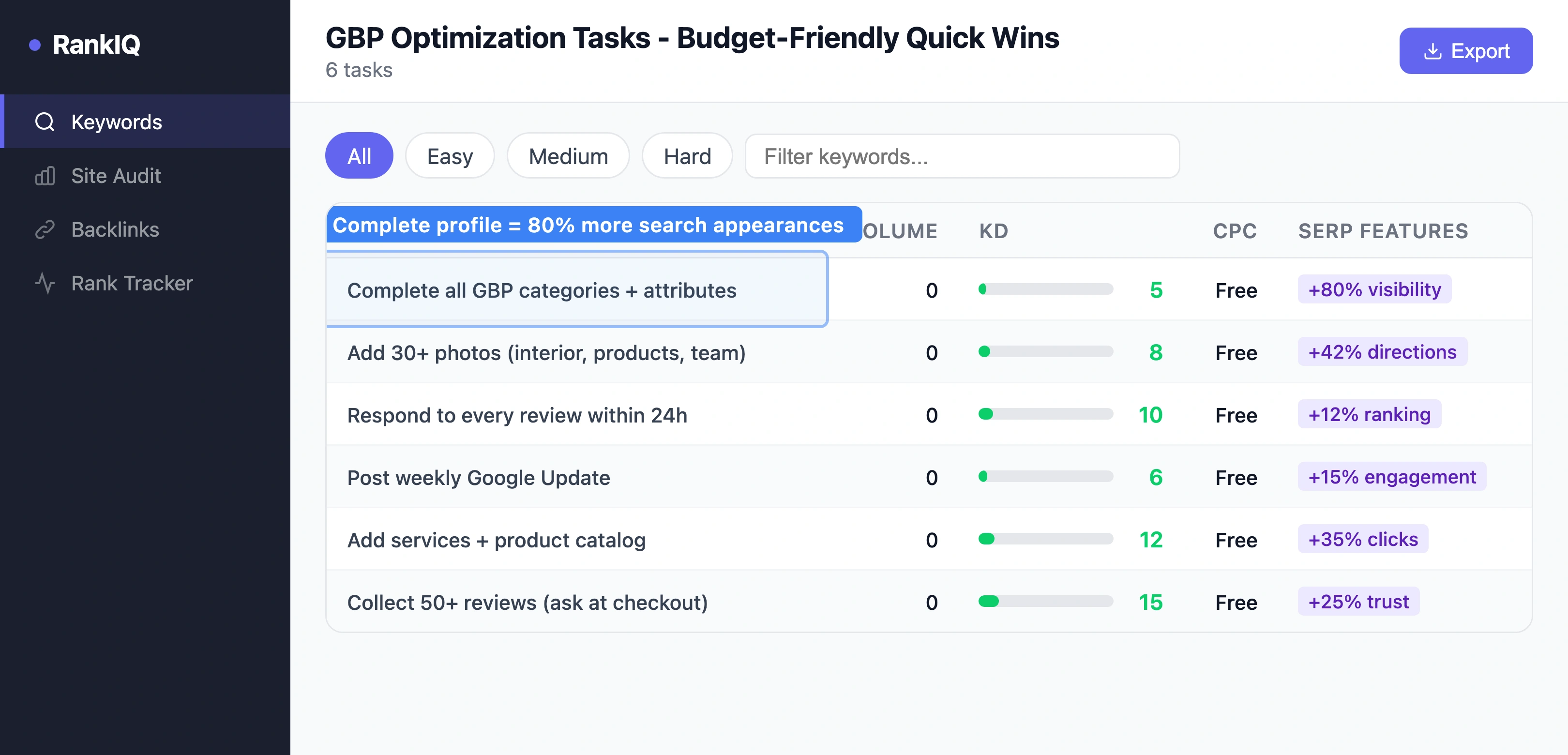
- Claim your profile at business.google.com (if not already claimed)
- Complete every field: business name, address, phone, website, hours, categories
- Add your primary category ("Pet Store") and all relevant secondary categories ("Pet Supply Store," "Dog Day Care Center," etc.)
- Upload 10-20 photos: storefront, interior, products, team, happy customers with pets
- Write a 750-character business description with your main keywords
- Add your products and services
- Create your first Google Post (a weekly update, promotion, or tip)
Ongoing (15 minutes/week): Post a Google Update weekly. Respond to every review within 24 hours. Add new photos monthly. This ongoing activity signals to Google that your profile is active and deserves higher placement.
For a complete optimization guide, see our Google Business Profile guide for pet stores.
Weeks 2-3: Fix Your On-Page SEO Basics (2 Hours Each Week)
On-page SEO is the foundation that everything else builds on. These are the fixes that cost nothing, take minimal time, and make every future effort more effective.
Week 2 actions (2 hours):
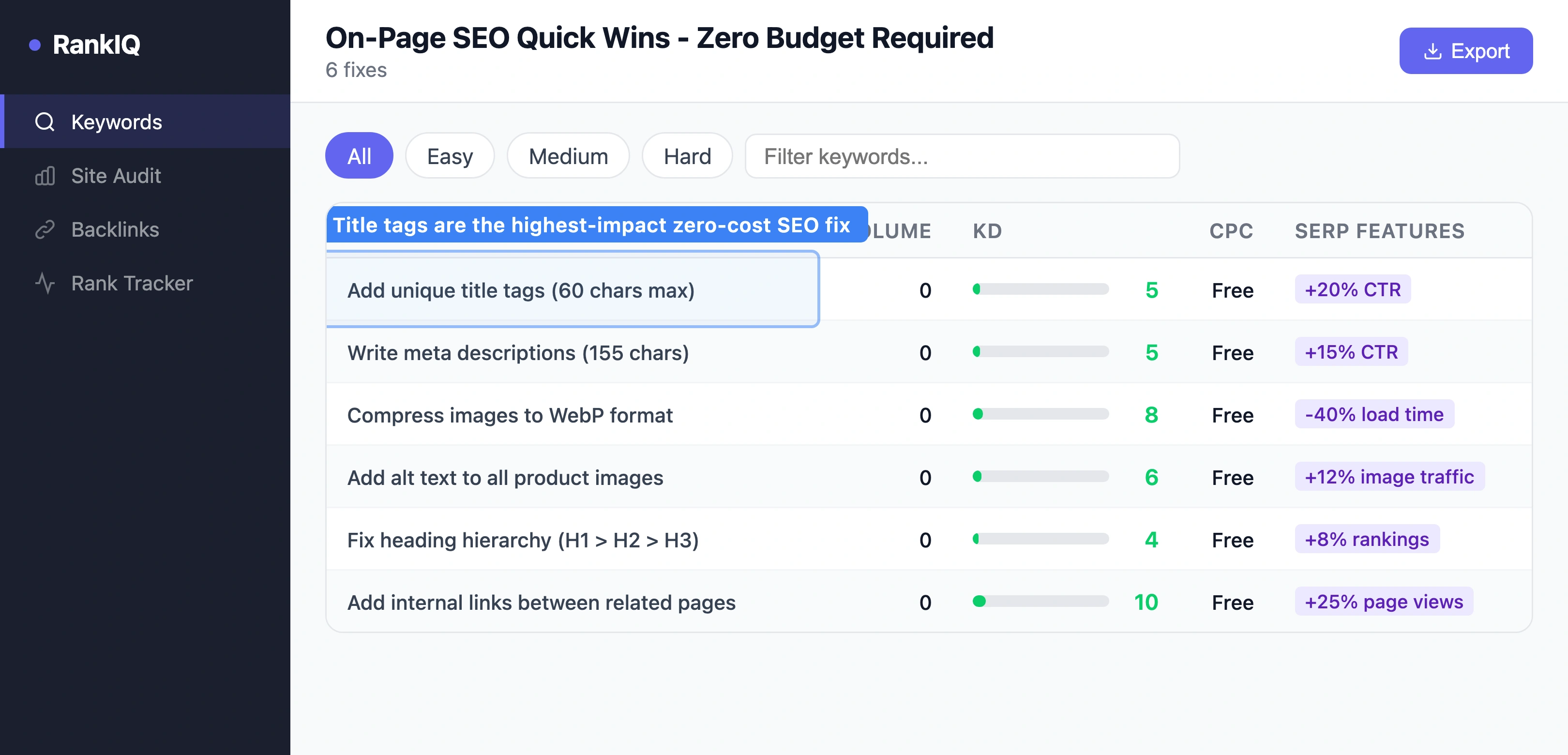
- Title tags: Every page needs a unique title tag under 60 characters that includes your primary keyword. Homepage: "[Store Name] - Pet Store in [City] | [Key Product]". Product pages: "[Product Name] for [Pet Type] | [Store Name]".
- Meta descriptions: Write a compelling 150-160 character description for your homepage, top product pages, and category pages. Include a call to action.
- H1 headings: Every page should have exactly one H1 heading that includes the primary keyword. Check that no page has multiple H1s or is missing one entirely.
- Image alt text: Add descriptive alt text to every image. Not "IMG_3847" but "Golden Retriever eating grain-free dry food from ceramic bowl."
Week 3 actions (2 hours):
- Internal linking: Link your homepage to your top category pages. Link category pages to key product pages. Link any existing blog posts to related product pages. Every important page should be reachable within 3 clicks from the homepage.
- Mobile check: Open every key page on your phone. Can you read the text? Can you tap buttons easily? Does the page load in under 3 seconds? Fix anything that fails this test.
- Site speed: Run your homepage through Google PageSpeed Insights. The most common fixes for pet store websites: compress images (use WebP format), remove unused plugins, and enable browser caching.
The average cost per lead from SEO is $31 compared to $164 from paid advertising[5]. These on-page fixes ensure that every piece of content you publish going forward has the best chance of ranking.
For a comprehensive audit checklist, see our pet store SEO checklist.
Week 4+: Publish Your First Blog Posts (2-3 Hours Per Week)
Content is where small-budget SEO delivers its biggest returns. Every blog post is a new page that can rank for a new keyword and attract new visitors. The compounding effect is what makes content marketing so powerful for small businesses.
Choosing your first keywords: Start with questions your customers ask you in-store. "What should I feed my senior dog?" "Is grain-free food actually better?" "How often should I groom a Poodle?" These questions are real search queries with low competition and high purchase intent.
Writing your first 4 posts: Each post should be 1,500-2,500 words, target one specific long-tail keyword, and provide a genuinely helpful answer. Use your own product knowledge and customer experience - this is the E-E-A-T signal that separates your content from generic competitors.
Structure each post with:
- A clear H1 that includes the keyword
- H2 subheadings phrased as questions (matching "People Also Ask" queries)
- Short paragraphs (2-3 sentences)
- Bullet points for lists and specifications
- Internal links to your product or category pages where relevant
- A clear call to action at the end
If you cannot dedicate 2-3 hours per week to writing, a pet-specific AI tool like Petbase produces 10 SEO-optimized articles per month for USD 199 - less than the cost of a single freelance blog post, and far less than an agency's monthly retainer. Small businesses using content tools see 23% higher ROI than those producing content manually[7].
For content strategy guidance, read our pet store blog strategy guide.
Month 2+: Build Momentum With Content Clusters and Local SEO
After your first 4-6 blog posts, shift from individual posts to structured content clusters. Pick one topic area (e.g., dog nutrition) and plan 8-10 interconnected articles. Each article links to the others, building topical authority that makes every page in the cluster rank higher.
Month 2 actions (2-3 hours/week):
- Publish 4-6 more blog posts, all within your first content cluster
- Add internal links between new posts and your earlier articles
- Submit your business to 10 local directories with consistent NAP data (see our local citations guide)
- Ask 5 satisfied customers to leave Google reviews (reviews are the second most important Local Pack ranking factor)
- Check Google Search Console for indexing issues and fix any errors
Month 3+ actions:
- Review Search Console data - which keywords are gaining impressions? Which posts are climbing?
- Start your second content cluster based on your next strongest product category
- Update and expand your best-performing posts with fresh data and more detail
- Reach out to 2-3 local organizations (vet clinics, shelters, pet clubs) for link-building partnerships
The compounding math: after 6 months of consistent effort (2-3 hours/week), you will have 25-30 published articles, 2-3 content clusters building topical authority, an optimized Google Business Profile generating local traffic, and a growing foundation of backlinks. This is the point where SEO starts generating visible, measurable results.
How Do SEO Actions Compare by Time and Impact?
Not all SEO actions deliver equal value. This table ranks every action in this guide by the time required and the impact delivered:
| Action | Time (One-Time) | Time (Ongoing) | Cost | Impact | Results Timeline |
|---|---|---|---|---|---|
| Google Business Profile | 2 hours | 15 min/week | Free | Very high (local) | 4-8 weeks |
| Title tags and meta descriptions | 2 hours | As needed | Free | High | 2-4 weeks |
| Image alt text | 1-2 hours | Per new image | Free | Medium | 2-4 weeks |
| Internal linking | 1-2 hours | Per new post | Free | High | 4-8 weeks |
| Blog posts (manual) | N/A | 3-4 hrs/post | Free (your time) | Very high | 8-12 weeks |
| Blog posts (AI tool) | 1 hour setup | 1-2 hrs/month review | USD 199/month | Very high | 8-12 weeks |
| Local citations | 2-3 hours | Quarterly check | Free | Medium (local) | 4-8 weeks |
| Google review requests | N/A | 5 min/customer | Free | High (local) | Ongoing |
| Site speed optimization | 2-4 hours | Quarterly check | Free | Medium | 1-2 weeks |
| Schema markup | 2-3 hours | Per new page type | Free | Medium | 2-4 weeks |
The highest-impact, lowest-cost combination for a pet store on a small budget: Google Business Profile (free, 2 hours) + weekly blog posts (free or USD 199/month) + internal linking (free, ongoing). This combination covers local SEO, content marketing, and site structure - the three pillars that drive organic traffic growth.
What About Paid Tools and Services?
You do not need paid tools to start. But as your SEO effort grows, a small budget can accelerate results significantly. Here is how to spend USD 50-200/month wisely:
USD 0/month (tools): Google Search Console (keyword tracking, indexing), Google Analytics (traffic analysis), Google Business Profile (local SEO), Google PageSpeed Insights (speed testing). These four free tools cover 80% of what you need.
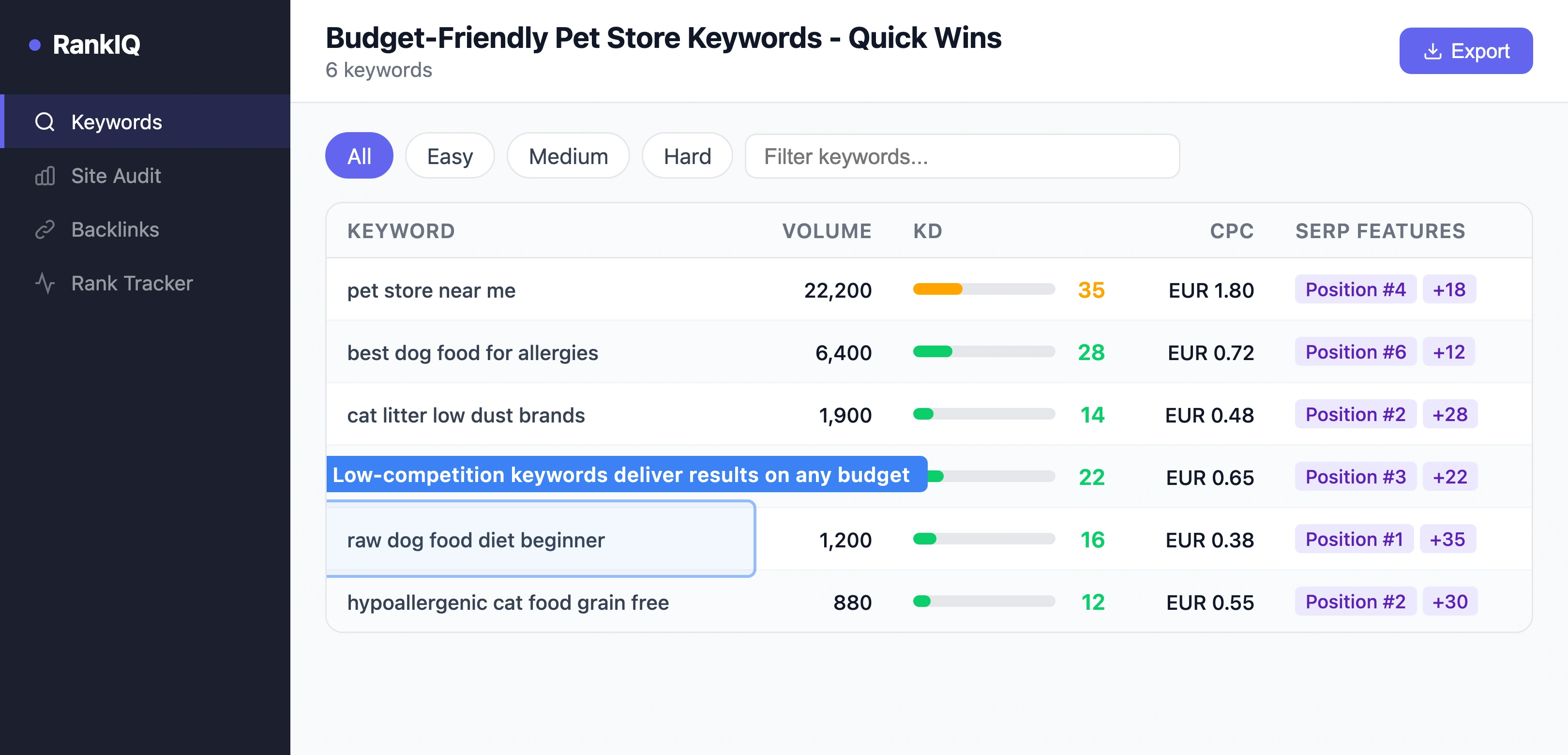
USD 50-100/month: A keyword research tool like Ubersuggest or SE Ranking gives you search volume data, competitor analysis, and rank tracking. This helps you choose better keywords and measure progress more accurately than Search Console alone.
USD 199/month: A pet-specific AI content tool like Petbase produces 10 optimized blog posts per month. The average SEO agency charges USD 3,209/month[6]. At USD 199/month, you get more content volume (10 articles vs. the agency's typical 4-8) with built-in pet industry expertise. This is the single most impactful paid investment for a pet store with limited budget.
The principle: spend money on content production (the highest-leverage activity) before spending on tools. A keyword tool without content to publish is useless. Content without a keyword tool still ranks - you just choose keywords less optimally.
What Are the Most Common Mistakes Pet Stores Make With SEO?
After working with dozens of pet stores, these are the mistakes that waste the most time and money:
1. Targeting keywords that are too broad. "Dog food" has millions of competing pages. "Best grain-free food for miniature Schnauzers with allergies" has a fraction of the competition and higher purchase intent. Start narrow, expand later.
2. Publishing inconsistently. Four posts in January, nothing until June, then three more in July. Google rewards consistency. Two posts per week, every week, outperforms bursts of activity followed by silence. Read why in our analysis of why pet store blogs fail to get traffic.
3. Ignoring local SEO. If you have a physical store, local SEO (Google Business Profile, reviews, local citations) generates the fastest results. Many pet stores skip this entirely while chasing national organic rankings that take much longer. See our local SEO guide for pet businesses.
4. Using manufacturer product descriptions. Every store selling the same product has the same manufacturer description. Google sees duplicate content and ranks none of them. Unique descriptions - even short ones - dramatically improve product page visibility.
5. Not measuring results. If you do not track which keywords are gaining, which pages are getting traffic, and which posts are climbing in rankings, you cannot optimize your effort. Set up Google Search Console on day 1 and check it weekly.
6. Quitting too early. SEO takes 8-12 weeks to show initial results and 6-12 months to deliver significant traffic. Most pet stores quit after 4-6 weeks because they do not see immediate results. The stores that persist for 12 months build a compounding traffic asset that their competitors cannot replicate quickly. Our guide on the real cost of ignoring SEO quantifies what this inaction costs.
Frequently Asked Questions
Can I do pet store SEO completely by myself?
Yes. Every action in this guide can be done without hiring an agency or consultant. Google Business Profile, on-page SEO, and blog writing require no technical expertise - just consistent time investment. The only area where professional help is sometimes valuable is technical SEO (site speed, schema markup, crawl issues). If your website has significant technical problems, a one-time technical audit (USD 300-500) can identify and fix issues that are holding back your content efforts.
What free tools do I need to get started?
Four tools, all free: Google Search Console (track which keywords your site appears for), Google Analytics (track visitor behavior), Google Business Profile (manage your local listing), and Google PageSpeed Insights (check site speed). These four tools provide all the data you need for the first 6 months of SEO. Paid keyword tools are helpful but not essential when starting out.
How much budget do I actually need for pet store SEO?
You can start with USD 0 and 2-3 hours per week. If you have USD 199/month, a pet-specific AI content tool dramatically accelerates your content production. If you have USD 300-500/month, add a keyword research tool and occasional freelance help for technical issues. You do not need an agency-level budget (USD 2,000-5,000/month) to see meaningful results. The most important investment is time, not money.
When will I see results from SEO?
Local SEO (Google Business Profile): 4-8 weeks for Local Pack visibility. Long-tail blog content: 8-12 weeks for first page 1 rankings. Competitive product keywords: 3-6 months. Significant organic traffic growth: 6-12 months. The key insight: results compound. Month 6 delivers more than months 1-3 combined. Month 12 delivers more than months 1-6 combined. Every month of consistent effort makes every future month more productive.
References
- Clutch (2025). SEO Statistics. clutch.co
- First Page Sage (2024). SEO ROI Statistics. firstpagesage.com
- HubSpot (2024). Marketing Statistics. hubspot.com
- Birdeye (2025). State of Google Business Profile. birdeye.com
- First Page Sage (2024). Average Cost Per Lead by Industry. firstpagesage.com
- First Page Sage (2024). SEO Agency Pricing. firstpagesage.com
- HubSpot (2024). Marketing Statistics - Small Business Content ROI. hubspot.com