Monthly AI SEO Workflow for Pet Stores


Table of Contents +
- Why Does a Monthly Rhythm Matter More Than Publishing Volume?
- What Should Week 1 Look Like for Content Planning?
- How Do You Generate and Review 10 Articles Per Month?
- What Does the Publishing Process Look Like in Week 3?
- How Do You Optimize Existing Content in Week 4?
- What Does the Monthly Time Budget Actually Look Like?
- What Are the Most Common Workflow Failures to Avoid?
- How Do You Scale the Workflow After the First 6 Months?
- Frequently Asked Questions
- References
The 11-step monthly AI SEO workflow for pet stores: content planning, generation, quality review, publishing, and optimization in 12-17 hours per month.
Most pet stores that try AI content publishing follow the same pattern: generate a batch of articles, publish them all at once, see no results after two months, and conclude that AI content does not work. The problem is never the content itself. The problem is the absence of a repeatable monthly process. Google rewards consistent publishing over sporadic volume. Blog posts gain 60% more traffic after 12 months of being live[1], but only if you keep publishing alongside them.
This guide breaks down the exact monthly workflow that turns AI content from a one-time experiment into a compounding traffic engine. It covers 11 steps across 4 weeks, assumes 10 articles per month (the baseline for meaningful topical authority growth), and includes the time budget for each phase. The entire process takes 12-17 hours per month - compared to 39 hours for writing the same volume manually.
TL;DR: A repeatable monthly workflow is what separates pet stores that build compounding SEO traffic from those that publish sporadically and see nothing. This 11-step, 4-week process covers planning, generation, quality review, publishing, and optimization. Total time: 12-17 hours per month for 10 articles, versus 39 hours writing manually.
Why Does a Monthly Rhythm Matter More Than Publishing Volume?
A pet store that publishes 10 articles every month for 12 months will significantly outperform one that publishes 60 articles in one month and then nothing for five. Google interprets consistent publishing as a freshness and maintenance signal. Organic search drives 46.98% of all web traffic[2], and that traffic compounds when your publishing cadence is predictable.
The monthly rhythm also creates a feedback loop. Articles published in month one have performance data by month three. That data reveals which topics resonate, which keywords you rank for that you did not target, and which articles need optimization. Businesses that publish 16 or more posts per month generate 4.5x more leads than those publishing four or fewer[3]. A quarterly publishing burst gives you no actionable feedback cycle. A monthly process does.
In my experience working with pet stores on content programs, the stores that hit 50 articles with consistent monthly publishing always outrank stores with 80 articles published in random bursts. The consistency signal is that powerful. SEO delivers a 748% return on investment[4] when backed by disciplined execution.
Petbase automates SEO content for pet stores - publishing 10 optimized articles monthly so you can focus on running your shop - start your free trial.
What Should Week 1 Look Like for Content Planning?
Content planning is not optional. Articles published without a plan drift away from your topic cluster and build no authority. Planning takes 2-3 hours and determines everything you publish for the month. Sites with 5 or more connected pages on a topic earn 86% of all AI citations[5], so every article must connect to a cluster.
Step 1: Review last month's performance (30 minutes)
Open Google Search Console. Filter to the previous month. Identify three things:
- Your top 5 articles by clicks. These are proven performers. Plan internal links from this month's new articles to them.
- Queries where you rank at positions 8-20. These are articles to optimize this month, not new articles to write. A small content improvement can push them to page one.
- Queries with impressions but no clicks. These reveal topics where Google shows your content but your title or meta description is not compelling enough to earn the click.
Active blogs generate 97% more inbound links[1]. This monthly review ensures you invest effort where the data says it will pay off.
Step 2: Select 10 content targets (60 minutes)
From your topical map (the keyword list described in AI keyword research for pet stores), select the next 10 articles. Apply this distribution:
- 1 authority article - comprehensive, 2,000+ words, cornerstone topic
- 3 commercial articles - product comparisons, best-of lists, buying guides
- 6 breadth articles - specific questions, breed topics, how-to guides
This mix builds depth (authority articles), drives revenue (commercial articles), and expands your cluster footprint (breadth articles). Topic clusters generate approximately 30% more organic traffic[6]. The full planning framework is in AI content strategy for pet brands.
Step 3: Plan internal links in advance (30 minutes)
Before writing a single article, document which existing articles each new article will link to, and which existing articles need updating to link to the new ones. Internal linking boosts rankings by up to 40%[7]. This upfront planning prevents orphan articles and ensures every piece of content connects to the cluster from day one.
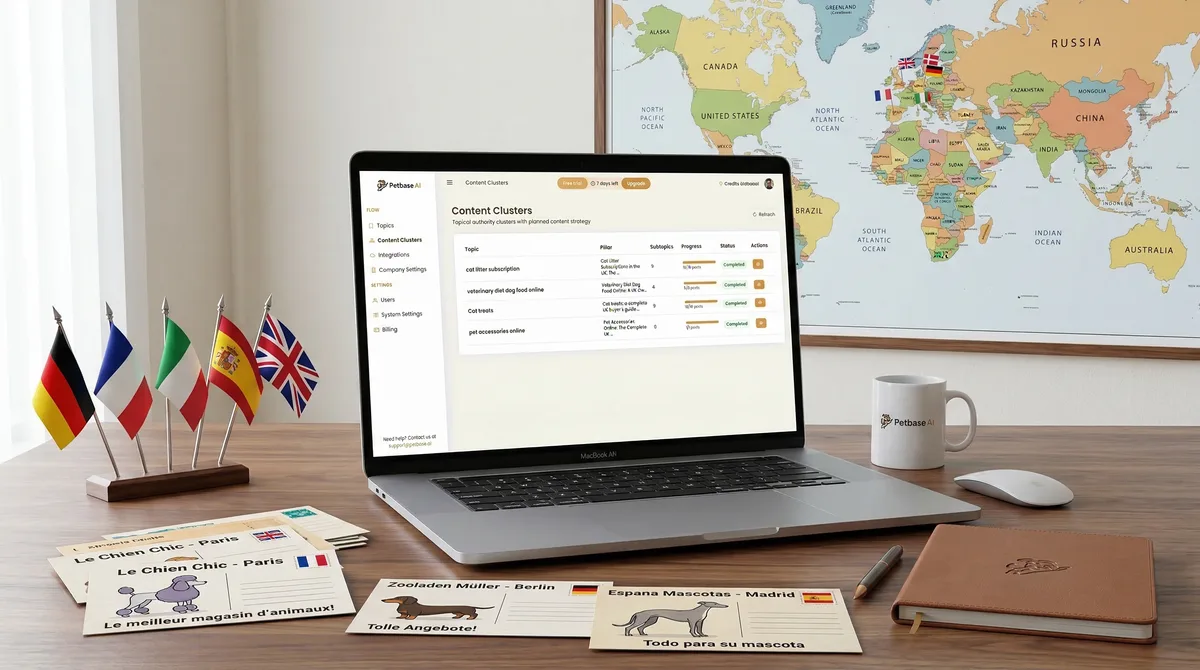
Content planning takes 2-3 hours every month. Petbase generates your monthly topic plan automatically from your cluster configuration. See how it works.
How Do You Generate and Review 10 Articles Per Month?
Weeks 1-3 cover generation and quality review. The average blog post takes 3 hours 55 minutes to write manually[8]. At 10 articles, that is 39 hours of writing alone - before editing, publishing, or optimization. AI reduces that to 2-4 hours of generation plus 3-4 hours of review. Companies using AI produce 42% more content per month[9] while maintaining quality standards.
Step 4: Generate article drafts (2-4 hours total)
For each of the 10 planned articles, follow this process:
- Input the target keyword, intended audience (buyer persona), and planned internal links into your AI content tool
- Generate the initial draft with specific instructions for structure: question-phrased H2 headings, FAQ section, comparison table where relevant
- Save each draft with metadata: target keyword, planned internal links, scheduled publication date
Content created with AI and strategic human direction improves rankings by 49.2%[10]. The key distinction is "strategic direction" - AI generates the base content, but the keyword targeting, cluster mapping, and structural requirements come from your plan.
Step 5: Review each article against the quality checklist (15 minutes per article)
Run every AI-generated draft through the quality checklist from how to make AI content good enough to rank:
- Factual accuracy: toxic substances, dosing, breed data, nutritional figures must be verified
- Specificity: no vague statements. Replace every generalization with a specific figure or example
- Structure: direct answer in paragraph one, question-phrased H2s, FAQ section present
- E-E-A-T signals: one experience-based observation added, health claims cited, author attribution planned
- Internal links: 3-5 links to related articles confirmed
85% of marketers now use AI for content creation[9]. The quality review step is what separates ranked content from ignored content. Never skip it.
Step 6: Add experience-based observations (5 minutes per article)
For each article that benefits from a first-person perspective, add one specific insight from your business experience: a pattern you have observed with customers, a product that performs differently from manufacturer claims, an approach that works better than standard advice. These additions are brief (2-4 sentences) but they provide the E-E-A-T signal AI tools cannot replicate. Content with statistics earns 28-40% higher AI visibility[11].
Step 7: Write meta descriptions (5 minutes per article)
Write a unique meta description for each article: 150-160 characters, including the target keyword, stating specific value. Do not reuse the AI-generated summary. The meta description is what search engine users read first - it must earn the click.
What Does the Publishing Process Look Like in Week 3?
Publication week is where many content teams lose quality. They rush to hit deadlines and skip technical steps that directly impact rankings. Long-tail keywords drive 70% of all search traffic[12], but only if your pages are technically sound enough to be indexed and ranked.
Step 8: Publish with technical completeness (10 minutes per article)
For each article at publication, verify these elements:
- URL slug matches the target keyword (hyphenated, lowercase, no stop words)
- Target keyword appears in the title tag and H1
- Meta description is loaded correctly
- Author attribution uses a real person name
- Publication date is set
- All internal links resolve correctly (no 404s)
- Structured data is added: FAQ schema for FAQ sections, HowTo schema for step-by-step guides
AI Overviews now appear in 48% of Google queries[13]. Structured data helps your content surface in both traditional results and AI-generated answers. For the full schema implementation guide, see schema markup for pet stores.
Step 9: Update existing articles with new internal links (5 minutes each)
For each pre-planned link from an existing article to a new one, make the edit. This step is essential but easy to skip. Most content teams publish new articles without updating old ones to link to them. The result: new articles start with zero internal link equity and old articles never pass authority forward. Topic clusters with strong internal linking see rankings last 2.5x longer[6].
Publishing 10 articles with correct schema, links, and metadata takes hours. Petbase handles publication, internal linking, and schema automatically. Start your free trial.
How Do You Optimize Existing Content in Week 4?
Week 4 is for optimization and performance review. This is where the monthly workflow creates its compounding advantage. One pattern I have seen repeatedly: optimizing near-miss articles (positions 8-20) produces faster ranking improvements than publishing additional new content. When an article already ranks at position 12, you need a smaller improvement to reach page one than when starting from zero.
Step 10: Optimize 2-3 existing articles (2 hours)
Each month, identify articles ranking at positions 8-20 for target keywords. These near-miss articles respond best to optimization. The actions that most reliably move rankings up:
- Expand thin sections with more specific information and current statistics
- Add a comparison table if one is missing
- Strengthen the FAQ section with additional questions (40-60 word answers)
- Add internal links from recently published related articles
- Update any statistics or dates older than 12 months
- Improve the title tag to match the query more precisely
62.8% of content marketers saw year-over-year traffic growth in 2024-2025[1]. The marketers seeing the strongest growth are those who optimize existing content alongside publishing new articles. For the complete content strategy framework, read building an SEO content calendar for your pet business.
Step 11: Monthly performance review (1 hour)
At the end of each month, document these metrics:
- Total organic clicks versus prior month (Google Search Console)
- Total indexed pages versus prior month
- Top 10 articles by clicks
- Top 10 new keywords you appeared for that you did not target explicitly
- Articles that dropped in ranking - flag for optimization next month
- AI search visibility: test 5-10 target queries in ChatGPT and Perplexity to check for citations
ChatGPT now has 900 million weekly users[14] and Perplexity has 45 million active users[14]. Monitoring AI citations alongside traditional rankings is now essential. This review feeds directly into next month's planning session: new keywords become breadth targets, near-miss articles become optimization targets.
What Does the Monthly Time Budget Actually Look Like?
The full workflow at 10 articles per month requires approximately 12-17 hours. Here is the breakdown compared to manual content creation:
| Task | AI-Assisted Time | Manual Time |
|---|---|---|
| Content planning (Steps 1-3) | 2-3 hours | 3-4 hours |
| Article generation (Step 4) | 2-4 hours | 39 hours (3h55m x 10) |
| Quality review and editing (Steps 5-7) | 3-4 hours | 5-7 hours |
| Publication and linking (Steps 8-9) | 2-3 hours | 2-3 hours |
| Optimization (Step 10) | 2 hours | 2 hours |
| Performance review (Step 11) | 1 hour | 1 hour |
| Total | 12-17 hours | 52-56 hours |
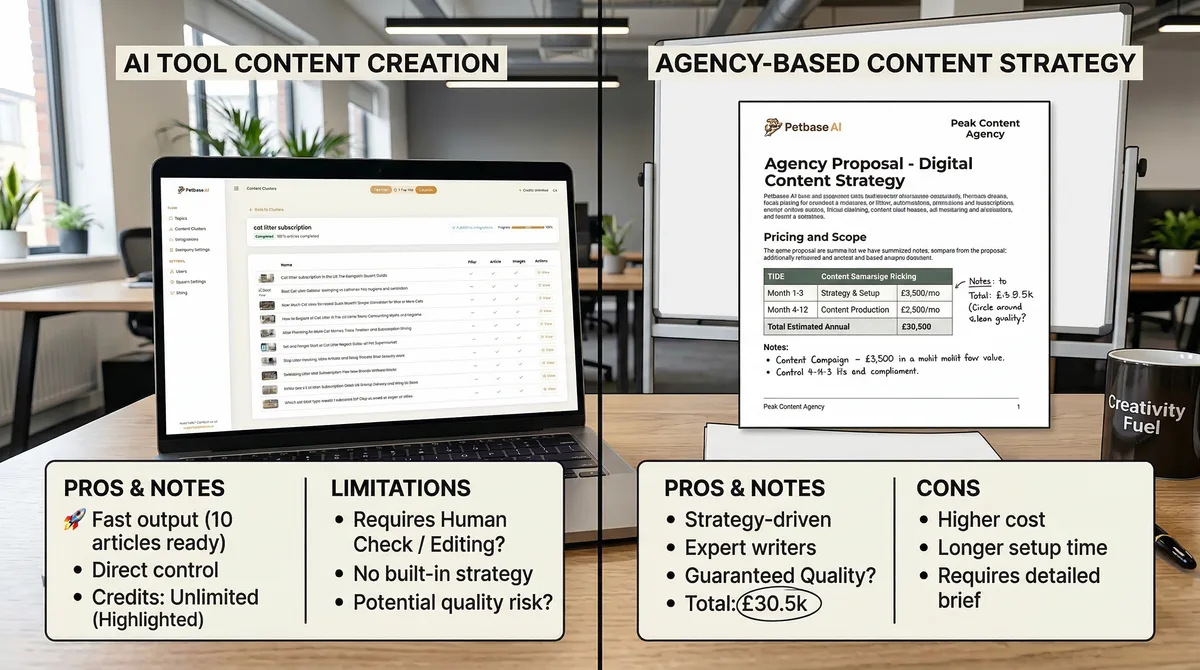
The AI-assisted workflow reduces total content effort by 60-70% while maintaining quality standards. At 10 articles per month, you build meaningful topical authority. Sites with high topical authority gain traffic 57% faster[6]. The time saved on generation shifts to the higher-value work: planning, review, and optimization.
What Are the Most Common Workflow Failures to Avoid?
After advising multiple pet stores through their first 6 months of content programs, I have seen four failure patterns that derail results:
Skipping the planning step. Publishing 10 articles on random topics each month builds no topical cluster. Every month without a plan is a month of content that does not compound. Topic clusters generate 3.2x more AI citations[5] than isolated articles. Planning takes 2-3 hours. It is not optional.
Skipping internal link updates. New articles published without inbound links from existing content are orphans. They take longer to index and accumulate authority slowly. Five minutes per new article to update existing articles is the single highest-return linking action available. Internal linking boosts rankings by up to 40%[7].
Generating but not reviewing. AI-generated pet content without quality review is a liability. Incorrect health information, breed errors, and outdated statistics appear in AI output and pass through to readers. 68% of marketers see increased ROI from AI content[9] - but only when that content is reviewed before publication. A 15-minute review per article prevents errors entirely.
Treating optimization as optional. Most teams focus entirely on new articles and ignore optimization. The data consistently shows that improving articles at positions 8-20 produces faster traffic gains than publishing new articles in the same timeframe. Reserve 2 hours per month for optimization from month two onward. Complete clusters see ranking improvements in 60-90 days[15].
How Do You Scale the Workflow After the First 6 Months?
Once the monthly workflow produces consistent results, scaling follows a clear path. The global pet care market reached USD 273.42 billion in 2025[16], and pet e-commerce hit USD 102.3 billion[17]. The addressable search market for pet content is enormous. Here is how to capture more of it:
- Add a second topic cluster. When your primary cluster reaches 20+ articles with strong internal linking and consistent traffic growth, begin building an adjacent cluster using the same monthly process.
- Increase publication volume to 15-20 articles. Only increase if you have the review capacity. Volume without quality degrades the cluster faster than it builds it. AI-referred traffic converts 23x higher than traditional referrals[11], so quality matters more than quantity.
- Add a content refresh cycle. After 6 months, your oldest articles are candidates for a full refresh: updated statistics, new sections, additional FAQ questions. Plan 2-3 refreshes per month as a permanent workflow component.
- Monitor AI citation growth. Track which of your articles are cited by ChatGPT and Perplexity. 93% of AI sessions end without a click[18], but citations build brand awareness that drives direct visits over time.
For guidance on the first three months specifically - when the workflow is new and the content library is small - see the first 90 days of AI content for a pet store. For the broader content strategy, see pet store blog strategy.
Running this workflow manually takes 12-17 hours every month. Petbase automates planning, generation, and publishing so you focus on review and strategy. See the plan.
Frequently Asked Questions
Can one person run this workflow or does it require a team?
One person can manage 10 articles per month. The bottleneck is quality review, not generation. With a pet-specific AI platform producing accurate drafts, review takes 10-15 minutes per article. At 15+ articles per month, most pet store operators need a part-time reviewer. The full workflow takes 12-17 hours monthly.
What happens if you miss a month of publishing?
One missed month will not cause significant ranking drops if your existing library is strong. Avoid multi-month gaps - two or more months of zero publishing sends a staleness signal. If a gap is coming, front-load the previous month. Blog posts gain 60% more traffic over 12 months[1], so existing content continues working.
How do you know if the workflow is producing results?
Track three metrics monthly: organic clicks (should grow), indexed pages with clicks (should grow), and average position for target keywords (should decrease, meaning improving). If all three improve after three months, the workflow is working. Businesses prioritizing blog SEO are 13x more likely to see positive ROI[1].
References
- Shno (2025). Blogging and Content ROI Statistics. shno.co
- DemandSage (2025). SEO Statistics. demandsage.com
- HubSpot (2025). Marketing Statistics. hubspot.com
- SEOProfy (2025). SEO ROI Statistics. seoprofy.com
- Yext (2025). AI Citations and Topic Clusters. yext.com
- HireGrowth (2025). Topical Authority and Content Clusters. hiregrowth.com
- Authority Hacker (2025). Internal Linking Study. authorityhacker.com
- Orbit Media (2024). Annual Blogging Survey. orbitmedia.com
- Typeface (2025). Content Marketing Statistics. typeface.ai
- ZoomYourTraffic (2025). AI SEO Impact Study. zoomyourtraffic.com
- Averi AI (2025). AI Visibility and Content Statistics. averi.ai
- Semrush (2025). Long-Tail Keyword Research. semrush.com
- Position Digital (2026). AI SEO Statistics. position.digital
- Business of Apps (2025). AI Platform Statistics. businessofapps.com
- Knapsack Creative (2025). Topic Cluster Ranking Timelines. knapsackcreative.com
- Fortune Business Insights (2025). Pet Care Market Report. fortunebusinessinsights.com
- Mordor Intelligence (2025). Pet E-Commerce Market. mordorintelligence.com
- Superlines (2025). AI Search Statistics. superlines.io