How Pet Brands Get Cited by ChatGPT and Perplexity

Table of Contents +
- How Do ChatGPT and Perplexity Select Sources Differently?
- What Content Characteristics Get Pet Brands Cited?
- How Does Schema Markup Improve AI Citation Rates?
- What Authority Signals Do AI Platforms Look For?
- How Should Pet Brands Structure Content for Maximum Citability?
- What Types of Pet Content Get Cited Most Often by AI?
- What Technical Requirements Must Pet Store Websites Meet?
- How Do You Track Your AI Citation Performance?
- Frequently Asked Questions
- References
Learn how ChatGPT and Perplexity select sources and what pet brands need to do to get cited. Covers content structure, schema, authority signals, and tracking.
An estimated 31.3% of the US population will use generative AI search in 2026[1]. That means nearly one in three potential customers is now asking ChatGPT, Perplexity, or Google's AI for product recommendations instead of typing a traditional search query. For pet brands, this shift is both an opportunity and a threat. If your content is not cited when someone asks "what is the best food for a French Bulldog with allergies," you are invisible to a growing share of your market.
The challenge: AI platforms do not work like Google. They do not show ten blue links. They generate a single synthesized answer and cite sources inline. Only 11% of domains are cited by both ChatGPT and Perplexity[2], which means optimizing for one platform does not automatically help with the other. Each platform has distinct citation preferences, source selection criteria, and content format biases. This guide breaks down exactly how ChatGPT and Perplexity select their sources, and what pet brands need to do to get cited by both.
TL;DR
ChatGPT and Perplexity cite sources differently - only 11% of domains appear in both. ChatGPT favors established domains (average cited domain age: 17 years) while Perplexity prioritizes structured, recently updated content. Pet brands that want AI citations need clear headings, FAQ schema, breed-specific depth, and presence on multiple platforms. This guide covers the specific optimization tactics for each platform.
How Do ChatGPT and Perplexity Select Sources Differently?
Understanding the mechanical differences between these platforms is the first step to getting cited. They do not use the same index, the same ranking signals, or the same citation formats.
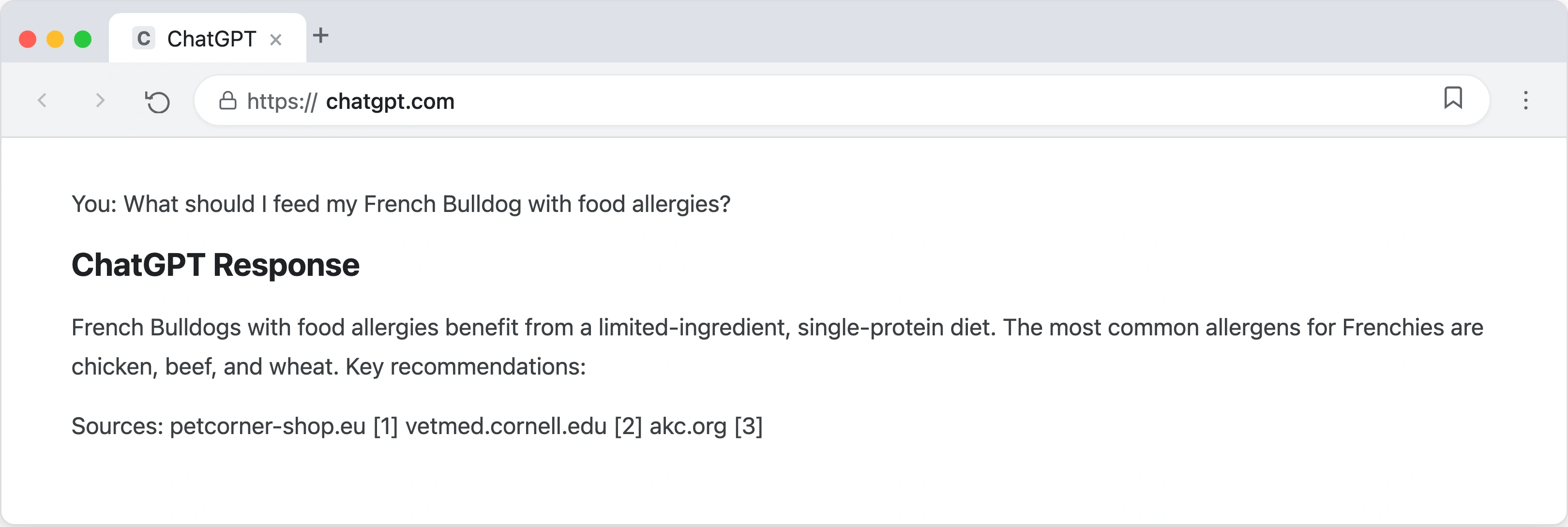
ChatGPT uses Bing's real-time index to find sources when browsing is enabled. It decomposes each user prompt into multiple sub-queries (a process called query fan-out), searches for relevant passages, and synthesizes an answer with inline citations. ChatGPT averages 7.92 citations per response[3]. It has a strong preference for established, high-authority domains - the average domain age of ChatGPT-cited sources is 17 years[4]. Wikipedia accounts for 47.9% of ChatGPT citations[3].
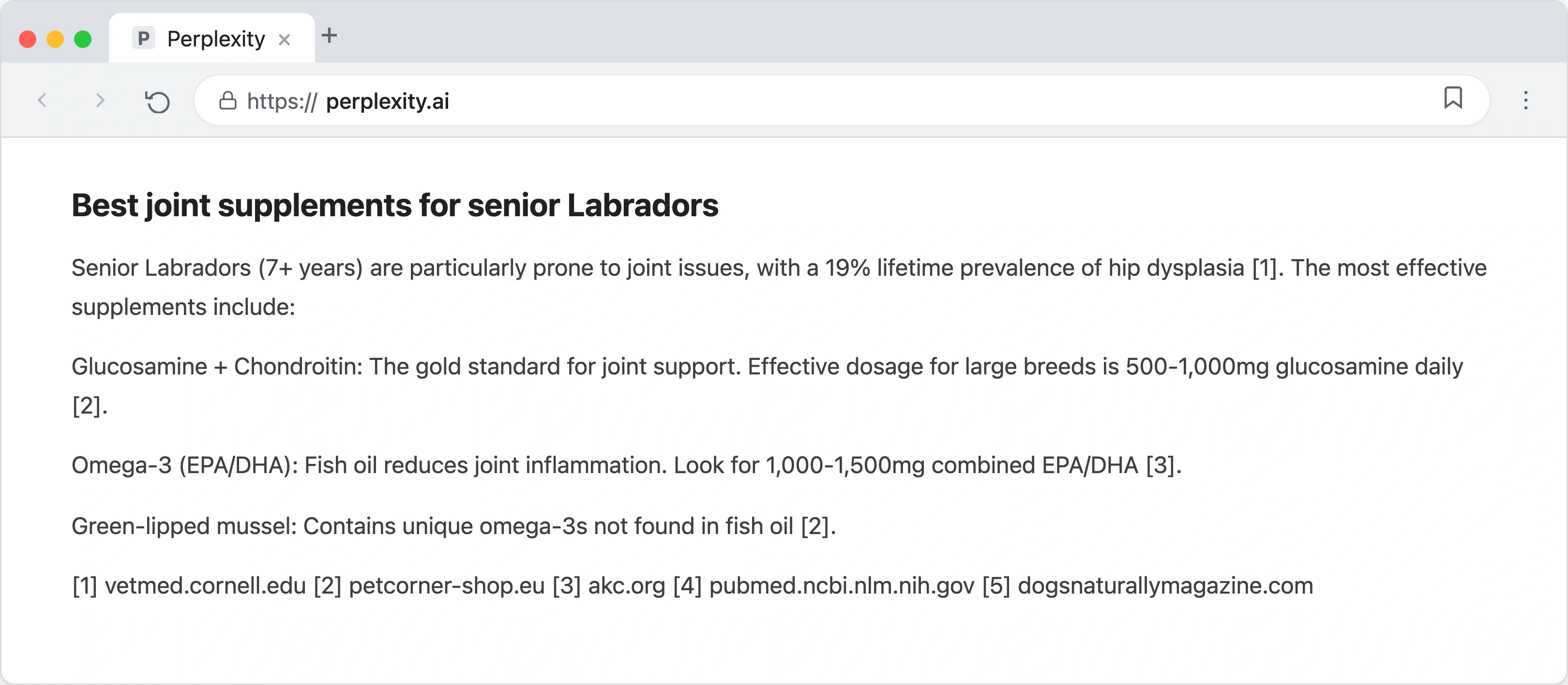
Perplexity crawls the web continuously with its own crawler and uses multiple search backends. It is far more citation-heavy, averaging 21.87 citations per question[3] - nearly 3x more than ChatGPT. Perplexity prioritizes Reddit (46.7% of citations[3]) and pulls 40% more citations from high-authority websites compared to mid-tier blogs[5]. It also favors recently updated content, with fresher pages outperforming older content by as much as 30% in citation visibility[5].
| Factor | ChatGPT | Perplexity |
|---|---|---|
| Search index | Bing real-time | Own crawler + multiple backends |
| Average citations per response | 7.92 | 21.87 |
| Top cited source type | Wikipedia (47.9%) | Reddit (46.7%) |
| Average cited domain age | 17 years | Not published |
| Freshness preference | Moderate | High (30% boost for recent content) |
| Structured content preference | Moderate | High (28% more likely to cite) |
| Domain overlap | Only 11% of domains cited by both | |
The low overlap means pet brands need a dual optimization strategy. What works for ChatGPT may not work for Perplexity, and vice versa. The good news: the foundational elements - quality content, clear structure, accurate information - help on both platforms.
Petbase writes and publishes this kind of content automatically - 10 SEO articles per month for pet businesses - start your free trial.
What Content Characteristics Get Pet Brands Cited?
Despite the platform differences, several content characteristics increase citation probability across both ChatGPT and Perplexity:
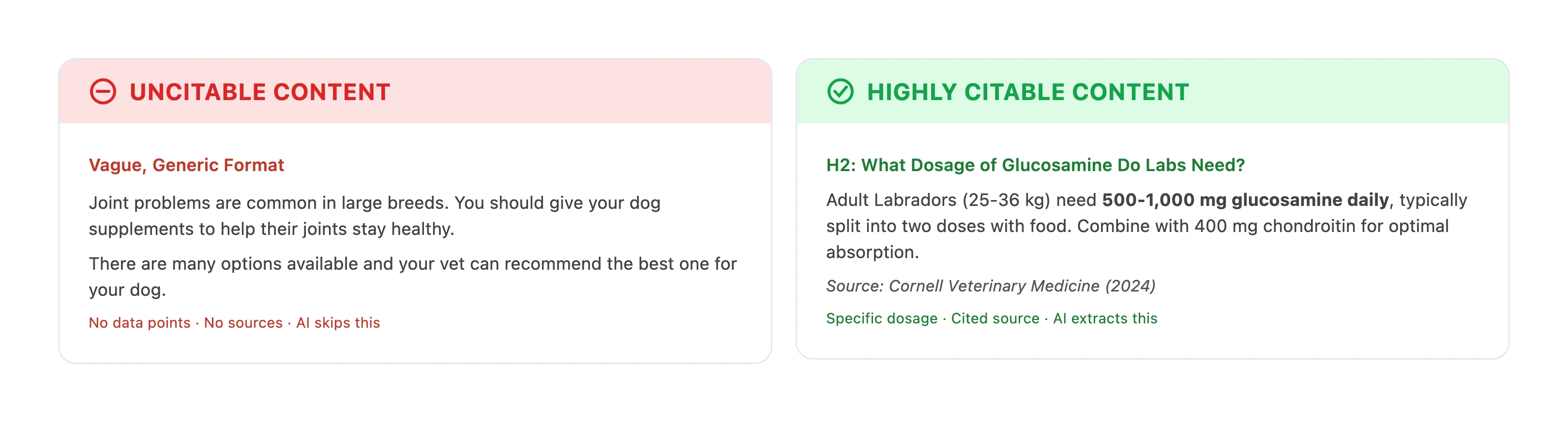
1. Passage-level clarity. LLMs do not cite entire pages. They cite specific passages - a single paragraph, sentence, or data point that directly supports a claim in their response[4]. For pet content, this means every section should contain at least one self-contained, factual statement that can stand on its own. "Adult Golden Retrievers need 1,200-1,500 calories per day, adjusted for activity level, with at least 22% protein content" is a citable passage. "Feed your dog the right amount" is not.
2. Structured headings that match questions. Pages with clear H2 and H3 headings formatted as questions are 28% more likely to be cited by Perplexity[5]. When a user asks Perplexity "how often should you bathe a Shih Tzu," the platform searches for pages with that exact question (or close variants) in a heading, then extracts the answer from the content below it. Use id attributes on your headings to enable deep-linking directly to a passage.
3. Data density with citations. Both platforms evaluate the credibility of your content by checking whether claims are supported by references. Content that cites veterinary studies, industry data, and authoritative sources is treated as more trustworthy than unsourced assertions. A breed health guide that cites specific clinical studies about hip dysplasia prevalence in German Shepherds is more citable than one that says "large breeds sometimes have joint problems."
4. Freshness signals. Update your content regularly with current dates visible on the page. Perplexity in particular favors recently updated content by as much as 30%[5]. A feeding guide updated in March 2026 with current nutritional research is more citable than the same guide from 2023.
5. Multi-platform presence. Brands appearing on four or more platforms are 2.8x more likely to appear in ChatGPT responses[4]. For pet brands, this means having content on your website, Reddit, YouTube, and industry forums. A pet store that publishes blog content, participates in pet care subreddits, and posts educational videos creates multiple citation touchpoints that AI platforms can reference.
How Does Schema Markup Improve AI Citation Rates?
Schema markup is not just for Google rich snippets anymore. It directly impacts whether AI platforms can find, understand, and cite your content. FAQPage schema improves AI citation rates by 30% on average[6]. The reason: FAQ schema pre-formats your content as question-answer pairs that AI systems can extract and cite without reformatting.
The schema types that matter most for AI citations:
- FAQPage: Marks your FAQ section as structured Q&A pairs. AI platforms can extract individual questions and answers as citation material. This is the single highest-impact schema type for AI visibility.
- Article: Provides publication date, author, and topic context. Helps AI platforms evaluate freshness and authorship authority.
- HowTo: Structures step-by-step content (grooming routines, training protocols) in a format AI can extract as numbered steps.
- Organization: Establishes your brand entity, linking your website to your business identity across the web.
For pet stores, the ideal implementation combines FAQPage schema on every blog post, Article schema with a named author, and HowTo schema on step-by-step guides. For detailed implementation examples with copy-paste code, see our schema markup guide for pet stores.
What Authority Signals Do AI Platforms Look For?
AI citation is fundamentally about trust. Both ChatGPT and Perplexity evaluate whether your content is authoritative enough to cite as a source for health, nutrition, or product recommendations. The authority signals they check overlap significantly with Google's E-E-A-T framework:
Domain authority and age. ChatGPT strongly favors established domains - the average age of its cited sources is 17 years[4]. Pet brands cannot change their domain age, but they can build domain authority through consistent publishing, backlink acquisition, and topical depth. Long-form content (3,000+ words) earns an average of 3,000 more backlinks than shorter posts[7]. For practical link building strategies, see our guide on building backlinks for pet stores.
Topical authority through content clusters. A pet store with 50 interlinked articles about dog nutrition demonstrates more topical authority than one with 5 isolated articles on random topics. AI platforms evaluate the breadth and depth of your content on a topic when deciding whether to cite you. Content clusters - a pillar page connected to 5-8 supporting articles through internal links - signal comprehensive expertise. For a full guide on building these clusters, see our post on content clustering for pet websites.
Branded mentions across the web. Branded mentions correlate stronger with AI visibility than backlinks alone[8]. When your pet store brand is mentioned in Reddit threads, YouTube descriptions, forum posts, and industry articles, AI platforms recognize your brand as an entity worth citing. This is different from traditional SEO where the link itself carries the value. For AI platforms, the mention is the signal.
Author credibility. Anonymous content rarely gets cited. Build strong author pages with verifiable credentials, professional headshots, and links to published work. A pet nutrition article attributed to "Dr. Maria Schmidt, DVM with 15 years of clinical experience" is more citable than the same article with no author attribution. Organic search still drives 53% of all website traffic[9], but AI citations are an increasingly important secondary traffic channel.
How Should Pet Brands Structure Content for Maximum Citability?
Based on the citation patterns across both platforms, here is the content structure that maximizes citation probability for pet content:
Step 1: Lead with a direct answer. The first 50-70 words should contain a clear, factual answer to the primary question. AI platforms extract opening statements as citation material. "Adult Border Collies need 90 to 120 minutes of daily exercise, split into at least two sessions combining physical activity and mental stimulation" is an ideal lead.
Step 2: Use question-format H2 headings with ID attributes. Each major section should be headed by a question that matches how users phrase queries to AI chatbots. Add ID attributes so platforms can deep-link to specific sections. Example: <h2 id="how-often-feed-puppy">How Often Should You Feed a Puppy?</h2>
Step 3: Include citable data in every section. Each section should contain at least one specific, factual data point with a source citation. "German Shepherds have a 19% lifetime prevalence of hip dysplasia" is citable. "Hip dysplasia is common in large breeds" is not.
Step 4: Add comparison tables for product and breed content. Comparison tables are frequently extracted by AI platforms because they provide structured, scannable information. A table comparing three grain-free dog food brands across protein content, price per kilogram, and key ingredients is highly citable.
Step 5: Close with FAQ section and schema. Add 3-5 FAQ items with concise answers (50-100 words each) and implement FAQPage schema. These Q&A pairs are among the most frequently cited content elements across all AI platforms.
In my experience working with pet stores, the sites that earn the most AI citations are not the ones with the flashiest design or the most content. They are the ones with the most clearly structured, deeply researched, breed-specific content. A 3,000-word guide on Cavalier King Charles Spaniel heart health with cited veterinary sources will earn citations from AI platforms that a 500-word generic "dog heart health" article never will.
Or let Petbase handle this automatically. Every Petbase article is structured with question headings, direct answer blocks, comparison tables, and FAQ sections - the exact format AI platforms prefer to cite. Ten articles per month for USD 199/mo.
What Types of Pet Content Get Cited Most Often by AI?
Not all pet content is equally citable. AI platforms prioritize content types that provide clear, factual, and verifiable information. Based on citation patterns across ChatGPT and Perplexity, these pet content categories earn the most citations:
Breed-specific guides. When a user asks "what health problems do French Bulldogs have" or "how much should I feed a Labrador puppy," AI platforms search for breed-specific content with precise, actionable data. A comprehensive breed health guide with specific condition names, prevalence percentages, symptoms, and veterinary recommendations is highly citable. Generic "dog health" content is not.
Comparison and recommendation content. "Best wet food for senior cats" and "grain-free vs regular dog food" are among the most common AI queries in the pet space. Content structured as clear comparisons with tables, pros and cons, and specific product criteria gives AI platforms the structured data they need to generate useful responses. The comparison table format is particularly citable because AI can extract specific rows and columns.
Health and nutrition reference content. Calorie requirements by breed and weight, toxic food lists, supplement dosing guides, and vaccination schedules serve as reference material that AI platforms cite repeatedly. This evergreen reference content earns citations long after publication because the underlying facts do not change frequently. A toxic food list for dogs that includes specific substances, symptoms of poisoning, and emergency steps is the kind of content both ChatGPT and Perplexity cite when users ask about pet safety.
Step-by-step care guides. Grooming routines, training protocols, and at-home health check procedures structured as clear numbered steps are easy for AI to extract and cite. A nail trimming guide with 7 specific steps, each with a brief explanation, is more citable than the same information in paragraph form. These guides also benefit from HowTo schema, which further improves citability.
FAQ-structured content. Content that answers common questions in a clear question-answer format aligns perfectly with how users interact with AI chatbots. Pet owners ask AI chatbots the same questions they would ask a store employee: "Can puppies eat adult dog food?" "How often should I clean my cat's litter box?" Content that answers these questions directly and concisely earns citations. Companies publishing 16 or more blog posts per month get 3.5x more traffic than those publishing four or fewer[11]. Building a library of these content types across multiple pet topics maximizes your total citation surface area.
What Technical Requirements Must Pet Store Websites Meet?
Content quality is only half the equation. If AI crawlers cannot access your content, they cannot cite it. Several technical requirements are essential:
Crawler access. Verify that PerplexityBot and BingPreview (which ChatGPT uses) are allowed in your robots.txt file. Some security plugins block unknown crawlers by default. If these bots are blocked, your content is invisible to both platforms regardless of its quality.
Server-side rendering. AI crawlers often cannot execute JavaScript. If your content is rendered client-side (common with React or Vue frameworks without server-side rendering), the crawlers see an empty page. Ensure your content is accessible in raw HTML without JavaScript execution. Static site generators and server-rendered frameworks work best.
XML sitemap. Keep your XML sitemap updated and submit it via Google Search Console and Bing Webmaster Tools. ChatGPT uses Bing's index, so Bing submission is particularly important. If you use Bing, submit via IndexNow for faster indexing.
Page speed. While AI crawlers are not as sensitive to page speed as human users, slow-loading pages may time out during crawling. Ensure your pages load within 3 seconds. 53% of mobile visitors abandon a page that takes longer than 3 seconds[10].
Clean URL structure. Use descriptive, keyword-rich URLs: /blog/golden-retriever-nutrition-guide rather than /blog/post-12345. AI platforms use URL structure as a relevance signal when selecting citations.
How Do You Track Your AI Citation Performance?
Measuring AI citations is harder than measuring Google rankings because there is no single dashboard that shows all your citations across all AI platforms. Here is a practical tracking approach:
Manual testing. Ask ChatGPT and Perplexity the same 10-20 questions your target audience would ask. Document which responses cite your content, which cite competitors, and which cite neither. Run this test monthly to track changes.
Citation monitoring tools. Several tools now track AI citations, including Ahrefs (which monitors the top 10 most cited domains across AI platforms[8]), Semrush, and specialized platforms like Profound and Discovered Labs. These tools automate the monitoring process and provide competitive analysis.
Referral traffic analysis. Check your analytics for traffic from chatgpt.com, perplexity.ai, and related domains. While not all AI citations generate click-through traffic, a growing trend in referrals from these domains indicates increasing citation visibility.
Key metrics to track:
- Number of target queries where your content is cited
- Citation position (first source vs. supplementary)
- Platform coverage (cited by ChatGPT only, Perplexity only, or both)
- Referral traffic from AI platforms (monthly trend)
- Competitor citation frequency for the same queries
The top 10 most-cited domains capture 53.87% of all AI citations[8]. Pet brands will not displace Wikipedia or Reddit from those top spots, but within the pet vertical, the competition for AI citations is far less concentrated. A well-optimized pet store blog can earn citations for breed-specific, nutrition, and product queries where the major platforms have thin or generic content.
Frequently Asked Questions
Can small pet stores compete with major brands for AI citations?
Yes, particularly for breed-specific and niche queries. AI platforms cite the most relevant, authoritative source for each specific claim - not the biggest domain overall. A small pet store with a comprehensive, well-cited guide on Cavalier King Charles Spaniel nutrition can earn citations over PetSmart or Chewy if their guides are generic or poorly structured. The 11% domain overlap between ChatGPT and Perplexity[2] also means there are citation opportunities on each platform that larger competitors may not be capturing.
How often should pet brands update content for AI citation freshness?
Review and update your top-performing content quarterly. Perplexity in particular favors recently updated content, with fresher pages outperforming older content by 30%[5]. Updates do not need to be major rewrites - adding current statistics, updating product recommendations, and refreshing the publication date signal freshness to AI crawlers. For seasonal pet content (flea season, winter care, holiday safety), update annually before the relevant season begins.
Does getting cited by AI platforms reduce or increase website traffic?
It depends on the citation type. When AI platforms cite your content with a visible link, users can click through to your site, generating referral traffic. Some brands report that AI citations drive qualified traffic because users who click through from an AI response have already read a summary and are seeking deeper information. However, if the AI response fully answers the query without requiring the user to visit your site, the citation provides brand visibility without direct traffic. The long-term value is in brand recognition - users who see your pet store cited repeatedly by AI platforms develop trust that drives future direct visits and purchases.
Should pet brands create content specifically for AI platforms or for Google?
Create content for your audience and structure it for maximum machine readability. The good news is that the characteristics AI platforms look for - clear headings, structured data, authoritative sourcing, comprehensive coverage - are the same qualities that rank well on Google. FAQPage schema helps with both Google rich snippets and AI citations[6]. Question-format headings help with both Google's "People Also Ask" and AI platform query matching. You do not need separate content strategies - you need one strategy executed with both audiences in mind.
References
- eMarketer (2026). FAQ on GEO and AEO: Where AI Search and SEO Overlap in 2026. emarketer.com
- Qwairy (2025). Perplexity vs ChatGPT: AI Citation Study Q3 2025. qwairy.co
- Discovered Labs (2025). AI Citation Patterns: How ChatGPT, Claude, and Perplexity Choose Sources. discoveredlabs.com
- ALM Corp (2026). AI Citation Patterns by Platform, Industry, and Intent. almcorp.com
- Wellows (2025). Perplexity Search Visibility Tips: 8 Ways to Get Cited. wellows.com
- Frase (2025). Are FAQ Schemas Important for AI Search, GEO and AEO? frase.io
- BuzzStream (2025). Link Building Statistics. buzzstream.com
- Ahrefs (2025). The 10 Most Mentioned Domains for ChatGPT, Perplexity, and AI Overviews. ahrefs.com
- BrightEdge (2025). How Much Traffic Comes From Organic Search. seoinc.com
- Deloitte/Google via Magnet (2024). Understanding Google's Core Web Vitals. magnet.co
- HubSpot (2025). Marketing Statistics. hubspot.com