How to Launch a Long-Tail Keyword Campaign for Your Pet Store: Complete Checklist


Table of Contents +
- Why Does Launch Strategy Matter for Long-Tail Keywords?
- Do You Have These 5 Pre-Launch Foundations?
- How Do You Find Your First 20-30 Rankable Keywords?
- Building Your Pillar-and-Spoke Cluster Architecture
- Which Publishing Mistakes Delay Your Rankings?
- What Should You Track in the First 30 Days?
- Questions about launching long-tail keywords
- Sources and further reading
A step-by-step checklist for launching long-tail keywords for pet stores: assess, discover, cluster, publish, and rank within weeks - not months.
Here's the mistake I see most often when a pet store starts launching long-tail keywords: you pick a handful of promising phrases, write an article for each, hit publish, and wait. Then you wait some more. Six months later the pages are barely indexed, the rankings have stalled, and the traffic you were promised never turned up.
The problem usually isn't the keywords. It's that isolated articles - no shared structure, no internal linking, no coordinated difficulty targeting - give Google nothing to reward. Every piece competes alone, and alone is exactly where an independent store with limited domain authority loses. Meanwhile roughly 70% of search volume sits in long-tail queries you could genuinely rank for, untapped, while the big chains keep the head terms and you keep refreshing your analytics.
A structured launch fixes this. What follows is the complete checklist - from pre-launch foundations through discovery, cluster architecture, publishing, and the first 30 days of measurement - that turns scattered posts into a cluster that compounds authority instead of leaking it.
Why Does Launch Strategy Matter for Long-Tail Keywords?
Launch strategy matters because isolated long-tail articles rarely rank on their own - an independent store with limited domain authority needs the compounding effect of a connected cluster. How you sequence discovery, structure, and publishing decides whether pages rank in weeks or stall for months.
Three launch mistakes cause most of the damage. The first is publishing keyword articles in isolation: each page floats alone with no internal links, so Google sees no topical relationship and no reason to treat your store as an authority. The second is misaligned difficulty targeting - chasing terms your domain can't realistically win. The third is an uncoordinated schedule, where spokes trickle out over months and the cluster never actually forms.
That first mistake is the expensive one. Large chains such as Fressnapf and zooplus hold domain ratings above 70, and independent retailers can't out-rank them on head terms like "dog food" with any realistic effort. Long-tail queries are your opening - and they convert far higher, at 8-15% against 1-5% for broad head terms, because the buyer has already narrowed their intent to a breed, a condition, or a specific product.
A structured launch flips the maths. Instead of one article hoping to rank alone, you publish a connected cluster where every spoke feeds authority to the pillar and back. If you're still weighing which long-tail terms are worth targeting in the first place, our guide to long-tail keyword examples for pet retailers is the strategy companion to this checklist - read it first if the concept is new.
Petbase automates SEO content for pet stores - publishing 10 optimized articles monthly so you can focus on running your shop - start your free trial.
Do You Have These 5 Pre-Launch Foundations?
Before launching long-tail keywords for pet stores, confirm five foundations are in place: a mapped product catalogue, a basic grasp of keyword difficulty, a realistic difficulty sweet spot for your domain, the capacity to internally link, and a feasible publishing schedule. This is a clarity step, not a pass-or-fail gate.
Run through each one honestly before you write a single word:
Product catalogue audit. List every product category, breed focus, and health condition you stock. Each becomes a potential keyword theme. If you run a bricks-and-mortar or hybrid shop, your location belongs on this map too - local long-tail keywords like "pet shop near me" deserve their own place in the plan.
Baseline keyword difficulty understanding. You don't need to be an analyst, but you should know that difficulty scores estimate how hard a term is to rank for, and that a new site can't win high-difficulty phrases quickly no matter how good the article is.
Your difficulty sweet spot. For most independent stores that sits at difficulty 20-45 - competitive enough to signal real demand, low enough to rank within a few months. Brand-new domains should start even lower and graduate upward.
Internal linking capacity. Confirm your CMS lets you add contextual links between posts without friction. The cluster's entire power comes from linking, so this cannot be a chore you'll skip.
Publishing schedule feasibility. Can you realistically get a pillar and 6-8 spokes live within 2-4 weeks? If not, secure the resource before you start - or automate it, which is exactly the coordination Petbase AI handles for pet stores.
How Do You Find Your First 20-30 Rankable Keywords?
Find your first 20-30 rankable keywords by starting from product-based seeds, filtering to a minimum of 50 monthly searches, checking difficulty against your domain, and confirming buyer intent. Aim for difficulty 0-30 in month one, then graduate toward 20-35 as your topical authority builds.
Work through this pet store keyword research checklist in order:
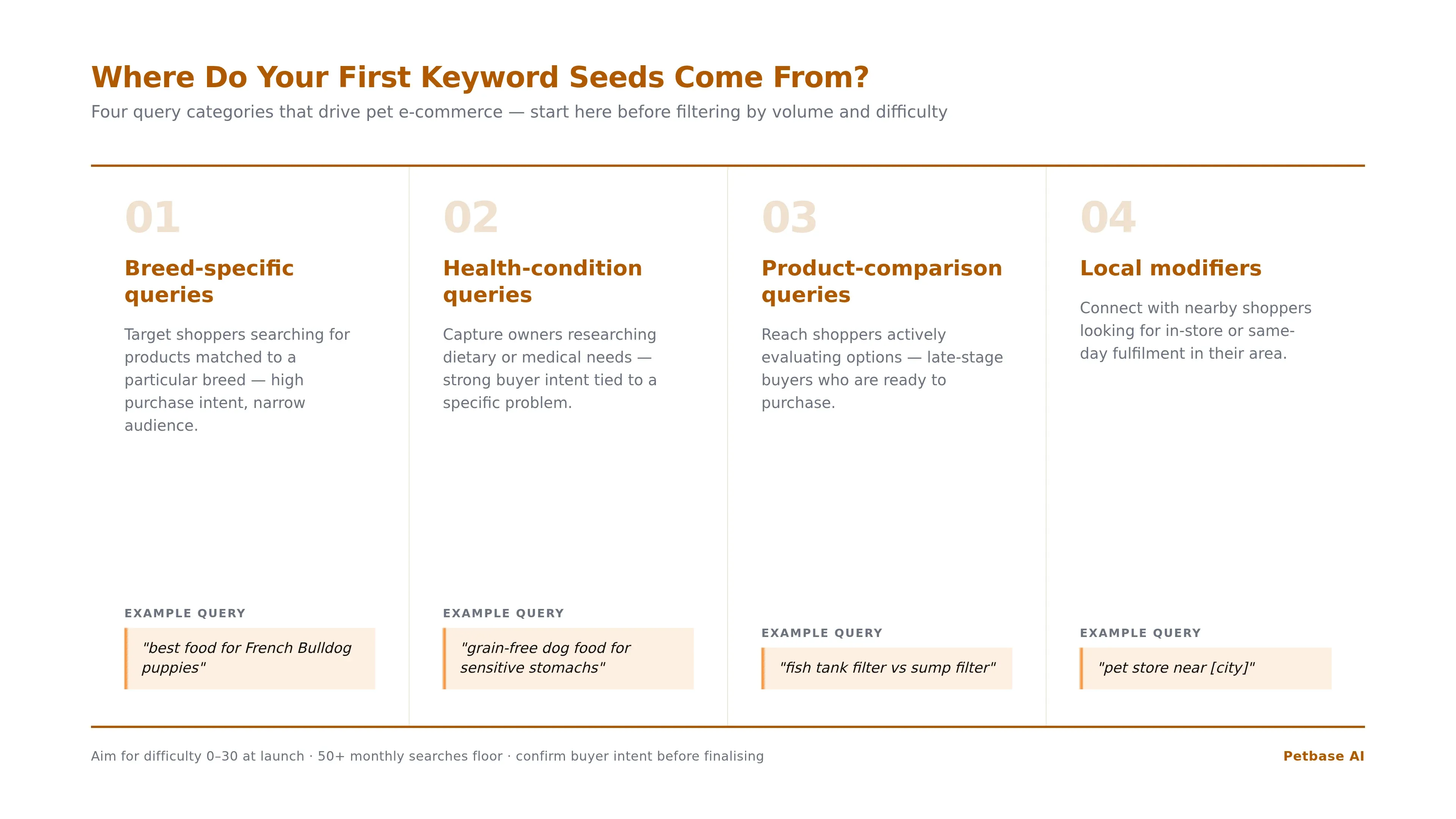
Choose your seeds. Start from the four query categories that drive pet e-commerce: breed-specific ("best food for French Bulldog puppies"), health-condition ("grain-free dog food for sensitive stomachs"), product-comparison ("fish tank filter vs sump filter"), and local modifiers ("pet store near [city]").
Assess difficulty realistically. New sites should target difficulty 0-30 at launch, graduating to 20-35 by month six as the cluster earns authority. Reserve difficulty 50+ for after 18-24 months of clustering.
Apply the volume floor. Fifty monthly searches is the commercial viability floor for a standalone page. Below that, a term still earns its place inside a cluster, where sibling and pillar links transfer authority - especially when it points to a higher-value product.
Confirm intent. A phrase with 30 monthly searches and explicit purchase intent can out-earn one with 3,000 searches and vague intent. Match each term to a buyer-journey stage before it makes the list.
If discovery is where you feel least confident, our complete guide to finding low-competition keywords for pet stores walks through the tools and filters step by step.
Building Your Pillar-and-Spoke Cluster Architecture
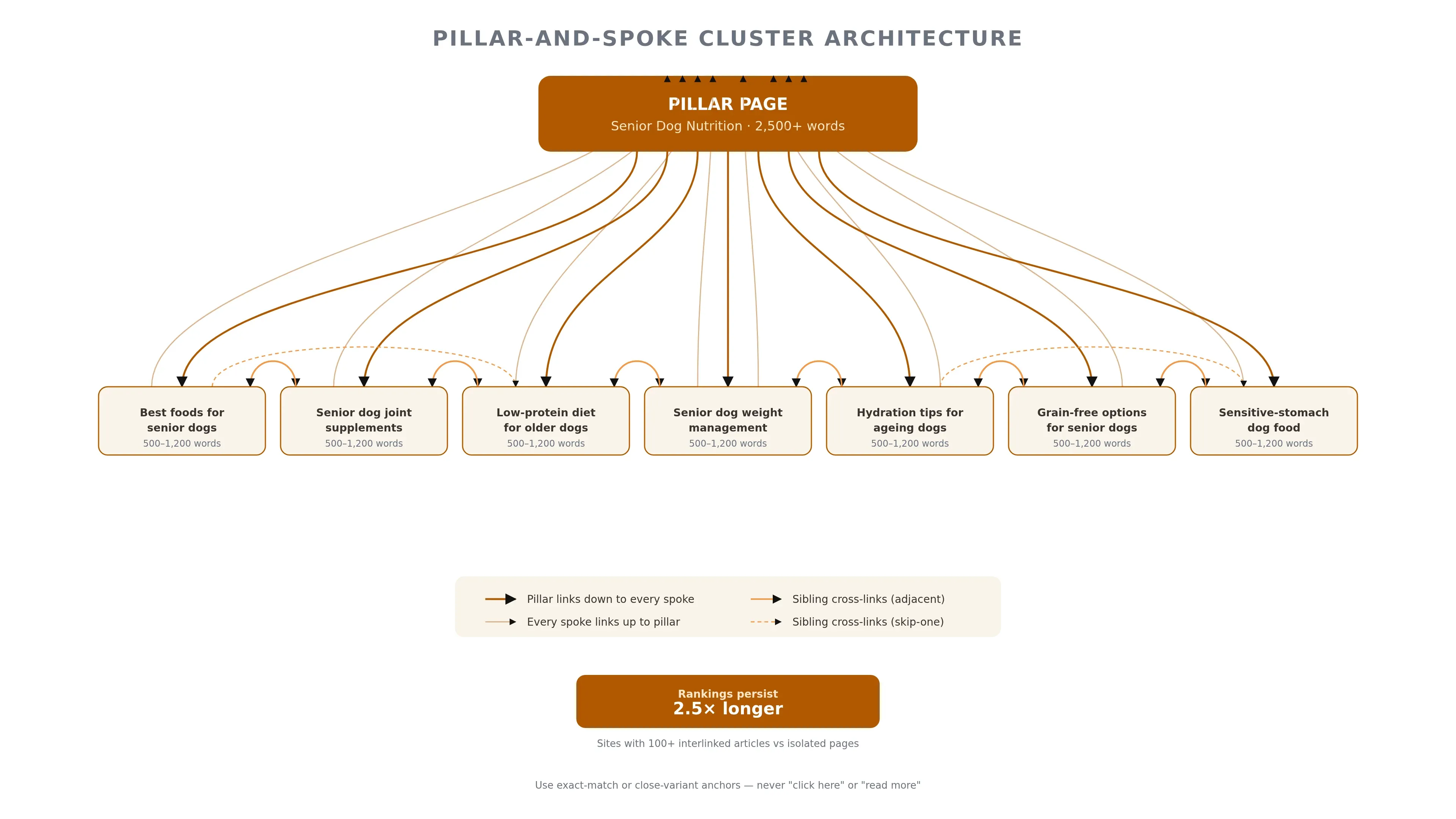
A pet-store cluster is one pillar page of 2,500+ words covering a broad topic - say, senior dog nutrition - supported by 6-8 spoke pages of 500-1,200 words, each targeting one long-tail angle. Spokes link up to the pillar and across to two or three siblings using exact-match anchors.
Use this keyword cluster launch guide to assemble the structure:
Select the pillar topic. Pick a broad theme you'll never rank for directly but that unifies your spokes - "senior dog nutrition" or "sensitive-stomach dog food".
Assign one keyword per spoke. Map each discovered long-tail term to a single spoke so no two pages compete for the same query and cannibalise each other.
Plan the internal links. Every spoke links up to the pillar; the pillar links down to every spoke; each spoke cross-links to two or three siblings. Draw this out before you publish anything.
Write the anchor text first. Use exact-match or close-variant anchors - the actual keyword phrase, never "click here" or "read more".
This structure is what compounds: sites with 100+ interlinked articles see rankings persist around 2.5 times longer than isolated pages. For the strategy behind why this lets a small shop out-manoeuvre bigger rivals, see our piece on building topical authority as an independent retailer.
Which Publishing Mistakes Delay Your Rankings?
The publishing mistakes that delay rankings are predictable: weak anchor text, linking spokes before the pillar exists, and dribbling content out over months. Publish the whole cluster within 2-4 weeks, use descriptive anchors, add Article and FAQ schema, and keep metadata consistent across the set.
When you're implementing a long-tail strategy for pet retailers, the sequence matters as much as the prose. Work this publishing checklist:
Publish the pillar first, then the spokes. Linking spokes to a pillar that doesn't yet exist creates broken links and wastes crawl budget.
Compress the timeline. Get every piece live within 2-4 weeks so Google crawls the cluster as one connected set, not a slow trickle that never reads as a group.
Get anchor text right. Exact-match and close-variant anchors tell Google what each linked page is about; generic anchors throw away the signal.
Embed schema. Add Article and FAQ structured data to every piece to earn rich results and help search engines interpret the content.
Keep metadata consistent. Titles, descriptions, and headings should reinforce each spoke's target term without duplicating across pages.
This is the stage where manual launches stall - coordinating publishing, linking, and schema across ten pages is a fortnight of fiddly work. Petbase AI automates the whole publishing and internal-linking workflow, pushing schema-ready articles straight to your Shopify, WooCommerce, or WordPress site so the mechanics never become the bottleneck.
What Should You Track in the First 30 Days?
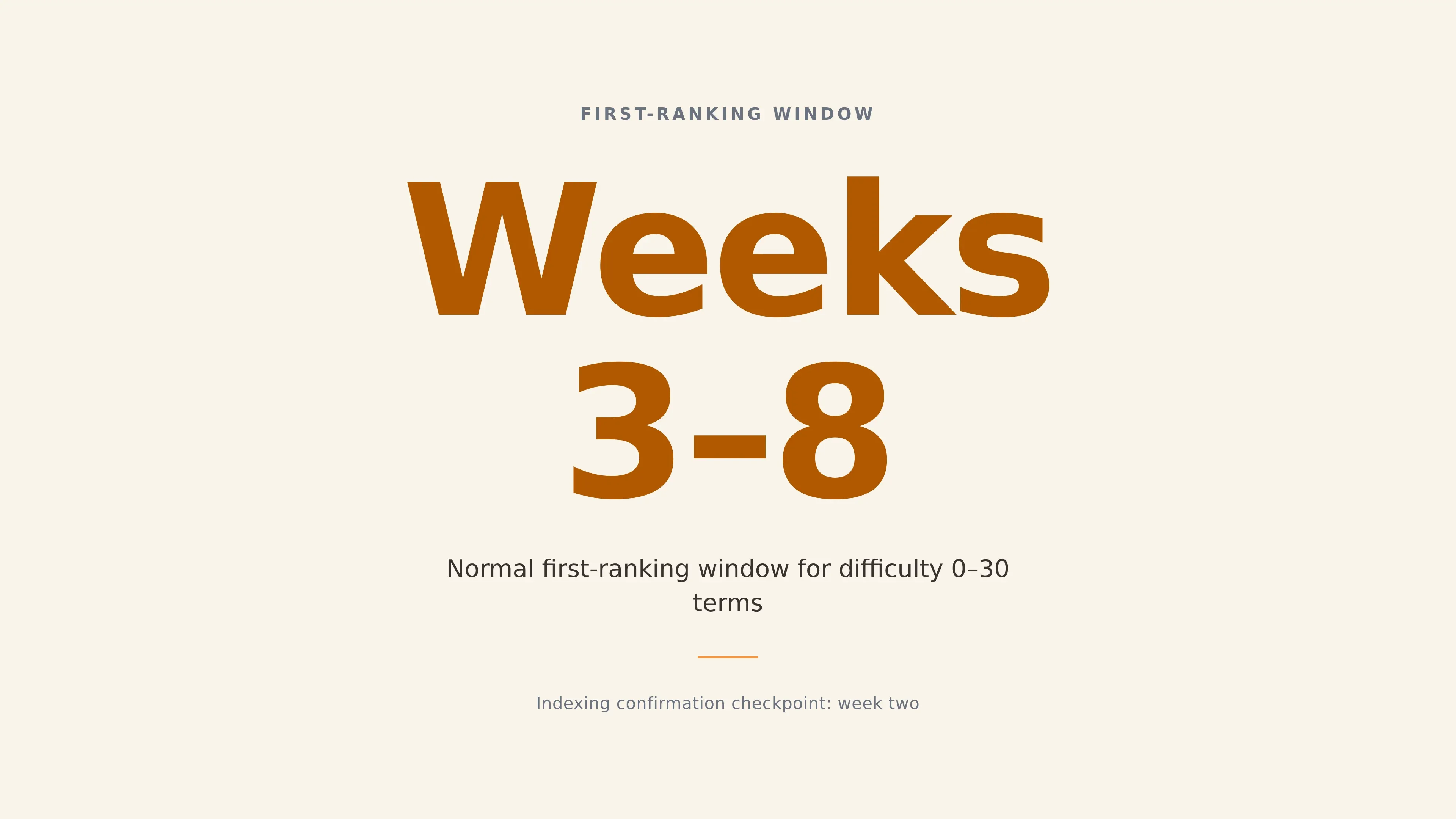
In the first 30 days, track four things: indexing confirmation, ranking positions, click-through patterns, and internal-link crawlability. For difficulty 0-30 terms, expect movement between weeks three and eight. Rankings before week three are a bonus; nothing on indexing by week two is your first warning sign.
Confirm indexing. Check that each page is indexed within two weeks. If it isn't, investigate crawlability before you touch anything else.
Track ranking position. Expect first rankings for difficulty 0-30 terms in weeks three to eight. Stalling at position 30+ well past that window signals a real problem.
Watch click-through patterns. Impressions without clicks usually mean the title or meta description needs sharpening, not the article rewriting.
Verify internal-link crawlability. Make sure every spoke-to-pillar and sibling link is live and followable.
Petbase AI's built-in analytics dashboard tracks indexing, keyword rankings, and organic traffic for every published article, so you can watch the cluster mature without stitching together separate third-party tools.
Launching long-tail keywords for pet stores isn't about finding one magic phrase - it's about executing a coordinated sequence: assess your foundations, discover 20-30 rankable terms in your difficulty sweet spot, build a pillar-and-spoke cluster, publish it tightly within 2-4 weeks, then measure the first 30 days with patience. Do that, and you turn the 70% of search volume the chains ignore into traffic you actually own.
Done by hand, that sequence takes two to four weeks of setup and constant coordination. If you'd rather spend your time validating keywords than wrangling content mechanics, there's a faster path.
Questions about launching long-tail keywords
How long does it take to rank when launching long-tail keywords for a pet store?
For low-difficulty terms (0-30), expect first rankings between weeks three and eight after publishing, provided pages are indexed within two weeks. A structured cluster launch can compress the old 6-12 month timeline considerably, but ranking isn't instant: the first two weeks are about indexing and crawling, and meaningful position movement follows after that. Rushing to rewrite a page before week three usually does more harm than good.
What is the minimum search volume worth targeting for a pet store keyword?
Fifty monthly searches is the commercial floor for a standalone article. Below that, a keyword still earns its place inside a cluster, where internal links from the pillar and sibling pages transfer authority. Volume alone doesn't decide value, though - a term with 20 searches and clear intent toward a €150 product can justify a page that a €5 commodity at the same volume never would.
How many articles do I need in a long-tail keyword cluster?
A typical pet-store cluster is one pillar page of 2,500 or more words plus six to eight spoke pages of 500-1,200 words each, giving you seven to nine connected articles per topic. The pillar covers the broad theme while each spoke targets one long-tail query. Spokes link up to the pillar and across to two or three siblings, which is what compounds authority across the whole set.
Do I need to publish all the cluster articles at once?
Publish the whole cluster within a tight 2-4 week window rather than all in one day or dribbled over months. A compressed timeline lets Google crawl the pages as a connected set and recognise the topical relationship quickly. Publish the pillar first so spokes have something to link to, then release the spokes in quick succession. Dragging publication across months is one of the most common reasons launches stall.