Health-Condition Keywords for Pet Stores: Mastering EEAT Requirements


Table of Contents +
- What Makes Health-Condition Keywords a Distinct Category?
- Why Do Health Keywords Convert at Higher Rates?
- What Are YMYL and EEAT, and Why Do They Apply?
- What Does EEAT Actually Require-and What Doesn't It?
- Building EEAT Authority as an Independent Retailer
- How Do Health-Condition Clusters Compound Authority?
- Questions you're probably asking
- Sources and citations
Health condition keywords for pet stores convert high but face YMYL and EEAT scrutiny. See what Google really requires-no vet writer needed.
Behind every search result sits a classification step most retailers never see. Before Google ranks a page, it sorts the query by the stakes of getting the answer wrong-and health and medical topics get routed into a stricter evaluation lane. That routing is exactly why your health condition keywords for pet stores behave so differently from your breed or product pages.
The same cluster strategy that lifts "best harness for a Labrador" can stall on "grain-free food for a dog with colitis"-not because the keyword is harder to find, but because Google judges it against a higher bar. Ignore that mechanism and you pour effort into pages that never surface, ceding the highest-intent, highest-converting queries in your catalogue to competitors who understood the rule. The good news: the bar is a filter, not a wall.
What Makes Health-Condition Keywords a Distinct Category?
Health-condition keywords are long-tail queries where the searcher describes a specific problem-"grain-free dog food for sensitive stomachs", "joint supplement for an arthritic cat"-rather than a breed, a product comparison, or a location. They form one of four distinct query categories in pet e-commerce, defined by a problem-aware, high-urgency intent no other category shares.
Pet e-commerce long-tail search falls into four categories, each mapping to a different stage of the buying journey and each needing its own content framing to capture.
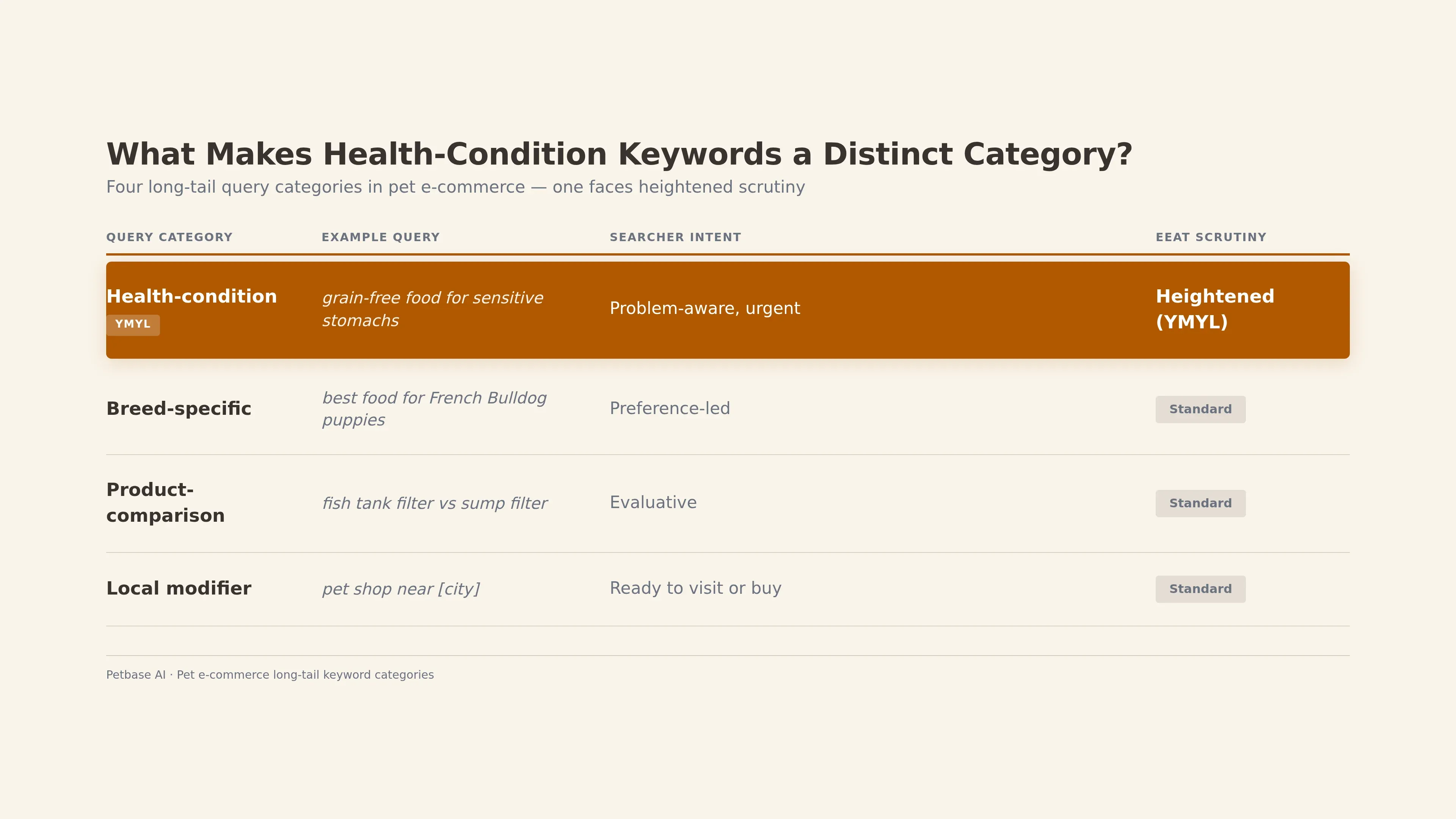
| Query category | Example | Searcher intent | EEAT scrutiny |
|---|---|---|---|
| Breed-specific | best food for French Bulldog puppies | Preference-led | Standard |
| Health-condition | grain-free food for sensitive stomachs | Problem-aware, urgent | Heightened (YMYL) |
| Product-comparison | fish tank filter vs sump filter | Evaluative | Standard |
| Local modifier | pet shop near [city] | Ready to visit or buy | Standard |
Health-condition queries stand apart because the searcher has already narrowed their need to a symptom or diagnosis. A shopper typing "best food for a dog with pancreatitis" isn't browsing-they have a distressed animal and a decision to make today. If you're still mapping the wider long-tail landscape, our guide to long-tail keyword examples for independent pet retailers is the right place to start before you tackle the health category specifically.
That urgency is what makes the category so valuable-and, as the rest of this article shows, it's also why Google guards it more closely than any other type of pet query.
Petbase automates SEO content for pet stores - publishing 10 optimized articles monthly so you can focus on running your shop - start your free trial.
Why Do Health Keywords Convert at Higher Rates?
Health keywords convert at higher rates because the searcher has already diagnosed their need and is ready to buy the solution. Long-tail queries convert at 8-15% versus 1-5% for broad head terms, and health-condition searches sit at the top of that range-driven by an urgency that compresses the usual research-to-purchase gap.
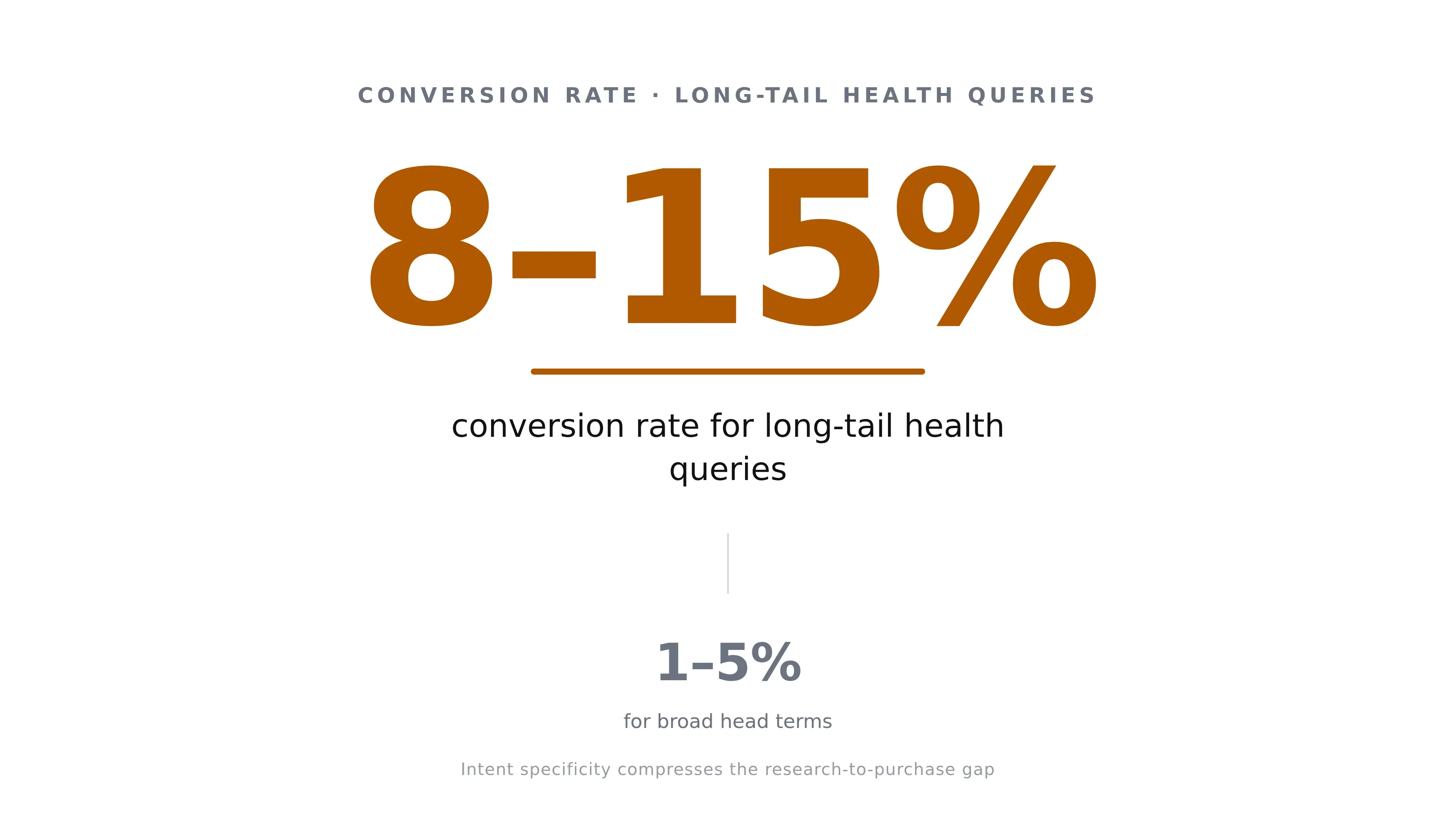
The mechanism is intent specificity. A shopper searching "dog food" is exploring; a shopper searching "low-fat dog food for a spaniel recovering from pancreatitis" has narrowed the field to a handful of viable products and is comparing, not browsing. That specificity strips out the friction that kills conversion on head terms-there is nothing left to decide except which retailer to trust.
Much of this intent overlaps with breed specificity. "Sensitive-stomach food for a Miniature Schnauzer" is both a health and a breed query, which is why breed-specific keywords outperform generic pet searches on the same conversion logic. In the UK especially, buyers lean on a research-heavy "best [product] for [condition]" template, working through symptoms and solutions before any purchase-intent signal appears.
The catch is that these same high-value queries are the ones Google scrutinises hardest. The conversion upside is real, but it comes bundled with an EEAT barrier the other three categories never face-so understanding that barrier is the difference between capturing the revenue and watching your pages sit unranked.
What Are YMYL and EEAT, and Why Do They Apply?
YMYL-Your Money or Your Life-is Google's label for topics that can affect a person's health, safety, or finances. Pet-health content falls under it because inaccurate advice can harm an animal. YMYL pages face heightened EEAT scrutiny: Google evaluates Experience, Expertise, Authoritativeness and Trustworthiness far more strictly before it will rank them.
Pet owners increasingly turn to search for veterinary and medical information about their animals, which is precisely why Google treats the category as YMYL and applies stricter EEAT standards to health content. A sound YMYL pet content strategy starts by understanding what each of the four EEAT signals means in this specific context.
The four EEAT signals for pet health
- Experience - first-hand, practical familiarity with the problem: what a sensitive-stomach diet actually looks like in a bowl, how owners describe the symptoms.
- Expertise - demonstrable knowledge, shown through accurate explanation and appropriate sourcing rather than a single credential.
- Authoritativeness - recognition that your site is a go-to source on the topic, built through depth and consistency.
- Trustworthiness - the signal Google weights most heavily for YMYL: transparent authorship, honest disclaimers, and claims a reader can verify.
These are the EEAT requirements for pet health articles in plain terms. None of them, on their own, demands a laboratory or a medical degree-they demand that a careful, honest source is visibly behind the page.
What Does EEAT Actually Require-and What Doesn't It?
EEAT does not require a veterinary degree or an expensive specialist writer. It requires accurate, clearly written content, credible sourcing, and transparent authorship. What Google rewards is trustworthiness you can demonstrate-cited references, an honest author bio, and sensible medical disclaimers-not a particular set of letters after the writer's name.
The confusion between health keywords and veterinary authority is where most independent retailers get stuck. Expert input genuinely adds value: research on health content shows that clinical review helps counter misinformation. But that is an argument for accuracy and appropriate attribution, not for putting a vet on the payroll before you publish a single article.
Genuine EEAT signals
- References to reputable sources-veterinary associations, peer-reviewed studies, and qualified guides-placed next to the claims they support.
- A transparent author bio that states who is behind the content and why they can be trusted on the subject.
- Clear medical disclaimers where advice touches diagnosis or treatment.
- Plain-language explanation: pet owners frequently misinterpret veterinary terminology, so writing in accessible terms is itself a trust signal, not a compromise of authority.
What EEAT does not require is a veterinarian's byline on every page, or citations drawn exclusively from academic journals. A well-sourced, clearly written, honestly attributed article by an informed retailer clears the bar. The myth that health content must be produced by specialist medical writers is the single most expensive misconception in this category-and acting on it hands the queries back to the chains.
Building EEAT Authority as an Independent Retailer
You build EEAT authority incrementally, not by outsourcing to a veterinary content agency. Start with reputable references, a credible author bio, honest disclaimers, and structured data-then layer those signals into every health article you publish. Each element is inexpensive to implement, and together they compound as your catalogue of trustworthy content grows.
A practical, repeatable checklist keeps the effort manageable:
- Source before you write. Gather two or three reputable references-veterinary associations, peer-reviewed studies, qualified guides-and cite them inline, adjacent to the claim each one supports.
- Attribute the author. A short, honest bio stating relevant experience does more for trust than an anonymous page ever will.
- Add a medical disclaimer wherever content touches symptoms, diagnosis, or treatment, pointing readers to their own vet for individual advice.
- Embed schema markup. Article and FAQ structured data help Google interpret the page and can surface rich results.
These signals pay off fully only when the article sits inside a broader structure-which is where topical authority lets independent retailers compete against far bigger rivals. This is exactly the workload an automated platform like Petbase AI is built to carry, embedding cited sources, schema markup, and disclaimers during generation rather than bolting them on afterwards.
How Do Health-Condition Clusters Compound Authority?
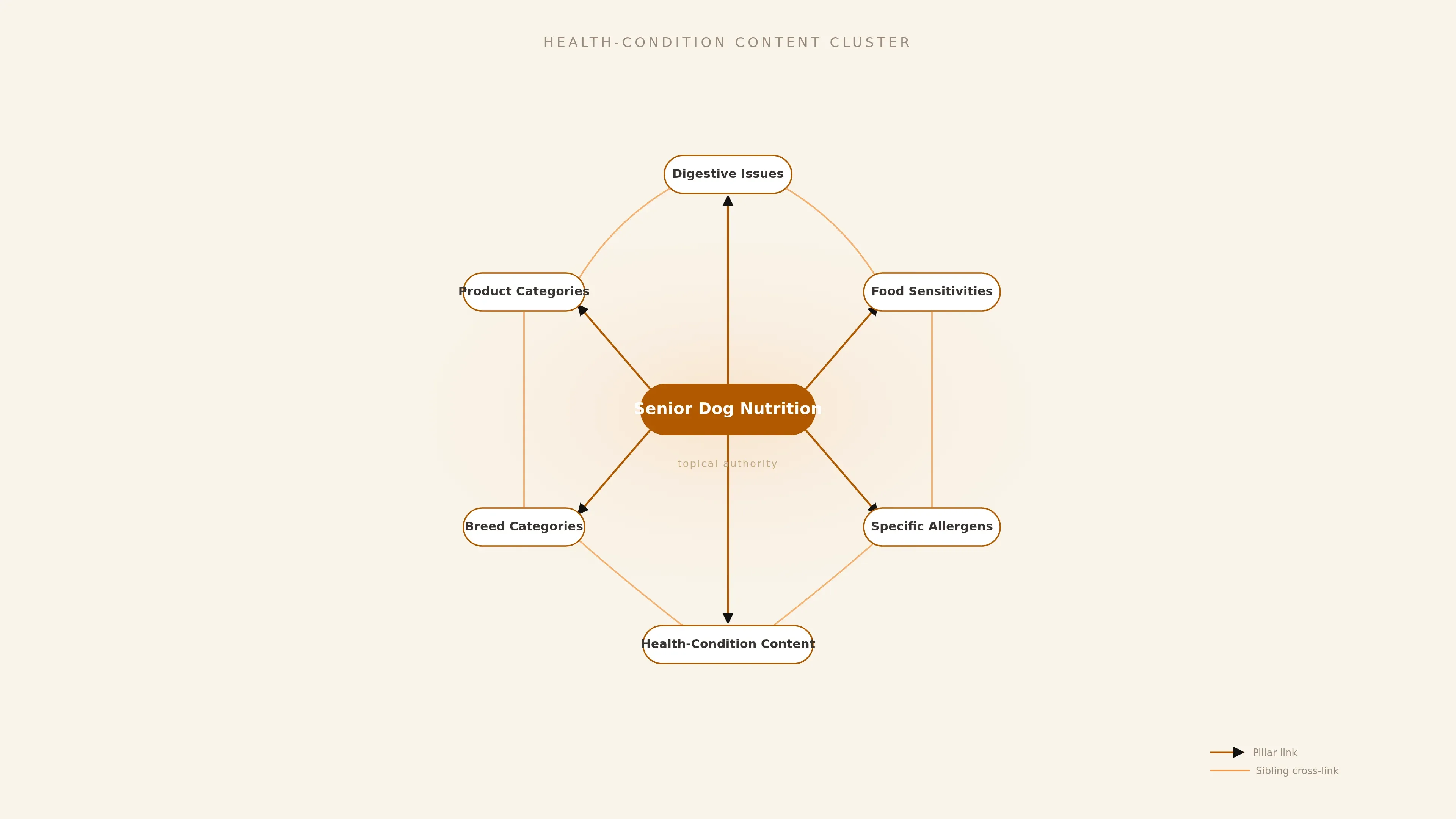
Health-condition keywords compound when you link related articles into a cluster. Publish several pieces on connected conditions-digestive issues, food sensitivities, specific allergens-and internally link them, and Google reads that depth as topical authority. The signal lifts every page in the cluster and builds a foundation for broader category rankings later.
The architecture is straightforward: a broad pillar page covering the umbrella topic-say, senior dog nutrition-supported by six to eight focused spoke pages, each targeting one long-tail health query and linking back to the pillar and across to two or three sibling articles. That cross-linking transfers authority between pages, so even a low-volume condition query benefits from the collective weight of the cluster.
The durability advantage is the real prize. Content clusters consistently outperform isolated, unlinked posts in both ranking speed and sustained position-interlinked pages hold their rankings substantially longer than standalone articles. A single health article can spike and fade; a cluster of them anchors a retailer's presence in a topic.
Starting with health-condition content is a deliberate strategic choice. Because these queries carry the highest intent and the clearest purchase signal, a cluster built around them earns commercial return while it accumulates the topical depth you'll later extend into breed and product categories. You clear the hardest bar first, then everything downstream ranks more easily.
Health-condition keywords are the highest-intent queries in your catalogue, and the EEAT bar that guards them is a filter, not a wall. The retailers who win them aren't the ones with the biggest budgets-they're the ones who understood that Google routes health topics through YMYL evaluation and answered with clarity, credible sourcing, and clustered depth rather than a veterinary payroll.
Start with one condition theme, source it properly, link it tightly into a cluster, and let the authority compound across every related page. If you'd rather have that structure built and published for you-EEAT signals, schema, and cluster architecture included-Petbase AI produces health-condition articles that meet the bar automatically, ten a month, straight to your CMS.
Questions you're probably asking
Do I need a veterinarian to write health-condition content?
No. Google's EEAT framework rewards trustworthiness you can demonstrate, not a specific qualification. You need accurate content, credible cited sources, a transparent author bio, and sensible medical disclaimers. A qualified vet reviewer adds value, but an informed retailer who sources responsibly and writes clearly can meet EEAT standards without hiring specialist medical writers.
What counts as a health-condition keyword?
A health-condition keyword is a search where the shopper describes a specific problem their pet has-"grain-free food for sensitive stomachs" or "joint supplement for an arthritic dog". It sits within the long-tail category and is defined by problem-aware, high-urgency intent rather than by breed, product comparison, or location. These queries carry unusually strong purchase intent.
Why do health keywords fall under YMYL?
Google classifies content that can affect health, safety, or finances as Your Money or Your Life. Pet-health advice qualifies because inaccurate guidance can harm an animal. YMYL pages face stricter EEAT evaluation, so Google weighs the author's credibility, the quality of sources, and the accuracy of claims far more heavily before ranking them.
How many health articles do I need to build authority?
There's no fixed number, but authority compounds when related articles are linked into a cluster-typically a broad pillar page supported by several focused spokes on connected conditions. Interlinked clusters hold their rankings far longer than isolated posts, so consistency matters more than any single count. Start with one condition theme and expand outward from there.