Why Breed-Specific Keywords Outperform Generic Pet Searches: A Strategic Guide for Independent Retailers


Table of Contents +
- Why Can't Independent Retailers Rank for Generic Pet Keywords?
- How Much Better Do Breed-Specific Keywords Convert?
- Why Do Breed Queries Signal Purchase Intent Better Than Generic Searches?
- How Many Rankable Breed Keywords Are You Ignoring?
- How Breed Keywords Build Topical Authority by Default
- Which Breeds Should You Target First?
- Frequently Asked Questions
- References
Breed-specific keywords convert 2.5x better. See why breed-specific keywords outperform generic pet searches, and which breeds to target first.
Here is the number that should reshape how every independent pet retailer approaches search: breed-specific queries convert at roughly 2.5 times the rate of generic product searches. That single multiplier explains why breed-specific keywords outperform generic pet searches so decisively - and why the retailers still pouring effort into terms like "dog food" and "pet supplies" are competing hardest for the traffic worth least.
The gap compounds. Head-term keywords are locked down by sites with domain ratings above 70 - Fressnapf.de sits at 74, zooplus.de at 75 - so an independent store with limited domain authority has almost no realistic path to page one for them. Meanwhile long-tail phrases account for around 70% of all search volume, and the breed-specific slice of that pool is both higher-converting and far less contested. Chasing the same generic five-to-ten keywords everyone else targets means fighting the fiercest battle for the smallest reward.
Why Can't Independent Retailers Rank for Generic Pet Keywords?
Independent retailers can't rank for generic pet keywords because head terms are dominated by high-authority chains - Fressnapf.de at domain rating 74, zooplus.de at 75, plus Amazon and Maxi Zoo - whose accumulated link profiles are unassailable with realistic effort. Yet most stores still chase these same contested, low-return keywords.
The maths is unforgiving. A term like "dog food" carries enormous volume, but the rankings are held by domains that have spent years building authority; small and medium retailers need a far more targeted SEO approach to win organic ground against them (SMEs need targeted SEO for organic market advantage). For a store with limited domain authority, long-tail keywords are the only viable path to a page-one ranking within six months.
That matters because the traffic is not where most retailers are looking. Around 70% of all search volume runs through specific, multi-word queries - breed-specific, health-condition, and life-stage phrases - yet the typical independent store fixates on the five-to-ten highest-volume generic keywords. The result is predictable: heavy competition for a thin slice of intent, and near-total neglect of the majority of searches that actually convert. Long-tail specificity is what drives the conversion uplift these stores leave on the table.
If this is the first time you're mapping the long-tail opportunity in full, our complete guide to long-tail keyword examples for independent pet retailers lays out the wider strategy that breed-specific keywords sit inside.
Petbase automates SEO content for pet stores - publishing 10 optimized articles monthly so you can focus on running your shop - start your free trial.
How Much Better Do Breed-Specific Keywords Convert?
Breed-specific keywords convert at roughly 2.5 times the rate of generic product queries because breed names carry personalised, specific search signals that improve conversion rate significantly. Someone searching "best food for French Bulldog puppies" has already declared what they own and what they want; "dog food" captures browsers at every stage.
Royal Canin built an entire business model on exactly this insight, commanding 30-50% price premiums for breed-specific formulas. That premium is evidence in itself: pet owners actively seek out, trust, and pay more for solutions tailored to their specific breed. When a searcher types the breed name, they have self-selected into a purchase-ready audience before they ever reach your page.
The conversion economics make the case plainly. This kind of dog breed keywords conversion rate comparison shows breed and other long-tail queries converting in the region of 8-15%, against just 1-5% for broad head terms.
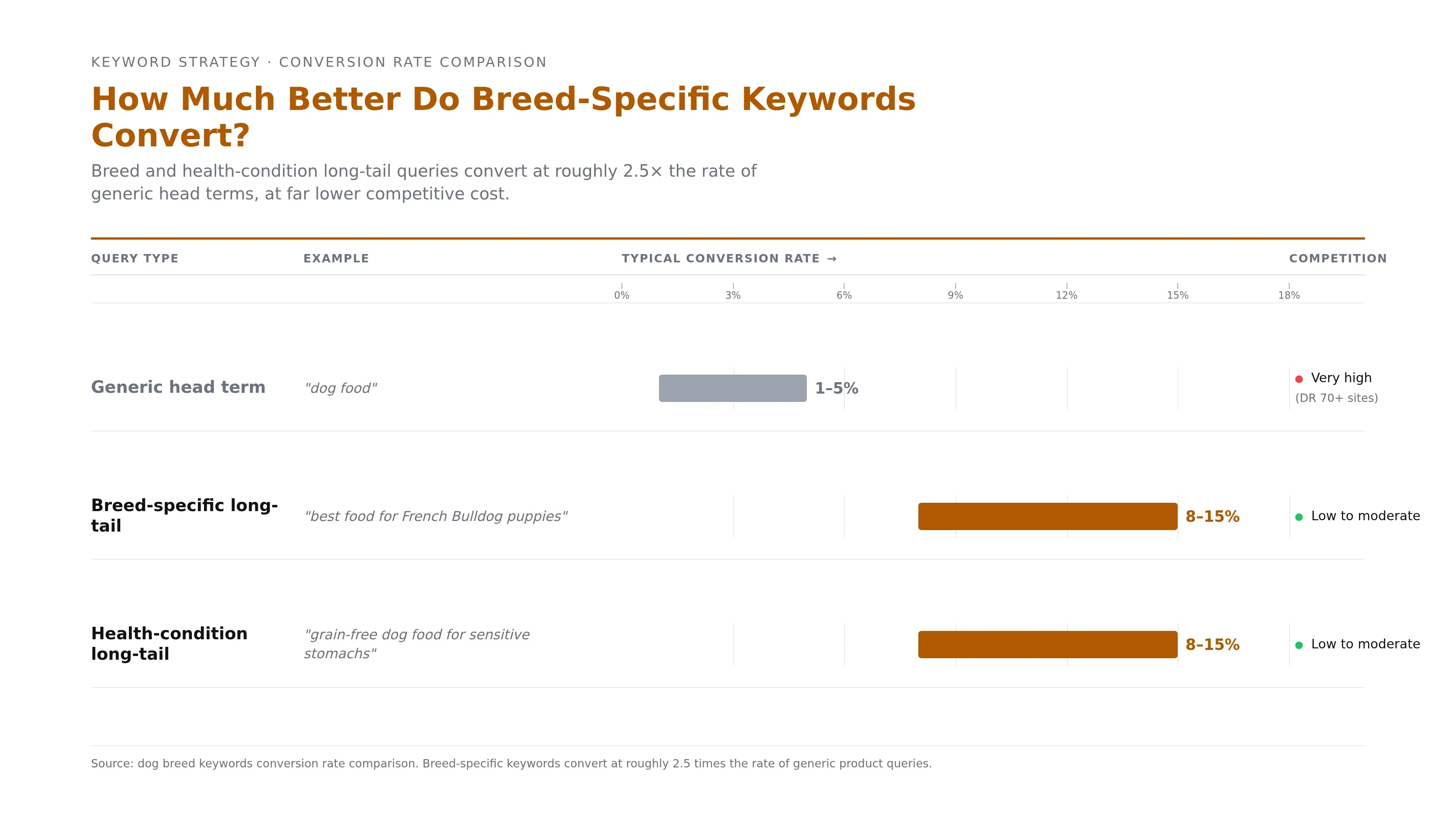
| Query type | Example | Typical conversion | Competition |
|---|---|---|---|
| Generic head term | "dog food" | 1-5% | Very high (DR 70+ sites) |
| Breed-specific long-tail | "best food for French Bulldog puppies" | 8-15% | Low to moderate |
| Health-condition long-tail | "grain-free dog food for sensitive stomachs" | 8-15% | Low to moderate |
A breed-specific keyword strategy for pet stores therefore does more than win rankings - it wins the rankings that turn into orders.
Why Do Breed Queries Signal Purchase Intent Better Than Generic Searches?
Breed queries signal purchase intent better because the breed name acts as a disambiguator. Generic searches like "pet supplies" pull in a mixed audience - researchers, comparison shoppers, and idle browsers alike. A query such as "sensitive stomach dog food for Miniature Schnauzers" can only come from someone who owns that breed and is ready to buy.
Pet e-commerce intent splits into four query categories, and each maps to a different point in the buying journey: breed-specific ("best food for French Bulldog puppies"), health-condition ("grain-free dog food for sensitive stomachs"), product-comparison ("fish tank filter versus sump filter"), and local ("pet shop near me"). Semantic search engines increasingly reward this fine-grained alignment between specific queries and buyer intent, matching detailed phrases to the products that answer them.
This is the core of why breed-specific content converts better than generic material: the breed name strips out ambiguity. "Dog food" could be a student researching an essay, a shopper three months from adopting, or a buyer ready to check out. "Puppy food for a German Shepherd" is almost always the last of those. You are no longer guessing which stage the reader occupies - the query tells you.
Breed queries also overlap heavily with health-condition searches, since so many breeds carry recognised dietary and joint sensitivities. Those crossover terms come with their own credibility bar; our guide to health-condition keywords and the EEAT standards they trigger covers what your content needs to demonstrate when the query touches on an animal's wellbeing.
How Many Rankable Breed Keywords Are You Ignoring?
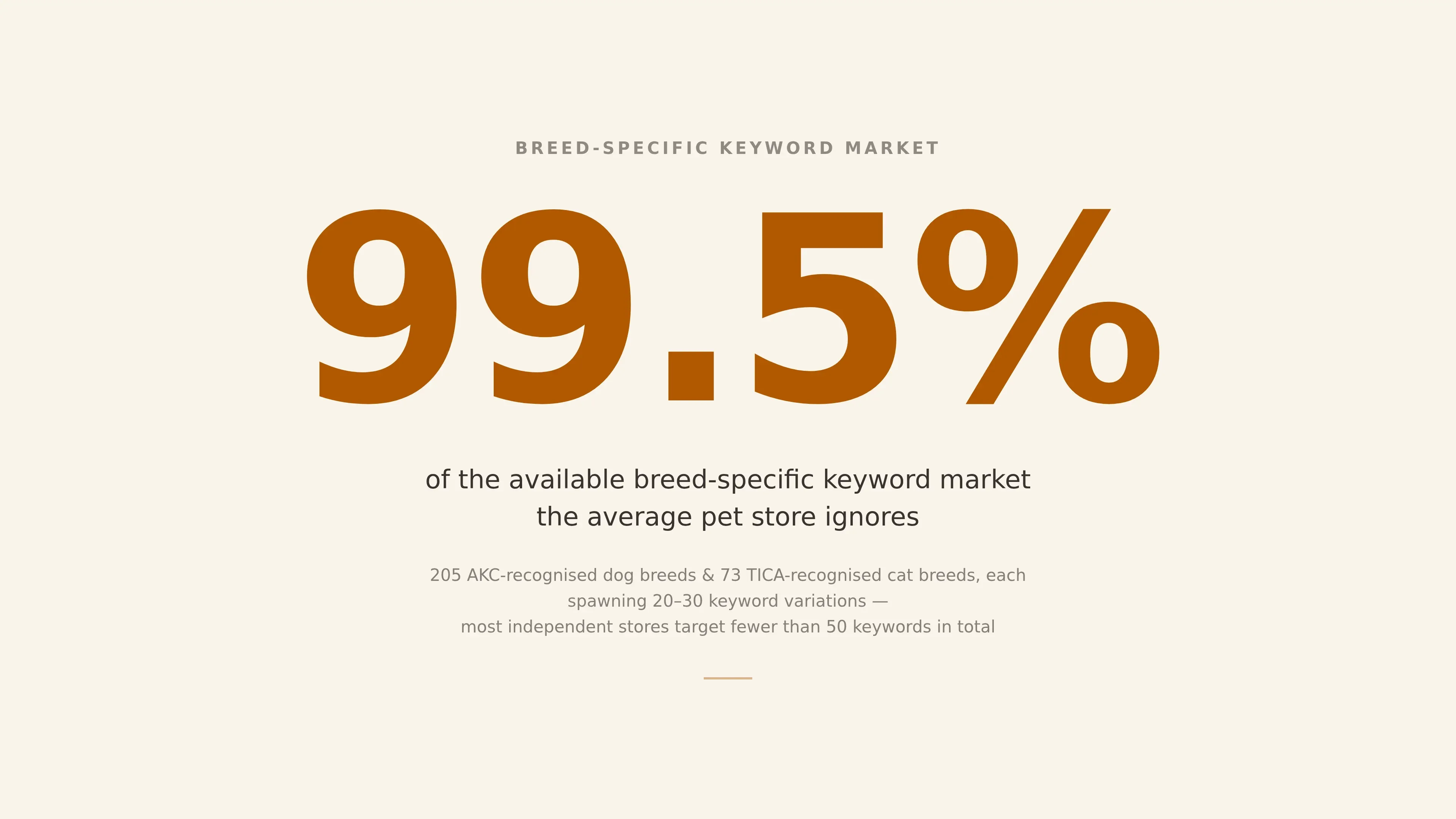
You are almost certainly ignoring the vast majority. With 205 AKC-recognised dog breeds and 73 TICA-recognised cat breeds, each spawning 20-30 keyword variations across product categories, life stages, and health conditions, the addressable universe runs into the tens of thousands. Most independent stores target fewer than 50 keywords in total.
Put those numbers side by side and the neglect is stark: the average pet store ignores roughly 99.5% of the available breed-specific keyword market. Every breed name can be multiplied further by size modifiers ("large-breed"), life stages ("senior", "puppy"), health conditions ("joint support", "sensitive stomach"), and activities ("training", "grooming"). One breed is not one keyword - it is a small cluster of them.
Take a single example. "Golden Retriever" alone unlocks puppy nutrition, senior nutrition, joint and hip support, coat and shedding care, weight management, and training treats - half a dozen rankable pages before you have touched a second breed. Scale that across even the 40 breeds most relevant to your inventory, and the pipeline dwarfs anything a generic keyword list can offer.
The specifics shift by market, though. Breed popularity and the exact search vocabulary differ between the UK, Germany, and smaller European markets, so a list built for one country rarely transfers cleanly to another; our guide to multi-market long-tail keyword research walks through adapting breed targeting per territory.
How Breed Keywords Build Topical Authority by Default
Breed keywords form topical authority clusters almost automatically. A single breed supports one pillar page - say, "Senior Golden Retriever nutrition" - surrounded by spoke pages on puppy feeding, joint support, coat care, and weight management. Because every spoke reinforces the same breed topic, the cluster builds authority faster than isolated, unconnected articles ever could.
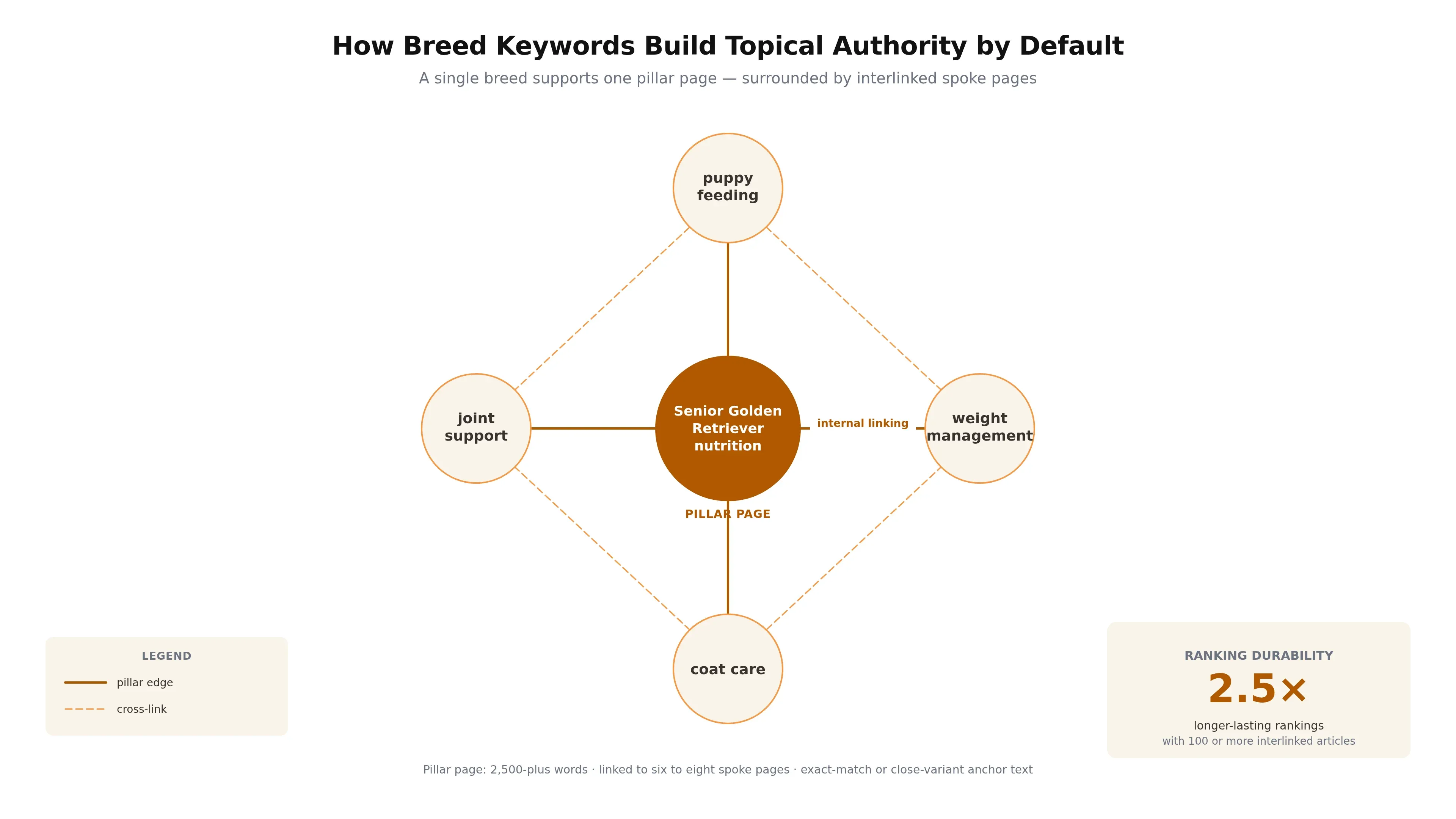
The mechanism is internal linking. A pillar page of 2,500-plus words linked to six to eight spoke pages, cross-linked with exact-match or close-variant anchor text, signals genuine topical depth to Google. Sites that build 100 or more interlinked articles around a niche see their rankings persist around 2.5 times longer than isolated pages - internal linking and topical relevance measurably improve visibility and ranking durability.
Breed content lends itself to this structure without any forcing. The topic boundaries are natural, the sibling relationships obvious, and the anchor text almost writes itself. If you want the full mechanics of how this compounds, our explainer on building topical authority to compete against bigger rivals sets out why clustered content outranks scattered posts.
The catch is execution. Researching breeds, mapping variations, and hand-building interlinked clusters is slow work, which is exactly the gap platforms like Petbase AI are built to close - discovering breed-specific keywords and publishing them as ready-linked clusters rather than one-off posts.
Which Breeds Should You Target First?
Start with the breeds that combine high search demand with your actual inventory. The top 20 breeds by search volume - French Bulldog, Labrador, Golden Retriever, German Shepherd, and Poodle among them - capture roughly 60% of all breed search volume, so a handful of well-chosen clusters covers most of the opportunity.
Three rules keep the selection disciplined:
- Match breeds to what you stock. If your strength is large-breed nutrition, begin with German Shepherds and Labradors rather than toy breeds you can't supply. Content that ranks but can't convert is wasted effort.
- Favour mid-popularity breeds for speed. Breeds ranked roughly 15th to 40th in popularity tend to reach the first page fastest - often within 8-12 weeks - because they still carry real demand while attracting far less competition than the top five.
- Respect keyword difficulty. New sites should target difficulty 0-30 to begin with, graduating to 20-35 by around month six as topical authority accrues; disciplined keyword selection is essential to small-business competitiveness. Save difficulty 50+ for after 18-24 months of clustering.
From there, the workflow is repeatable: pick a breed, build the pillar, write the spokes, interlink them, and move to the next breed. It is systematic rather than creative, which is why so much of it can be automated - Petbase AI runs exactly this loop for pet retailers across more than 40 stores, turning a breed shortlist into published, interlinked clusters each month.
Breed-specific keywords win on every axis that matters to an independent retailer: they convert at roughly 2.5 times the rate of generic queries, they signal unambiguous purchase intent, they open a keyword universe most competitors never touch, and they cluster into topical authority by their very nature. The generic head terms your rivals fight over are the worst possible use of a limited domain's effort.
The next step is practical. Look at your inventory, shortlist the breeds you can genuinely serve, and start building clusters - a pillar page and its spokes - one breed at a time. Understanding why breed-specific keywords outperform generic pet searches is the easy part; the durable advantage comes from executing those clusters consistently, month after month.
Frequently Asked Questions
Why do breed-specific keywords convert so much better than generic ones?
Because they carry unambiguous intent. A generic term like "dog food" captures browsers at every stage - research, comparison, idle curiosity - while a breed-specific phrase like "best food for French Bulldog puppies" comes from someone who already owns the breed and is ready to buy. That intent differential is why long-tail queries convert at around 8-15%, against just 1-5% for broad head terms.
Can an independent pet store realistically rank for terms like 'dog food'?
Not with realistic effort. Head terms are held by chains with domain ratings above 70 - Fressnapf.de at 74, zooplus.de at 75 - alongside Amazon and Maxi Zoo, whose link profiles have taken years to build. For a store with limited domain authority, long-tail breed-specific keywords are the only viable route to a page-one ranking within six months.
How many breeds should I create content for first?
Begin with the top 20 breeds by search volume, since roughly five of them - French Bulldog, Labrador, Golden Retriever, German Shepherd and Poodle - capture around 60% of breed search demand. Match your choices to what you actually stock, and favour breeds ranked 15th to 40th in popularity for the fastest first-page results, often within eight to twelve weeks.
How do breed-specific keywords help build topical authority?
Each breed naturally forms a cluster: a pillar page on the broad topic - say senior Golden Retriever nutrition - supported by spoke pages on puppy feeding, joint support and coat care, all cross-linked. This interlinked structure signals topical depth to Google, and sites with 100-plus interlinked articles see rankings persist around 2.5 times longer than isolated, standalone pages.