Seasonal Pet Keywords: Build a Long-Tail Calendar to Capture Every Peak


Table of Contents +
- Why Does Seasonal Timing Beat Finding the Perfect Keyword?
- When Should You Publish Seasonal Pet Keywords?
- How Do You Build a 12-Month Seasonal Keyword Calendar?
- Organising Keywords by Difficulty: From Easy Wins to Competitive Peaks
- How Do You Avoid Keyword Cannibalisation in a Seasonal Calendar?
- How Do Seasonal Articles Build Lasting Topical Authority?
- Getting Started: Your First Seasonal Calendar in Three Months
- Frequently Asked Questions About Seasonal Pet Keyword Calendars
- Sources and References
Learn when to publish seasonal pet keywords and build a 12-month long-tail calendar that ranks 60-90 days before each demand peak.
Before you write a single word about summer tick prevention or Christmas puppy gifts, you face one decision that decides whether the article earns traffic at all: when do you press publish? Most independent pet retailers building seasonal pet keywords into their content plan answer on instinct - publish when the season starts, so the article is live while people are searching.
That instinct quietly costs you the whole peak. There is a second answer - publish 60-90 days before demand climbs - and the gap between the two is the difference between ranking on page one when searches surge and watching a fresh, unranked page sit invisible while a competitor who planned ahead takes every click. Get this decision wrong once and you have burned an article's entire budget on a window that closed before Google finished reading it. This guide resolves that decision and turns it into a calendar you can run for two years.
Why Does Seasonal Timing Beat Finding the Perfect Keyword?
Seasonal timing beats keyword selection because a perfectly chosen seasonal keyword published too late never ranks in time to capture its peak. Retailers pour effort into identifying which terms spike each season, then undo that work by publishing the moment demand arrives - when Google has no time to crawl, index, and rank the page.
Seasonal long-tail phrases - 'flea treatment for cats in summer', 'best winter coat for greyhounds' - convert far harder than generic terms because the searcher has a specific, time-bound need. That is why seasonal long-tail keywords drive revenue: they convert at 8-15% against 1-5% for broad head terms like 'dog food'. Miss the ranking window and you forfeit the highest-intent traffic of the whole year.
This is an advanced application of the framework in our long-tail keyword guide for independent pet retailers, and it depends on the discovery skills covered in our guide to finding low-competition keywords for your store. Get those two foundations right and timing becomes the multiplier that turns a rankable term into seasonal traffic. Skip them, and even a well-timed calendar has nothing rankable to schedule.
Petbase handles this entire content workflow automatically - 10 SEO articles published to your blog every month - start your free trial.
When Should You Publish Seasonal Pet Keywords?
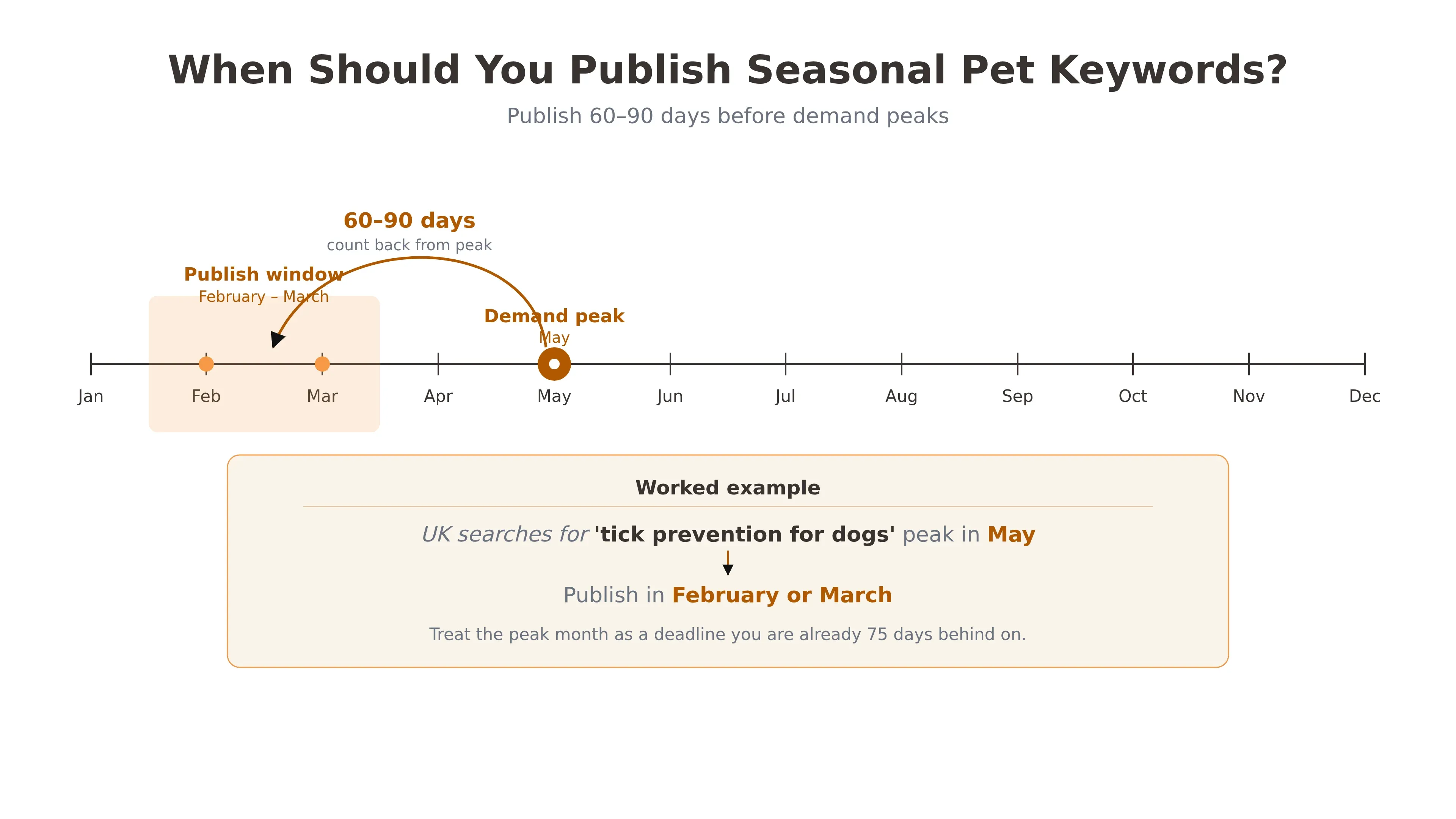
Publish seasonal pet keywords 60-90 days before demand peaks. Google needs time to crawl, index, and rank a new page, and fresh content rarely holds a strong position immediately. Backdating your publication by two to three months gives the article room to climb, so it ranks when searches surge rather than after the peak has passed.
The mechanic is simple: find the month demand peaks, then count back 60 to 90 days to set the publication date. If UK searches for 'tick prevention for dogs' peak in May, publish in February or March. For a Christmas gifting term, publish in late September. Treat the peak month as a deadline you are already 75 days behind on.
Regional climate and language shift these windows. Tick and flea season arrives earlier in a mild UK spring than in a Central European one, so the same keyword peaks on a different calendar in each market - a difference worth planning for if you sell across borders, which we cover in international keyword research for pet retailers. Vocabulary shifts too: UK and German buyers phrase seasonal queries differently, with UK shoppers favouring 'best [product] for [condition]' templates and German shoppers searching established terms such as 'Hundefutter' (dog food) and 'Nassfutter' (wet food). Build each market's calendar on its own peaks, not on a translated copy of another's.
How Do You Build a 12-Month Seasonal Keyword Calendar?
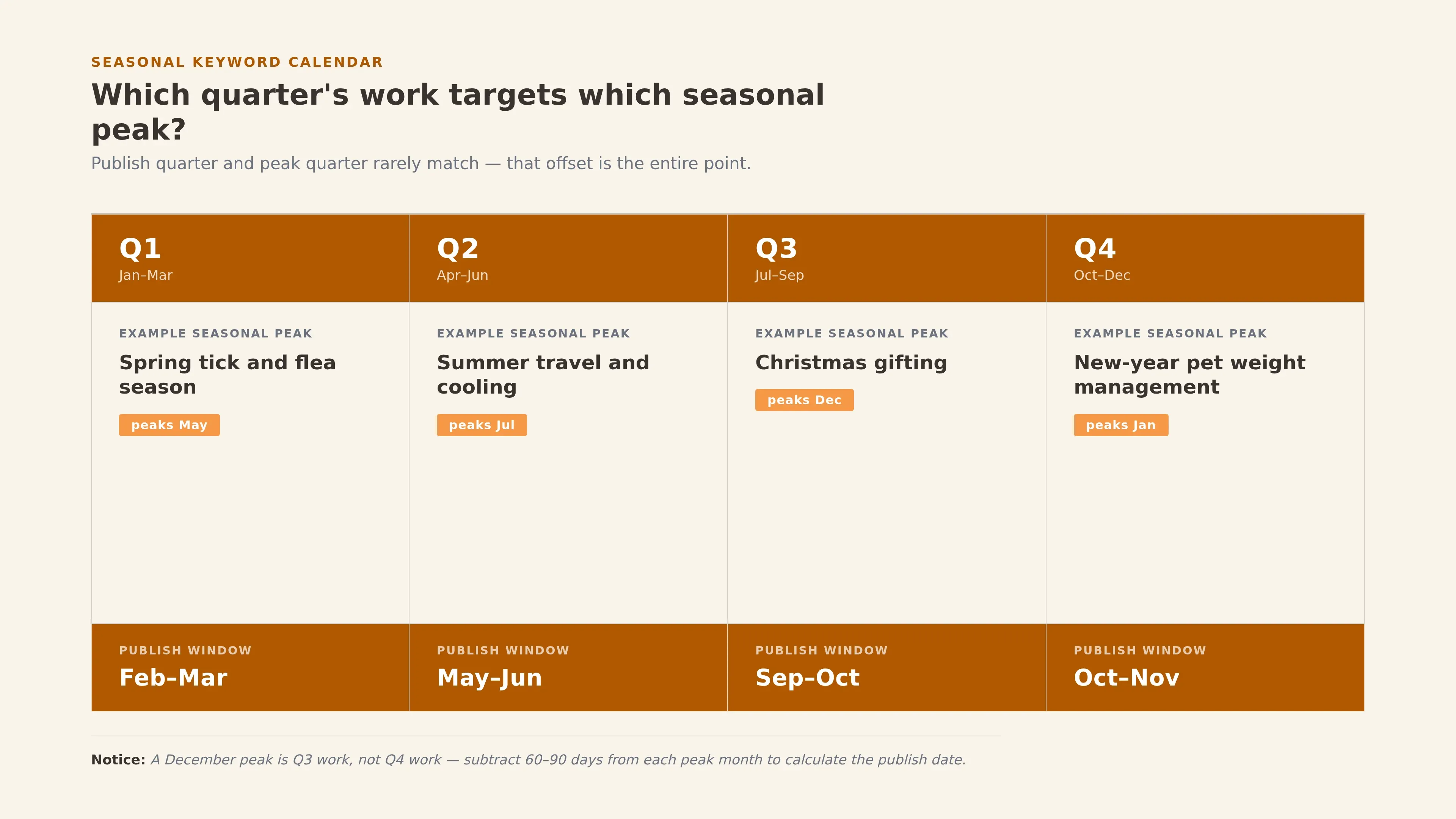
Build a 12-month seasonal keyword calendar by mapping every predictable demand peak to its month, assigning long-tail keywords to each peak, then calculating a publication date 60-90 days earlier. The result is a rolling schedule that tells you exactly what to write and when, quarter by quarter, across the whole year.
Work through it in four moves:
- List your peaks by month. Flea and tick season, summer travel, back-to-school puppy adoptions, Christmas gifting, new-year weight management - every niche has its own rhythm.
- Map long-tail keywords to each peak. Choose specific, intent-rich phrases rather than merely long ones - what makes a keyword long-tail is specificity of intent and search volume, not word count.
- Calculate the publication date. Subtract 60-90 days from each peak month and write that date into the plan.
- Assign each article to a quarter so your workload spreads evenly instead of clustering into two frantic weeks a year.
A simple quarterly view keeps the seasonal pet keyword calendar legible at a glance:
| Quarter | Example seasonal peak | Publish window |
|---|---|---|
| Q1 (Jan-Mar) | Spring tick and flea season (peaks May) | Feb-Mar |
| Q2 (Apr-Jun) | Summer travel and cooling (peaks Jul) | May-Jun |
| Q3 (Jul-Sep) | Christmas gifting (peaks Dec) | Sep-Oct |
| Q4 (Oct-Dec) | New-year pet weight management (peaks Jan) | Oct-Nov |
Notice that the publish quarter and the peak quarter rarely match - that offset is the entire point. A December peak is Q3 work, not Q4 work.
Organising Keywords by Difficulty: From Easy Wins to Competitive Peaks
Sequence your seasonal keywords by difficulty so early wins build the authority you need for competitive peaks later. New pet retailers should start with keyword difficulty scores of 0-30, which are achievable within three to six months, then graduate to 20-35 as topical authority accumulates across the first six months of consistent publishing.
Within each quarter, publish the lowest-difficulty term first. An early ranking sends Google a topical-relevance signal that makes the next, slightly harder article easier to rank - so an easy 'winter coat for small dogs' win in October strengthens a more competitive 'best dog coats for winter' push in November. You are laying stepping stones, not gambling on one big term.
The difficulty sweet spot for independent retailers sits at 20-45: high enough to signal real demand, low enough to rank within two to six months with one optimised article. Reserve difficulty 50+ for after 18-24 months of consistent clustering - those peaks belong to established domains, and chasing them in your first season wastes budget you could spend on three rankable terms instead. Difficulty thresholds are not universal, either; a lower-competition language market lets you attempt harder terms sooner than a saturated one would.
How Do You Avoid Keyword Cannibalisation in a Seasonal Calendar?
Avoid cannibalisation by publishing one article per intent per season, then using internal links to elevate the primary variant and subordinate the rest. Cannibalisation happens when two seasonal articles chase the same searcher intent in the same window, so they compete against each other and split the ranking signal instead of concentrating it into one strong page.
Three rules keep a seasonal calendar clean:
- Segment by specificity tier. One article owns 'summer tick prevention for dogs'; a narrower 'tick prevention for puppies in summer' becomes a supporting spoke, not a rival.
- Elevate the primary variant with anchor text. This is how to structure seasonal variants without overlap - internal links pointing to the primary article, using exact-match or close-variant anchor text, tell Google which page should rank.
- Stagger secondary variants 4-6 weeks after the primary launch so the lead article stabilises its ranking before its siblings arrive and start competing for the same clicks.
The audit is quick: before scheduling, scan the quarter for two titles a searcher could reasonably use interchangeably. If you find a pair, promote one to primary, demote the other to a linked spoke, and space their publication dates. Done at the calendar stage, this costs minutes; done after both rank poorly, it costs a rewrite.
How Do Seasonal Articles Build Lasting Topical Authority?
Seasonal articles build lasting authority when they cross-link into a topical cluster instead of standing alone. Each seasonal piece links back to a pillar page and across to sibling articles, transferring authority through the whole cluster. Sites with 100+ interlinked articles covering a niche see rankings persist 2.5 times longer than isolated pages.
Seasonal content has a hidden advantage here. A winter article you publish this year does not expire - it re-ranks every winter, and each season it accrues more internal links from new sibling articles. That compounding is how seasonal articles amplify through cluster linking: pairing evergreen pillars with seasonal spokes so authority builds across the calendar rather than resetting to zero every year.
Low-volume seasonal terms earn their place this way. A phrase with under 50 monthly searches rarely justifies a standalone page, but low-volume seasonal keywords justify a dedicated page once they slot into a cluster and draw authority from the pillar and their siblings - an effect that compounds fastest in lower-competition markets such as Slovenia, the Czech Republic, and Hungary, where five-article clusters have reached the first page within 20 days and top-three within four months. The lesson: judge a seasonal keyword by its cluster fit and intent, never by its raw volume alone.
Getting Started: Your First Seasonal Calendar in Three Months
Start by identifying your three most important seasonal peaks, then backdate 75 days from each peak month to set publication dates. Map 8-12 long-tail keywords across those peaks, schedule the articles, and build internal links as you publish. Three focused months give you a working calendar you can extend across the rest of the year.

Turn the plan into execution with a repeatable sequence. Your long-tail keyword launch checklist covers the per-article steps; the calendar simply decides which article runs when.
- Pick three peaks with clear commercial value for your store.
- Backdate 75 days from each peak month to fix publication dates.
- Map 8-12 keywords, sequenced from lowest to highest difficulty within each peak.
- Publish and interlink, connecting every new article to its pillar and siblings.
Running a full seasonal keyword strategy for pet stores across ten or more peaks by hand is where most independent retailers stall - the calendar is sound, but the writing never keeps pace. Platforms built for this, Petbase AI among them, generate topically linked articles with seasonal timing and cluster cross-linking handled automatically, which keeps the calendar moving in the months you cannot.
The decision you faced at the start - publish when the season arrives, or 60-90 days ahead - has a clear answer: plan backwards from every peak. A seasonal keyword calendar turns that single rule into a system that captures high-intent demand your competitors publish too late to reach, and compounds authority across your clusters year after year.
Start today: name your three biggest seasonal peaks, backdate 75 days from each, and map your first 8-12 long-tail keywords. That calendar becomes a two-year advantage, not a one-off campaign.
Frequently Asked Questions About Seasonal Pet Keyword Calendars
How far in advance should I publish seasonal pet content?
Publish 60-90 days before demand peaks. Google needs time to crawl, index, and rank a new page, and fresh content rarely holds a strong position straight away. Backdating publication by two to three months gives the article room to climb so it ranks during the surge rather than after it. For a May tick-season peak, that means publishing in February or March.
Do low-volume seasonal keywords justify their own article?
Sometimes. A keyword below 50 monthly searches rarely earns a standalone page on its own, but it becomes valuable inside a topical cluster, where internal links from the pillar and sibling articles transfer authority to it. Product price matters too: 20 monthly searches can justify a page for a £150 product but not for a £5 commodity.
How do I stop my seasonal articles competing with each other?
Publish one article per searcher intent per season, then use internal links to promote the main variant and subordinate the narrower ones. Segment keywords by specificity tier so a broad term and its narrower cousin support each other rather than compete. Stagger secondary variants four to six weeks after the primary article launches, giving the lead page time to stabilise its ranking first.
What keyword difficulty should a new pet store target for seasonal terms?
Start with difficulty scores of 0-30, which new sites can realistically rank for within three to six months. As topical authority builds over the first six months, move up to 20-35. The broader 20-45 range is the sweet spot for independent retailers. Reserve difficulty 50+ for established domains after 18-24 months of consistent content clustering.