Finding Low-Competition Keywords for Your Pet Store: The Complete Discovery Guide


Table of Contents +
- Why Can't Independent Pet Stores Rank for Generic Keywords?
- What Counts as a Low-Competition Keyword for a Pet Store?
- Five Methods for Discovering Low-Competition Keywords Your Competitors Miss
- How Do You Tell a Rankable Keyword from a Trap?
- Five Mistakes Pet Retailers Make When Discovering Keywords
- Your First Week: What Does the Discovery Workflow Look Like?
- Questions About Finding Low-Competition Keywords
- References & Further Reading
Finding low-competition keywords for pet stores comes down to difficulty, intent and clusters-here's the discovery system that ranks you fast.
It's a Tuesday evening in your shop after closing. The till's cashed up, the last customer has collected their order, and you finally open the analytics tab you've been avoiding. Earlier you typed "dog food" into Google to see where your store lands. Page eight. Above you sit zooplus, Fressnapf, Amazon and a chain you'd never even heard of. You've written blog posts. You've tweaked product descriptions. And still, nothing moves. The problem isn't effort-it's that finding low-competition keywords for pet stores is a completely different game from the one you've been playing.
Here's what that ranking position is actually costing you. Every month you spend chasing head terms you can't win, buyers searching for exactly what you sell-the specific breed food, the sensitive-stomach formula, the tick treatment-are finding someone else. That traffic isn't unavailable to you. It's just hiding behind queries you haven't learned to look for yet. This guide is the discovery system that changes that.
Why Can't Independent Pet Stores Rank for Generic Keywords?
Independent pet stores can't rank for generic keywords like 'dog food' or 'pet supplies' because those terms are locked up by chains with domain ratings above 70. Fressnapf, zooplus, Amazon and Maxi Zoo have spent years accumulating authority that no new site can match with realistic effort.
The gap is structural, not temporary. Large chains dominate head-term keywords through accumulated domain authority that smaller retailers competing in the organic market simply cannot out-muscle: Fressnapf.de carries a domain rating of 74, zooplus.de sits at 75, and Pets at Home and Amazon aren't far behind. Domain rating roughly measures how much authority a site has earned through links and age-and it takes years to build.
This is exactly why generic terms are a dead end. When you publish an article targeting 'dog food', you're entering a fight against sites that will outrank you on that phrase no matter how good your content is. The maths doesn't work. But it flips completely once you look at where demand really lives: that fragmented 70% of all search volume sitting in specific, multi-word queries is your territory-lower-volume per phrase and mostly ignored by the big players because chasing each one individually isn't worth their while. For you, it's the whole opportunity. Before you start discovering those queries, it helps to see how they fit a bigger plan: our guide to long-tail keyword examples for pet retailers lays out the framework this discovery work feeds into.
Petbase automates SEO content for pet stores - publishing 10 optimized articles monthly so you can focus on running your shop - start your free trial.
What Counts as a Low-Competition Keyword for a Pet Store?
A low-competition keyword for a pet store is one with a keyword difficulty score of roughly 20 to 35 and at least 50 monthly searches. Difficulty-not search volume-is the number that decides whether you can rank. It measures how hard the competing pages are to beat.
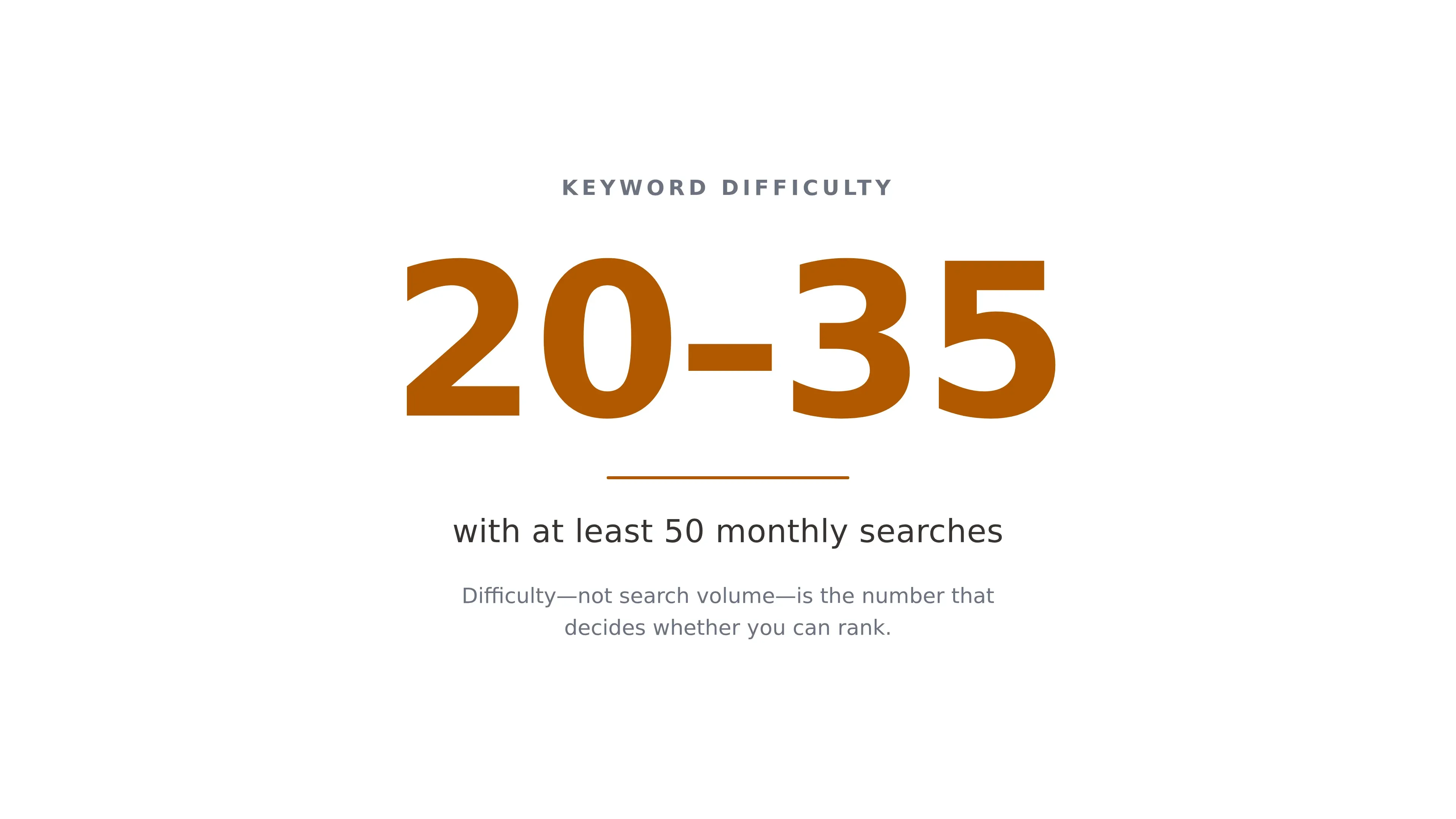
This trips up a lot of retailers, so it's worth being precise. Search volume tells you how many people search a phrase; difficulty tells you whether you stand a chance of ranking for it. A term can carry thousands of searches and be completely unwinnable, or a few hundred and be wide open. For evaluating low-competition keywords as a small business building organic competitiveness, difficulty 20-45 is the sweet spot-high enough to signal real demand, low enough to rank within two to six months. If your site is new, start at 0-30 and graduate to 20-35 as your topical authority builds over the first six months.
Length has nothing to do with it. A long-tail keyword is defined by intent specificity and competition level, not word count: a single-word query with 60 monthly searches is long-tail, while a five-word phrase pulling 100,000 searches is very much a head term. What makes a keyword genuinely low-competition for a pet business is the combination of a manageable difficulty score, a specific buyer intent, and enough volume to matter. Understanding how long-tail keywords differ from short-tail head terms makes these judgements much faster.
The 50-searches-a-month figure is a floor, not a rule. Consistent, well-executed SEO built around genuine visibility treats it as the point where a standalone article becomes commercially viable, but price point changes everything. A keyword with 20 monthly searches easily justifies a dedicated page when it leads to a £150 orthopaedic dog bed; the same 20 searches wouldn't justify a page for a £5 chew toy. When you evaluate long-tail keywords for ranking potential, always weigh volume against the value of what the searcher is likely to buy.
Five Methods for Discovering Low-Competition Keywords Your Competitors Miss
Five practical methods uncover low-competition keywords the chains overlook: mining Google Autocomplete and People Also Ask, analysing your Search Console page-two rankings, running competitor content-gap analysis, using free and paid research tools, and reading the search results by hand. None of them requires an expensive subscription to start.
Mine Google Autocomplete and People Also Ask. Type a seed phrase such as 'dog food for' into the search bar and note every suggestion Google offers-each one comes from real searches. Then scroll to the 'People Also Ask' box and the related searches at the bottom of the page. Ten minutes of this yields dozens of specific, lightly contested queries.
Analyse your page-two rankings in Search Console. Open the Performance report and filter for queries where your pages already sit in positions 11 to 30. These are keywords Google already considers you relevant for-nudging them onto page one is the fastest ranking work you can do, because the hard part is already done.
Run a competitor content-gap analysis. Rather than studying the untouchable chains, look at pet retailers roughly your size. Note the topics and queries they rank for that you don't cover at all. Those gaps are proven-achievable keywords-if a comparable site ranks, so can you with a better article.
Evaluate free and paid research tools. Google Keyword Planner is free and gives volume ranges; free tiers of larger platforms show difficulty for a limited number of queries a day. Paid tools speed the work up, but you don't need one to begin. Start free and upgrade only once discovery becomes a regular habit.
Read the search results by hand. For any promising keyword, actually look at page one. Who ranks? Are they high-authority chains or beatable independent sites and blogs? Manual inspection tells you more about real difficulty than any single score, especially for niche pet queries the tools estimate poorly.
As you work, sort what you find into the four query types that drive pet e-commerce: breed-specific ('best food for French Bulldog puppies'), health-condition ('grain-free dog food for sensitive stomachs'), product-comparison ('fish tank filter versus sump filter') and local ('pet supplies near you'). Each maps to a different stage of the buying journey, and aligning content with query intent is what turns a keyword list into a plan. This is precisely the research layer Petbase AI automates for pet retailers-scanning your catalogue and niche to surface these categories without the manual grind.
How Do You Tell a Rankable Keyword from a Trap?
A rankable keyword clears five filters: a difficulty score in your range, clear buyer intent, search results made of articles rather than only product pages, no dominant AI Overview swallowing the clicks, and a clean fit into a topical cluster. A keyword that fails any of these is usually a trap.
Work through the filters in order. First, confirm the difficulty score sits in your 20-35 band using whatever tool you have. Second, read the intent: does the phrase signal someone ready to buy, or just browsing? Commercial-intent long-tail phrases convert at 8-15% versus 1-5% for broad, exploratory head terms, so a lower-volume commercial query often beats a higher-volume vague one.
Third, look at what actually ranks. If page one is nothing but retailer product pages, an informational article may struggle; if it's a mix of guides and blog posts, there's room for your content. Fourth, check whether an AI Overview dominates the results and answers the query outright, which can suppress clicks. Fifth, ask whether the keyword fits a cluster or sits alone as an orphan.
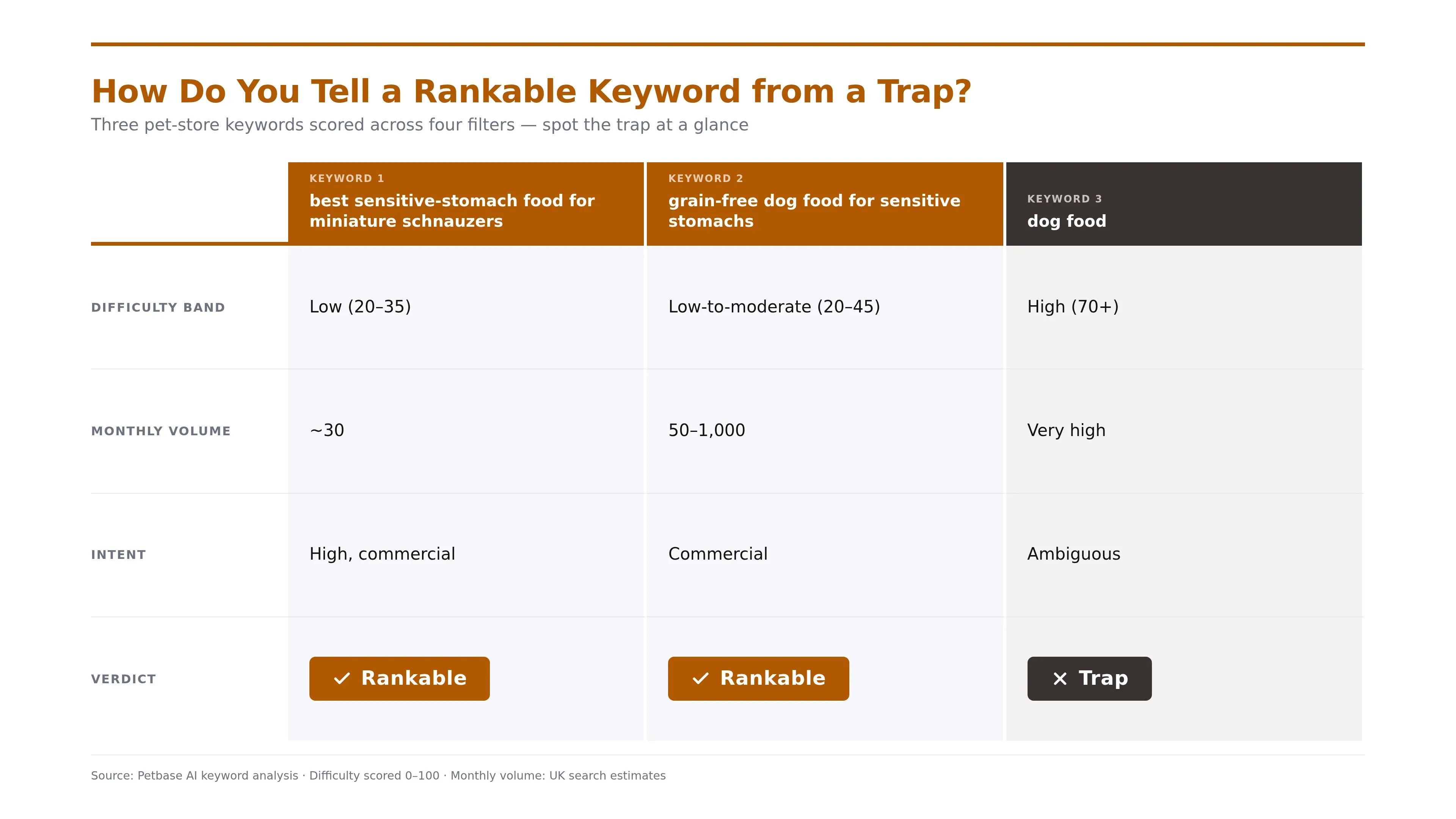
| Example keyword | Difficulty band | Monthly volume | Intent | Verdict |
|---|---|---|---|---|
| best sensitive-stomach food for miniature schnauzers | Low (20-35) | ~30 | High, commercial | Rankable |
| grain-free dog food for sensitive stomachs | Low-to-moderate (20-45) | 50-1,000 | Commercial | Rankable |
| dog food | High (70+) | Very high | Ambiguous | Trap |
The fifth filter-cluster fit-is the one retailers skip most often, and it's the one that compounds. A keyword that slots into a group of related articles gains authority from its neighbours; an orphan keyword stands alone and struggles. This is where building topical authority to compete against bigger rivals turns individual keywords into a ranking system rather than a scatter of one-off posts.
Five Mistakes Pet Retailers Make When Discovering Keywords
The five most common discovery mistakes are: judging a keyword by search volume alone, ignoring how specific the intent is, underestimating clear difficulty signals in the results, chasing orphan keywords that sit outside any cluster, and targeting competitors' brand names. Each one wastes effort on keywords you either can't rank for or shouldn't.
Confusing volume with value. A keyword with 30 monthly searches and explicit purchase intent-'best sensitive-stomach dog food for miniature schnauzers'-can bring in more revenue than one with 3,000 searches and vague intent. Volume is not demand. Weigh every phrase against the intent behind it and the value of the product it points to.
Ignoring intent specificity. Two phrases with the same volume can be worlds apart. 'Dog food ingredients' is someone researching; 'buy grain-free dog food for sensitive stomachs' is a buyer. Read the wording for signals of where the searcher sits in the journey before you commit a page to them.
Underestimating difficulty signals. If page one for a keyword is wall-to-wall chains rated 70 and above, the difficulty score is telling you the truth-walk away, however tempting the volume. Trust what the results show you over your optimism about a single well-written article.
Targeting orphan keywords. A keyword with no related articles around it ranks slowly and drops easily. Keywords that sit inside a cluster borrow authority from their neighbours and hold their positions far longer. Always ask whether a term connects to others you're covering.
Chasing competitor brand terms. Ranking for a rival's shop name plus 'discount' or 'reviews' rarely converts-those searchers want that shop, not yours-and you're unlikely to outrank them for their own brand. Spend the effort on the product and condition queries they've neglected instead.
Avoiding these five mistakes is mostly discipline, and it's exactly the kind of judgement Petbase AI builds into its keyword research-filtering for intent, difficulty and cluster fit before a single article is written, so no effort goes into keywords that can't pay off.
Your First Week: What Does the Discovery Workflow Look Like?
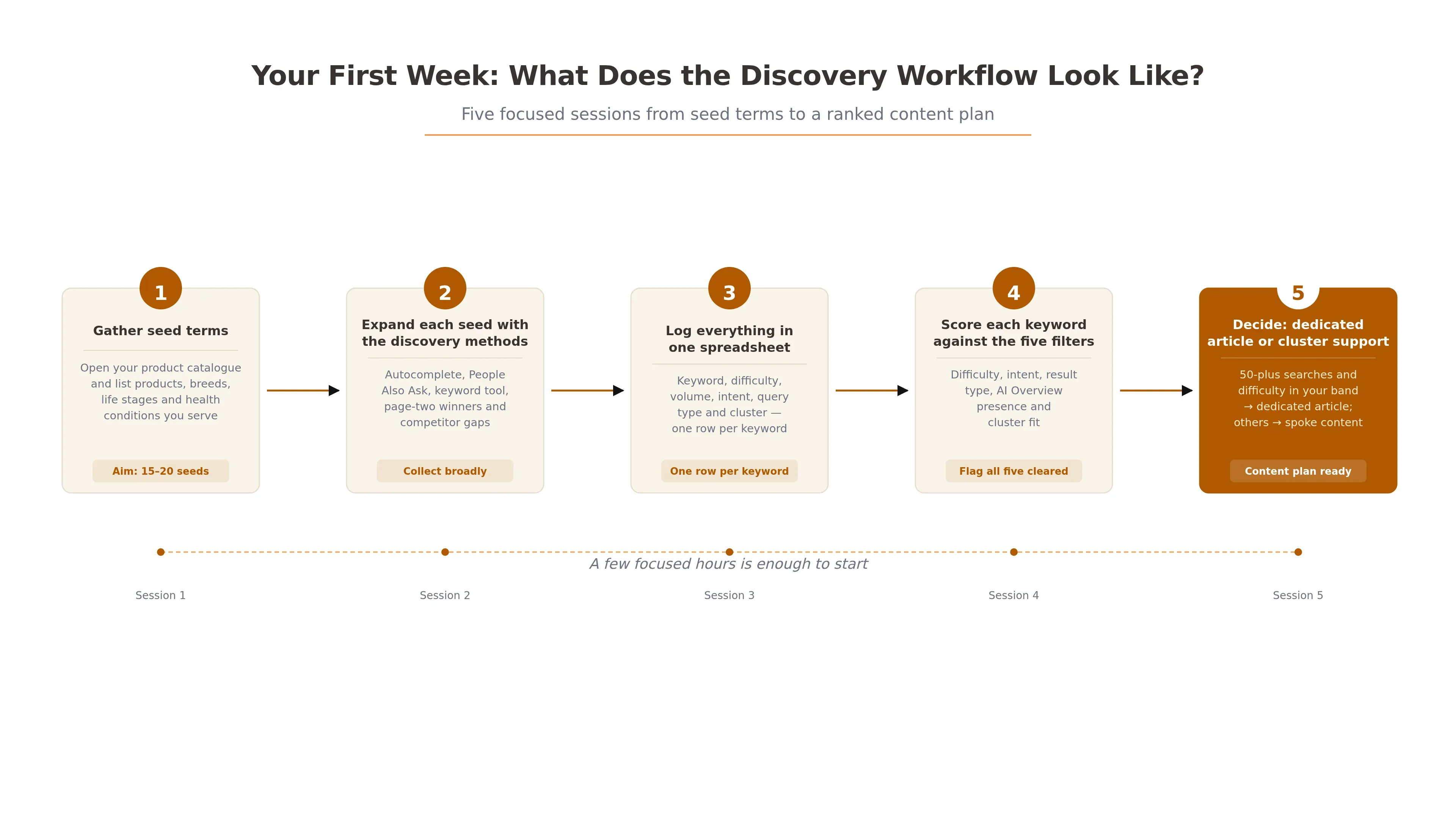
Your first week of finding rankable keywords for independent pet stores breaks into five short sessions: gather seed terms, expand them with the discovery methods, log everything in a spreadsheet, score each keyword against the filters, then decide which earn a dedicated article and which support a cluster. A few focused hours is enough to start.
What you'll need
- Access to Google Search Console for your site
- A spreadsheet (Google Sheets or Excel)
- One keyword tool-a free Google Keyword Planner account is fine to start
- Your product catalogue, to ground keywords in what you actually sell
Gather your seed terms. Open your product catalogue and list the products, breeds, life stages and health conditions you serve. Each becomes a starting point-'puppy food', 'senior cat', 'sensitive stomach', 'flea treatment'. Aim for fifteen to twenty seeds by the end of the first sitting.
Expand each seed with the discovery methods. Run every seed through Autocomplete, People Also Ask and your keyword tool. Pull the page-two winners from Search Console and the gaps from a comparable competitor. Don't filter yet-collect broadly and sort later.
Log everything in one spreadsheet. Create columns for the keyword, difficulty score, monthly volume, intent, query type (breed, health, comparison or local) and the cluster it belongs to. One row per keyword. This sheet becomes the backbone of your content plan.
Score each keyword against the five filters. Work down the sheet applying difficulty, intent, result type, AI Overview presence and cluster fit. Flag the ones that clear all five. Be ruthless-a shorter list of genuinely rankable keywords beats a long list of traps.
Decide: dedicated article or cluster support. Keywords with 50-plus searches and a difficulty in your band earn their own article; lower-volume, high-intent phrases become spoke content that supports a pillar. When you're ready to turn the sheet into a live plan, our launch checklist for a new pet store takes you through execution.
If a week of manual discovery sounds like time you don't have, this is the entire workflow Petbase AI runs automatically for pet retailers-scanning your catalogue, evaluating difficulty and intent, and organising rankable keywords into ready-to-publish clusters.
Finding low-competition keywords for pet stores isn't about a secret tool-it's about looking where the big chains won't: the specific, high-intent, long-tail queries that make up the bulk of real search demand. Get the difficulty band right, respect the intent, and organise your findings into clusters, and you can rank on page one in months rather than years.
Once you've built your keyword list, the next move is turning it into topical authority clusters that compound your gains and protect you against ranking volatility.
Questions About Finding Low-Competition Keywords
What is the minimum search volume worth targeting for a pet store keyword?
Around 50 monthly searches is the floor for a standalone article, but it isn't a hard rule. A keyword with just 20 searches can justify a dedicated page if it leads to a high-value product like a £150 orthopaedic bed. Below that, low-volume phrases still earn their place as spoke content inside a topical cluster, where internal links pass authority from pillar and sibling articles.
How long does it take to rank for a low-competition keyword?
With a difficulty score in the 20-35 range and supporting content, independent retailers can typically reach page one within two to six months. New sites should start with the easiest terms, difficulty 0-30, and graduate to slightly harder ones by month six as topical authority builds. Ranking speed also depends on your market's competitive density and how well your keywords cluster together.
What's the difference between keyword difficulty and search volume?
Search volume counts how many people search a phrase each month; keyword difficulty estimates how hard it is to outrank the pages already there. They're independent. A term can carry huge volume and be unwinnable, or modest volume and be wide open. For independent pet stores, difficulty is the number that decides whether ranking is realistic-so check it before you get excited about a high volume.
Should I target keywords my competitors already rank for?
Focus on gaps rather than direct copies. Analysing what smaller rivals rank for that you don't is a legitimate discovery method and reveals achievable terms. But avoid targeting competitors' brand names-phrases like a rival store's name plus 'discount' rarely convert for you and are hard to win. Look instead for the specific product, breed and health-condition queries your competitors have overlooked entirely.