Pet Product Comparison Pages That Convert

Table of Contents +
- Why Do Comparison Pages Convert So Well?
- Which Pet Product Comparisons Should You Build?
- How Do You Structure a Comparison Page for SEO?
- What Makes Comparison Content Rank on Google?
- How Do You Handle Competitor Mentions Legally?
- Which Marketing Channels Amplify Comparison Content?
- What Is the Comparison Page Build Sprint?
- How Does Petbase Help Build Comparison Content?
- Frequently Asked Questions
- References
Build pet product comparison pages that convert at 5-10%. Structure, SEO, schema, and fairness rules for content that ranks and sells.
Comparison pages convert at 5 to 10% - three to five times higher than general content[1]. Pet parents compare constantly: Brand A vs Brand B, kibble vs raw, grain-free vs grain-inclusive, joint supplement vs fish oil, pet insurance Plan A vs Plan B. Every "vs" search is a buyer at the decision stage, credit card within reach. Yet most pet stores never create comparison content because it feels risky to mention competitors.
This guide covers exactly how pet product stores build comparison pages that rank, convert, and build trust - including which comparisons to prioritize, how to structure them for SEO, and why honest trade-offs outperform one-sided marketing copy.
TL;DR
Comparison pages convert 3-5x higher than general content because they catch buyers at the decision stage. Pet parents search "Brand A vs Brand B" and "kibble vs raw" constantly. This guide covers which comparisons to build, how to structure them for SEO, and why honest balanced content outranks one-sided marketing pages every time.
Why Do Comparison Pages Convert So Well?
70% of the buying journey happens before a customer contacts sales or clicks "add to cart"[2]. During that journey, comparison searches represent the moment a buyer narrows from consideration to decision. They have already identified their need. They know the options. They need someone to lay out the differences honestly.
87% of consumers say product content is the most important factor in purchase decisions[3]. Comparison pages deliver exactly that: structured, specific content that answers "which one is right for my pet" with data rather than marketing language.
For pet stores, comparison content captures searches that product pages and category pages miss entirely. Nobody finds your store by searching "Brand X vs Brand Y" unless you have written the comparison.
Petbase automates SEO content for pet stores - publishing 10 optimized articles monthly so you can focus on running your shop - start your free trial.
Which Pet Product Comparisons Should You Build?
Prioritize comparisons by search volume and purchase intent:
Brand vs Brand (Highest Intent)
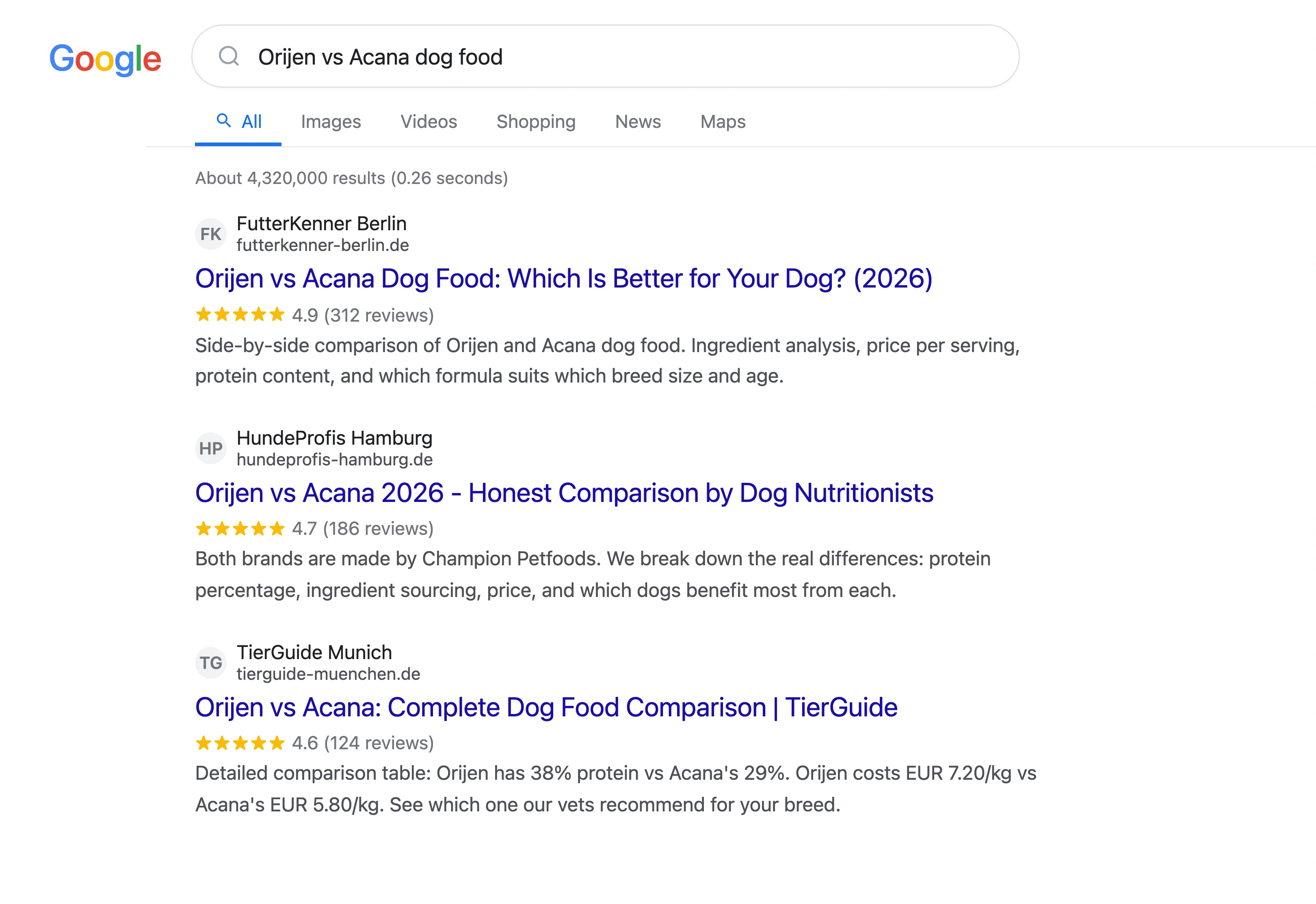
- Orijen vs Acana for dogs
- Hill's Science Diet vs Royal Canin
- Greenies vs Whimzees dental chews
- Farmer's Dog vs Ollie fresh food
- Chewy vs Amazon for pet supplies
Format vs Format (High Volume)
- kibble vs raw dog food
- grain-free vs grain-inclusive
- wet food vs dry food for cats
- freeze-dried vs dehydrated raw
- fresh food vs kibble
Product Category Comparisons
- glucosamine vs fish oil for joint health
- probiotics vs prebiotics for dogs
- flea collar vs topical vs oral flea treatment
- harness vs collar for walking
Service Comparisons
- pet insurance Plan A vs Plan B
- mobile grooming vs salon grooming
- dog daycare vs dog walker
How Do You Structure a Comparison Page for SEO?
Every comparison page should follow this structure:
- TL;DR verdict at the top. State your recommendation immediately. Readers who want the quick answer get it. Readers who want detail keep scrolling.
- Side-by-side comparison table. Cover: price, key features, ingredients (for food), pros, cons, best for which pet type. Tables earn featured snippets and are easy to scan.
- Detailed category-by-category analysis. Break the comparison into 4 to 6 H2 sections, each covering one decision factor (ingredient quality, price per serving, health benefits, taste and palatability, availability).
- Who should choose which. End with clear recommendations by use case: "Choose Product A if your dog has [condition]. Choose Product B if you prioritize [factor]."
- FAQ section. Add 3 to 4 comparison-specific questions with FAQPage schema.
What Makes Comparison Content Rank on Google?
Google explicitly favors balanced, honest comparison content over one-sided marketing. The signals that matter:
Balanced Trade-Offs
Never write a comparison where one product wins on every criterion. Pet parents can smell bias. If you sell Product A, say so transparently: "We carry Product A. Here is an honest comparison so you can decide what is right for your pet." Acknowledge where the competitor is stronger. This builds trust with readers and signals quality to Google.
Specific Data Points
Vague comparisons ("Product A is better quality") rank poorly. Specific comparisons ("Product A has 38% crude protein from deboned chicken; Product B has 26% from chicken meal") rank well because they answer the actual question.
Structured Data
Add Product schema with AggregateRating for each product compared. Google can pull comparison data into featured snippets and knowledge panels. Use a comparison table with clear headers that Google's table extraction can parse.
Fresh Content
Comparison pages need annual updates. Prices change. Formulas change. New products launch. Set a calendar reminder to review every comparison page every 6 months. Update the "last reviewed" date visibly on the page.

How Do You Handle Competitor Mentions Legally?
Mentioning competitors in comparison content is legal in most jurisdictions as long as:
- all claims are factually accurate and verifiable
- you do not use competitor logos without permission (describe the product, do not display their branding)
- you disclose any commercial relationship (if you sell one of the products, say so)
- you avoid trademark infringement in URLs (use "brand-x-vs-brand-y" not the trademarked brand styling)
- you update content when products change (outdated comparisons with wrong specs could be considered misleading)
One pattern I have seen repeatedly with pet stores: the stores afraid to mention competitors lose comparison traffic entirely. The stores that write honest, balanced comparisons build more trust with customers than their own product pages ever do.
Which Marketing Channels Amplify Comparison Content?
| Channel | Approach | Value |
|---|---|---|
| Organic Search | Target "X vs Y" keywords directly | Very High (highest-converting organic content) |
| Email Sequences | Send comparison guides to subscribers considering a purchase | High (decision-stage nudge) |
| Google Ads | Bid on competitor brand names with comparison landing pages | High (expensive but high intent) |
| Social Media | Share comparison infographics and verdict summaries | Medium |
| YouTube | Video versions of top comparisons (side-by-side review) | High (video comparisons rank independently) |
Consumer reviews drive a 120.3% lift in conversion[4]. When comparison pages include real customer quotes about each product, conversion rates climb even higher.
For broader content strategy, see our pet business content marketing guide.
What Is the Comparison Page Build Sprint?
| Week | Action | Impact |
|---|---|---|
| 1 | Research: identify top 20 "vs" searches in your product categories using keyword tools | Strategic |
| 2-3 | Write 5 brand-vs-brand comparisons (highest intent, easiest to structure) | Very High |
| 3-5 | Write 5 format-vs-format comparisons (kibble vs raw, grain-free vs grain, etc.) | Very High |
| 5-6 | Add Product schema and FAQPage schema to all comparison pages | High |
| 6-7 | Build internal links from product pages and blog posts to comparison pages | High |
| 7-8 | Write 5 product-category comparisons (supplements, treatments, accessories) | High |
| Ongoing | Review and update every comparison every 6 months | Maintains rankings |
This sprint complements the broader cadence in our how long pet store SEO takes guide.
How Does Petbase Help Build Comparison Content?
Writing balanced, data-rich comparison pages takes significant research time. Each comparison requires checking ingredient panels, pricing, nutritional analysis, and customer reviews for both products. Most pet store owners do not have time for 15+ comparison articles.
Petbase generates product comparisons, ingredient analysis, and educational content tailored to the pet care industry. 10 articles per month, published directly to your website, for USD 199/month.
Comparison pages convert at 5 to 10%[1]. A single well-written comparison page ranking for a high-volume "vs" keyword can generate dozens of sales per month. The ROI is among the highest of any content type in e-commerce.
Start your 7-day free trial and start capturing the comparison searches your competitors are ignoring.
Frequently Asked Questions
How many comparison pages should a pet store have?
Most pet stores benefit from 15 to 30 comparison pages covering the top "vs" searches in their product categories. Start with 5 brand-vs-brand comparisons for your best-selling categories, then expand to format and product-type comparisons. Quality matters more than quantity - one thorough, balanced comparison outperforms ten thin pages.
Should you compare your own products against competitors?
Yes, transparently. Disclose that you sell one of the products. Write an honest comparison with genuine trade-offs. Pages that acknowledge competitor strengths convert better than one-sided marketing because pet parents trust balanced content. If your product genuinely loses on one criterion (price, for example), say so and explain what the buyer gets in return.
Do comparison pages cannibalize product page rankings?
No. Comparison pages target different keywords ("X vs Y") than product pages ("buy X" or "X review"). They serve different search intents and typically rank for queries your product pages would never appear for. Internal links from comparison pages to product pages actually strengthen product page rankings.
How often should comparison pages be updated?
Review every comparison page every 6 months. Update prices, check if formulas or ingredients have changed, and add new customer review quotes. Add a visible "last reviewed" or "last updated" date to build trust. Outdated comparisons with wrong pricing or discontinued products lose rankings and damage credibility.
References
- Marcus Sheridan (2024). They Ask, You Answer. marcussheridan.com
- Gartner (2024). The B2B Buying Journey. gartner.com
- 1WorldSync / Salsify (2024). Product Content and Consumer Behavior. convertcart.com
- CXL / PowerReviews (2024). User-Generated Reviews and Conversion. cxl.com